Institutions and open questions
In the last few articles I put the weight on some historical dimensions and on the stages that Kurdish names have lived through and passed through. This in no way means that I have moved away from the subject of the names of Kurdish plants, flowers and blossoms. On the contrary, it is fair to say that what those articles set out has been a basic awareness and warning for anyone who wants to serve Kurdish names. Whether we like it or not, those stages are the real historical framework in which Kurdish names and the Kurdish language have lived, and through which, with all their details, they have reached the present day.
The day we decided to take this burden on our shoulders, we knew well that finding every correct name of plants and flowers, in all the Kurdish dialects, needs a revolution in research. Fortunately, carrying out this work is easier now than at any time before, thanks to the sources available and the progress of technology. Our country is vast, there is still no unified language, the language is full of dialects and there are two alphabets: all of this makes the list of obstacles to this work longer. But whenever we take a step forward against all these obstacles, or establish a term (a name), it gives us a great feeling of joy and calm. We knew well that this is a long-term work, passed from one generation to the next.
Who can protect and restore these original Kurdish names?
In part 8 we saw that place names were officially changed, but survived in the people’s memory and in the dialects. Now the question is: who can protect and restore these original Kurdish names? After much searching and research in this field, and after comparing experts’ views on the questions before us, we set out these questions as a suitable roadmap for restoring the Kurdish names that have been changed.
Flora Kurdica, too, sees its own effort and work within these six points.
- Documentation
- Which institution collects the original names of villages, rivers, mountains, plants and herbs? Is there a shared database?
- Have dengbêjs, elders and villagers been recorded as living sources?
- Language and standardisation
- Principle and policy
- In the Kurdistan Region, who is responsible for restoring the names of the 140 villages and correcting the remaining Arabised names: parliament, a ministry or the municipalities?
- How is the relationship with Baghdad (property records, maps) being resolved?
- In Rojava and Turkey, how far can institutions act officially?
- Visibility and education
- Do Kurdish names have a place in schools, textbooks, signs and digital maps (Google Maps, OpenStreetMap)?
- Names of plants, flowers and herbs
- Why is there still no comprehensive list? Which universities, botanical gardens and museums could do this?
- How should the folk name and the scientific (Latin) name be told apart?
- Are classical texts and the songs of dengbêjs used as primary sources?
- Cooperation
- Do the institutions of the four parts and of the diaspora work together, or does each one work for itself?
Who will take on this task?
The heritage that has come down to us through dengbêjs, poetry and songs is living evidence. But without organisation and documentation, this heritage will leave with the generation of the elders. The big question is: who will take on this task?
Anyone devoted to the cause who takes a quick look at the points of this roadmap will see clearly that in some places and stages of putting it into practice, the work is still very heavy. For now, the most feasible thing is for this work to start from the bottom up (community, academic, municipal), because work in the parts tied to Baghdad, Damascus and Ankara is still difficult. Given the situation we are in, what can be done?
My notes on the roadmap
1. Documentation
This is the freest part, because it does not need the state’s permission. It is possible to build a shared database. It can start now, by recording dengbêjs, elders and villagers and placing them on the map, through university projects, community organisations and (OpenStreetMap, OSM, on Google).
2. Language and standardisation
Kurdish is an official language in Iraq, and Kurdish names in the Kurdistan Region have official status, but the sources for Kurdish names are limited, and the way they are written is not consistent from one source to another. In other words, there is a standardisation gap. I have not found an authoritative body (a specialised authority) in this field, neither inside the country nor abroad.
The effective solution is for academies and universities to record how each name is written in the dialect of its own region and in both alphabets, Latin and Arabic. But this is complicated by the lack of a Kurdish language academy; no such academy has yet been founded, either in the South or abroad (as Prof. Dr. Mihemed Mehwî also firmly points out). Likewise, to this day no unified and independent organisation for Kurds abroad, recognised by international organisations, has been founded.
3. Principle and policy
- Iraq/Kurdistan Region: I cannot confirm which institution is responsible for restoring the names of the “140 villages” and the remaining places. Article 140 of the constitution, on the disputed territories (Kirkuk, Khanaqin, Sinjar), is still deadlocked: in August 2026 a KDP official said that Arabisation and demographic change are continuing in Kirkuk. For this reason, names in these areas are tied only to Baghdad’s property records and maps.
- Rojava: In Kobani, local officials are supporting a signature campaign for the official recognition of the name Kobani and for restoring the Kurdish names of villages in the state’s records. In Afrin, too, the Kurdish National Council has handed an official letter to the administration. But there is debate over whether Kurdish names will once again stay Arabised in official documents.
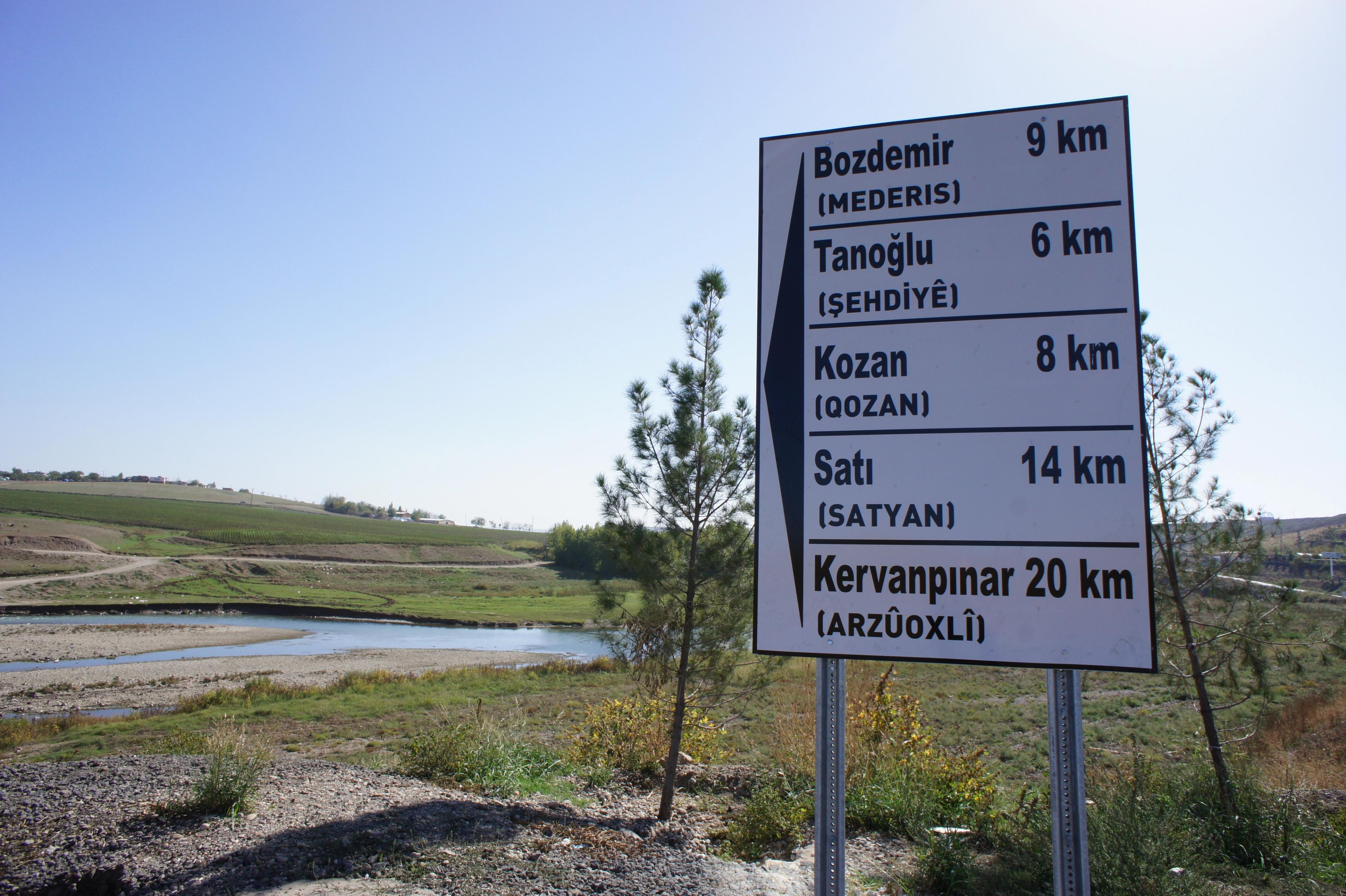
- Turkey: In 2012 a law to restore the names of villages was put forward, but a study shows that the restoration of place names has remained limited, even though municipalities in many Kurdish cities use bilingual signs and street names.
4. Visibility and education
The most feasible part is OpenStreetMap, because anyone can add Kurdish names to it. Google Maps is harder. In schools and textbooks, this depends on the decisions of the ministries of education, and that differs in each part.
5. Names of plants and herbs
Because of the lack of sources!! The most correct way is for the scientific (Latin) name to be established as the key and to become the main basis, against which the folk names of each region are recorded, backed by clear source details (who said it, and where). Botanical gardens and the biology departments of universities can do this. Classical texts and the songs of dengbêjs can be used as supporting sources.
6. Cooperation
Unfortunately, there is no institution for official cooperation between the four parts, neither inside the country nor abroad. It is possible for the diaspora and civil-society organisations to build an open, shared database under a free licence.
The other half is solving the problem itself
However much one talks about a problem and points out all its sides, all those words and explanations together make up half of that problem, and the other half is solving the problem itself.
In a collective work like the one we want to carry out, all the institutions concerned must work together; it needs the diaspora itself to unite, and support from inside the country as well.
A proverb says:
“Ignorance is a greater calamity than God’s own.”
With these words I bring this article to a close:
Banning the Kurdish language, wherever it happens, is a genocide of the Kurdish mind, and the beginning of all the other genocides of a nation.