Restoration
Place names in Turkey, Syria and Iraq have been officially changed, but they have survived in the local dialects and in the people’s memory, and in some places they are coming back. In Iran, the situation regarding the changing of Kurdish names is somewhat less clear; the exact number is not known, and systematic studies are few.
What the sources confirm:
- Syria: In Hasakah province, between 1978 and 1998, the names of more than 500 villages were Arabised, according to the researcher Zohrab Qado. Local committees are being consulted about the original Kurdish name, which shows that the old names are still known. But Damascus does not recognise this process and keeps the Arabised names in its records.
- Afrin: The Kurdish National Council says that the names of 190 villages and towns have been changed and have entered the official records, including identity papers, places and road signs.
- Iraq: The Baath government changed the names of neighbourhoods and small towns in order to display an Arab heritage. In the Kurdistan Region, too, there is a campaign to restore the Kurdish names of 140 villages that still bear Turkish and Arabic names.
- In Turkey, according to the sources, 28,000 geographical names have been changed, not counting people’s surnames; according to the British government’s toponymic document (2023), too, about 28,000 geographical names were changed, mostly in the eastern provinces.
Names are changed, but they are not wiped out altogether
Studies confirm that names are changed, but they are not wiped out altogether, especially in those countries where the life of their people on the land goes on. One of those researchers is Joost Jongerden. He is a Dutch researcher and associate professor of rural sociology at Wageningen University in the Netherlands.
What Joost Jongerden says:
- In his 2009 article (Crafting Space, Making People) he discusses the design (planning) of the countryside as an important tool for building a Turkish culture and strengthening the nation-state. Renaming is part of this policy here, but it is not his main subject.
- In his 2007 book (The Settlement Issue in Turkey and the Kurds) the policy of settlement and war is examined; Joost dwells in particular on the policies of rural design and the aims behind them.
- Joost Jongerden has carried out studies on Turkey’s policy in the Kurdish region.
Direct studies on the restoration of names
Direct studies on the restoration of names are many, but these three below are the most notable:
- The original study by Beril Çakır (2014): an academic source.
- The Turkish government’s documents submitted to the Council of Europe: they document the legal changes and the possibilities for restoring the old names.
- The official British source on the geographical names of Turkey (2023): it examines the historical changes to the names of the regions.
Although Beril Çakır has many important studies in this field, I will only set out a few short notes on the research of this specialist scholar:
- Beril Çakır (Crafting Symbolic Geographies in Modern Turkey): Kurdish naming methods and practices aim, by restoring historical names or giving new Kurdish names, to revive and strengthen the historical memory, the cultural identity and the bond of the Kurdish people with their place and homeland.
- An ethnographic study in Diyarbekir (Diyarbakır) and Batman brings to light aspects of the Kurds’ collective memory that have been suppressed under Turkified names.
- On restoration: a study in the municipalities and councils of the Kurdish regions shows that the return of Kurdish names is limited, but bilingual signs and the naming of streets do exist in many towns.
Official restoration is still difficult
The answer to the question that asks “will the names that have been changed be forgotten?”: the sources I found say no, on the whole. Names that have been officially changed have often lived on in the local dialects and languages. But official restoration is still difficult. For example, in South Kurdistan (Başûr), an official change requires the correction of property records, state documents and maps, and finds its solution through agreement between the regional government and the federal one.
So if the state of the names of towns, places and villages is like this, what will the state of the names of plants, flowers and herbs be like? Before I say a word on this question, every Kurdistani ought to be grateful to all the dengbêjs and singers of Kurdistan, for with their melodies, music and voices they have carried many of these names down to the present day.
To clarify this subject and a few questions, let us look below at these examples, which fall within the span of the past 15 centuries.
The most important historic gardens
The garden of Qesra Şîrîn (Qasr-e Shirin)
- The Sasanian period.
- By order of Khosrow II (590–628 AD).
- About 147 hectares.
- It held a palace, water channels, pools, tree-lined paths and places for festivities.
- This is one of the most remarkable examples of an ancient royal garden.
The Şarezûr (Shahrizor) plain
- In the Sasanian period it belonged to the province of Media.
- Sites such as Girdî Qelrex and Girdî Kejaw bear traces of Sasanian settlement.
- It was an important region for agriculture and rural life.
- But we must say that the existence of private royal gardens here has not yet been directly confirmed.
Other Kurdish emirates and their palaces and mansions
Such as the Baban emirate, the gardens of Silêmanî (Sulaymaniyah): there were gardens around the emirs’ palaces. There was also a neighbourhood called Çwarbax, which was famous for its four gardens. The emirate of Botan-Cizîr and the garden of Îrem were famous, and Melayê Cizîrî praises the garden of Îrem in this way, with this verse of poetry:
Gula baxê Îremê Bohtan im
Şebçiraxê şebê Kurdistan im
I am the rose of the garden of Îrem, Bohtan;
I am the night-lamp of the night of Kurdistan.
Likewise, all the Kurdish emirates had orchards and gardens.
The gardens of the Sasanian palaces
In Sasanian culture the garden was the symbol of power, pleasure and paradise. Around the palaces, pools, springs, long paths and trees were used. The four-part style of gardens was also important in this tradition.
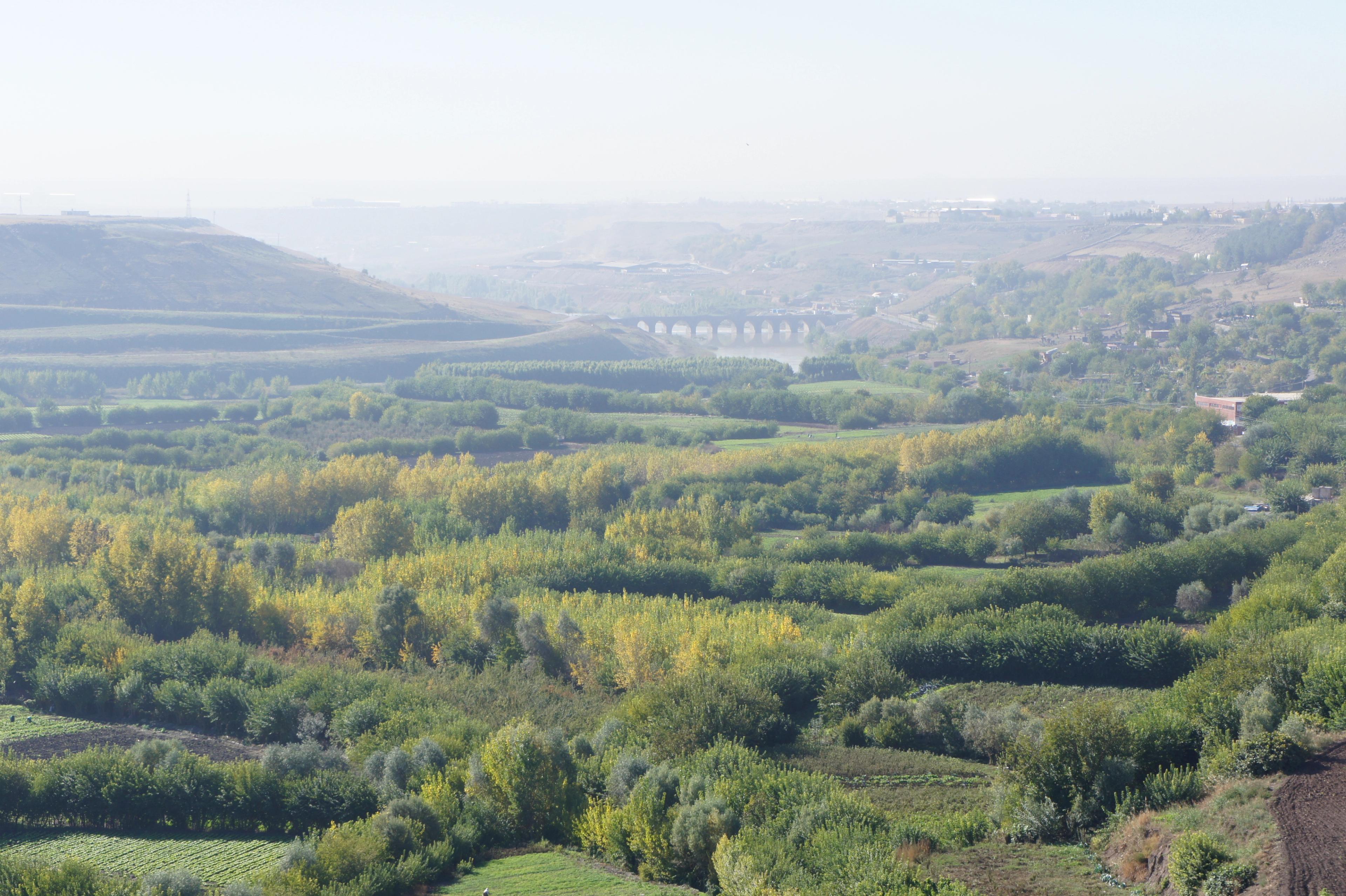
The Hewsel Gardens – Amed
Ancient gardens beside the river Tigris. For thousands of years they have been used to feed the city. In 2015 they became a UNESCO World Heritage site.
There are hundreds of other examples on the soil of Kurdistan, but even after fifteen centuries, a comprehensive list of the names of plants and flowers in Kurdish has still not seen the light of day.
In part 9 we will share with you suitable views and opinions on the ways and means available for restoring the names that have been changed.