
Loss
Before we come to the subject of the loss of names, we must set the phenomenon of the changing of names and surnames in a proper framework; it is worth saying that the changing of names shows itself along two main paths:
- Natural, spontaneous change.
- The erasure (wiping out) of culture by force.
Natural change: when names change slowly because of changes in language and customs, migration, and contact with other peoples.
The erasure of culture, or its destruction by force (assimilation): when original names are banned, or pressure is put on people to give them up, and names tied to another culture or language are put in their place.
In the second case, the changing of names can become part of a wider process whose aim is to weaken historical memory or to make people forget some sides of the collective identity, of course once documents support this interpretation.
In other words, the true picture of these changes is not given and shown by the changing of names and surnames alone. The historical framework, the language, the documents, the kind of change and its causes must be weighed as well. The old names and surnames of a people carry the deepest historical, cultural and social meanings, but each of those meanings becomes clear only in the light of the conditions in which it took shape; the kind of change and the causes that brought it about change that meaning too.
The phenomenon of the changing of names
We can frame the phenomenon of the changing of names in five points. Dr. Lusine Sahakyan has valuable research on this subject.
The loss of a part of historical memory
Names and surnames are not just words; they carry the memory of the forefathers, the roots of families, tribes, places, migrations and historical events. When these names are lost, tracing the history of some families, or making clear the ties between their descendants, may become hard and full of obstacles.
The weakening of cultural continuity and identity
Without doubt, old names form part of a people’s language, heritage and collective identity. Giving them up on a wide scale will cause a damaging rift in the future of the society, or it is a sign that some elements of its traditional culture are falling back. But this does not necessarily mean that the people has lost its identity; it may preserve its language, customs and memory in other ways.
The influence of other peoples’ rule
If names and surnames have been changed because of occupation, colonialism or policies that impose a particular language and culture by force, this may be a sign of an effort to merge the inhabitants into another identity, or to weaken their tie to their original identity. But if the change came about voluntarily, through living together, migration, social integration or linguistic development, then it may simply be a natural change within the society.
The cutting of the tie to one’s roots
When people do not know the meaning of their old surnames or where they come from, some links of knowledge between the generations may be broken. A person may not be able to know whether his surname is tied to a place, a trade, a tribe, a language or a family lineage. And yet, the changing of a surname alone is no proof that a lineage has been cut off or that the roots have been wiped out; such things need historical documents and independent evidence.
The shift from a historical identity to a new identity
Sometimes the names and surnames of a people change along with a change in its language, religion, political system or social ties. This may lead to the rise of a new identity that blends old and new elements. This can be a natural change, or the result of outside pressure, or else a mixture of the two.
The loss of Kurdish names
What has stayed in the sieve of historical scholarship, and can be said with confidence, is this: the loss of Kurdish names was not a single event, but a step-by-step, many-layered change, and we can sum it up in the following phases:
The phase of early Islam (7th–10th centuries AD)
After most Kurds became Muslims, Arabic and Islamic names (Mihemed, Ehmed, Eli, Evdilah, Fatima…) slowly entered Kurdish society, as the old Kurdish and Iranian names remained for a time, especially in princely and tribal families.
The phase of principalities and dynasties (10th–16th centuries)
Kurdish names remained in the houses of the rulers (the Shaddadids, the Hasanwayhids, the Ayyubids and later the Kurdish principalities), but the official, religious and cultural language was Arabic and Persian. Because of this, the religious name gained a higher social status, and the original Kurdish name was pushed to the margins.
The phase of compound names and titles
In this phase an in-between pattern emerged: titles and lineage names of Arabic origin (Şêx, Seyid… and so on) joined the Kurdish ones, such as (Axa, Beg, Mîrza) and names of Persian-Turkish character, while the names of the tribes remained as Kurdish frameworks. Religious and tribal titles carried more identity than a person’s own name.
The phase of the modern state (20th century)
This is the most influential phase in terms of documentation. The states of the region, to different degrees, put limits on Kurdish names in the official registers (through the Turkification of names and surnames in Turkey after the Surname Law of 1934, and similar restrictions in the other states). This created a gap between the official name and the name used at home.
The present-day phase
Since the end of the twentieth century there has been a noticeable return to Kurdish names, especially in the south of the country, together with a movement of national and linguistic revival. Even so, in most circles religious names have remained the most widespread.
Notes on these phases:
- The word “loss” (“winda bûn”) needs correcting. What happened was, on the one hand, a displacement and a layering one on top of the other (it is a coexistence of religious and Kurdish names), not a total loss. This varies by region, class and creed (the Yazidis, Alevis, Yarsan and Kaka’i have preserved more distinctive names, bless them all).
- Documents for the early centuries are scarce, and most of what is said is drawn from Arabic and Persian sources, not from Kurdish records. For this reason, caution is needed in generalising.
- This must not be separated from factors such as religion, urbanisation, illiteracy and the lack of a unified Kurdish written institution.
The loss of names between the pronunciation of Kurdish names and official writing
Even though they stay intact in speech, in the records their state does not stay intact. This happens in several ways:
The Arabisation of spelling in the records
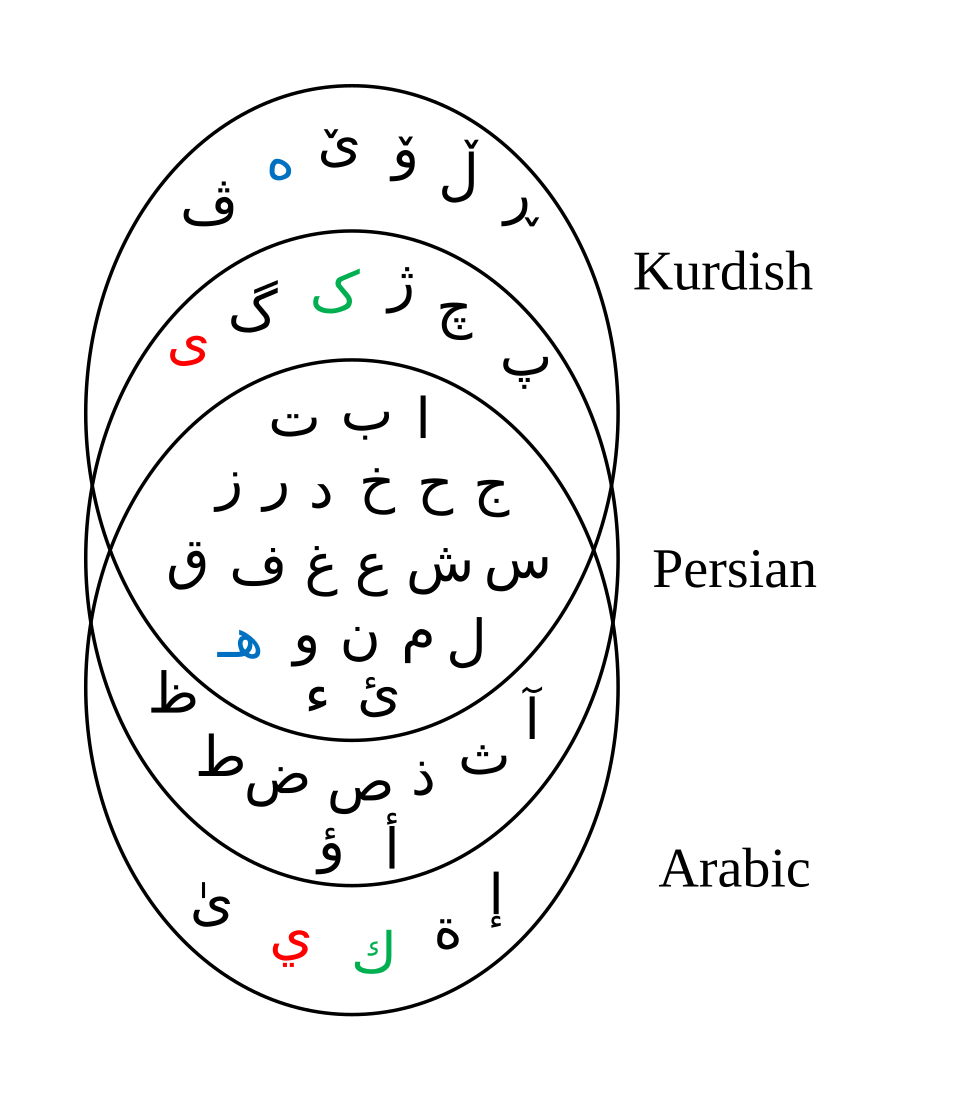
When «عەمەرێ گوزێ» is recorded in documents in ordinary Arabic letters, it becomes «عمر كوزئ». Precisely here, several things are lost:
- The Kurdish vowels (i, ê, e, u, û / ە، ێ، ۆ، وو) do not exist in Arabic spelling, so the difference between the short fatha, kasra and damma disappears.
- The letters peculiar to Kurdish (گ، ڤ، ڕ، ڵ) are replaced by the nearest Arabic letter (گ ← ك، ڤ ← ف، ڕ ← ر), and in this way the name is changed in its sound.
- The original Kurdish name is recorded as a mangled Arabic name and is automatically “corrected” into an Arabic form.
The effect of the pattern of linking vowels (the izafe)
The form «عەمەرێ» contains the izafe marker (ێ), and this is part of the grammatical structure of Kurdish, not of the name itself. The official record does not see this structure, so it turns it into a hamza («كوزئ») or drops it altogether, and the name loses its spoken form.
The gap between two systems
- The registry clerk often works in Arabic spelling and has no knowledge of Kurdish spelling.
- The speaker sees the name as a Kurdish sound that has its own spelling.
Result: the official document builds a new form that even the bearer of the name does not recognise.
The effect of two kinds of writing
The Kurds in Iraq write with a modified Arabic alphabet, and officially apply this system, and in the civil registry the commitment to it is not always kept; it differs from one clerk to another and from one province to another, so there is no single, firm standard.
In short: This says that a name can stay intact in speech and die in the document, and in this way a generation comes about that has two names: the home name and the state name. This is exactly the pattern that has been put in place in Turkey, with a softer mechanism alongside political oppression and the backing of Turkish law, through an administrative spelling that is still in the saddle and at work.