Erysimum kurdicum is a yellow-flowered wallflower of the high grassy and rocky slopes of the mountains along the Başûr–Rojhilat border. It was first collected in July 1867 on Şaho, in Rojhilat, and Hewraman (Avroman), the range that runs along the line between Rojhilat and Başûr[1][2][3], and nearly all later records come from the same mountain country: Hewraman, Pîremegrûn, Qendîl and Helgurd[4][4][5][6]. It is a biennial[1][7]: it spends its first year as a leafy plant, and flowers, sets seed and dies in its second.
How it got its name
- Named by
- Boiss. & Hausskn., 1888Published in Fl. Orient. , Suppl.: 38
Grassy slopes on Şaho and Hewraman, July 1867
The plant was found by Carl Haussknecht (1838–1903), a botanist who travelled and collected in Kurdistan between 1866 and 1869[8][9]. In July 1867 he gathered it in the grassy places of the mountains Şaho and Hewraman, which Boissier's Latin spells Schahu and Avroman and places in "Persian Kurdistan", at 5,000 to 7,000 feet, roughly 1,500 to 2,100 metres[1][2]:
Hab. in graminosis montium Schahu et Avroman Kurdistaniæ Persicæ 5-7000′ (Haussk.!).
Grows in grassy places on the mountains Schahu and Avroman in Persian Kurdistan, 5,000–7,000 feet (Haussknecht; seen by the author).[1] (our translation)
Haussknecht's specimens were studied by Edmond Boissier (1810–1885) in Geneva, author of Flora Orientalis, the great flora of the lands from Greece and Egypt to the borders of India[1][8]. One of the pressed plants survives in Haussknecht's own herbarium at Jena, with its original handwritten label: "Erysimum kurdicum B. & Hskn. (ex aff. E. brachycarpi)", in M. Schahu, Avroman, 5–7000, July 1867[10]. The note "ex aff. E. brachycarpi", akin to E. brachycarpum, already says where the plant was thought to belong.
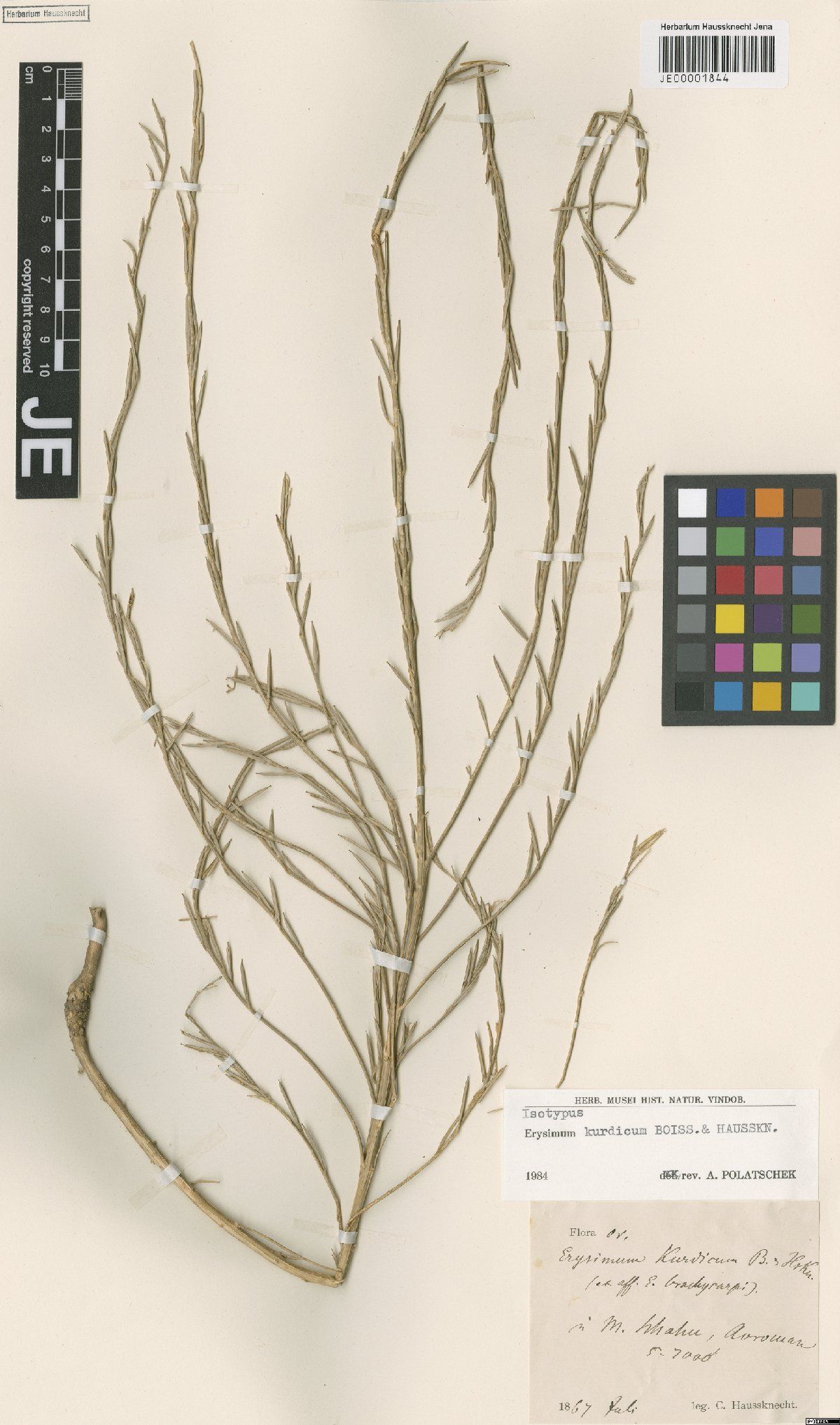
Published three years after its author's death
Boissier never saw the name in print. He died in 1885, and the Supplementum to Flora Orientalis was finished and published in 1888 by R. Buser, keeper of the de Candolle herbarium in Geneva, as its title page says[1]. On page 38 it carries an instruction to the reader, "195, post E. brachycarpum insere": insert this after E. brachycarpum on page 195 of the first volume. What follows is the new species, under the names of Boissier and Haussknecht[1][8].
The description is short and very exact. In plain English it says[1] (our translation):
- a biennial, greyish with hairs pressed flat against it, most of them forked in two, a few in three or four;
- stems rather stout, sharply angled, branching stiffly upwards;
- leaves untoothed, oblong and broader towards the tip, narrowing into a short stalk;
- flowers of middling size and yellow, the calyx with two pouched sepals at its base;
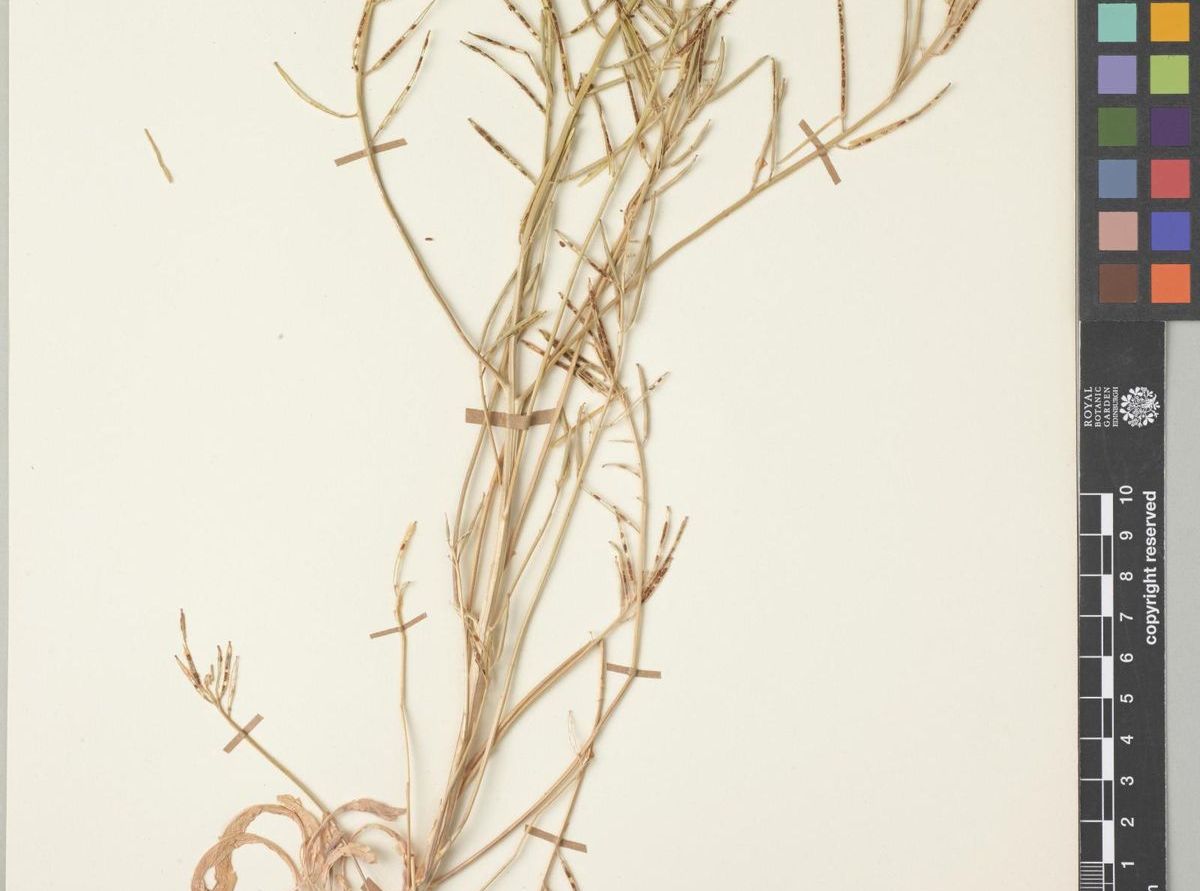
- after flowering the fruiting clusters stretch out to half a foot or a foot, very straight and stiff, with the pods on short stalks and pressed tight against the stem, four-angled and very short: only 7 to 10 "lines" long and two-thirds of a line wide (roughly 1.5–2.3 cm by 1.5 mm), ending in a short, cone-shaped style.
Boissier then set it beside a relative: E. brachycarpum is told apart by its deeply toothed leaves and a stigma twice as thin and long[1].
Much later the Erysimum specialist Adolf Polatschek described it again in his 2011 revision of the genus, from many more specimens[11]:
- a single stem, 23–59 cm tall in flower and up to 68 cm in fruit, 3–6 mm thick and "extremely sharp-edged" (our translation), its base looking swollen because it is wrapped in a sheath of old, broad leaf bases;
- 12 to 20 leaves on the stem, the lowest tongue-shaped and shallowly toothed, the rest almost untoothed;
- 32 to 50 flowers, with yellow, spoon-shaped petals 8–10 mm long;
- pods 1.5–3.1 cm long (rarely only 1 cm) and about 1 mm wide, four-angled, very densely hairy, less so on the angles, and standing almost parallel to the stem;
- oval seeds, 2 mm long.
Its chromosome number is unknown. Polatschek had published a count of 2n = 14 for it in 1971, but he later found that the count had been assigned to this species by mistake, after a mix-up among his plants in cultivation[11].
He also placed it next to a species he had described in 2008, E. iraqense[11][8]. In his key E. kurdicum has pods held parallel to the stem, spoon-shaped petals and a style only 0.3–0.8 mm long but still clearly set off, while E. iraqense has pods standing well out from the stem, wedge-shaped petals and no style at all, the stigma sitting directly on the pod[11]. The two grow on the same mountains: Rechinger collected the type of E. iraqense on Hewraman towards Tewêle (Tawilla), on limestone rocks at 1,400–1,600 m, on 15 June 1957, the same day as one of his E. kurdicum sheets[11]. Polatschek also noted that some plants earlier named E. kurdicum belong to E. iraqense[11].
Which plant is the plant?
Every scientific name hangs on a type, a particular specimen. For E. kurdicum that turned out to be a small puzzle. Haussknecht's gathering from Şaho and Hewraman was shared out among herbaria, and duplicates are now in Geneva, Berlin, Jena (two sheets), Paris, Vienna and London, with a photograph at Kew[2][3][6]. Some carry his number 78, some 72, others no number at all, and Polatschek treated them all as a single gathering[2].
In 2011 Polatschek chose the Vienna sheet, which carries number 72, as the "lectotype", the specimen that fixes the name[2][11]. In 2019, in their work on the types of all of Boissier's Cruciferae, Ihsan Al-Shehbaz and Gabrielle Barriera pointed out that this was unnecessary: Boissier had written his description from the specimen in his own herbarium, so that sheet, now at Geneva (G-BOIS), is the holotype, and the others are isotypes, duplicates of it[2].
Where it grows
Kew's checklist gives its range as "N. Iraq to NW. Iran"[7]. In Kurdish terms it is a plant of the mountains along the line between Başûr and Rojhilat. The type comes from Şaho and Hewraman, from the Rojhilat side as far as the old labels tell[1][2][3], and most later specimens come from the Başûr side of the same mountain chain[11][4][4][5][6]:
- Hewraman: in June 1957 the botanist Karl Heinz Rechinger collected it near Tewêle (Tawilla), on limestone rocks at 1,800–2,000 m[4]; other sheets come from Jebel Avroman above Darimar at 2,100 m (J. B. Gillett) and from Kamarspa, on the road between Helebce (Halabja) and Tewêle, at about 1,920 m (A. Rawi)[6].
- Pîremegrûn (Pira Magrun): Gillett collected it on Pir Omar Gudrun above Zewiya at 1,600 m[6], and A. Rawi at Zewiya at 1,700 m in June 1948, on the mountain Polatschek glosses as "[Magrun]"[11]; in July 1961 R. W. Haines found it "on open rocky slope above village" at a place his label calls Piera Magroun[6].
- Qendîl (Qandil): Rechinger, July 1957, on the eastern slopes above Pushtashan, at 1,800–2,000 m[11][6].
- Helgurd: Rechinger again, 10–14 August 1957, in the valley above the village of Nowanda, at 2,000–2,600 m[4]; and in June 1960 the botanist E. Hadač found it at Sarcal at the foot of Helgurd, at about 2,200 m[11].
- North of Rewandiz: north of Mount Potin, at 1,900–2,100 m, in June 1961 (A. Agnew and others)[11].
- Qeredax (Qara Dagh), south-west of Silêmanî: at 1,500 m in June 1957 (R. Wheeler Haines)[11].
- Near Zaxo: Rechinger, July 1957, in the limestone mountains north of Zaxo, near Sharanish on Jabal Khantur, close to the border with Bakur[6].
- Rojhilat: Polatschek lists two gatherings from July 1971, one on Kuh-e Chehel Chashmeh, 44 km north-east of Merîwan (Marivan), at 2,000 m (Rechinger), and one between Merîwan and Seqiz (Saqqez) at 1,600 m[11].
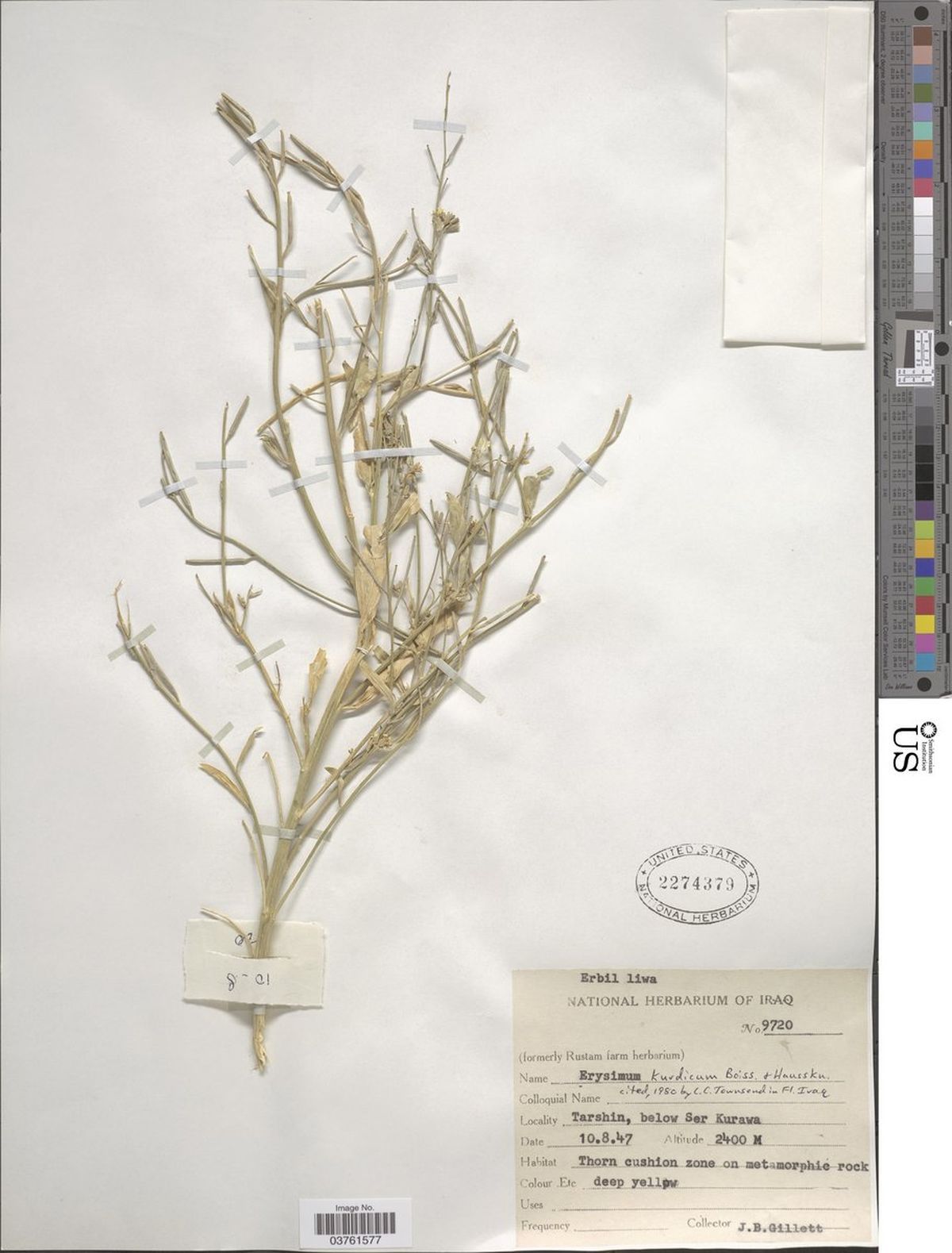
The highest exact altitude on any label is from Tarshin, below Ser Kurawa, in the Hewlêr (Erbil) region. There, on 10 August 1947, Gillett found it at 2,400 m in the "thorn cushion zone on metamorphic rock", with flowers he noted as "deep yellow"[5]. A later hand wrote on the label that the sheet was cited in 1980 by C. C. Townsend in the Flora of Iraq[5].
So the plant lives high. Polatschek, who took his altitudes from the labels, gives 1,500–2,200 m, occasionally from 1,200 m and up to 2,600 m, on clay shale and limestone[11]. The labels speak of grassy places, limestone rock and rocky slopes, up into the zone of spiny cushion plants[1][4][5][6]. Polatschek gives its flowering time as May to June[11], but Gillett still found it with deep-yellow flowers at 2,400 m on 10 August[5].
Two recent photographs on iNaturalist, taken near Silêmanî in May 2023 and near Pêncwên (Penjwin) in April 2025, show a yellow wallflower posted under this name[12]. So far only the photographer has identified them, so they are leads rather than records.
The species has not been assessed for the IUCN Red List[6].
A wallflower's chemistry
Wallflowers belong to the cabbage and mustard family (Brassicaceae), and like the rest of the family they defend themselves against plant-eaters with glucosinolates. But Erysimum also makes a second, evolutionarily newer line of defence: cardenolides. A 2020 study of 48 wallflower species, published under the title "Independent evolution of ancestral and novel defenses in a genus of toxic plants", found that the two defences vary independently between species and probably do different jobs[13]. We could not find out whether E. kurdicum was among the species studied, and we found no record of the plant being used, as food or medicine, in Kurdistan.
Its names in Kurdish
Kurdish plant lists give it several names. Edîb Polat's list of 2006 prints four for Erysimum kurdicum: helîkek, giloka zer, gelûka zerde and helikok, with the English gloss "wallflower"[14]. Ehmedê Dirihî's dictionary of Kurdish plant names (2013) gives gulika zerde, with heikek beside it[15]. Several of these names contain zer, the Kurdish word for "yellow". Polat glosses them only with words for the whole genus ("vélar, érysimum", "wallflower"), so they may well be names for wallflowers in general rather than for this one species[14].
Sources
- 1.Boissier, E. (1888). Flora Orientalis, Supplementum (ed. R. Buser). Geneva & Basel.
- abcdefghijk
- Fl. Orient. Suppl.: 38. archive.orghttps://archive.org/details/PierreEdmondBoissierFloraOrientalisSiveEnumeratioPlantarumInOrienteAGraeciaEtAeg/page/n76/mode/1upaccessed 14 November 2026
- p. 38. archive.orghttps://archive.org/details/PierreEdmondBoissierFloraOrientalisSiveEnumeratioPlantarumInOrienteAGraeciaEtAeg/page/n76/mode/1upaccessed 14 November 2026
- 2.abcdefgAl-Shehbaz, I. A. & Barriera, G. (2019). Typification of Edmond Boissier's Cruciferae (Brassicaceae) names enumerated in Flora Orientalis. Boissiera 72: 1–193 (p. 36).
- 3.abcRoyal Botanic Gardens, Kew – Herbarium Specimens. via GBIF, specimen K000075636, photograph of a type sheet (via GBIF). gbif.orghttps://www.gbif.org/dataset/cd6e21c8-9e8a-493a-8a76-fbf7862069e5
- 4.Royal Botanic Garden Edinburgh Herbarium (E), specimen catalogue (via data.rbge.org.uk and GBIF). data.rbge.org.ukhttps://data.rbge.org.uk/herb/
- 5.abcdefSmithsonian Institution, US National Herbarium, specimen US 2274379, J. B. Gillett 9720 (via GBIF).
- 6.abcdefghijGBIF.org GBIF Backbone Taxonomy and occurrence records. occurrence records and IUCN category for Erysimum kurdicum (accessed 15 November 2026). gbif.orghttps://www.gbif.org/
- 7.Plants of the World Online. Royal Botanic Gardens, Kew.
- abErysimum kurdicum.
- plant_name_id 2800175. powo.science.kew.orghttps://powo.science.kew.org/taxon/urn:lsid:ipni.org:names:283913-1accessed 14 November 2026
- 8.International Plant Names Index. Royal Botanic Gardens, Kew, Harvard University Herbaria and Australian National Herbarium.
- abcdErysimum kurdicum, E. brachycarpum, E. iraqense; author records for Boissier and Haussknecht.
- urn:lsid:ipni.org:names:283913-1. ipni.orghttps://www.ipni.org/n/283913-1accessed 14 November 2026
- 9.↩Harvard University Herbaria, Index of Botanists: Haussknecht, Heinrich Carl.
- 10.↩Herbarium Haussknecht, Jena (JE), specimen records (JACQ) via GBIF. Jena, specimen JE00001844, isotype of Erysimum kurdicum (via GBIF). api.gbif.orghttps://api.gbif.org/v1/occurrence/3028980654
- 11.Polatschek, A. (2011). Revision der Gattung Erysimum (Cruciferae), Teil 2. Annalen des Naturhistorischen Museums in Wien 112B: 369–497.
- 12.↩iNaturalist. observations 160023250 and 272268293 (Silêmanî region, 2023 and 2025; identifications unconfirmed). inaturalist.orghttps://www.inaturalist.org/
- 13.↩Züst, T., Strickler, S. R., Powell, A. F. et al. (2020). Independent evolution of ancestral and novel defenses in a genus of toxic plants (Erysimum, Brassicaceae). eLife 9: e51712. doi:10.7554/eLife.51712https://doi.org/10.7554/eLife.51712
- 14.abEdîb Polat (2006). Flora Kurdistanê (I). institutkurde.orghttps://www.institutkurde.org/publications/kurmanci/
- 15.↩Ahmet Kasımoğlu (Ehmedê Dirihî) (2013). Ferhenga Navên Nebatan a Kurdî (Dictionary of Kurdish Plant Names). Mardin Artuklu University, Institute of Living Languages in Turkey (ISBN 978-605-4202-12-6).
Last updated 20 November 2026