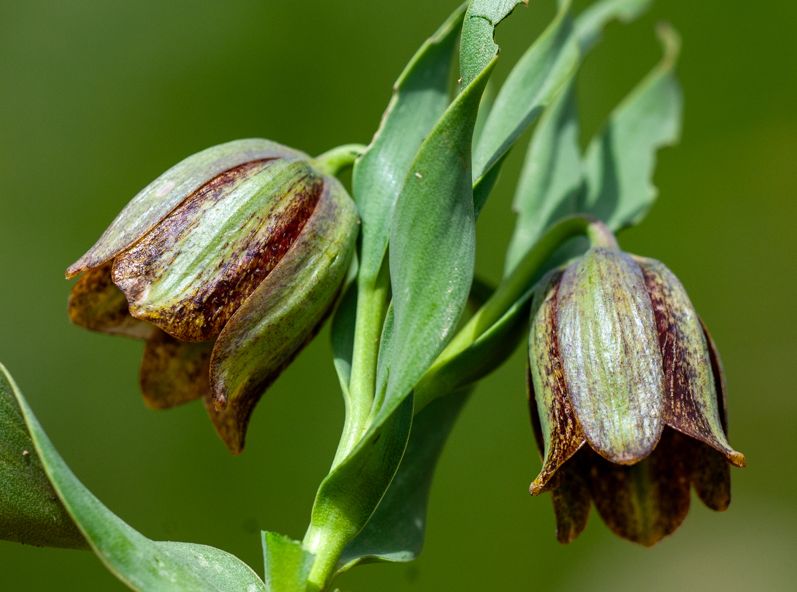
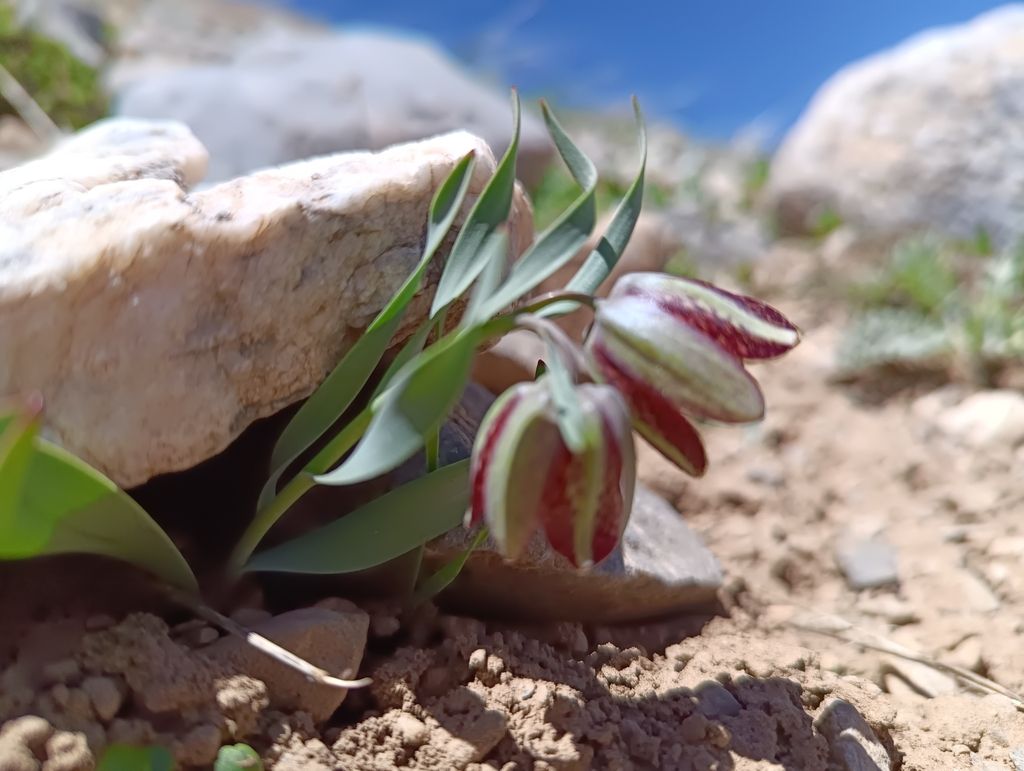
Fritillaria kurdica is a small fritillary of the high mountains of Kurdistan, a bulb a few fingers tall with one or two nodding bells, chequered in purple and brown and often striped green down the back. It was first collected in the mountains near Wan (Van) in North Kurdistan (Bakur), and it still flowers on screes and stony slopes from Wan and Colemêrg (Hakkâri) to Rewandiz in South Kurdistan (Başûr) and Merîwan in East Kurdistan (Rojhilat)[1][2]. The name kurdica means "Kurdish": the plant is named after the land where it was found.
How it got its name
- Named by
- Boiss. & Noë, 1859Published in Diagn. Pl. Orient. , ser. 2, 4: 103
"A pretty little species"
In 1859 the botanist Edmond Boissier (1810–1885)[3] published a new batch of plants from the Orient. Among them was a fritillary collected by Friedrich Wilhelm Noë (1798–1858)[3] "in the subalpine places near Van", in flower in May[1]. Boissier named it Fritillaria kurdica and was charmed by it:
Species pulchella 2-3 pollicaris.
A pretty little species, two to three inches tall.[1] (our translation)
His Latin description gives a low, one-flowered stem with about five scattered leaves, the lower ones oblong and the upper ones narrow, all pointed. The flower is a small, very short bell whose segments are purple and chequered, each with a greenish-yellow band running down its outside[1]. He likened the flower to those of the smaller plants of a European fritillary, F. montana, only shorter, and set it apart from the slender F. tenella by its low stature and broad, not thread-like, leaves[1].
Noë's parcel held a second surprise. On the next page Boissier described Fritillaria minuta, found "with the preceding, in the subalpine places of Kurdistan", remarkable for having "the smallest flower of all"[1]. And on the same page as F. kurdica, just above it, he had described F. crassifolia from near Bayburt and Erzurum[1]. Those two neighbours on one printed page would be joined together more than a century later.
Three fritillaries on one mountain
In Flora Orientalis (1882) Boissier had more places for it. Besides Noë's plants from "the subalpine region of Turkish Kurdistan near Van", it had been collected between Wan and Bedlîs (Bitlis), and in mountain valleys of the Selmas (Salmas) district, which Boissier placed in the province of Azerbaijan[4]. He now described the flower as reddish with darker lines, only faintly chequered, with the same greenish-yellow band outside[4]. An old sheet at Kew, labelled "In distr Salmas prov. Aderbeidschan" and pencilled with the name of the collector Szovits, is probably one of these plants[5].
In June 1899 a collector named A. Kronenburg gathered plants on a mountain near Wan that the botanist Josef Freyn (1845–1903)[3] spelled "Warack-Dagh". Freyn worked through them and wrote that the fritillaries from Wan "belong to three species"[6]. From a single specimen gathered "in stony places" on 1 June he described a new one, Fritillaria wanensis, "the Van fritillary": a broad, unchequered, dark brown bell, reddish inside, with golden spots at the tips of the segments[6]. Three more gatherings from the scree of the same mountain, at 2,500 m, he listed as "Fritillaria kurdica Boiss. et Noë?": one very dark, without the yellow stripe on the back, one with the yellow stripes clearly visible, and one with two flowers. He thought all three belonged to one species "very close to F. kurdica or identical with it", but their filaments were hairless, and "the scarcity of the material" did not allow a sure answer[6] (our translation). His third species was F. pinardi[6].
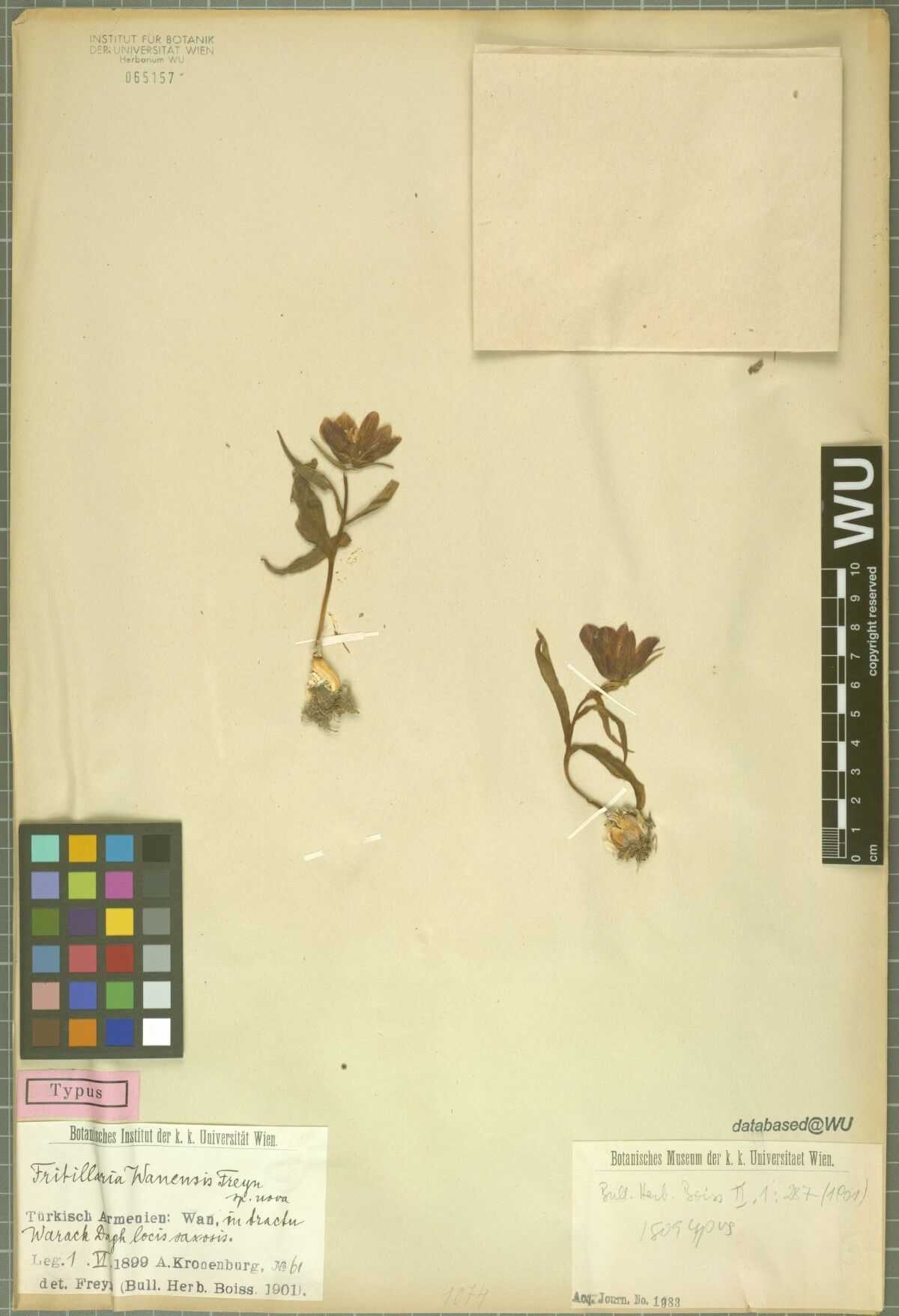
Today botanists count F. wanensis as F. kurdica[2][7]: the species Freyn named as new was the Kurdish plant after all.
Named again and again
The plant kept being named. Bulbs collected by G. Egger in the Karadagh hills north of Tabriz reached Europe in 1929. One of them flowered in early April 1930 in cultivation in Weimar, and the botanist Joseph Bornmüller (1862–1948)[3] described it as Fritillaria foliosa, "the leafy fritillary"[3][8]. A year earlier the botanist William Turrill (1890–1961)[3] had named one F. karadaghensis, after the same Karadagh, and in 1935 the Flora of the USSR added F. grossheimiana[3]. All of them now stand as synonyms of F. kurdica[2][7].
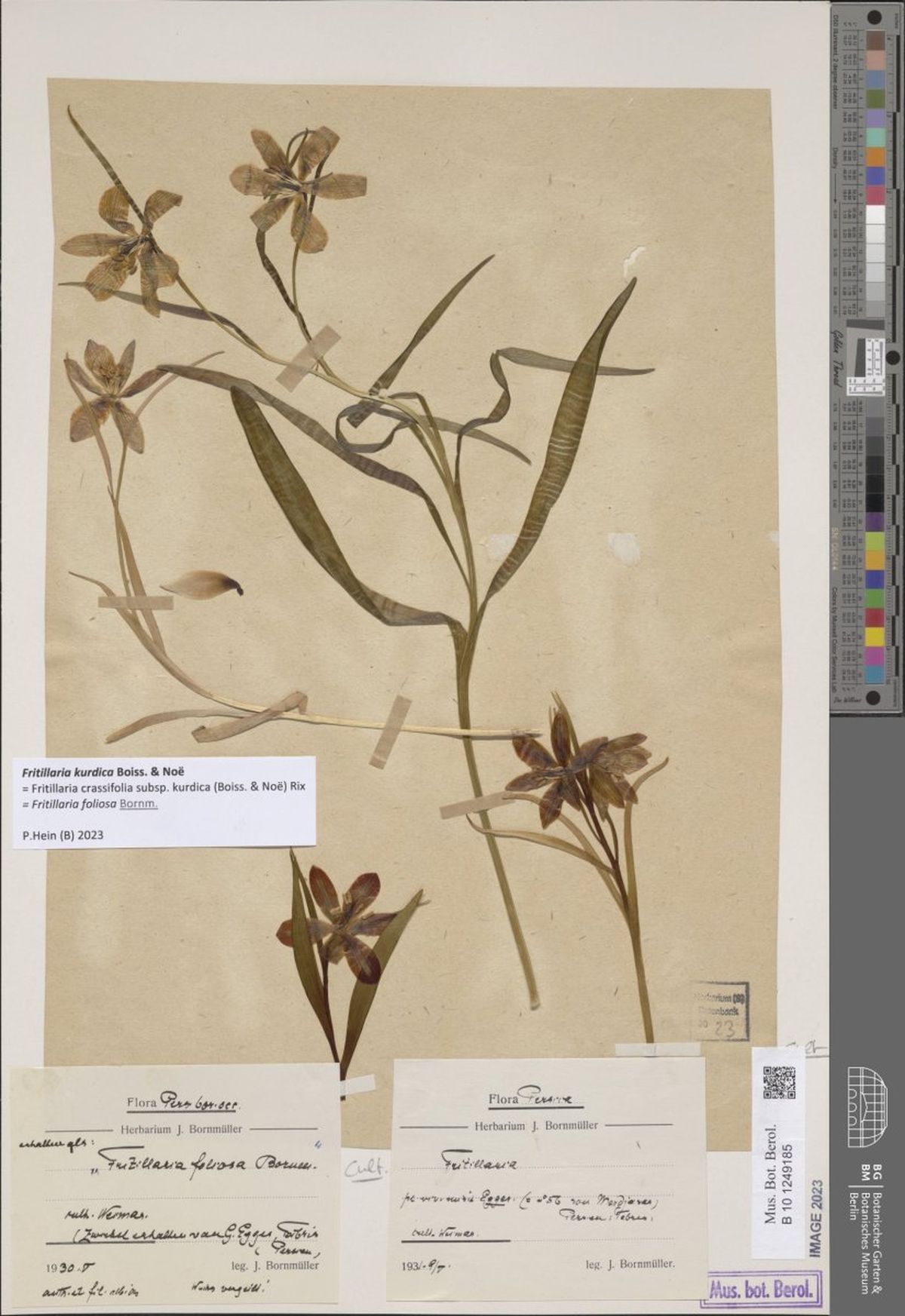
Why so many names? Because the plant varies a great deal. In his 1977 study of the fritillaries of Iran, the botanist Martyn Rix[3] called it "very variable" in size and in flower colour. Plants from north of Tabriz, he noted, are usually larger and have a yellowish rather than a greenish ground colour[2]. He also suspected that one of the named forms, from Kuh-e Sahand near Tabriz, might be of hybrid origin, with another species, F. michailovskyi, as one parent[2].
Species or subspecies?
Rix looked at the old pair from Boissier's page of 1859 and decided they belonged together. In 1974 he made the Kurdish plant a subspecies of the other, Fritillaria crassifolia subsp. kurdica[3][2], and herbarium sheets were labelled with that name for decades[9][5]. Kew's checklist of the world's plants now accepts Fritillaria kurdica as a species in its own right again, with F. crassifolia subsp. kurdica among its synonyms[7].
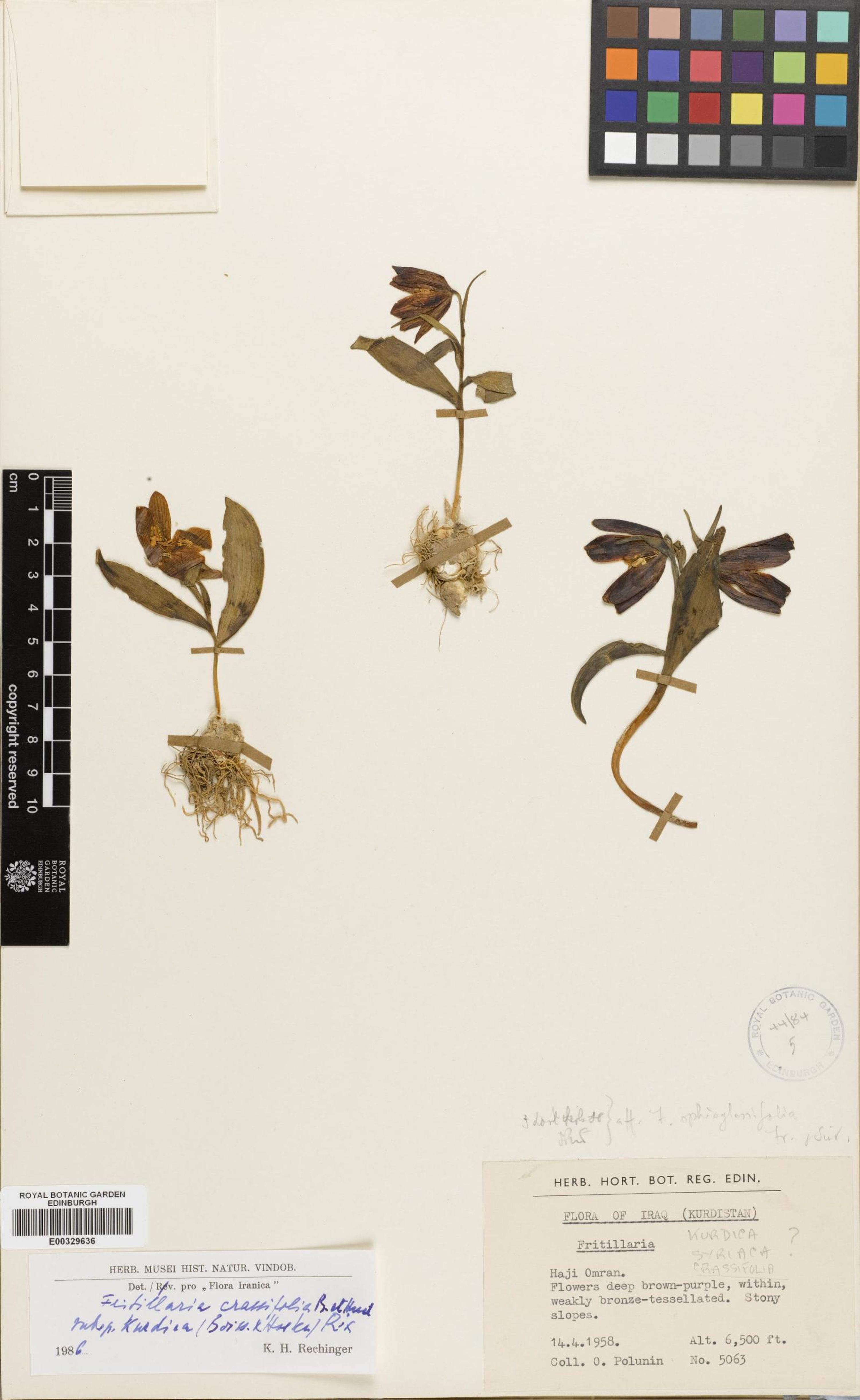
The labels on one sheet tell the whole story. On 14 April 1958 the plant collector Oleg Polunin gathered fritillaries at Haji Omran in Başûr, at 6,500 feet (about 1,980 m), on stony slopes, and noted: "Flowers deep brown-purple, within, weakly bronze-tessellated"[9]. His field note on a duplicate at Kew adds that they were "weakly chequered, deep brown-purple (sometimes greenish); on loose scree. 1–3 ins."[5]. Someone pencilled three possible names on the Edinburgh label, with a question mark: kurdica, syriaca, crassifolia[9]. In 1964 the botanist Per Wendelbo named the Kew duplicate F. crassifolia[5], and in 1986 Karl Heinz Rechinger, revising it for the Flora Iranica, wrote F. crassifolia subsp. kurdica on the Edinburgh sheet[9].
What to look for
Fritillaria kurdica is easy to miss: a stem of only 3 to 10 cm, rising from a bulb up to about 3 cm across[2].
- Leaves: usually five or six, scattered up the stem, grey-green with a bluish bloom, the lower ones broader and the upper ones narrow and pointed[1][2].
- Flowers: one or two, rarely up to four, nodding, broad and short bells[1][2].
- Colour: purple, red-brown or almost black-brown, chequered strongly or only faintly, and often with a green or greenish-yellow stripe down the back of each segment[1][4][2][9]. Inside, near the base of each segment, sits a narrow nectary[4][2].
- Fruit: a cylindrical capsule up to 3.5 cm long[2].
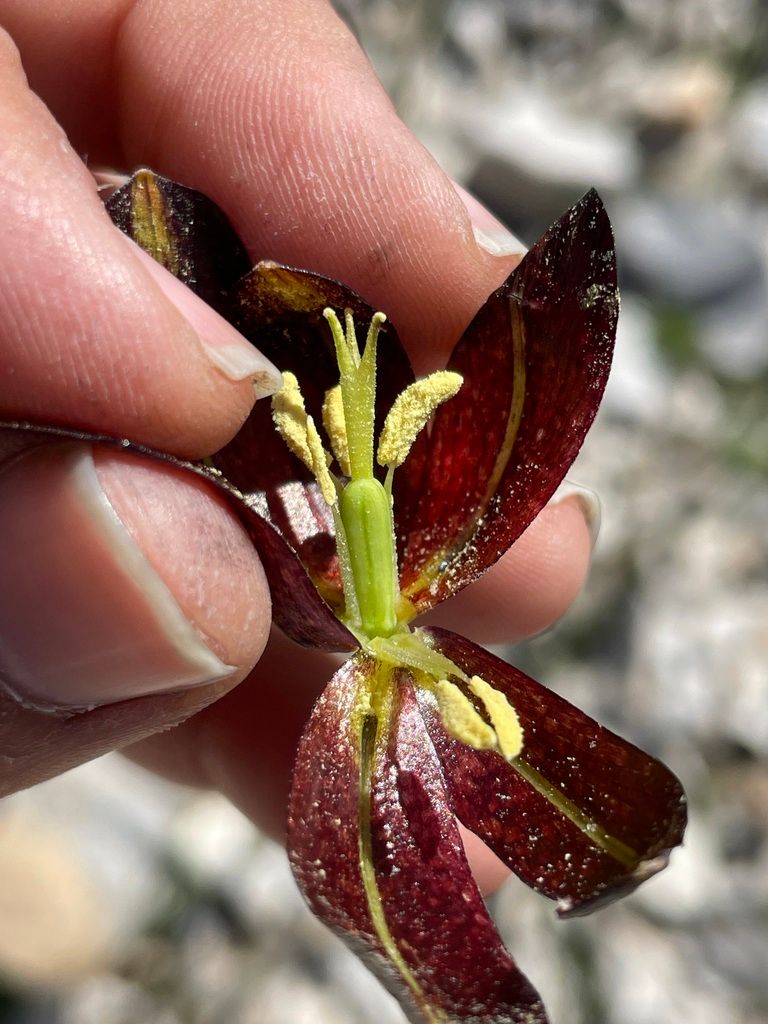
The colour is not fixed[2]. Some plants are much paler:
Where it grows
Kew's checklist gives its native range as south-eastern Turkey to western Iran, with records from the Caucasus, Iran, Iraq and Turkey[7]. In Kurdish terms it is a mountain plant of Bakur, Başûr and Rojhilat:
- Bakur: near Wan, the place it was first found[1]; between Wan and Bedlîs[4]; around Mûş (Muş), Tetwan (Tatvan), Wan and Colemêrg[2]. Rix himself collected it on the road from Gever (Yüksekova) towards the border at Bajirge in May 1972[5].
- Başûr: the Rewandiz (Rowanduz) district[2], and Haji Omran, where Polunin collected it in 1958[9][5].
- Rojhilat: the Selmas district[4]; and south as far as Merîwan, with a record from Tiz-tiz between Merîwan and Sine (Sanandaj)[2].
- Beyond Kurdistan: Rix traced it north through Iranian Azerbaijan to near Baku[2].
It grows on screes, mountain steppe and rock ledges, at about 1,500 to 3,500 m[2]. It flowers from April to July[2], depending on the height and the snow: Noë's plants were in flower in May[1], Polunin's in mid-April[9].
Kurdish names
No Kurdish name for this species with a place or a speaker attached has been found yet. Two Kurdish plant lists do mention it:
- Ehmedê Dirihî's dictionary of Kurdish plant names (2013) lists three dictionary names whose wording mirrors the Latin kurdica, şilêra kurde, bernixunka kurdan and qanzika kurdan, for Fritillaria crassifolia ssp. kurdica, without a regional code[10]. On the same pages şilêr, bernixunk and qanzik are names of the crown imperial, F. imperialis[10].
- Edîb Polat's plant list in the journal Kurmancî (2006) gives şilêra sernuxwîn, şilêra sernixwînk and gulbenda şahî for "Fritillaria kurdica, Fritillaria imperialis" together, and translates them as "crown imperial"[11].
The crown imperial has its own page on Flora Kurdica, under Weysî's name Şilêr. It is a very different plant from the little F. kurdica, which barely reaches the ankle[2].
Conservation
Fritillaria kurdica has not been assessed for the IUCN Red List[12].
Sources
- 1.Boissier, E. (1859). Diagnoses plantarum orientalium novarum, ser. 2, no. 4. Leipzig & Paris.
- ahijkl
- bcdgp. 103.
- epp. 103–104.
- fp. 104.
- Diagn. Pl. Orient., ser. 2, 4: p. 103. archive.orghttps://archive.org/details/e.-boissier-diagnoses-plantarum-orientalium-novarum-series-secunda.-n.o-1-1854/page/n554/mode/1upaccessed 14 November 2026
- p. 103. archive.orghttps://archive.org/details/e.-boissier-diagnoses-plantarum-orientalium-novarum-series-secunda.-n.o-1-1854/page/n554/mode/1upaccessed 14 November 2026
- 2.Rix, E. M. (1977). Fritillaria L. (Liliaceae) in Iran. Iranian Journal of Botany 1(2): 75–95.
- 3.International Plant Names Index. Royal Botanic Gardens, Kew, Harvard University Herbaria and Australian National Herbarium.
- 4.abcdefBoissier, E. (1882). Flora Orientalis. 5: 183.
- 5.Royal Botanic Gardens, Kew – Herbarium Specimens. via GBIF. gbif.orghttps://www.gbif.org/dataset/cd6e21c8-9e8a-493a-8a76-fbf7862069e5
- 6.Freyn, J. (1901). Bemerkenswerthe orientalische Pflanzenarten. Bulletin de l'Herbier Boissier, sér. 2, 1: 287–288.
- 7.Plants of the World Online. Royal Botanic Gardens, Kew.
- abcdFritillaria kurdica.
- plant_name_id 306692. powo.science.kew.orghttps://powo.science.kew.org/taxon/urn:lsid:ipni.org:names:535180-1accessed 14 November 2026
- 8.↩Botanic Garden and Botanical Museum Berlin, herbarium specimens B 10 1249185 and B 10 0366411 (Herbarium J. Bornmüller), via GBIF.
- 9.abcdefgRoyal Botanic Garden Edinburgh Herbarium (E), specimen catalogue (via data.rbge.org.uk and GBIF). herbarium specimen E00329636 (O. Polunin 5063), via GBIF. data.rbge.org.ukhttps://data.rbge.org.uk/herb/
- 10.Ahmet Kasımoğlu (Ehmedê Dirihî) (2013). Ferhenga Navên Nebatan a Kurdî (Dictionary of Kurdish Plant Names). Mardin Artuklu University, Institute of Living Languages in Turkey (ISBN 978-605-4202-12-6).
- 11.↩Edîb Polat (2006). Flora Kurdistanê (I). p. 3. institutkurde.orghttps://www.institutkurde.org/publications/kurmanci/
- 12.↩GBIF.org GBIF Backbone Taxonomy and occurrence records. IUCN Red List category for Fritillaria kurdica. gbif.orghttps://www.gbif.org/
- University of Vienna herbarium, specimen WU 0065157 (A. Kronenburg 61), via GBIF.
Last updated 20 November 2026