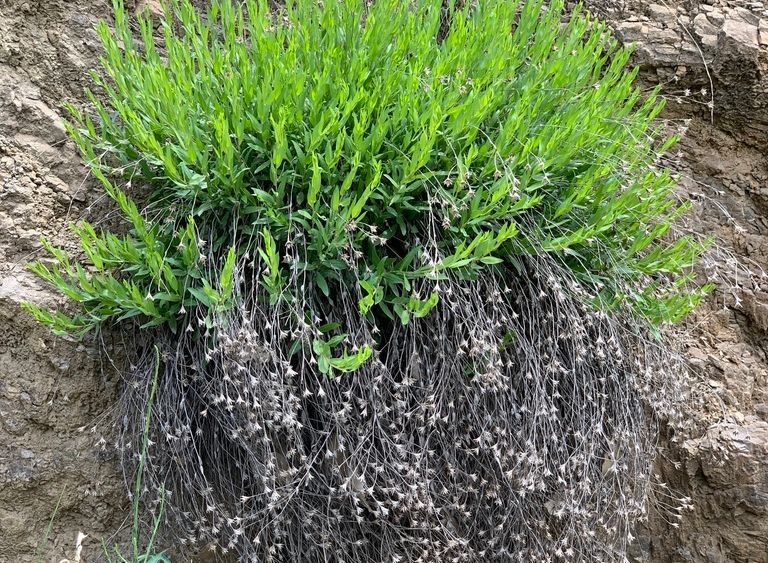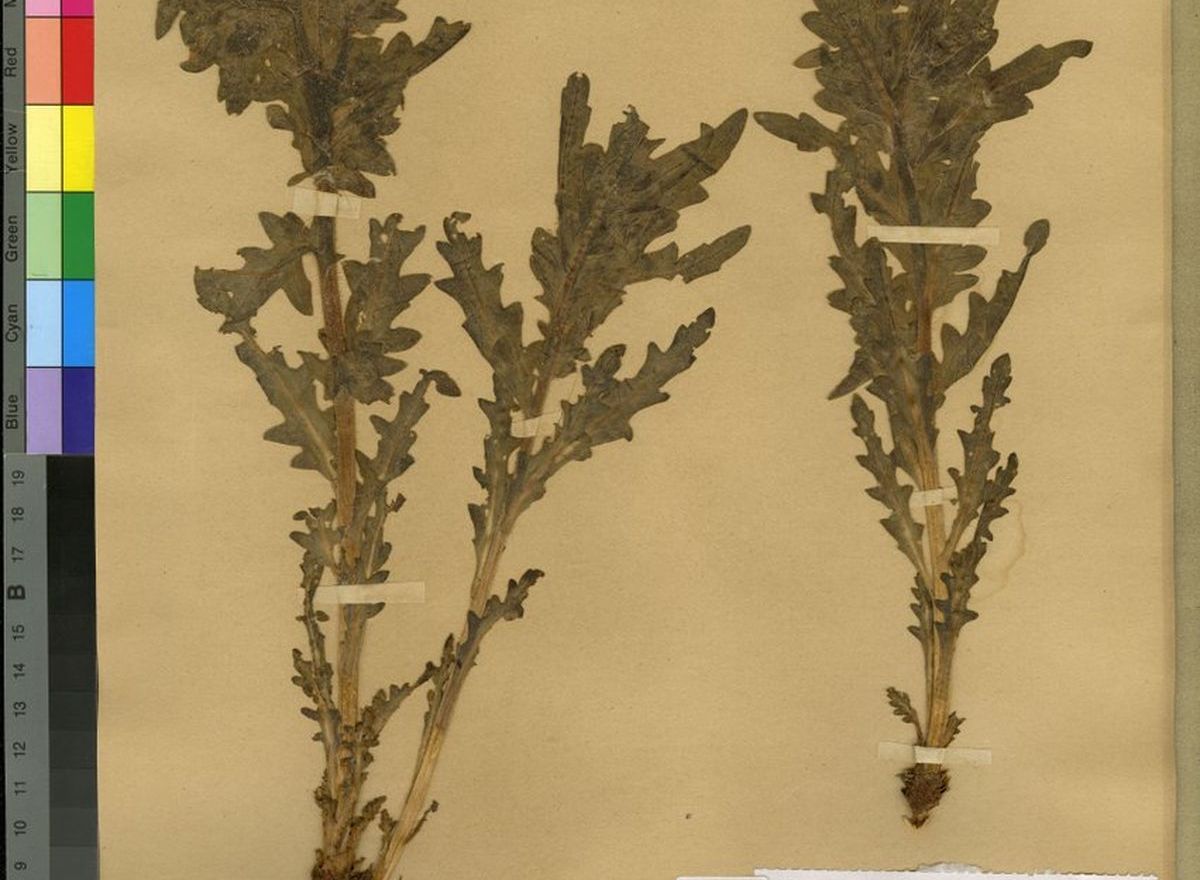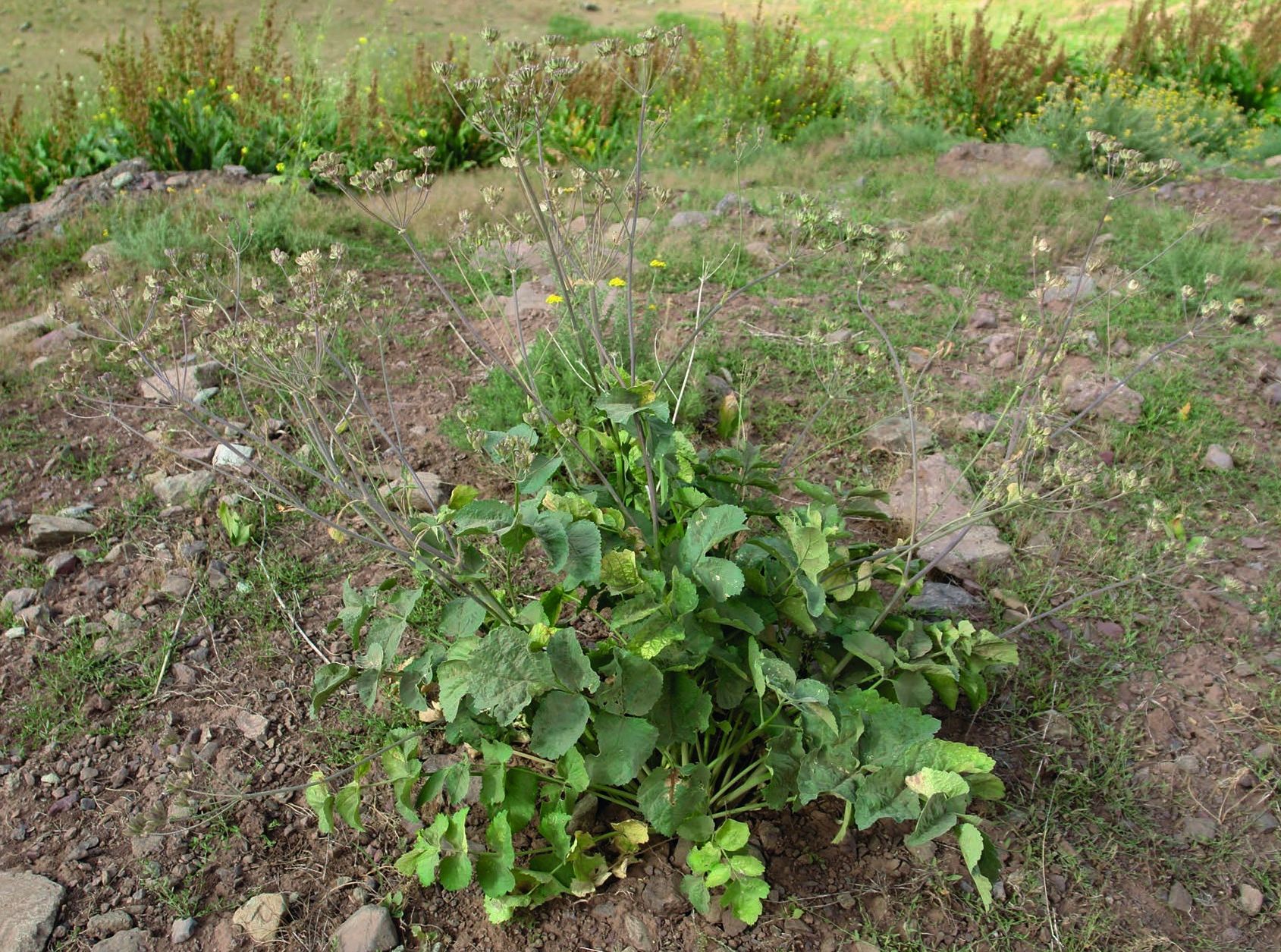
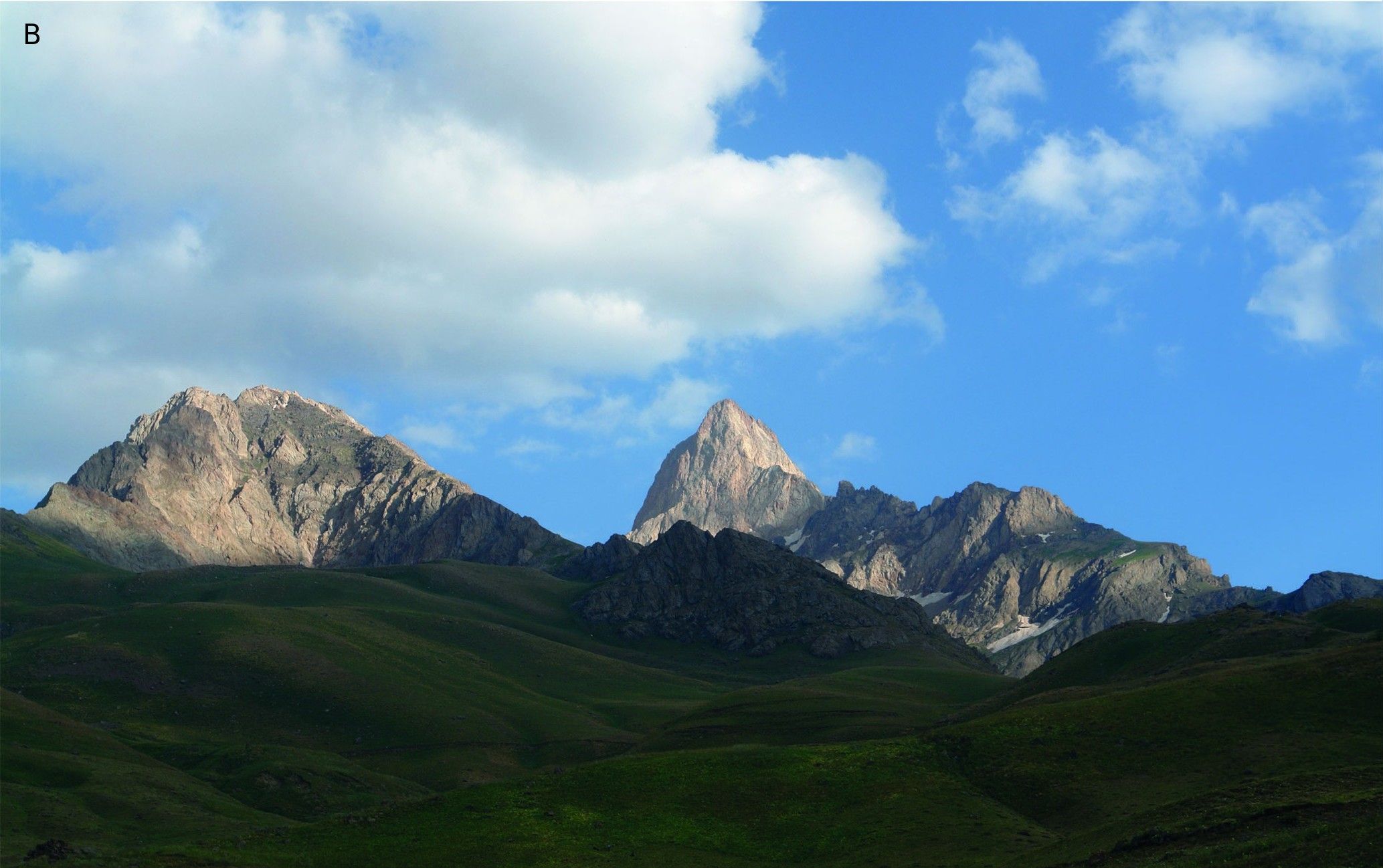
Heracleum kurdicum is a white-flowered member of the carrot family (Apiaceae) from the high summer meadows of Cîlo (Cilo), in Colemêrg (Hakkari) in Bakur (North Kurdistan). It is one of the newest plants on this site: its type was collected in July 2013, and the species was described only in December 2024[1][2]. As far as is known, it grows in a single place, on the Bala plateau at about 2,700–2,800 m, where the botanist who described it counted around a thousand plants[1].
How it got its name
- Named by
- Fırat, 2024Published in Adansonia , sér. 3, 46: 226
- Type collected by
- M. Fırat20 July 2013
Where it grows in Kurdistan
At 2700–2800 m above sea level.
Named after a people
Many plants called kurdica or kurdicum are named after the land where they were found. This one says more. Its author, Mehmet Fırat of Van Yüzüncü Yıl University in Wan (Van), wrote in the paper that described it that the species is "named after the Kurdish people who have inhabited this region (Kurdistan) since the earliest times of history"[1].
He also wrote down what the people who live there call it. In the protologue, the paper in which a new species is first published, Fırat records that the plant is called Suha piltanî in Kurdish by the local people of Colemêrg[1].
Twenty years from meadow to name
Fırat knew the plant long before he named it. During field work on the Bala plateau, in the Cîlo mountains, between 2001 and 2023, he came across "an unusual population" of Heracleum that at first glance looked like a known species, H. rawianum (more on it below). His first specimen of it dates from 17 July 2004, and he went back for more in 2011, 2012, 2014, 2018, 2022 and 2023: ten specimens in all, from three neighbouring spots on the plateau[1].
On 20 July 2013 Fırat was on the Bala plateau, in the Cîlo mountains, at 2,747 m. There, in dry and slightly moist meadows, he collected the plant that became the type of the new species, his number 30271[1]. The type specimen, the sheet to which the name is tied for good, is kept in the herbarium of his university in Wan (VANF), with duplicates in a second herbarium (VHLV) and in his own collection[1].
It took more than twenty years from his first specimen, and eleven from the type, before the name appeared in print. Heracleum kurdicum was published in Adansonia, the botanical journal of the Muséum national d'Histoire naturelle in Paris, on 19 December 2024[1][2]. The paper's figures, including photographs of the living plant, are also kept in the Biodiversity Literature Repository[3].
It shares its meadows with Eryngium bornmuelleri, Chaerophyllum macrospermum, Silene vulgaris var. commutata, Crepis hakkarica, Rumex ponticus, Campanula persica and a clover (Trifolium)[1]. It flowers in June and July and carries fruit from July into August[1].
Hercules' all-heal
Heracleum is an old name. The Flora of Iraq traces it to a plant in Theophrastus, the Greek panakeia herakleion, "all-heal Hercules", because some species were once used as medicine. The Flora gives "Cow-Parsnip" as the genus's English name[4].
How many species it holds depends on who is counting: the Flora of Iraq gives about 70 in 2013, "but specific limits often uncertain"[4], while Fırat writes of about 120–130, with the Caucasus (about 30) and the Sino-Himalayan region (about 25) as its richest areas, followed by Iran with 11, or 12 since H. kurdistanicum was described in 2021[1]. With the new species, he counts 19 species of Heracleum in Turkey (24 taxa counting subspecies and varieties), 12 of them found nowhere else[1].
The genus is "very variable in stature, some gigantic, some dwarf"[4]. The two species the Flora of Iraq records from Başûr (South Kurdistan) are 30–60 cm and 6–35 cm tall[4]. One of them, H. lasiopetalum, has since been reported to belong to a related genus, Tetrataenium. Fırat, citing Kljuykov and colleagues (2021), sets out how to tell the two apart: Heracleum has white petals, with the outer petals of the outer flowers enlarged, while Tetrataenium has yellowish to yellow, symmetric flowers[1].
A small cousin from Helgurd
The species Fırat compares his plant with most closely is Heracleum rawianum, a slender alpine plant of the high mountains of Başûr[1][4]. C. C. Townsend described it in 1964[2] from a plant collected by Ali al-Rawi and I. Serhang on 1 September 1957 at Goum Tawera in the Helgurd (Halgurd) range, at about 2,800 m[4][5]. Its name, rawianum, carries al-Rawi's.
Their typed label survives on the type sheet at Kew. It is printed for the National Herbarium of Iraq, with lines to fill in for locality, habitat, colour, uses and "Colloquial Name". The name line was never used for a local name: someone wrote HOLOTYPUS! on it, the mark of the type specimen[5].
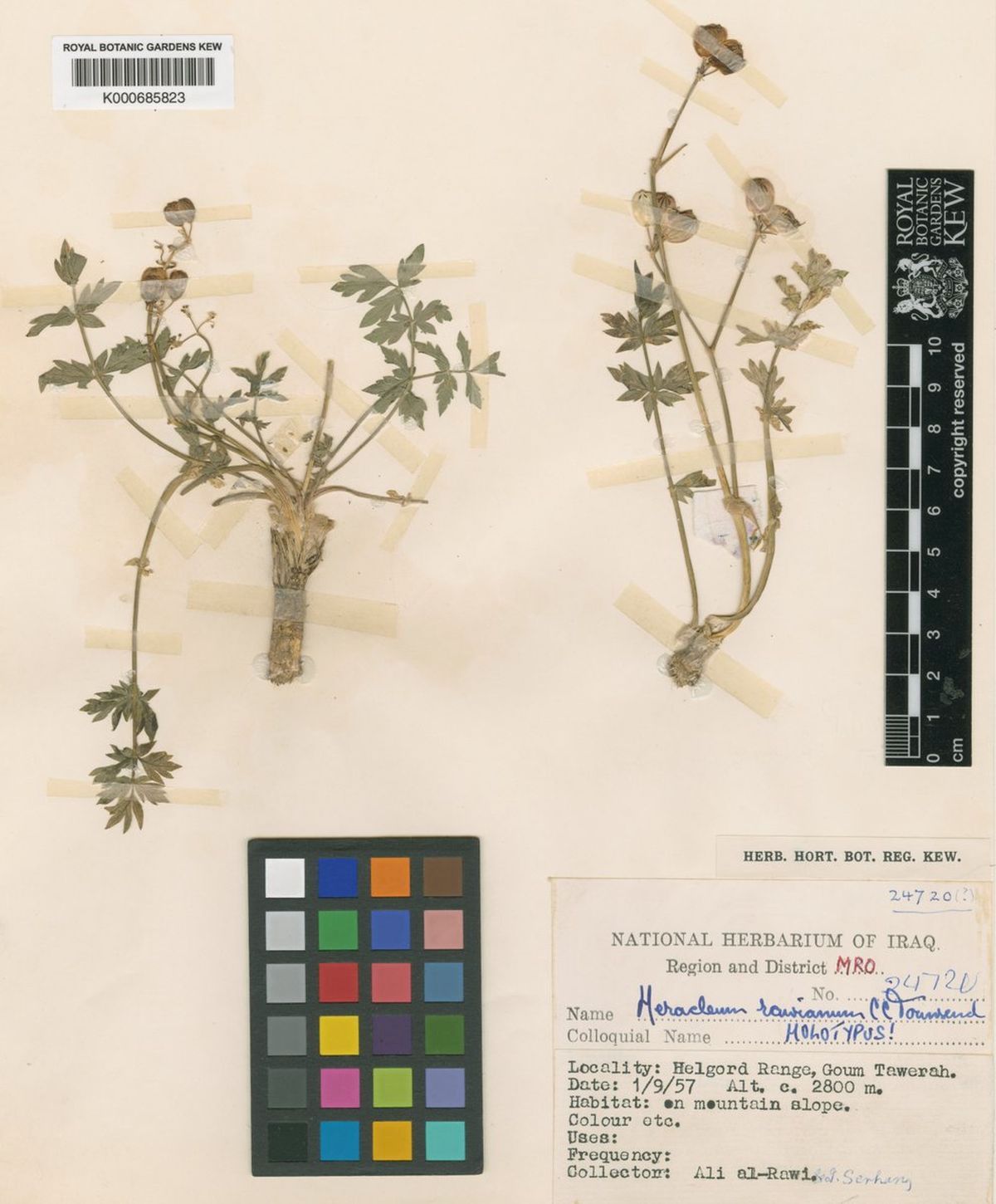
The Flora of Iraq describes H. rawianum as quite common high in the mountains of Helgurd and Qendîl (Qandil), on rocky slopes and damp scree between 2,300 and 3,500 m, and gives its range as also reaching south-eastern Anatolia and western Iran[4]. It has been found on Cîlo too: Kew holds a sheet collected by P. H. Davis and O. Polunin on 9 August 1954, "10 km. W. of Cilo Tepe, 10,500 ft." (about 3,200 m), on a rocky slope, with the note "Fls white", and named H. rawianum by Davis in 1970[5].
Fırat found it in Bakur himself, further north: on rocky slopes of the Kavuşşahap mountains in the province of Wan, near Miks (Bahçesaray) at 3,200 m in 2004 and 2022, and near Şax (Çatak) at 3,300 m in 2013 and 2023[1]. In his experience H. rawianum is "a higher mountain plant that grows at 3200-3300 m" and likes stony, rocky ground, "so the habitats of H. rawianum and the new species do not match at all"[1].
Side by side, though, the two are easy to tell apart. H. kurdicum is the larger plant in almost every part[1][4]:
- Height of stem: H. kurdicum 60–100 cm; H. rawianum 6–35 cm
- Basal leaves: H. kurdicum 20–55 cm long; H. rawianum 4–9 (rarely up to 20) cm long
- Rays of the umbel: H. kurdicum 7–14, each 5–16 cm; H. rawianum 2–5, each 1.5–4.5 cm
- Flowers per small umbel: H. kurdicum 18–30; H. rawianum 8–12
- Ripe fruit: H. kurdicum hairy; H. rawianum hairless
A second Heracleum named after Kurdistan
Heracleum kurdicum is not alone. In 2021 three botanists described Heracleum kurdistanicum from Dalanpar Mountain near Şino (Oshnavieh) in Rojhilat (East Kurdistan), at 2,750 m[2]. Its name, IPNI notes, "refers to Kurdistan, the land from which the species was collected"[2]. Fırat compared his plant with it too. H. kurdistanicum, he notes, has lower leaves with three leaflets (rarely a single blade), covered on both sides with dense, sabre-shaped hairs, 4–8 rays to the umbel, and petals that are not enlarged at the edge of the umbel. His verdict was blunt: "These two species are different in every respect."[1]
What to look for
From Fırat's description[1]:
- a perennial with a taproot and an upright stem 60–100 cm tall, branching in its middle and upper part, hairy below and sparsely hairy to hairless above;
- basal leaves once pinnate, with 2–5 pairs of leaflets; the end segments egg-shaped to round, 3–9 cm long, with rounded teeth, and finely hairy on both sides;
- long-stalked compound umbels with 7–14 rays; bracts below the umbel absent or single;
- white, hairless petals; the outer petals of the outer flowers are enlarged to about 5 mm and deeply split in two, the others about 2 mm;
- flat, elliptic to egg-shaped fruits 9–12 mm long, hairy, with four short oil channels on the back of each half.
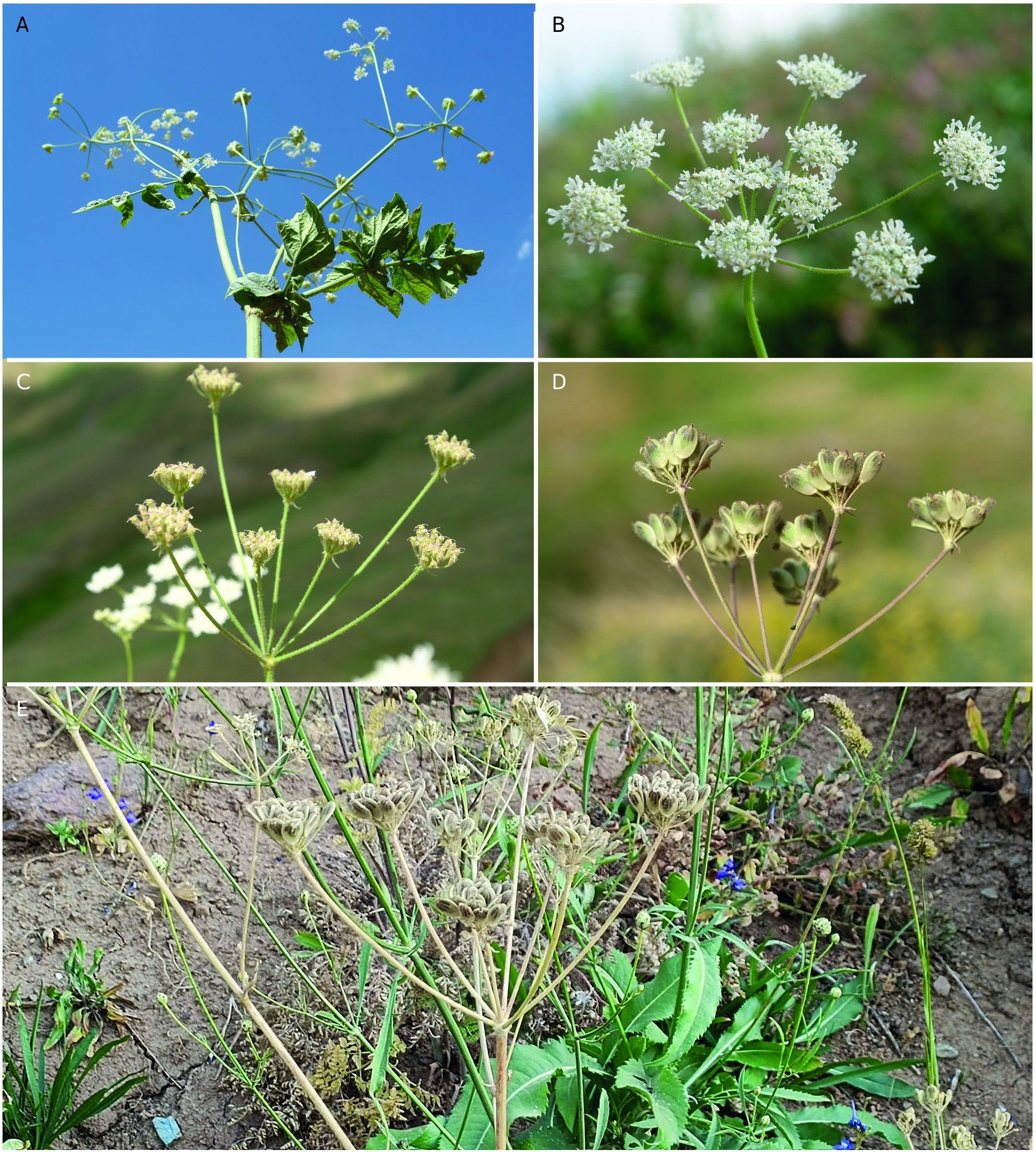
One meadow, a thousand plants
Everything known about H. kurdicum comes from one locality covering less than 10 km²[1]. Fırat counted about 1,000 plants there and saw the effects of people and grazing on the population. Using the criteria of the IUCN Red List, he proposed that the species be classed as Critically Endangered[1]. That is his proposal in the paper; it is not yet an official Red List assessment.
Its names in Kurdish
The species' own Kurdish name, as Fırat recorded it in Colemêrg, is Suha piltanî[1].
Fırat adds that local people use many Kurdish names for Heracleum in general, and lists twelve (genus names, still to be checked): Giyajehrik, Helerg, Lerg, So, Soy, Şabilxan, Zirgêjnok, Kilir, Salêw, Gulper, Sulan and Telkxaş[1]. For these he cites his own earlier book, Ferhenga Navên Riwekên Bi Kurdî, a dictionary of plant names in Kurdish (2013)[1]. The botanist who named this plant after the Kurds is himself a collector of Kurdish plant names.
Ehmedê Dirihî's dictionary of Kurdish plant names, published the same year, has no entry for H. kurdicum, which was not yet described[6]. But several of the same names appear there together for another species of the genus, Heracleum trachyloma: so, from Gimgim (Varto), listed with giyajehrik, helerg, lerg, şabilxan and zirgêjnok[6]. For Heracleum pastinacifolium, a relative Fırat discusses in his comparison[1], Dirihî gives kekerek, from Qoçgîrî[6].
Sources
- 1.Fırat, M. (2024). Heracleum kurdicum sp. nov. (Apiaceae), a new species from Hakkari (Turkey). Adansonia, sér. 3, 46(21): 223-237. doi:10.5252/adansonia2024v46a21https://doi.org/10.5252/adansonia2024v46a21
- 2.International Plant Names Index. Royal Botanic Gardens, Kew, Harvard University Herbaria and Australian National Herbarium.
- aband Plants of the World Online (Royal Botanic Gardens, Kew): Heracleum kurdicum Fırat.
- cHeracleum rawianum C.C.Towns., Kew Bull. 17(3): 429 (1964).
- deHeracleum kurdistanicum Rastegar, Maroofi & Tabad, Phytotaxa 508(1): 69 (2021).
- urn:lsid:ipni.org:names:77357402-1. ipni.orghttps://www.ipni.org/n/77357402-1accessed 14 November 2026
- 3.↩Fırat, M. (2024). Figures 1–3 of the above, Biodiversity Literature Repository (Zenodo). doi:10.5281/zenodo.14534454, doi:10.5281/zenodo.14534456. doi:10.5281/zenodo.14534452,https://doi.org/10.5281/zenodo.14534452,
- 4.Ghazanfar, S.A. & Edmondson, J.R. (eds) (2013). Flora of Iraq, Volume 5, part 2: Lythraceae to Campanulaceae. Royal Botanic Gardens, Kew. ISBN 978-1-84246-493-9. kew.iro.bl.ukhttps://kew.iro.bl.uk/items/35678593-9818-4cb1-b9d3-bf4ce9f313cb
- 5.Royal Botanic Gardens, Kew – Herbarium Specimens. via GBIF. gbif.orghttps://www.gbif.org/dataset/cd6e21c8-9e8a-493a-8a76-fbf7862069e5
- 6.Ahmet Kasımoğlu (Ehmedê Dirihî) (2013). Ferhenga Navên Nebatan a Kurdî (Dictionary of Kurdish Plant Names). Mardin Artuklu University, Institute of Living Languages in Turkey (ISBN 978-605-4202-12-6).
- Plants of the World Online. Royal Botanic Gardens, Kew, plant_name_id 3326264. powo.science.kew.orghttps://powo.science.kew.org/taxon/urn:lsid:ipni.org:names:77357402-1accessed 14 November 2026
Last updated 20 November 2026