How it got its name
- Named by
- Mill., 1768Published in Gard. Dict., ed. 8. : n.° 9
A blue weed with a sweet secret
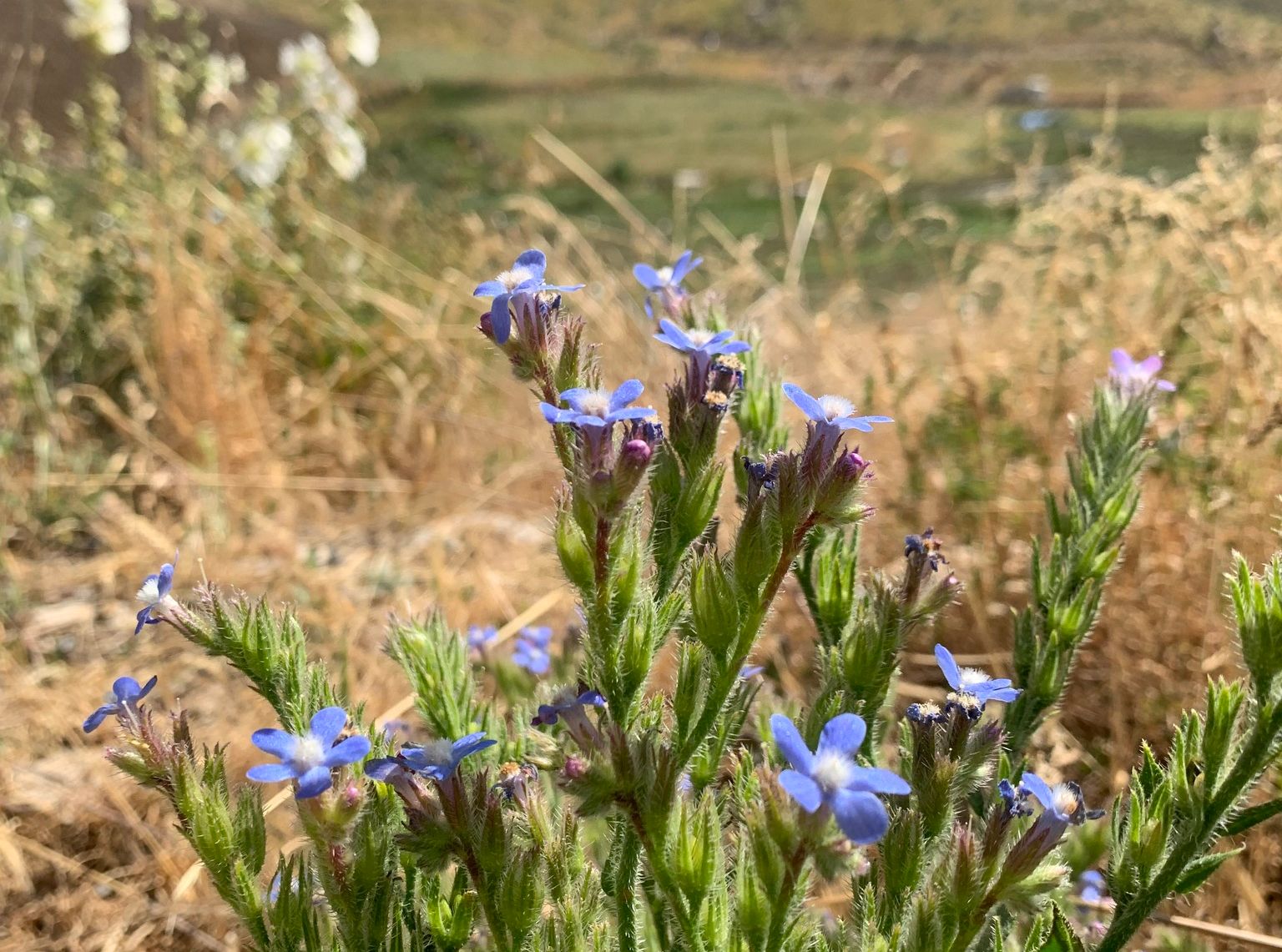
Along field edges, roadsides and stream banks across Kurdistan, a tall, bristly plant opens small flowers of an intense blue, from early spring into summer[1]. Botanists call it Anchusa azurea; in English it goes by Italian alkanet or garden anchusa; and in Kurdish it has more names than this page can comfortably hold: gûriz, golmize and zimanê ga in one Kurmanji list[2], Gozrwan in Hawraman[3], kezererky around Amêdî[4], Celezen in Dersim[5], and many more (see "One plant, many names" below).
People know it for two things above all. In Çermik, in Amed (Diyarbakır) province, its flowers are sucked for their sweet taste[6], and in Nazımiye in Dersim (Tunceli) people suck the nectar from the flowers too[5]. And it is a spring vegetable[5][3].
"Of a bright azure colour"
The name was given in Chelsea, on the edge of London. In 1768 Philip Miller (1691–1771)[7], who signed the book's dedication at Chelsea on 1 March that year, listed it as the ninth Anchusa in the eighth edition of his Gardeners Dictionary[8]:
Anchusa (Azurea) foliis longis hirsutis, floribus capitatis reflexis, pedunculis longissimis.
Alkanet with long hairy leaves, and flowers collected into heads which are reflexed, and very long foot-stalks.[8]
The ninth sort, he wrote, "is a perennial plant, with broad rough leaves … the flowers which are of a bright azure colour", and "a hardy plant"[8]. Azurea it has stayed: Anchusa azurea Mill. is the accepted name today[9].
Miller's English name, though, is a little misleading. "Alkanet" comes, through French orcanette and Spanish and Italian alcana, from the Arabic name of henna, a quite different plant that, like the alkanet of the old apothecaries, gives a red dye[10]. In Miller's own list that was another species, the woolly, red-rooted "true Alkanet of the shops"[8]. Our blue plant simply inherited the family name.
An ox's tongue in four languages
The Kurdish Institute of Paris's journal Kurmancî printed a long plant-name list in 2006, Flora Kurdistanê, with each Kurmanji name followed by the Latin, Turkish, French and English names[2]. One row reads:
gûriz, golmize, zimanê ga — Anchusa azurea kurdica — sığır dili — buglosse — bugloss[2]
Read across, the row tells a small story. Zimanê ga is "the ox's tongue" (our translation). The Turkish sığır dili in the same row means "cattle tongue" (our translation). And the English and French bugloss, buglosse come from the Greek for "ox" and "tongue", "descriptive of the shape and rough surface of the leaves", as R. C. A. Prior explained in his 1870 book on English plant names[10]. Anyone who has run a hand along the long, raspy leaves of this plant will see why four languages arrived at the same picture.
The 2007 continuation of the list repeats golmize and zimanê ga and adds gûroz[11].
The Kurdish variety
The Kurmancî list does not just say Anchusa azurea: it says Anchusa azurea kurdica[2][11]. That is a real botanical name. In 1927 the botanist Mihail Guşuleac (1887–1960)[7] described a variety of the plant, then called Anchusa italica, which he named kurdica, "Kurdish", in the bulletin of the science faculty at Cernăuţi[12][9]. Fifty years later David Chamberlain[7] moved it under A. azurea as var. kurdica, in a set of new names needed for volume 6 of the Flora of Turkey, published by the Royal Botanic Garden Edinburgh[12]. His entry gives only the new name and the old name it rests on, with no description and no locality[12]. Kew's world checklist accepts it today as one of three varieties of the species, with a range from the eastern Mediterranean to Iran[9].
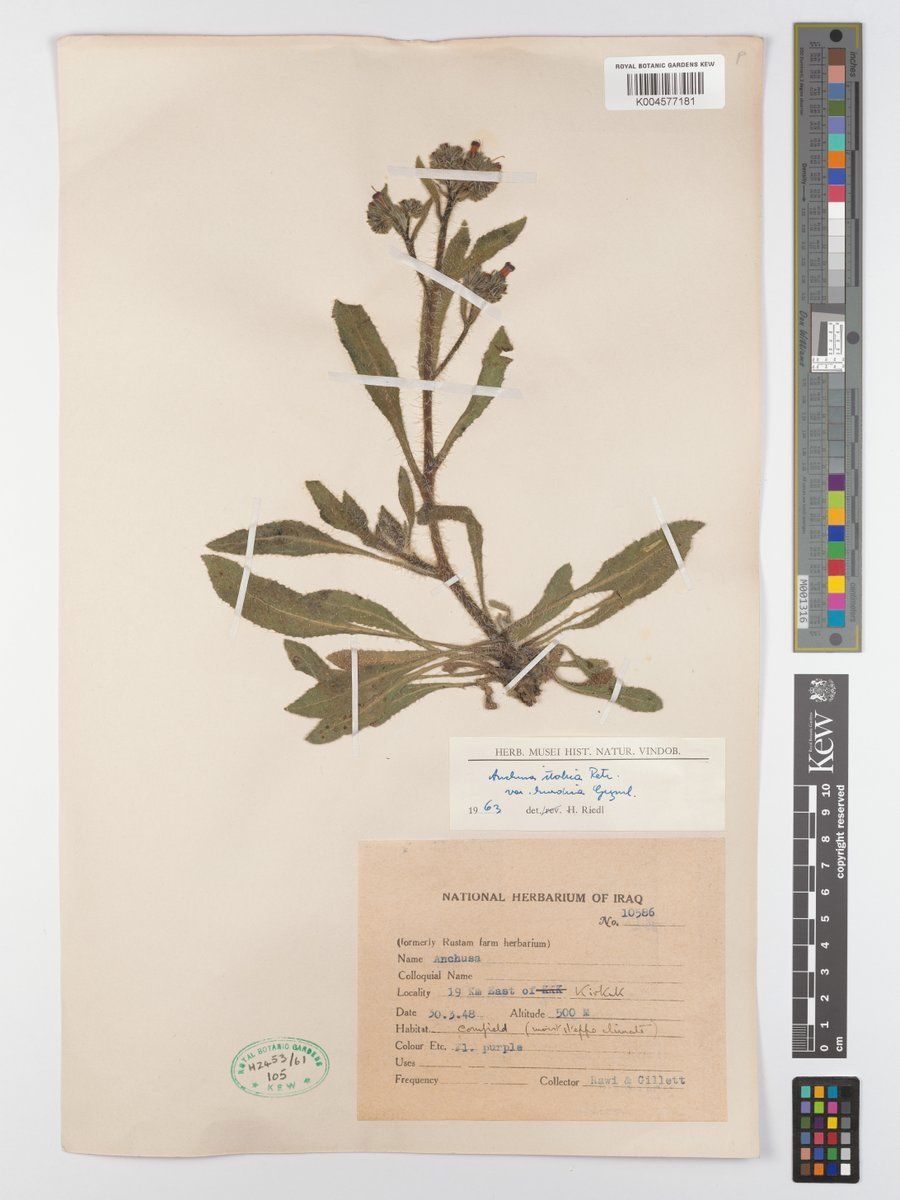
Guşuleac's paper is not online, so we cannot yet say exactly how he told his Kurdish plants apart. What we can show is where botanists have found them since. Herbarium sheets filed as var. kurdica come from a cornfield 19 km east of Kerkûk (Kirkuk) in March 1948, its flowers noted as purple; from a roadside between Mosul and Hammam al-Alil in April 1962; and from a stream bank 31 km north of Sine (Sanandaj), at 2,000 m in July 1964, on a label that begins simply "Kurdistan"[1]. In 2016 a survey of the plants of Amêdî (Amedi) collected it in the meadows and fields of Razeke village at 1,182 m[4].
There is a second Kurdish thread in this plant's family tree. In the same 1927 paper Guşuleac also made a variety macrocarpa[12][9], based on A. macrocarpa, which Boissier and Hohenacker had described as a species in 1844[12]: a white-flowered Anchusa that Boissier knew from the springs of Mount Gara in Kurdistan, collected by Theodor Kotschy[13]. (Mount Gara is also where the Kurdish hollyhock was first collected.) Boissier, in his Flora Orientalis, thought it "very close" (valde affinis) to the blue plant and separated it by its yellowish bristles, short flower stalks and white flowers[13]. Chamberlain moved it under A. azurea in 1977 as well[12], and Kew gives its range as south-eastern Turkey to western Iran[9]. So two of the three varieties of this widespread plant carry a Kurdish story: one named kurdica, one first known from a Kurdish mountain.
What to look for
Boissier's description of 1879 (as A. italica) still works in the field[13]:
- a perennial, rough all over with white, spreading bristles that rise from tiny warts;
- a tall, branched stem, the flowering branches upright and often forked;
- lower leaves oblong to lance-shaped and narrowed into a stalk, upper leaves narrow and stalkless;
- flower stalks about as long as the calyx, and the calyx cut almost to the base into narrow, pointed lobes that grow larger in fruit;
- a blue corolla whose tube is no longer than the calyx, with a ring of small, densely hairy, brush-like scales sticking out of its throat;
- four upright, angular nutlets, coarsely ridged and wrinkled.
The colour varies a little: collectors wrote "purple" on the Kerkûk sheet and "blue" on the Sine sheet[1].
Where it grows
Kew gives its native range as east-central Europe to the Mediterranean and the western Himalaya, including Iraq, Iran and Turkey[9]. It has also been carried far beyond: it grows as an introduced plant in Britain, Germany, South Africa and many parts of North America[9]. Boissier gave its home as roadsides and cultivated ground (ad vias et in cultis) throughout his region, up to 5,800 feet in Syria and Lebanon[13].
In Kurdistan the records match that picture of field edges and open ground, from the lowlands to the mountains:
- Başûr: a cornfield near Kerkûk at 500 m[1]; meadows and sandy soils in Spindar Kalvo and Razeke villages around Amêdî, at 1,074 and 1,182 m[4].
- Bakur: a stream bank and field edge near Sinek village in Çermik, 670 m[6]; fields north-west of Arıcak, near Xarpêt (Elazığ), at 1,088 m[14]; all the villages of Nazımiye in Dersim[5].
- Rojhilat: a stream bank north of Sine at 2,000 m[1].
Spring greens from Dersim to Hawraman
Across Kurdistan, people gather the young shoots and leaves in spring and cook them, and the recipes travel well across borders.
- In Hawraman in Başûr, Yarsani and Sunni Muslim villagers boil the young leaves and flowers, then fry them in oil with onion and egg[3].
- Hundreds of kilometres to the north-west, in Çermik, the leaves are fried in oil with onion, hot pepper and salça paste, and eggs are broken over the top[6]. In both districts it is a dish of greens and eggs.
- On the Rojhilat side of Hawraman and in Mukriyan, people use the flowers as a seasoning, fry them, or make tea[15]. Comparing the two sides of Hawraman, the researchers noted that for greens such as Allium and Anchusa the Hawramani in Iraq preferred frying, while those in Iran made more soups[15].
- In Muslim and Kakai (Yarsan) villages in the south of Başûr, the young aerial parts are boiled[16].
- In Dersim, the young stems and leaves are boiled, or fried raw, into pancar, a dish of mixed wild greens[5].
- Around Arıcak, the shoots are cut small, boiled and fried; some people eat the fresh shoots raw[14].
- Around Amêdî, the fresh stems, leaves and aerial parts are eaten fresh, and the leaves go into traditional cooking[4].
In Çermik and Arıcak it is among the fifteen plants people use most[6][14].
Sweet flowers and bees
The sweetness people find in the flowers is nectar, and the bees find it too. In Dersim the flowers are mixed with honey as a pick-me-up, and they are valued in beekeeping[5].
In folk medicine
Field studies also record the plant as a household remedy:
- In Amêdî, a decoction of the leaves (and, for the Kurdish variety, the flowers too) is taken to calm and against stomach pain[4].
- In Hawraman, a tea is drunk against abdominal pain[3].
- Around Arıcak, a mash of the boiled plant, roots and all, is spread on infected wounds, and a tea of the leaves, roots and flowering shoots is drunk for kidney stones[14].
- In Çermik, the liquid from the boiled stems is taken against diabetes and kidney stones, and women without children tie a mash of the boiled young shoots on the belly overnight[6].
These are records of traditional use, not medical advice.
One plant, many names
Few plants on this site have as many recorded Kurdish names. Here are the ones from field studies and the Kurmancî lists, each as the source prints it:
- Kurmanji (Kurmancî list): gûriz, golmize, zimanê ga[2]; gûroz[11].
- Behdînan, around Amêdî: kezererky and kolmza for the species, and bara kezererky and kolmza for the Kurdish variety[4].
- Hawraman, Başûr: Gozrwan[3]; Hawraman and Mukriyan, Rojhilat: Gozirvan, Gozorvaneh[15].
- South of Başûr: Gezerwan, Gozerwan, Gurmiza[16].
- Çermik (language not stated; the thesis says local names there are mostly Zazaki and Kurdish): Gurız, Gelızvan[6].
- Arıcak (Zazaki, as the thesis implies: it says most local names there are Zazaki): Gelzon, Pulek[14].
- Dersim (language not stated; the study names both Zazaki (Kırmancki) and Kurmanji as local languages): Celezen, Tar[5].
The names panel on this page lists still more, from Ehmedê Dirihî's plant-name dictionary, with their sources.
Names across Kurdistan
Dictionary namesBuilt from the scientific name (“… of the Kurds”)
Sources
- 1.abcdeHerbarium specimens filed as Anchusa italica var. kurdica: Royal Botanic Gardens, Kew (K004577181, K004577182, K004577183) and Missouri Botanical Garden (MO-3541744), via GBIF.
- 2.Edîb Polat (2006). Flora Kurdistanê (I). institutkurde.orghttps://www.institutkurde.org/publications/kurmanci/
- 3.abcdeAndrea Pieroni, Hiwa M. Ahmed, Hawre Zahir (2016). The spring has arrived: traditional wild vegetables gathered by Yarsanis (Ahl-e Haqq) and Sunni Muslims in Western Hawraman, SE Kurdistan (Iraq). doi:10.5586/asbp.3519https://doi.org/10.5586/asbp.3519
- 4.Shimal Ahmed Tahir (2017). Plant biodiversity and ethnobotanical properties of various plants in Amedi (Duhok, N. Iraq). tez.yok.gov.trhttps://tez.yok.gov.tr/UlusalTezMerkezi/
- 5.abcdefgBirgül Murat (2025). Nazımiye (Tunceli) ilçesinin etnobotanik özellikleri. tez.yok.gov.trhttps://tez.yok.gov.tr/UlusalTezMerkezi/
- 6.İsa Çiçek (2019). Çermik ilçesi ve köylerinin (Diyarbakır) etnobotanik özellikleri. tez.yok.gov.trhttps://tez.yok.gov.tr/UlusalTezMerkezi/
- 7.International Plant Names Index. Royal Botanic Gardens, Kew, Harvard University Herbaria and Australian National Herbarium.
- abcrecords for Anchusa azurea var. kurdica and for the authors Miller, Guşuleac and Chamberlain.
- urn:lsid:ipni.org:names:113203-1. ipni.orghttps://www.ipni.org/n/113203-1accessed 14 November 2026
- 8.abcdMiller, P. (1768). The Gardeners Dictionary. 8th edition. London. s.v. Anchusa.
- 9.Plants of the World Online. Royal Botanic Gardens, Kew.
- 10.Prior, R. C. A. (1870). On the Popular Names of British Plants. 2nd edition. London: Williams and Norgate.
- 11.abcEhmedê Dirihî (2007). Flora Kurdistanê (II). institutkurde.orghttps://www.institutkurde.org/publications/kurmanci/
- 12.Davis, P. H. (compiler) (1977). Materials for a Flora of Turkey XXXIV: Boraginaceae, Gentianaceae, Solanaceae. Notes from the Royal Botanic Garden Edinburgh 35(3): 297–314.
- 13.Edmond Boissier (1879). Flora Orientalis, vol. 4. H. Georg, Geneva and Basel (Internet Archive).
- ab4: 154–155. Geneva and Basel: H. Georg; p. 155.
- cd4: 154–155. Geneva and Basel: H. Georg; p. 154.
- p. 154. archive.orghttps://archive.org/details/floraorientaliss04bois/page/n161/mode/1upaccessed 14 November 2026
- 14.Şükrü Olgun (2019). Arıcak (Elazığ) ilçesinin etnobotanik özellikleri. tez.yok.gov.trhttps://tez.yok.gov.tr/UlusalTezMerkezi/
- 15.abcNaji Sulaiman, Fereshteh Salehi, Renata Sõukand, Andrea Pieroni, et al. (2024). Cultural vs. State Borders: Plant Foraging by Hawraman and Mukriyan Kurds in Western Iran. doi:10.3390/plants13071048https://doi.org/10.3390/plants13071048
- 16.abAndrea Pieroni, Hawre Zahir, Hiwa M. Ahmed, Renata Sõukand (2019). Where tulips and crocuses are popular food snacks: Kurdish traditional foraging reveals traces of mobile pastoralism in Southern Iraqi Kurdistan. doi:10.1186/s13002-019-0341-0https://doi.org/10.1186/s13002-019-0341-0
- 17.Ahmet Kasımoğlu (Ehmedê Dirihî) (2013). Ferhenga Navên Nebatan a Kurdî (Dictionary of Kurdish Plant Names). Mardin Artuklu University, Institute of Living Languages in Turkey (ISBN 978-605-4202-12-6).
- 18.Catalogue of Life, vernacular names via the GBIF Backbone Taxonomy. api.gbif.orghttps://api.gbif.org/v1/species/5341198/vernacularNamesaccessed 14 November 2026
Last updated 20 November 2026