How it got its name
- Named by
- (Post) Greuter & Wagenitz, 2003Published in Willdenowia 33: 59
A yellow flower from the Kurd Mountain
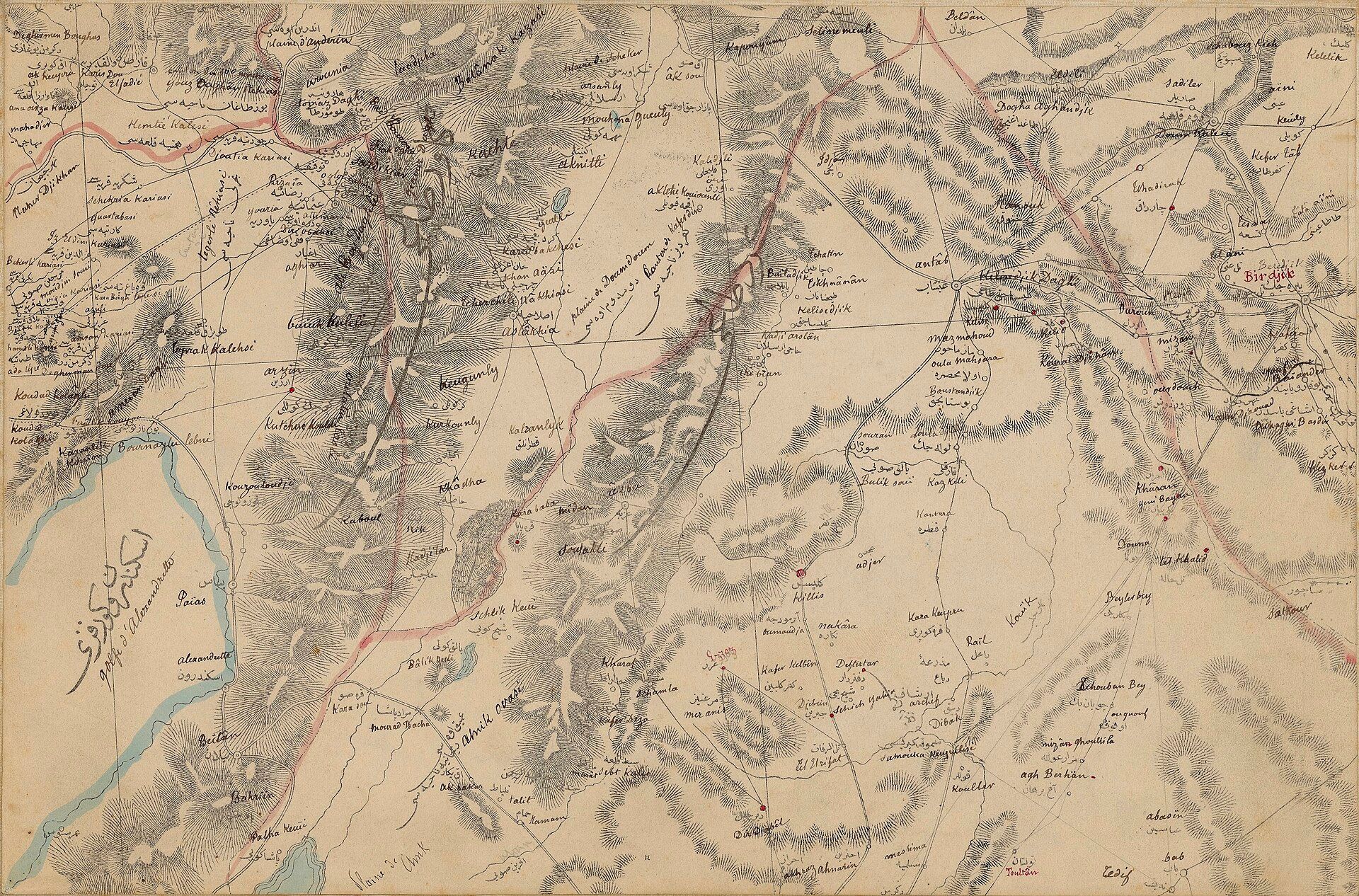
Klasea kurdica is a tall perennial of the daisy family with yellow florets packed into heads wrapped in leathery, sharp-tipped scales. It flowers in June[1][2]. It was first found in a single place: the Kurd Mountain, in Kurdish Çiyayê Kurmênc, which Post knew by its Turkish name Kurd Dagh, the highland around Efrîn (Afrin) in Rojava[1].
Very little is known about it. Kew's checklist gives its range as southern Turkey to Syria[3]. The global biodiversity database GBIF holds not a single specimen or observation of it, under either of its names[4], and we know of no photograph of the living plant. It has never been assessed for the IUCN Red List[4].
An excursion to Çiyayê Kurmênc, 1891
The plant was described by George Edward Post (1838–1909)[5] of the Syrian Protestant College in Beirut, who later wrote the Flora of Syria, Palestine and Sinai (1896)[2]. In 1891 plants were collected in the Kurd Mountain, in June and again in September[1], and in May 1892 he published them as the fourth part of his Plantae Postianae, printed in Lausanne[1].
He opened it with a short portrait of the mountain:
Le Kurd Dagh est une chaîne de montagnes situées entre le mont Amanus et le plateau d'Aintab en Asie Mineure ; sa hauteur moyenne est d'un millier de mètres au-dessus du niveau de la mer. La flore qui rappelle celle de l'Amanus est caractérisée par un assez grand nombre d'espèces qui lui sont spéciales ; nous avons été étonnés qu'une aussi petite collection fournît autant de formes nouvelles.
The Kurd Dagh is a chain of mountains lying between Mount Amanus and the plateau of Aintab in Asia Minor; its average height is about a thousand metres above sea level. Its flora, which recalls that of the Amanus, has a fairly large number of species of its own; we were astonished that so small a collection should yield so many new forms.[1] (our translation)
In the Kurdish geography of today, that is the mountain country of Efrîn, between the Amanus or Nur mountains and the plateau of Dîlok (Aintab, now Gaziantep). Post added that its vegetation has "a more desert character" than the Amanus, which lies nearer the sea, and that he hoped to publish an account of "our excursion in this region"[1].
He was not exaggerating about the new forms. In the space of a few pages he described five new species from the mountain, and called four of them kurdica: a sainfoin, Onobrychis kurdica[1]; a scabious, Scabiosa kurdica[1]; our plant, Serratula kurdica[1]; and a skullcap, Scutellaria kurdica[1]. The fifth, a woundwort, he called Stachys glandulifera[1]. The same pages list a buckthorn from the same slopes that Boissier and Hohenacker had already called kurdica, Rhamnus kurdica[1].
One plant in Post's herbarium
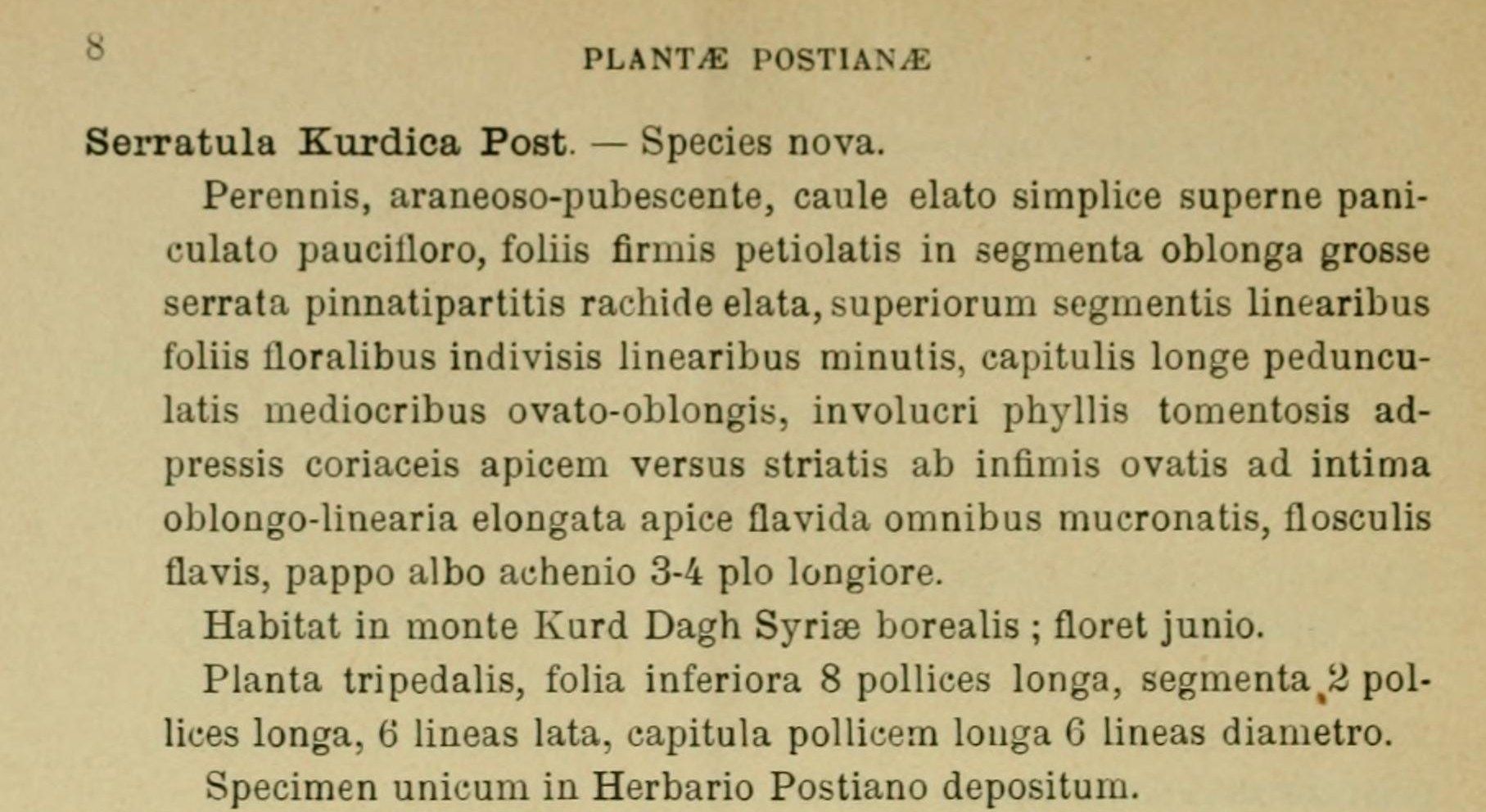
Post's Latin description of Serratula kurdica takes up half a page[1]. Where it grew and how much of it there was takes two lines:
Habitat in monte Kurd Dagh Syriæ borealis ; floret junio. … Specimen unicum in Herbario Postiano depositum.
It grows on the mountain Kurd Dagh in northern Syria; it flowers in June. … A single specimen, deposited in Post's herbarium.[1] (our translation)
Unlike most of the Kurd Mountain plants in the fascicle, it carries no collection number[1]. The whole species rested on one pressed plant, kept in Post's herbarium; for the sainfoin described two pages earlier he says where that herbarium was: in Beirut[1].
What to look for
Post described the plant twice, in Latin in 1892 and in English, with metric sizes, in his Flora of 1896[1][2]:
- a perennial about a metre tall or more, covered in cobwebby down, with a single, unbranched stem that opens at the top into a loose panicle of a few heads;
- firm, stalked leaves 20 to 30 cm long, cut almost to the midrib into oblong, coarsely toothed lobes 3 to 5 cm long, the midrib winged; the upper leaves have narrow lobes, and the small leaves among the flowers are undivided and linear;
- long-stalked heads, egg-shaped to oblong, 2 to 3 cm long;
- involucral scales that are downy, leathery and pressed close, the outer ones egg-shaped, the inner ones long and narrow; all end in a short point, and Post's Flora stresses that the point is yellow and lasting, and that the innermost scales run out into a yellow, glossy tip;
- yellow florets, and a white pappus three to four times as long as the seed.
In the Flora's key, what sets it apart from its relatives is that all its leaves, except those among the flowers, are deeply divided, while its florets are yellow[2].
From Serratula to Klasea
Post put his plant in Serratula[1][2]. A century later, the Euro+Med checklist of the thistle tribe drew the genus lines more narrowly. Werner Greuter, who thanks Gerhard Wagenitz for his advice on these genera, kept Klasea apart from Serratula, a split he described as "supported by cytological and palynological differences", that is, differences in the chromosomes and in the pollen, and "consistent with the molecular data so far available"[6]. In 2003 the two botanists moved Post's species across, and Klasea kurdica (Post) Greuter & Wagenitz is the name it carries today[6][5]. It went in one list of nineteen new names in Klasea, which also moved both relatives on this page, K. oligocephala and K. cerinthifolia, and K. hakkiarica, a species whose name refers to Colemêrg (Hakkari)[6]. The "(Post)" in brackets records that Post described it first.
Botanists in Turkey followed: there, every species once placed in Serratula except one, S. tinctoria, has since been moved to Klasea, which now counts fifteen species in the country, five of them found nowhere else[7].
Where it grows
The first plant came from the Kurd Mountain. The only other locality we found in print lies a little to the north-west, in southern Turkey: on 15 July 2009, the botanists B. Doğan and A. Duran collected it near Yarpuz in Osmaniye province, at 1,465 m, for a study of the Klasea species of Turkey[7]. With the type locality in Rojava, that gives the two corners of the range in Kew's checklist, "southern Turkey to Syria"[3].
Beyond that, little is known: no habitat beyond "the mountain" and no elevation for the first plant[1], and no record in GBIF[4]. The Flora of Turkey volume that covers the genus could not be read for this page, so other Turkish localities may exist.
Its nearest relatives in Kurdistan
When Doğan and his colleagues compared the DNA of the Turkish Klasea species, K. kurdica grouped together with K. oligocephala[7]. Post had already placed the two side by side in his Flora, separated in his key by their leaves and the colour of their florets: S. oligocephala has pink florets and grows on "rocky places; Amanus to Kurd-Dagh, Aintâb, Akherdagh, and north-eastward"[2].
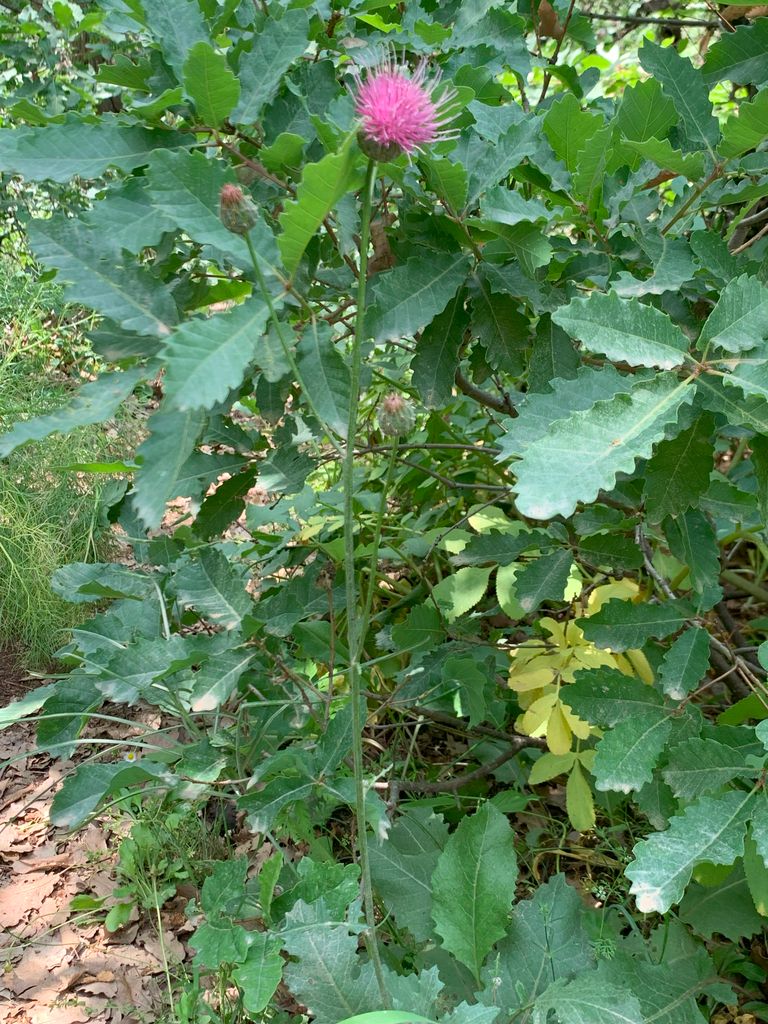
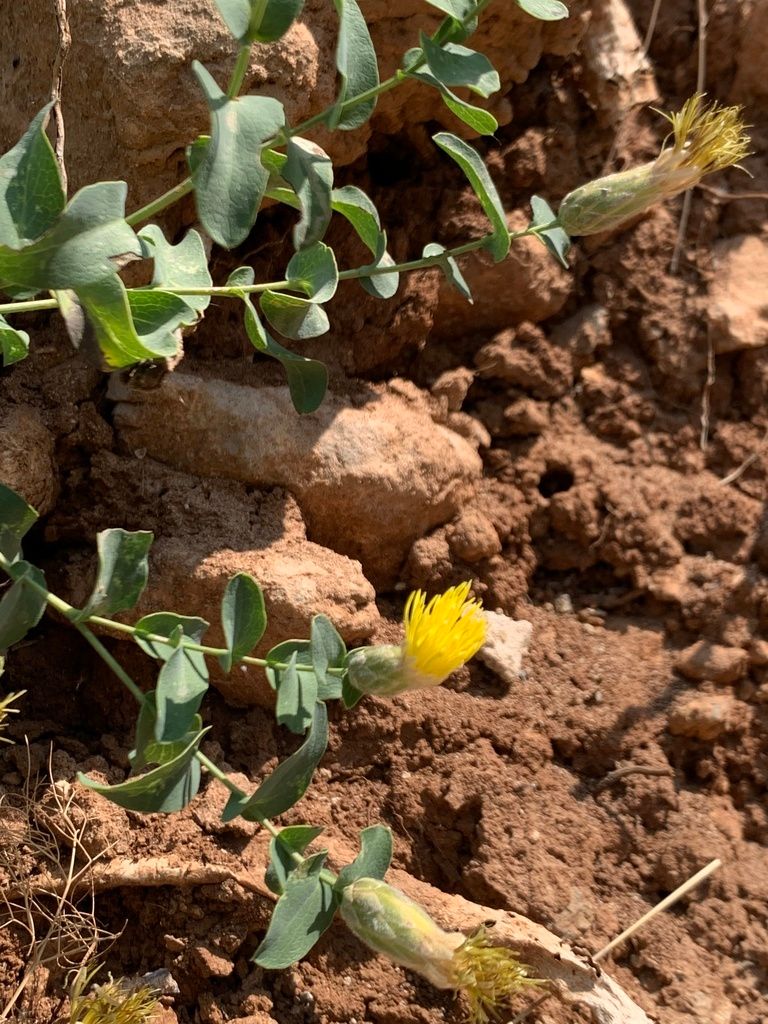
A yellow-flowered cousin is better documented in Kurdistan. Klasea cerinthifolia, which Post lists first in the genus with its Arabic name Wurreiqah[2], was collected in the 1930s at Şingal (Sinjar) with the Kurdish name tahla zraf, at Atrush and in the Zawita valley in Başûr, among limestone crags and on rocky slopes in oak forest. At Hewlêr (Erbil) it was used to make "tea", as the Kew Bulletin recorded in 1949[8].
A Kurdish name
We found no Kurdish name for it recorded in the field. Ahmet Dirihî's dictionary of Kurdish plant names, Ferhenga Navên Nebatan a Kurdî (2013), gives one for Klasea kurdica in its indexes: vizikê kurdan, a dictionary name whose wording mirrors the Latin[9]. The same dictionary gives vizik for another species of the genus, Klasea radiata[9].
Sources
- 1.Post, G.E. (1892). Plantae Postianae, fasc. 4. Lausanne.
- 2.Post, G.E. (1896). Flora of Syria, Palestine and Sinai. Beirut: Syrian Protestant College. biodiversitylibrary.orghttps://www.biodiversitylibrary.org/page/18086455
- 3.Plants of the World Online. Royal Botanic Gardens, Kew.
- abKlasea kurdica.
- plant_name_id 3047267. powo.science.kew.orghttps://powo.science.kew.org/taxon/urn:lsid:ipni.org:names:70029168-1accessed 14 November 2026
- 4.abcGBIF.org GBIF Backbone Taxonomy and occurrence records. (Global Biodiversity Information Facility): Klasea kurdica (species 3091216) and Serratula kurdica (5386366), consulted 15 November 2026. gbif.orghttps://www.gbif.org/
- 5.International Plant Names Index. Royal Botanic Gardens, Kew, Harvard University Herbaria and Australian National Herbarium.
- abKlasea kurdica (Post) Greuter & Wagenitz; Serratula kurdica Post; author record for G. E. Post.
- urn:lsid:ipni.org:names:70029168-1. ipni.orghttps://www.ipni.org/n/70029168-1accessed 14 November 2026
- 6.Greuter, W. (2003). The Euro+Med treatment of Cardueae (Compositae): generic concepts and required new names. Willdenowia 33: 49–61. doi:10.3372/wi.33.33104https://doi.org/10.3372/wi.33.33104
- 7.abcDoğan, B., Duran, A., Çetin, Ö., Öztürk, M. & Martin, E. (2015). Study of phylogenetic relationship of Turkish species of Klasea (Asteraceae) based on ISSR amplification. PhytoKeys 56: 29–40. doi:10.3897/phytokeys.56.5608https://doi.org/10.3897/phytokeys.56.5608
- 8.↩Blakelock, R. A. (1949). The Rustam Herbarium, 'Iraq. Systematic List. Part II. Kew Bulletin 4(1): 41–42.
- 9.Ahmet Kasımoğlu (Ehmedê Dirihî) (2013). Ferhenga Navên Nebatan a Kurdî (Dictionary of Kurdish Plant Names). Mardin Artuklu University, Institute of Living Languages in Turkey (ISBN 978-605-4202-12-6).
Last updated 20 November 2026