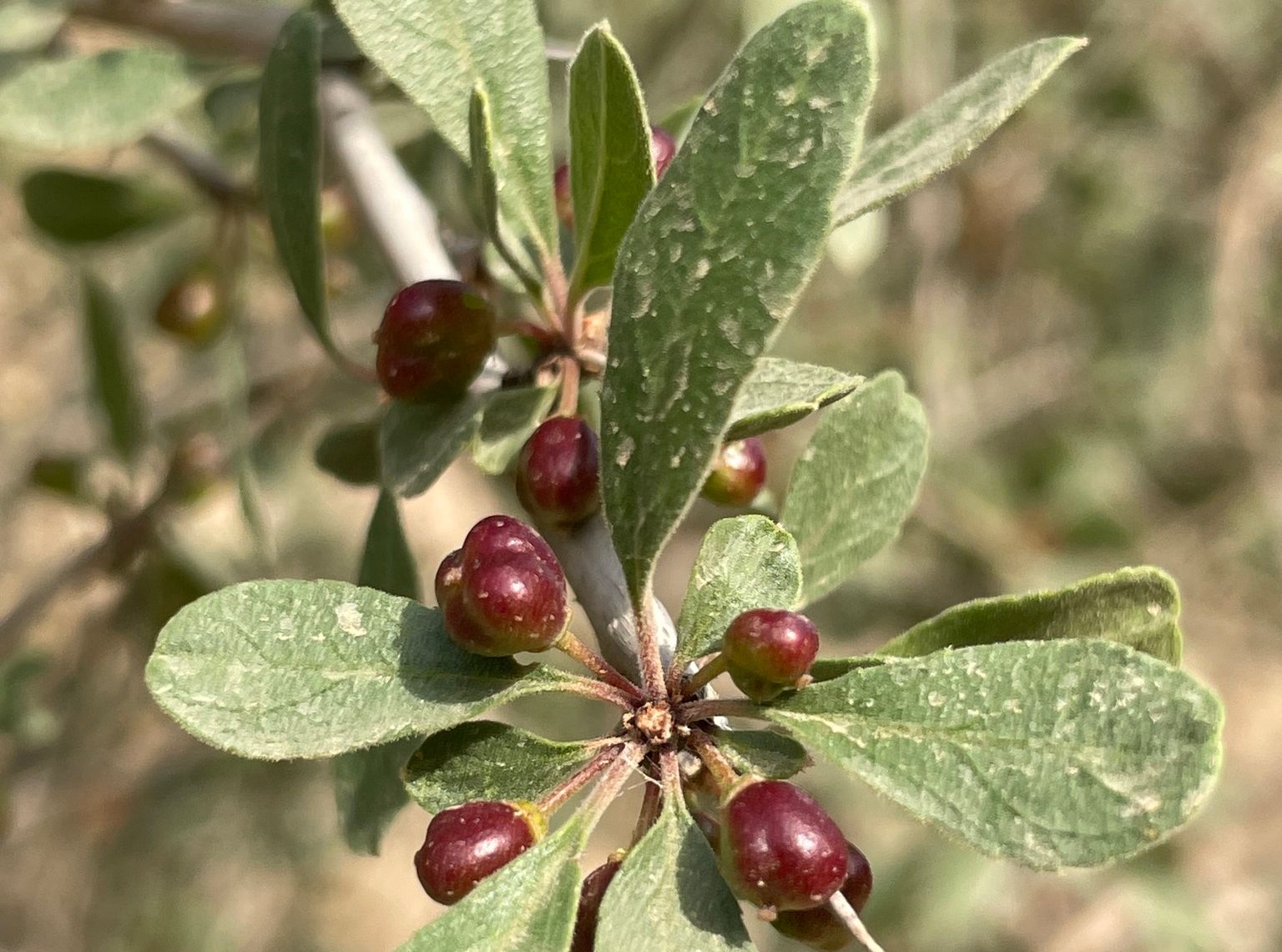
Rhamnus kurdica is a thorny buckthorn of limestone rocks and cliffs. Its twisted branches end in spines, its small leathery leaves are pale green and felted, and by September it carries small fruits that ripen bright red[1][2][3]. It grows in the mountains of Başûr (South Kurdistan), Bakur (North Kurdistan) and Rojhilat (East Kurdistan)[2][3][4], and it was named in 1843 from a single gathering on Mount Gara in Başûr[1][5].
How it got its name
- Named by
- Boiss. & Hohen., 1843Published in Diagn. Pl. Orient. 2: 3
A thorn bush on the summit of Gara
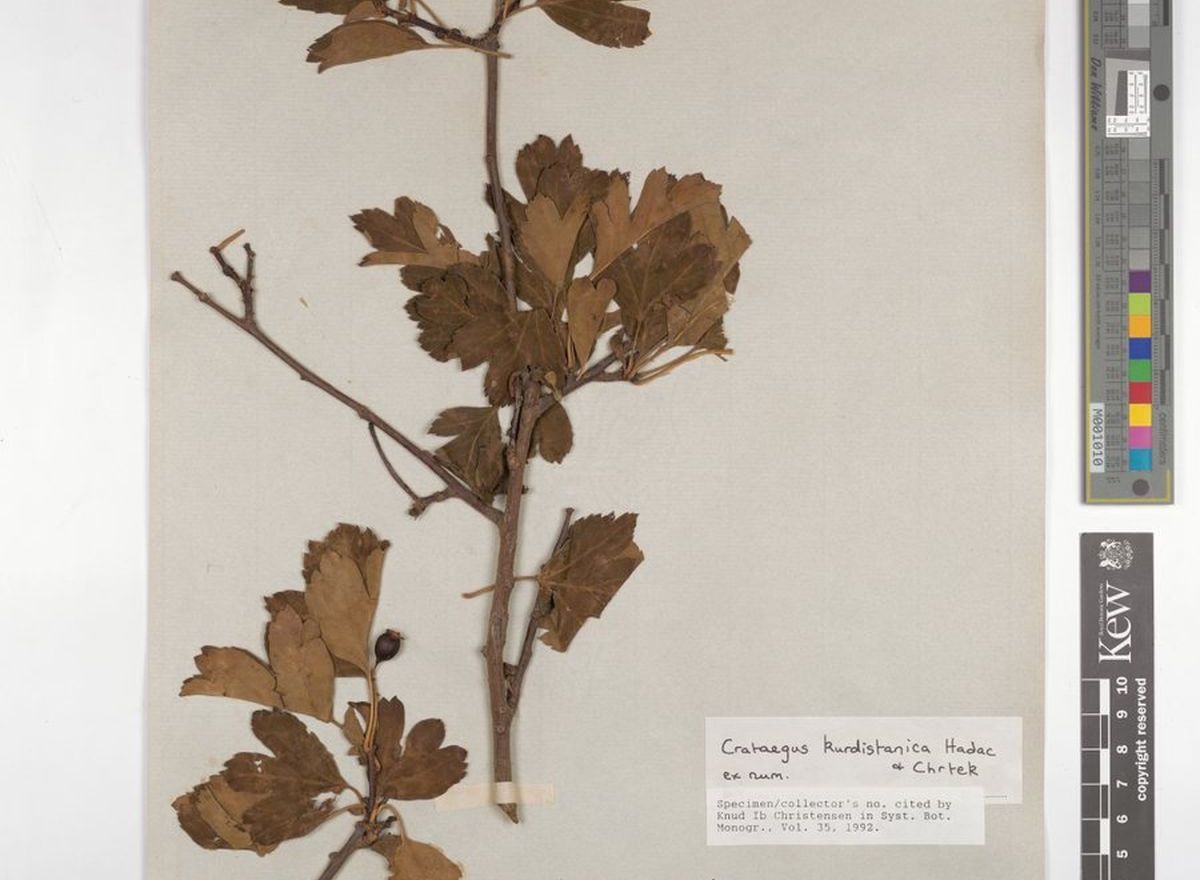
On 27 July 1841 the botanist Theodor Kotschy was on the summit of Mount Gara, collecting among rocks that face north[6]. His buckthorn went out under number 336, in a set of his plants issued by Rudolf F. Hohenacker in 1843, with a printed label that reads "Pl. Mesopot., Kurdistan & Mossul. Kotschy 1841"[5][6].
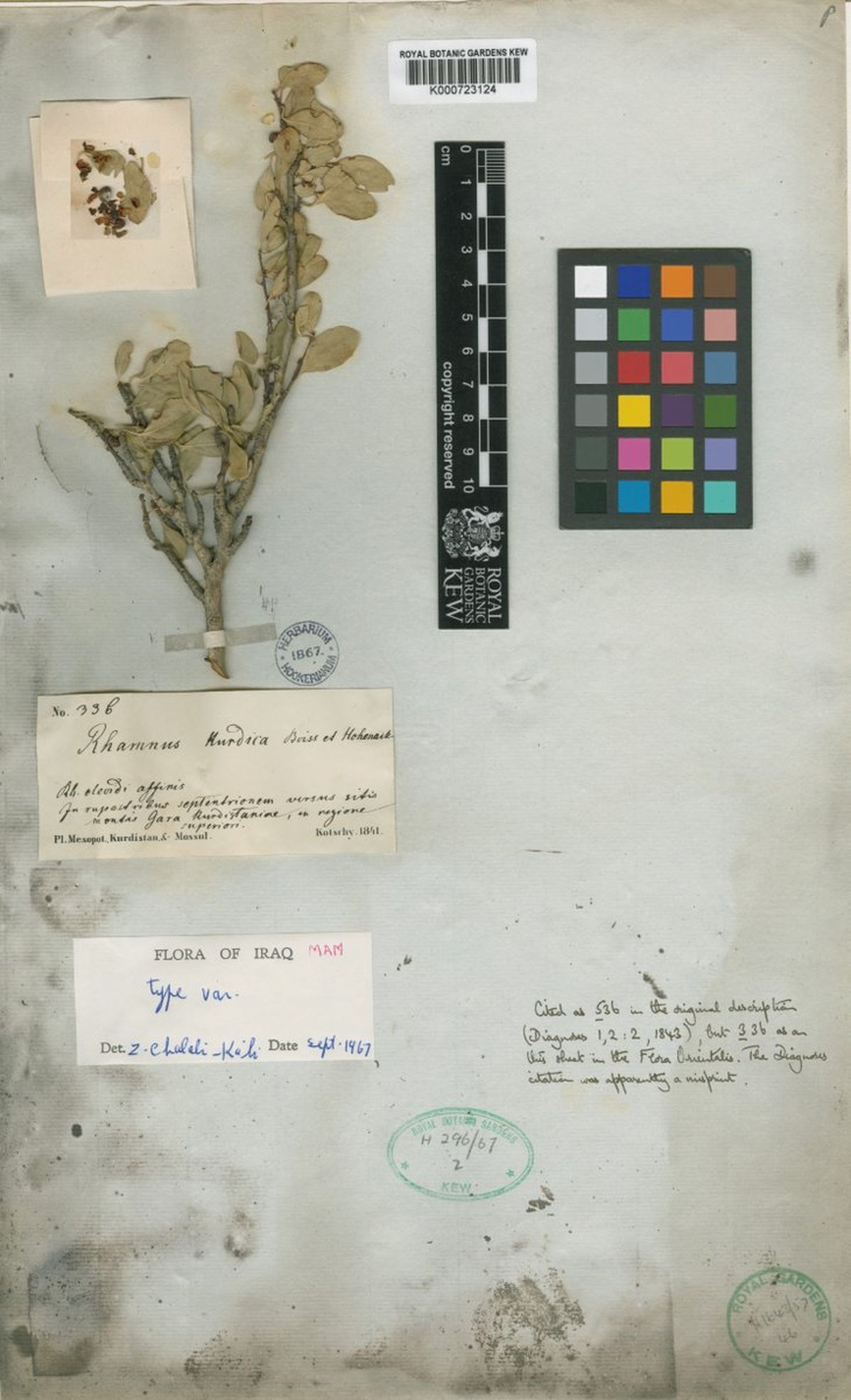
The handwritten label on the Kew sheet says where it grew:
In rupestribus septentrionem versus sitis montis Gara Kurdistaniae, in regione superiori.
On rocks facing north on Mount Gara in Kurdistan, in the upper region.[5] (our translation)
Above it, in the same hand, is a first verdict: "Rh. oleoidi affinis", "related to Rhamnus oleoides"[5].
In March 1843 Edmond Boissier and Hohenacker published it as a new species, Rhamnus kurdica, in the second part of Boissier's Diagnoses plantarum orientalium novarum[1][7]. The epithet kurdica means "Kurdish": the plant is named after the land where Kotschy found it. On the very same page they described a second new buckthorn from the same mountain, Rhamnus cornifolia, from the rock walls of Gara (Kotschy 560)[1]. Botanists today place that one in a separate genus, Atadinus[3].
336 or 536?
The 1843 description gives the place as "rocks in the upper part of Mount Gara in Kurdistan", but names the collection as "Aucher pl. exs. N° 536"[1], as if it had come from another collector, Pierre Aucher-Éloy. The sheets tell a different story. The type material in Kew, Halle, Harvard, Missouri, Göttingen and Wageningen all carries Kotschy 336[5][6], most of it dated 27 July 1841[6], and when Boissier came back to the species in his Flora Orientalis in 1872 he cited "Ky. exs. 336" himself[2]. A curator at Kew later added a handwritten note to the sheet: "The Diagnoses citation was apparently a misprint"[5].
What to look for
Boissier's first description, filled out by his own Flora Orientalis and by a 2021 revision of the buckthorns of Iran, gives a clear picture[1][2][3]:
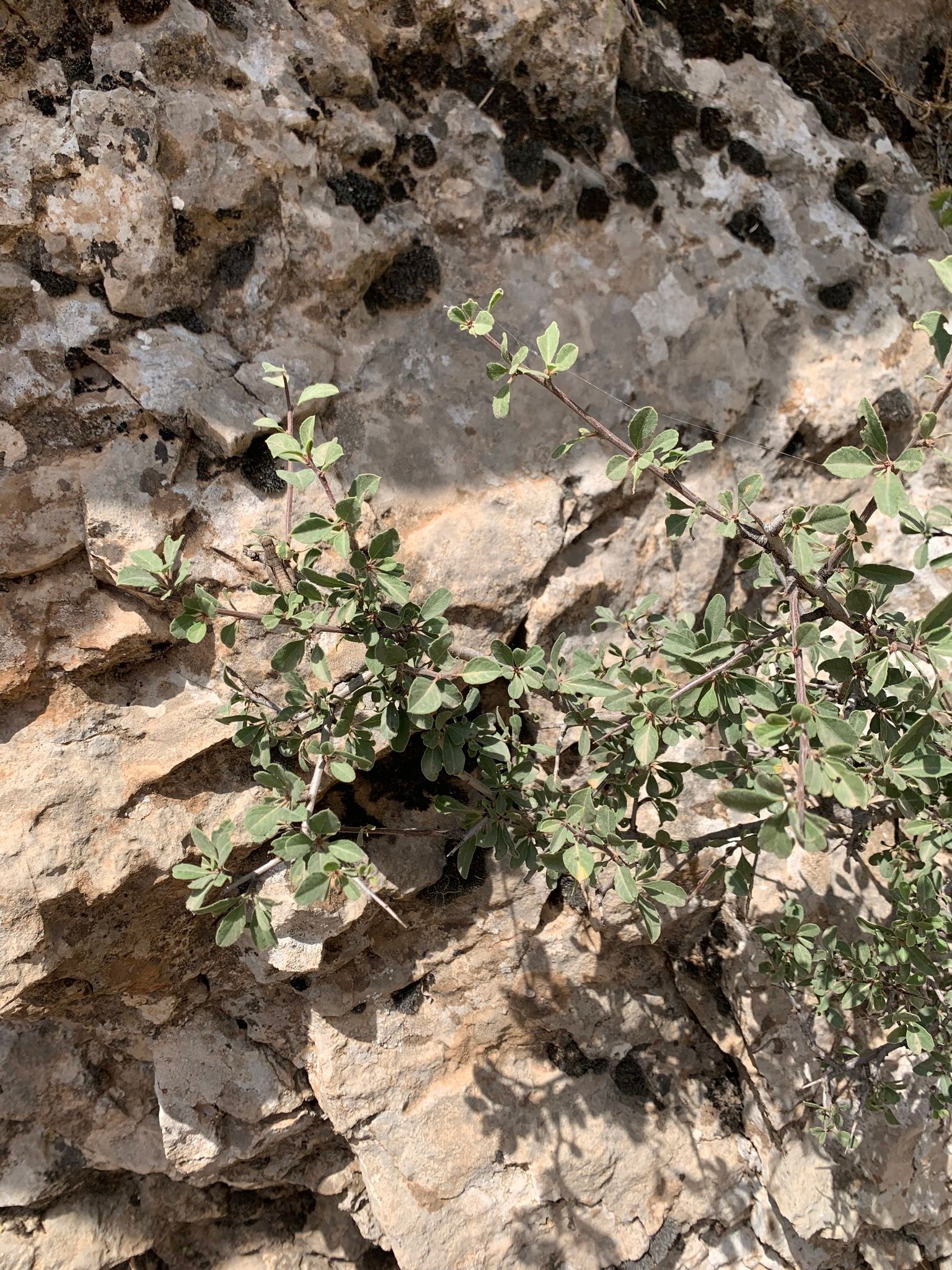
- a shrub from 30 cm to 2 m tall[3]; on the type the branches are twisted and lie flat[1]; the young shoots are velvety, and the branches end in spines up to 8 cm long[2][3];
- leaves leathery and pale green, 5–30 mm long and 3–12 mm wide, usually oblong and spoon-shaped, narrowing into the stalk, blunt or with a small point, covered on both sides with very short felt; the edge carries a few scattered small teeth tipped with black glands[1][2][3];
- flowers tiny, 2–3 mm long, a few together in the leaf axils, with narrow petals about 2 mm long[2][3];
- fruits small, roundish drupes 3–4 mm long, green or yellow at first and bright red when ripe, each holding two to three (rarely four) seeds about 3 mm long[1][3]. The base of the fruit sits on a small hemispherical cushion left from the flower[1].
Boissier never described its calyx or petals: in 1872 he still left them blank ("calyce…, petalis…")[2]. He set it apart from Rhamnus oleoides by its broader, shorter leaves with small teeth and by a furrow on the seed that splits into two at the tip[2]. In Iran it flowers in late May, and its fruits and seeds ripen in September[3].
The Iranian revision counts Rhamnus persica, first described on the same page as the Kurdish one[1], among its relatives[3], and a form that Bornmüller once named R. kurdica var. persica is now counted as R. persica[3][7].
A plant in between
In 1893 the botanist Joseph Bornmüller collected a buckthorn between Hewlêr (Erbil) and Rewandiz (Rowanduz), labelled "Kurdistania Assyriaca"[8]. More than forty years later, in 1937, he published his number 1021 as a variety of Rhamnus pallasii, var. intermedia[7][9]. In 1948 R. A. Blakelock of Kew, listing the plants of the Rustam Herbarium of Iraq, wrote of a buckthorn collected at Zawita in 1933 that "matches Bornmüller's type (no. 1021)" and noted that it "appears intermediate between R. pallasii and R. kurdica"[9]. Today Bornmüller's own sheets of number 1021 in Hamburg and Meise are filed under Rhamnus kurdica[8]. Where one buckthorn ends and the next begins in these mountains is still a question for specialists.
Where it grows
Kew's checklist gives its native range as south-eastern Turkey to north-western Syria and western and north-western Iran, with records from Iran, Iraq, Syria and Lebanon, and Turkey[10]. In Kurdish terms it is a shrub of Başûr, Bakur and Rojhilat, and Boissier's 1872 list already reads like a map of Kurdistan's limestone ranges[2]:
- Başûr: Mount Gara, the type locality[1][5]; the rock crevices of Mount Şingal (Sinjar)[2]; Zawita Gorge, at 780 m on limestone rocks, in 1932[9]; and, in later collections, Qeredax (Qaradagh), the Bêxme (Bekhme) gorge, Rewandiz, Sersing (Sarsink) and the mountains near Zaxo (Zakho)[4].
- Hewraman (Hawraman), Şaho (Shahu) and Pîremegrûn (Pira Magrun), on both sides of today's border: Heinrich Haussknecht collected it on these mountains in 1867[2][4], and it has been gathered there again since[4]. Boissier also lists a mountain he spells "Sawers"[2].
- Rojhilat: a 2021 revision of Iran's buckthorns records it, across Iran, on rocky slopes, rarely on cliffs, at about 1,000–1,600 m, with specimens from around Pawe (Paveh), Merîwan (Marivan), Şino (Oshnavieh) and Ûrmiye (Urmia), and further south along the Zagros into Lorestan and Fars[3].
- Bakur: collected in the Wan (Van) region, around Satak, on Kavuşşahap Dağ and near Bahçesaray; at Elcewaz (Adilcevaz) in Bedlîs (Bitlis); and at Çelê (Çukurca) in Colemêrg (Hakkâri)[4].
- Further west: Boissier also lists vineyards at Mereş (Maraş), which he counted as northern Syria[2].
Its places are almost always rocky ones: crevices, limestone crags, gorges and stony slopes[1][2][3][9].
The species has not been assessed for the IUCN Red List[10].
Its names in Kurdish
The plant-name list Flora Kurdistanê, prepared by Edîb Polat for the Kurdish Institute of Paris's journal Kurmancî (no. 38, 2006), gives gijok and rîxok for Rhamnus kurdicus[11]. Ehmedê Dirihî's dictionary of Kurdish plant names (2013) gives the same two names for the species, together with lalîn, givîj and guhîj, and, in a separate entry, bezweleruk[12]. None of these entries names a region or informant.
The same dictionary gives rîxok also for two other buckthorns, Rhamnus frangula (noted from Gimgim) and Rhamnus catharticus[12], so these names may be used for buckthorns in general rather than for this species alone.
Dirihî also lists givîja kurdan, siyateliyê kurdan and şeqalê kurdan[12]. These are dictionary names whose wording mirrors the Latin ("… of the Kurds"), not names collected from people who know the plant.
Sources
- 1.abcdefghijklmBoissier, E. & Hohenacker, R. F. (1843). Rhamnus kurdica. In: Boissier, E., Diagnoses Plantarum Orientalium Novarum ser. 1, no. 2: 3–4. Leipzig.
- 2.abcdefghijklmnoBoissier, E. (1872). Flora Orientalis vol. 2: 16–17. Geneva & Basel.
- 3.abcdefghijklmnAlijanpoor, B., Khodayari, H., Assadi, M., Rahiminejad, M. & Mehregan, I. (2021). A taxonomic revision of Rhamnus L. and Atadinus Raf. (Rhamnaceae) in Iran. Phytotaxa 521(3): 127–158. doi:10.11646/phytotaxa.521.3.1https://doi.org/10.11646/phytotaxa.521.3.1
- 4.abcdeHerbarium specimens of Rhamnus kurdica at Kew (K), Edinburgh (E) and the Nezahat Gökyiğit Botanic Garden (NGBB), via GBIF (accessed 15 November 2026).
- 5.abcdefgRoyal Botanic Gardens, Kew – Herbarium Specimens. via GBIF, herbarium specimen K000723124, type of Rhamnus kurdica (Kotschy 336, 1841), via GBIF (occurrence 912560822). gbif.orghttps://www.gbif.org/dataset/cd6e21c8-9e8a-493a-8a76-fbf7862069e5
- 6.abcdDuplicates of Kotschy 336 in the herbaria of Halle (HAL 0120466), Harvard (GH 00051489), Missouri (MO 100445277), Göttingen (GOET009867) and Wageningen (WAG0004729), via GBIF (accessed 15 November 2026).
- 7.International Plant Names Index. Royal Botanic Gardens, Kew, Harvard University Herbaria and Australian National Herbarium.
- abcRhamnus kurdica Boiss. & Hohen. and its varieties; Rhamnus pallasii var. intermedia Bornm.
- urn:lsid:ipni.org:names:718427-1. ipni.orghttps://www.ipni.org/n/718427-1accessed 14 November 2026
- 8.abBornmüller 1021 (1893), herbarium specimens in Meise (BR0000031822008) and Hamburg (HBG 0510039), via GBIF.
- 9.Blakelock, R. A. (1948). The Rustam Herbarium, 'Iraq. Systematic List. Part I. Kew Bulletin 3(3): 404–405.
- 10.Plants of the World Online. Royal Botanic Gardens, Kew.
- abRhamnus kurdica.
- plant_name_id 2524964. powo.science.kew.orghttps://powo.science.kew.org/taxon/urn:lsid:ipni.org:names:718427-1accessed 14 November 2026
- 11.↩Edîb Polat (2006). Flora Kurdistanê (I). p. 2. institutkurde.orghttps://www.institutkurde.org/publications/kurmanci/
- 12.Ahmet Kasımoğlu (Ehmedê Dirihî) (2013). Ferhenga Navên Nebatan a Kurdî (Dictionary of Kurdish Plant Names). Mardin Artuklu University, Institute of Living Languages in Turkey (ISBN 978-605-4202-12-6).
- 13.Catalogue of Life, vernacular names via the GBIF Backbone Taxonomy. api.gbif.orghttps://api.gbif.org/v1/species/3877654/vernacularNamesaccessed 14 November 2026
- Boissier, E. (1843). Diagnoses Plantarum Orientalium Novarum, ser. 1, no. 2. Geneva.
- Diagn. Pl. Orient. ser. 1, 2: 3–4 (p. 4). archive.orghttps://archive.org/details/e.-boissier-diagnoses-plantarum-orientalium-novarum-series-1-vol.-1-no.-1-7-1843-1846/page/n87/mode/1upaccessed 14 November 2026
- p. 4. archive.orghttps://archive.org/details/e.-boissier-diagnoses-plantarum-orientalium-novarum-series-1-vol.-1-no.-1-7-1843-1846/page/n87/mode/1upaccessed 14 November 2026
Last updated 20 November 2026