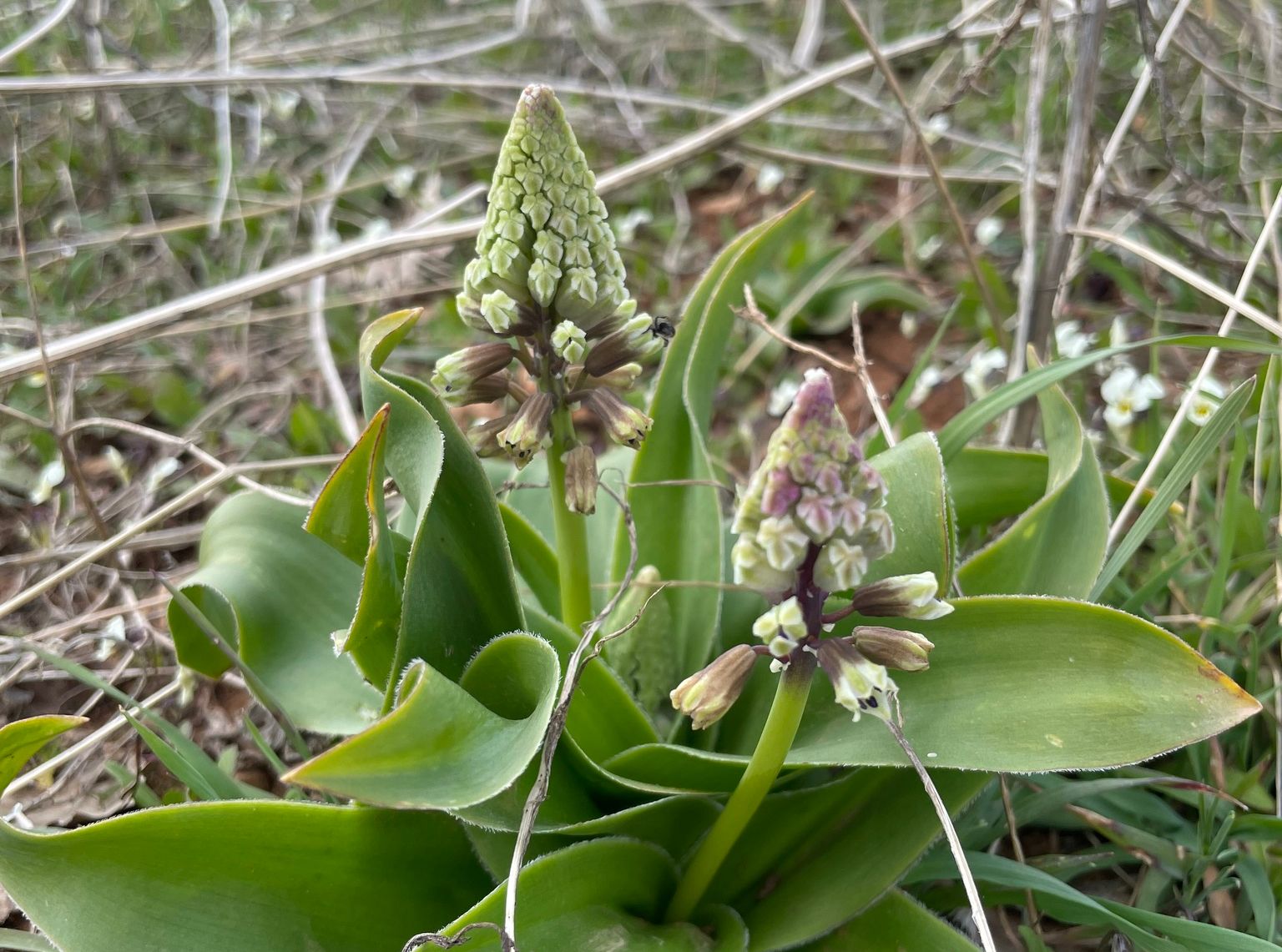
Bellevalia kurdistanica is a spring-flowering bulb of the asparagus family (Asparagaceae)[1], with dense spikes of small bell-shaped flowers that are lilac in bud and white when open[2]. It grows in North Kurdistan (Bakur)[3] and South Kurdistan (Başûr)[4]. The botanist Naomi Feinbrun named it after Kurdistan in 1940[5], from plants collected at Amêdî (Amadiya)[4].
The name
Naomi Feinbrun described the species in her monograph of the genus Bellevalia, published in the Palestine Journal of Botany, Jerusalem series[6]. IPNI dates that issue to March 1940[5]; Kew's checklist gives 1939[7]. Kurdistanica is Latin for “of Kurdistan”, and Feinbrun gave its range simply as “Iraqian Kurdistan”[6].
The holotype, in the herbarium of the Hebrew University of Jerusalem, was collected by Evan Guest at Amêdî on 26 March 1931[4], “in fields in the valley, and in deep soil pockets on the hillside”, at 3500 feet (about 1070 m)[8]. Kew keeps type material that Guest collected at Amêdî on the same day (his number 1210)[9], and a sheet he collected the day before at Mam, near Amêdî[10]. Feinbrun also saw a second gathering by Guest, from Kerkûk (Kirkuk)[8], collected on 4 April 1931[11]. She noted that the dense flower spike recalls that of Bellevalia densiflora, and that this is the easternmost species of its section, Patens[8].
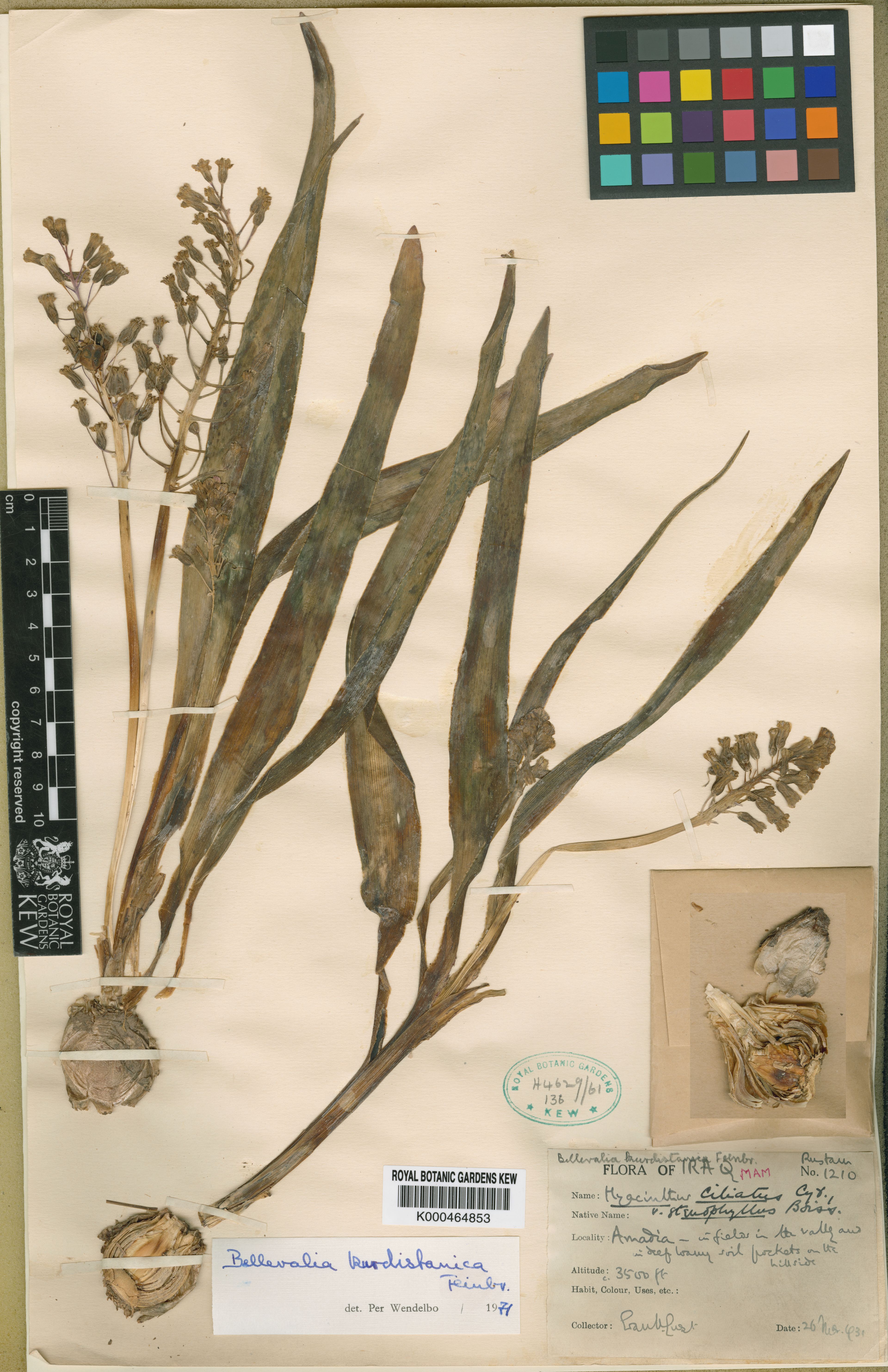
Description
A plant 25–35 cm tall, from a deep bulb about 3 cm across. It has five or six strap-shaped leaves that sheathe the flower stalk; they are 12–30 cm long, longer than the stalk, with short hairs along the edge, and the outer ones are 17–20 mm wide. Each bulb has two flower stalks. The spike is egg-shaped to oblong and dense, with about 25 flowers, 3.5–5 cm long and 2–2.5 cm wide, and much shorter than the stalk. The upper flowers are lilac and often sterile. The flowers are tubular and bell-shaped, 8–10 mm long, with lobes about half as long as the tube; the anthers are lilac. The fruit is an egg-shaped capsule on a spreading stalk about 2 cm long[6]. In Feinbrun's key, the buds are lilac and the open flowers white, turning grey only as they wither[2].
A study of the genus in South Kurdistan by Rupak Towfiq Abdul-Razaq and Nori Majid Abdulqader of the University of Sulaimani, based on fieldwork in 2015 and 2016, found five to seven strap-shaped, somewhat wavy leaves, short-fringed at the edge and bluish-green (glaucous), and flowers that are greenish-white with a purplish tinge when open, turning pale greyish-brown[1]. A study at the University of Tikrit measured its bulb at 6 cm long, the longest of the eleven species it compared[12].
Where it grows
In North Kurdistan, it was collected in 1972 on steep, loose slopes in the Zap gorge, opposite the turning to Colemêrg (Hakkâri, Turkey)[3], and in 2004 at 2000 m on the Şapatan pass in Colemêrg province[13] and at 1300 m, 15 km from Şirnex (Şırnak) on the road to Dih (Eruh)[14].
In South Kurdistan, besides the type locality at Amêdî, it was collected in 1959 at 820 m, 16 km north-west of Ranya[15], and in the same year at 390 m, 7 km north-west of Kerkûk[16]. The botanist Mehmet Fırat recorded it growing with Iris zagrica on loose soil in the Şêrwan area of Mêrgesor (Mergasur), where he collected the iris in open oak forest near the village of Hezil, at about 1100 m[17]. The photo at the top of this page was taken near Penciwên (Penjwen) in March 2024[18].
Feinbrun described its habitat as deep, moist soil[6]. Kew's checklist does not list it from Iran[7], and no specimen from East Kurdistan (Rojhilat) was found for this page.
Flowering
Feinbrun gives April and May[6]. The specimens from Kurdistan cited on this page were collected between 25 March, at Mam near Amêdî[10], and 20 May, on the Şapatan pass[13], and the photo near Penciwên was taken on 15 March[18].
Kurdish names
No Kurdish folk name specific to Bellevalia kurdistanica has been found yet. The dictionary of Kurdish plant names by Ehmedê Dirihî (Ahmet Kasımoğlu, 2013) gives it two dictionary names that render the Latin name, both meaning roughly “mountain hyacinth of Kurdistan”: simbila çiyayê kurdîstan and simbila koyî kurdîstan[19]. For the genus Bellevalia as a whole it gives çawke cîlan (source KMP, “Kurdistan Medical Plant”), gêlegir (source K, the journal Kurmancî) and simbila koyan[20].
Sources
- 1.abRupak Towfiq Abdul-Razaq, Nori Majid Abdulqader (2020). Morphology and palynology systematic studies of the genus Bellevalia Lapeyr. (Asparagaceae) in Kurdistan-Iraq. Tikrit Journal for Agricultural Sciences 20(2): 1–15, pp. 1–2 (study area, 2015–2016) and 6–7 (B. kurdistanica: leaves, raceme, perigon). tjas.orghttps://www.tjas.org/article_167_5878a7ab84fb43402106c575658472fa.pdfdoi:10.25130/tjas.20.2.1https://doi.org/10.25130/tjas.20.2.1archivedhttps://web.archive.org/web/20261030100520/https://www.tjas.org/article_167_5878a7ab84fb43402106c575658472fa.pdfaccessed 30 October 2026
- 2.abNaomi Feinbrun (1940). A monographic study on the genus Bellevalia Lapeyr. (caryology, taxonomy, geography). Palestine Journal of Botany, Jerusalem Series 1(4): 336–409, p. 343 (key, couplet 42: B. kurdistanica). archive.orghttps://archive.org/details/israel-journal-of-chemistry_1940-03_1_4/page/n40/mode/1upaccessed 30 October 2026
- 3.abRoyal Botanic Gardens, Kew – Herbarium Specimens. via GBIF, K002924604: Zap gorge, opposite the turning to Hakkari, steep loose slopes, 1 May 1972, E.M. Rix 1918. gbif.orghttps://www.gbif.org/occurrence/4607955290archivedhttps://web.archive.org/web/20261030040658/https://api.gbif.org/v1/occurrence/4607955290accessed 30 October 2026
- 4.abcThe Hebrew University of Jerusalem Herbarium (HUJ). via GBIF, HUJ 0000029607: holotype, Amadia [Amêdî], 26 Mar 1931, Evan Guest. gbif.orghttps://www.gbif.org/occurrence/5931940388archivedhttps://web.archive.org/web/20261030034331/https://api.gbif.org/v1/occurrence/5931940388accessed 30 October 2026
- 5.abInternational Plant Names Index. Royal Botanic Gardens, Kew, Harvard University Herbaria and Australian National Herbarium, Bellevalia kurdistanica Feinbrun, Palestine J. Bot., Jerusalem Ser. 1(4): 381 (Mar 1940). ipni.orghttps://www.ipni.org/n/531815-1archivedhttps://web.archive.org/web/20261030030155/https://www.ipni.org/n/531815-1accessed 30 October 2026
- 6.abcdeNaomi Feinbrun (1940). A monographic study on the genus Bellevalia Lapeyr. (caryology, taxonomy, geography). Palestine Journal of Botany, Jerusalem Series 1(4): 336–409, p. 381 (B. kurdistanica sp. nov.: description, flowering, range). archive.orghttps://archive.org/details/israel-journal-of-chemistry_1940-03_1_4/page/n78/mode/1upaccessed 30 October 2026
- 7.abPlants of the World Online. Royal Botanic Gardens, Kew, Bellevalia kurdistanica Feinbrun: native range and place of publication. powo.science.kew.orghttps://powo.science.kew.org/taxon/urn:lsid:ipni.org:names:531815-1archivedhttps://web.archive.org/web/20250219194106/https://powo.science.kew.org/taxon/urn:lsid:ipni.org:names:531815-1accessed 30 October 2026
- 8.abcNaomi Feinbrun (1940). A monographic study on the genus Bellevalia Lapeyr. (caryology, taxonomy, geography). Palestine Journal of Botany, Jerusalem Series 1(4): 336–409, p. 382 (B. kurdistanica: specimens seen, remarks). archive.orghttps://archive.org/details/israel-journal-of-chemistry_1940-03_1_4/page/n79/mode/1upaccessed 30 October 2026
- 9.↩Royal Botanic Gardens, Kew – Herbarium Specimens. via GBIF, K000464853: type material, Amadia, 26 Mar 1931, E. Guest 1210. gbif.orghttps://www.gbif.org/occurrence/912389156archivedhttps://web.archive.org/web/20261030040501/https://api.gbif.org/v1/occurrence/912389156accessed 30 October 2026
- 10.abRoyal Botanic Gardens, Kew – Herbarium Specimens. via GBIF, K002924613: Mam, Amadia, 25 Mar 1931, E.R. Guest 1208. gbif.orghttps://www.gbif.org/occurrence/4607953259archivedhttps://web.archive.org/web/20261030100619/https://api.gbif.org/v1/occurrence/4607953259accessed 30 October 2026
- 11.↩The Hebrew University of Jerusalem Herbarium (HUJ). via GBIF, HUJ 0000029608: paratype, Kirkuk, 4 Apr 1931, Evan Guest. gbif.orghttps://www.gbif.org/occurrence/5931940445archivedhttps://web.archive.org/web/20261030040352/https://api.gbif.org/v1/occurrence/5931940445accessed 30 October 2026
- 12.↩Najat Ameen Sa'eed, Naglaa Mustafa Al-Abide, Aqeel Husein Ali Al-Asi (2020). Comparative study of several morphological and reproductional aspects for some species of the Bellevalia Lapeyrouse, 1808 and Ornithogalum Linnaeus, 1753 (Asparagales, Asparagaceae) in central and north of Iraq. Bulletin of the Iraq Natural History Museum 16(2): 173–191, p. 175 (bulb length). jnhm.uobaghdad.edu.iqhttps://jnhm.uobaghdad.edu.iq/index.php/BINHM/article/download/470/314/1252doi:10.26842/binhm.7.2020.16.2.0173https://doi.org/10.26842/binhm.7.2020.16.2.0173archivedhttps://web.archive.org/web/20261030103054/https://jnhm.uobaghdad.edu.iq/index.php/BINHM/article/download/470/314/1252accessed 30 October 2026
- 13.abNezahat Gökyiğit Botanic Garden Herbarium (NGBB). via GBIF, NGBB-001042: Şapatan pass, Hakkâri, 2000 m, 20 May 2004, M. Koyuncu 14191. gbif.orghttps://www.gbif.org/occurrence/6315335464archivedhttps://web.archive.org/web/20261030040808/https://api.gbif.org/v1/occurrence/6315335464accessed 30 October 2026
- 14.↩Nezahat Gökyiğit Botanic Garden Herbarium (NGBB). via GBIF, NGBB-001484: 15 km from Şırnak towards Eruh, 1300 m, 25 Apr 2004, M. Koyuncu 14105. gbif.orghttps://www.gbif.org/occurrence/6315333331archivedhttps://web.archive.org/web/20261030040910/https://api.gbif.org/v1/occurrence/6315333331accessed 30 October 2026
- 15.↩Royal Botanic Gardens, Kew – Herbarium Specimens. via GBIF, K002924611: Derah and Nura villages, 16 km NW of Rania, 820 m, 11 May 1959, Rawi, Nuri & Kass 28609. gbif.orghttps://www.gbif.org/occurrence/4607958241archivedhttps://web.archive.org/web/20261030040550/https://api.gbif.org/v1/occurrence/4607958241accessed 30 October 2026
- 16.↩Royal Botanic Gardens, Kew – Herbarium Specimens. via GBIF, K002924602: 7 km NW of Kirkuk, 390 m, 6 May 1959, Rawi et al. 25945. gbif.orghttps://www.gbif.org/occurrence/4607954267archivedhttps://web.archive.org/web/20261030100745/https://api.gbif.org/v1/occurrence/4607954267accessed 30 October 2026
- 17.↩Mehmet Fırat (2022). Iris zagrica subsp. zagrica (Iridaceae): a new record locality for the flora of North Iraq. Doğu Fen Bilimleri Dergisi 5(2): 12–18, p. 15 (habitat of Iris zagrica: with Bellevalia kurdistanica; Hezil village, Şêrwan, Mergesor, open oak forest, 1104 m). dergipark.org.trhttps://dergipark.org.tr/tr/download/article-file/2791531archivedhttps://web.archive.org/web/20261030031129/https://dergipark.org.tr/tr/download/article-file/2791531accessed 30 October 2026
- 18.abiNaturalist. Observation 202533411: Penjwin, 15 Mar 2024, Arya Aras (research grade). inaturalist.orghttps://www.inaturalist.org/observations/202533411archivedhttps://web.archive.org/web/20261030101057/https://api.inaturalist.org/v1/observations/202533411accessed 30 October 2026
- 19.↩Ahmet Kasımoğlu (Ehmedê Dirihî) (2013). Ferhenga Navên Nebatan a Kurdî (Dictionary of Kurdish Plant Names). Mardin Artuklu University, Institute of Living Languages in Turkey (ISBN 978-605-4202-12-6), pp. 1078 (Latin index: Bellevalia kurdistanica) and 693 (simbila çiyayê kurdîstan, simbila koyî kurdîstan).
- 20.↩Ahmet Kasımoğlu (Ehmedê Dirihî) (2013). Ferhenga Navên Nebatan a Kurdî (Dictionary of Kurdish Plant Names). Mardin Artuklu University, Institute of Living Languages in Turkey (ISBN 978-605-4202-12-6), pp. 1078 (Latin index: Bellevalia), 158 (çawke cîlan, source KMP), 259 (gêlegir, source K) and 693 (simbila koyan); codes on p. 65.
- Photo: Arya Aras, CC BY-NC 4.0, via iNaturalist. inaturalist.orghttps://www.inaturalist.org/observations/202533411
Last updated 30 October 2026