Cephalaria kurdistanica is a recent discovery. It was found high on Chehel-Cheshmeh, a mountain in the north-west of Kurdistan province in East Kurdistan (Rojhilat), on 14 July 2018, and named in 2020 by botanists from Sine (Sanandaj) and Kirmaşan (Kermanshah)[1][2]. Its name says where it belongs: kurdistanica, "of Kurdistan". As far as the public record goes, it is known only from that mountain[2][3][4].
How it got its name
- Named by
- Maroofi, Tabad & Rastegar, 2020Published in Phytotaxa 455: 223
- Type collected by
- Tabad14 July 2018
A find at 2,850 metres
The plant was collected by Mohammad Aref Tabad, a graduate in medicinal plants from an institute in Kirmaşan, under his collecting number 14006[1][2]. He found it at about 2,850 m on Chehel-Cheshmeh, at 35° 49′ N, 46° 31′ E[2]. In Persian, the mountain's name means "forty springs".
Tabad's specimen became the holotype, the single sheet to which the name is tied for good. It is kept in the herbarium with the code HKS[2]. Two years later Tabad and two botanists of the Forests and Rangelands Research Department at the agricultural and natural resources research centre in Sine, Hossein Maroofi and Azad Rastegar, described it as new to science in the journal Phytotaxa, under the title "Cephalaria kurdistanica (Caprifoliaceae), a new species from Kurdistan, west of Iran"[1].
A family of "kurdistanica" names
The plant from Chehel-Cheshmeh is not the only plant these botanists have named after Kurdistan. Within a few years, Hossein Maroofi and his colleagues described a whole run of new species from the mountains of Rojhilat, each named after Kurdistan and each with its holotype in the same herbarium, HKS[2]:
- 2015: Campanula kurdistanica, from the slopes of Şaho (Shahoo), between Merîwan (Marivan) and Pawe (Paveh), at 1,800–3,000 m (Advay & Maroofi);
- 2016: Pentanema kurdistanicum, from near Bendol village, about 30 km south to south-east of Merîwan, at 2,600 m (Maroofi & Ghaderi);
- 2020: Cephalaria kurdistanica, from Chehel-Cheshmeh, at 2,850 m (Maroofi, Tabad & Rastegar)[1][2];
- 2021: Heracleum kurdistanicum, from Dalanpar mountain near Şino (Oshnavieh), at 2,750 m, again collected by Tabad (Rastegar, Maroofi & Tabad);
- 2022: Tanacetum kurdistanicum, from the north-west slopes of Abidar, just west of Sine, at 1,750 m (Maroofi & Rastegar).
Read together, the list is a small map of how much is still being found on the high mountains of East Kurdistan.
A head made of many flowers
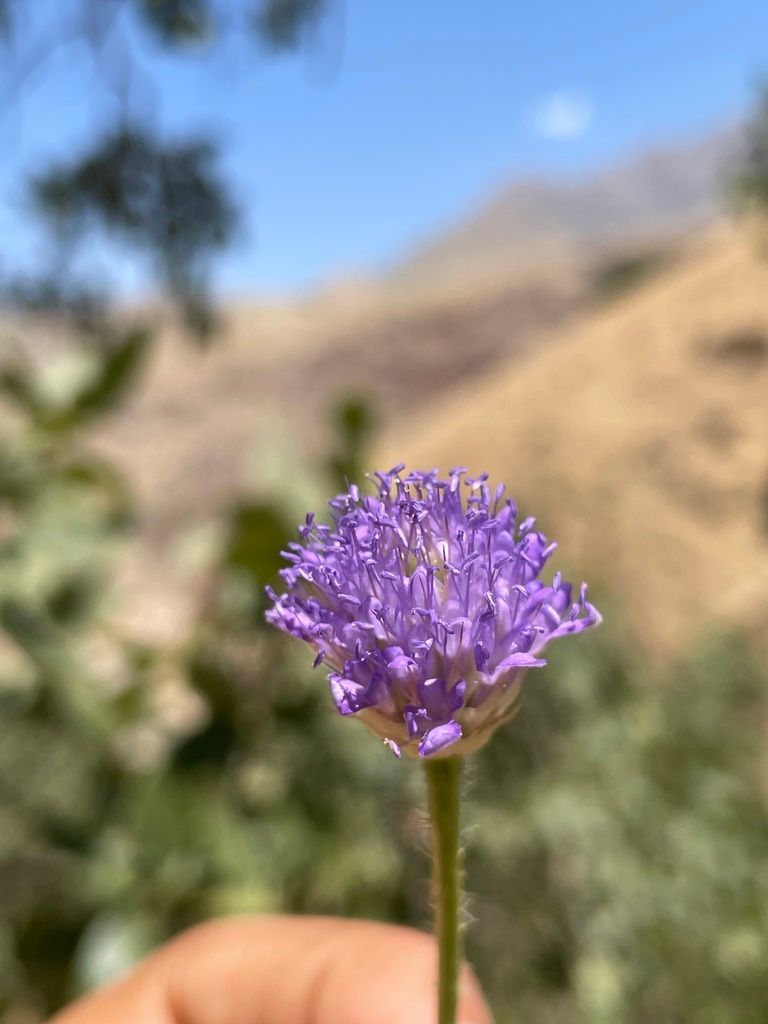
In Cephalaria, what looks like one flower is a rounded head of many small flowers packed together, ringed by bracts and held at the end of a long stalk[5][6]. The genus name comes from the Greek kephalē, "head". The genus grows from the Mediterranean to Central Asia and south through East Africa to South Africa[3]. Older works place it in the teasel family, Dipsacaceae, as IPNI still does[2]; today it is included in the honeysuckle family, Caprifoliaceae, which is the family in the title of the paper[1].
The new species' describers compared it with three relatives: C. microcephala, C. procera and C. kotschyi[1][2]. All three are treated in a 2017 revision of their group, which counted 16 species in Iran alone[5]. They give a good idea of what kind of plant to picture:
- C. procera can grow to 1–1.5 m. Its flower heads are round, mostly 1.5–2.5 cm long, with yellow flowers, and the bracts around the head are straw-coloured at the base and blackish at the tip[5]. It grows on rocky slopes, meadows, steppe and roadsides at 900–2,600 m in the north-west of Iran and beyond, into Turkey and the Caucasus[5].
- C. kotschyi is smaller, to about 50 cm, also with yellow flowers and blackish bracts, and is extremely rare in Iran, on sunny steppe slopes in the central Alborz[5].
- C. microcephala, "small-headed", was described by the botanist Edmond Boissier in 1856. His Latin calls its heads "spherical, minute" and its flowers yellow, with heads "half as large" as those of its relatives[6].
There is a small coincidence in that list. C. microcephala and C. kotschyi were both described from plants that Theodor Kotschy collected at the same place, Dudera in the Alborz: number 422 for the first and 422a for the second[5][6]. Kotschy is also the collector of the Kurdish hollyhock, Alcea kurdica, which he gathered on Mount Gara in Kurdistan[7].
What sets it apart
According to its describers, C. kurdistanica differs from these three relatives in the size of its stems, the size and shape of its flower heads, the number of bracts around the head and the shape of their tips, the shape and hairiness of the calyx (the small cup at the base of each flower), and the size of the bristles between the flowers inside the head[1]. Their paper includes a full description, a drawing, a distribution map and notes on its ecology and conservation[1].
Where it grows
Kew's checklist gives its native range as "NW. Iran"[3]. In Kurdish terms, that is one mountain in Rojhilat. The Global Biodiversity Information Facility (GBIF) holds no record of it, and no one has yet posted a photograph of it on iNaturalist[4]. In the public databases, everything known about it still leads back to Tabad's mountain.
The species has not been assessed for the IUCN Red List[4].
Its cousins in Kurdish
No Kurdish name has been recorded for Cephalaria kurdistanica itself. One of its relatives, though, was written down with a Kurdish name almost a century ago. In 1932, plant collectors working for the Rustam Herbarium noted the Kurdish name zîwan for Cephalaria syriaca at Duhok, where it grew "on pasture and cultivated land"[8]. The same name turns up in their notes from a wheatfield near Mosul and, spelled ziywan, near Şêxan (Shaikhan), where the plant was noted as a fodder plant[8].
Sources
- 1.abcdefghMaroofi, H., Tabad, M. A. & Rastegar, A. (2020). Cephalaria kurdistanica (Caprifoliaceae), a new species from Kurdistan, west of Iran. Phytotaxa 455(3): 221–228. doi:10.11646/phytotaxa.455.3.5https://doi.org/10.11646/phytotaxa.455.3.5
- 2.International Plant Names Index. Royal Botanic Gardens, Kew, Harvard University Herbaria and Australian National Herbarium.
- abcdeghCephalaria kurdistanica Maroofi, Tabad & Rastegar (type data; author records).
- fCampanula kurdistanica Advay & Maroofi; Pentanema kurdistanicum Maroofi & Ghaderi; Heracleum kurdistanicum Rastegar, Maroofi & Tabad; Tanacetum kurdistanicum Maroofi & Rastegar.
- iCephalaria kotschyi Boiss. & Hohen., C. procera Fisch. & Avé-Lall., C. microcephala Boiss.
- urn:lsid:ipni.org:names:77211099-1. ipni.orghttps://www.ipni.org/n/77211099-1accessed 14 November 2026
- 3.Plants of the World Online. Royal Botanic Gardens, Kew.
- acCephalaria kurdistanica.
- bCephalaria Schrad.
- plant_name_id 3243389. powo.science.kew.orghttps://powo.science.kew.org/taxon/urn:lsid:ipni.org:names:77211099-1accessed 14 November 2026
- 4.abcGBIF.org GBIF Backbone Taxonomy and occurrence records. and iNaturalist: occurrence records and IUCN category for Cephalaria kurdistanica (accessed 15 November 2026). gbif.orghttps://www.gbif.org/
- 5.abcdefRanjbar, M. & Ranjbar, Z. (2017). A taxonomic revision of Cephalaria subgen. Cephalaria sect. Atrocephalae (Caprifoliaceae) from Iran. Phytotaxa 311(2): 101–138. doi:10.11646/phytotaxa.311.2.1https://doi.org/10.11646/phytotaxa.311.2.1
- 6.abcBoissier, E. (1856). Diagnoses Plantarum Orientalium Novarum. ser. 2, 2: 123.
- 7.↩Schlechtendal, D. F. L. von (1843). Plantae Kotschyanae nonnullae, novae censitae. Linnaea 17: 124–128.
- 8.abBlakelock, R. A. (1948). The Rustam Herbarium, 'Iraq. Systematic List. Part I. Kew Bulletin 3(3): 404–405.
- iNaturalist. observation 369052687 (Cephalaria syriaca, Xurmał, 4 June 2026; photo Arya Aras, CC BY-NC 4.0). inaturalist.orghttps://www.inaturalist.org/
Last updated 20 November 2026