Eranthis kurdica is a small yellow spring flower of the mountains of Kurdistan, one of the winter aconites. It comes up from a tuber in March and April and opens a single buttercup-like flower on a short, leafless stem[1][2]. Science named it only in 2022[1][3], but the people of Alka in Başûr have their own name for it: Gula befrê[2].
How it got its name
- Named by
- Rukšāns, 2022Published in Int. Rock Gard. 151: 12
- Type collected by
- J.Rukšāns12 April 2022
Where it grows in Kurdistan
At 1550–2130 m above sea level.
Found out of flower
The story of the name begins in 2017, when the botanist Jānis Rukšāns travelled through Rojhilat (East Kurdistan) on a plant-hunting trip organised by Alice Munsey, Pietro Roseo, Norman Stevens and others[1]. At several places in what he called "Iranian Kurdistan" he found winter aconites, but too late: "They were already out of flower and no plants in seed were observed"[1]. He took a few tubers home to grow on[1].
At first he thought they were Eranthis iranica. When they finally flowered in his pots he relabelled them E. cf. cilicica[1]. Neither name sat comfortably. E. iranica had been described from the eastern Kopet-Dag, "around 1100 km" away[1]. And the tubers were wrong. In the winter aconites the shape of the tuber is one of the key features for telling the species apart, and these were elongated, with many small round daughter tubers hanging loosely on the main one[1].
In April 2022 he went back, this time in flower season, invited by Dr Alireza Dolatyari[1]. On 12 April, on the gentle slopes of a mountain pass on the road from Seqiz (Saqqez) to Merîwan (Marivan), at 2,130 m, he collected the plant in bloom[1]. That gathering, number 22IRS-089, became the holotype, the specimen the name is tied to; it is kept in the herbarium of the University of Latvia in Riga[1][3]. The new species appeared on 28 July 2022 in International Rock Gardener, the online journal of the Scottish Rock Garden Club[1][3]. The epithet kurdica means "Kurdish", after the land where it grows. Rukšāns added a guess: the new species grew in western Iran "and most likely in the adjacent Iraq"[1].
It was already in the herbarium
He was right, and the plant was in fact already in a herbarium. The botanist Mehmet Fırat of Van Yüzüncü Yıl University had been collecting the same winter aconite for over a decade, on both sides of the mountains between Bakur (North Kurdistan) and Başûr (South Kurdistan)[2]. His oldest sheets date from April 2011: one from the Barzan country, close to the border, at 929 m, and one from Geliya Helena near Şemzînan (Şemdinli) in Colemêrg (Hakkâri), a week later[2]. More followed from Cîyayê Govende on the way to Oremar (Dağlıca), from a vineyard at the village of Derya, and as far west as Ovacık in Dersim (Tunceli)[2].
In 2023 Fırat and Tahir Salih Mela, from the village of Alka in Barzan, published these plants as Eranthis kurdica in a paper in the Journal of Science of East, the first record of the species for the Kurdistan Region[2]. Until then, the only winter aconite recorded for Iraq was E. hyemalis[2], the species of European woods[1]. Fırat collected it twice in 2023 on Mela's home ground, Pîris Mountain above Alka: on 1 March the plants were in flower at 1,041 m, and by 11 April they were already in fruit[2].
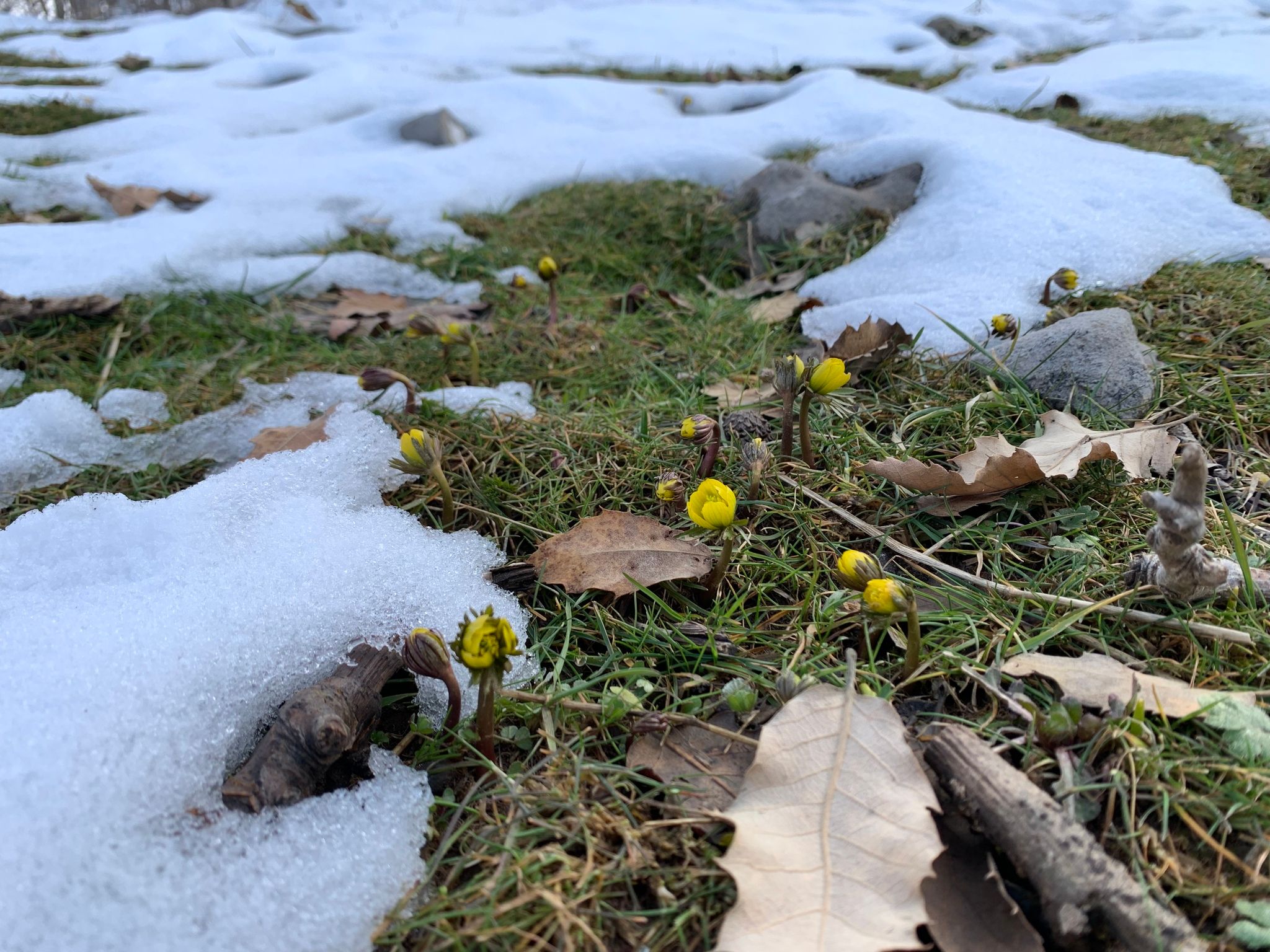
The snow flower
In Alka and around Mêrgesor, Fırat and Mela write, local people call the plant Gula befrê[2]. In Kurmanji that reads as "the flower of the snow" (our translation).
The same year, a survey of medicinal plants in four villages of Barzan listed Gula bafer in the villages of Esomara and Hassani, under the scientific name Eranthis hyemalis[4], then the only winter aconite recorded for Iraq[2]. The survey recorded no use for it, only a warning: "Poisonous ornamental plants no utilities mentioned"[4]. Neither paper says whether the Gula bafer of Esomara and Hassani is the same plant as the Gula befrê of Alka. The names are close, and both come from Barzan.
What it looks like
Rukšāns described a plant with one or two basal leaves, cut palmately into three to five deeply divided lobes, and a leafless stem 5 to 7 (rarely 9) cm tall carrying a single flower on a very short stalk[1]. The field record from Kurdistan adds more detail[2]:
- an elongated, branching tuber with small round daughter tubers;
- basal leaves often missing at flowering;
- below the flower, a ruff of leafy bracts, 3–5.5 cm long in flower and growing to 4.5–9 cm in fruit;
- a stem up to 21 cm tall in flower that lengthens to as much as 27 cm in fruit;
- one flower 2.5 to 4 cm across, with six pure yellow, petal-like sepals that fade to sulphur yellow as they age or dry;
- inside them six small tubular petals and a brush of many yellow stamens;
- 3 to 15 beaked pods (follicles), 10–19 mm long, with small black, wrinkled seeds.
Against E. cilicica, the species he had first taken it for, Rukšāns pointed to wider and deeper golden flower segments, longer leaves and a different tuber: at the end of flowering he measured segments of about 35 mm against about 30 mm, and leaves of 37–39 mm against 25–27 mm[1]. The tuber with daughter tubers is the feature a 2023 study of the genus's chromosomes also singles out, one it shares with E. iranica and the Central Asian E. longistipitata[1][5].
Where it grows
Kew's checklist gives the range as eastern Turkey to north-western Iran[6]. In Kurdish terms that is a plant of Bakur and Rojhilat, and since 2023 of Başûr too, a record the checklist has not yet taken in[2][6]. Fırat and Mela trace it from the Kurdistan province of Iran to Dersim, along the Zagros and the eastern Taurus, and expect it in the mountains in between[2].
It is a plant of mountain woods and meadows between about 900 and 2,130 m[1][2]. Rukšāns found it in shade under deciduous shrubs along streams and on open, gently sloping meadows, often with lesser celandine (Ficaria), and at the type locality with Iris marivanica and a crocus[1]. In Başûr it grows in wet openings in the mountain oak woods[2]. It flowers in March and April, depending on the year and the altitude, and sets seed in April and May[1][2].
Still a young species
As a name, E. kurdica is only a few years old, and the botanists who study winter aconites have not finished with it. The chromosome study of 2023 lists it among the recently described species whose taxonomy and relationships "need to be verified" with molecular and chromosome work, and plans to study its karyotype[5]. The species has not been assessed for the IUCN Red List[7].
In the garden it keeps its secrets too. Rukšāns' potted tubers took "two years to reach their first flowering", and he had "not tried to grow it in the outside garden yet"[1]. In the mountains of Kurdistan, the Gula befrê needs no such patience: it comes up every March and April on its own.
Sources
- 1.Rukšāns, J. (2022). A new species of winter aconite (Eranthis, Ranunculaceae) from Iran. International Rock Gardener 151 (July 2022). Scottish Rock Garden Club.
- 2.abcdefghijklmnopFırat, M. & Mela, T. S. (2023). New record for the flora of Kurdistan region of Iraq: Eranthis kurdica (Ranunculaceae). Journal of Science of East (Doğu Fen Bilimleri Dergisi) 6(1): 69–76. doi:10.57244/dfbd.1319377https://doi.org/10.57244/dfbd.1319377
- 3.International Plant Names Index. Royal Botanic Gardens, Kew, Harvard University Herbaria and Australian National Herbarium.
- abcEranthis kurdica Rukšāns.
- urn:lsid:ipni.org:names:77306676-1. ipni.orghttps://www.ipni.org/n/77306676-1accessed 14 November 2026
- 4.H. S. Faizy, G. Y. Haji, S. M. Saeed, T. S. Mala, M. S. Ibrahim, M. A. Khider, et al. (2023). Geographical Study of Medicinal Plants Using GIS and GPS Tools in Some Villages, Barzan Sub-District, Mergasor Districts, Iraqi Kurdistan Region. doi:10.1088/1755-1315/1252/1/012174https://doi.org/10.1088/1755-1315/1252/1/012174
- 5.abMitrenina, E. Y. et al. (2023). Karyotypes and physical mapping of ribosomal DNA with oligo-probes in Eranthis sect. Eranthis (Ranunculaceae). Plants 13(1): 47. doi:10.3390/plants13010047https://doi.org/10.3390/plants13010047
- 6.Plants of the World Online. Royal Botanic Gardens, Kew.
- abEranthis kurdica Rukšāns.
- plant_name_id 3291153. powo.science.kew.orghttps://powo.science.kew.org/taxon/urn:lsid:ipni.org:names:77306676-1accessed 14 November 2026
- 7.↩GBIF.org GBIF Backbone Taxonomy and occurrence records. Eranthis kurdica, IUCN Red List category (not evaluated). gbif.orghttps://www.gbif.org/
- iNaturalist. observation 148521104 (Arya Aras, 2023). inaturalist.orghttps://www.inaturalist.org/
Last updated 20 November 2026