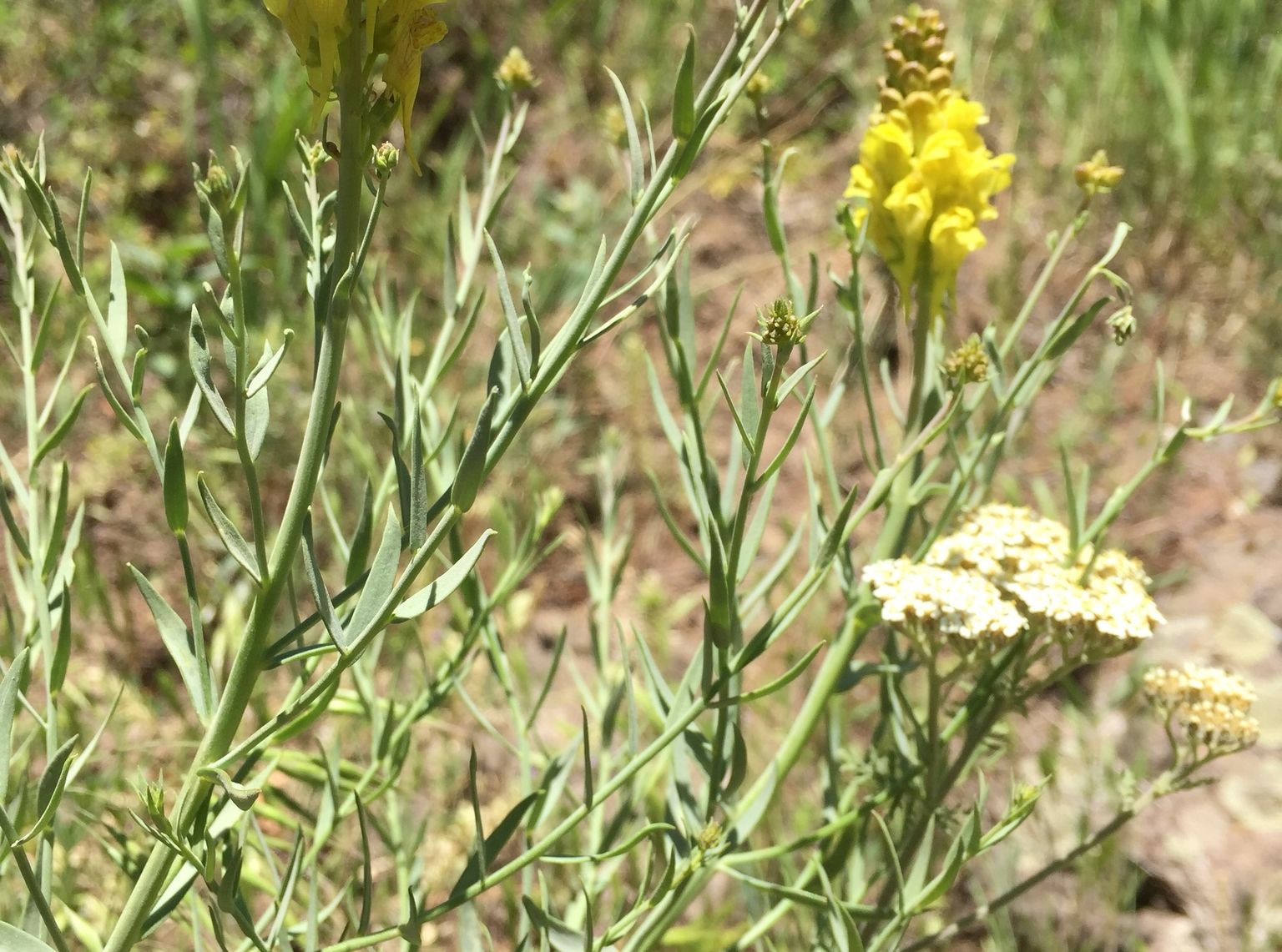
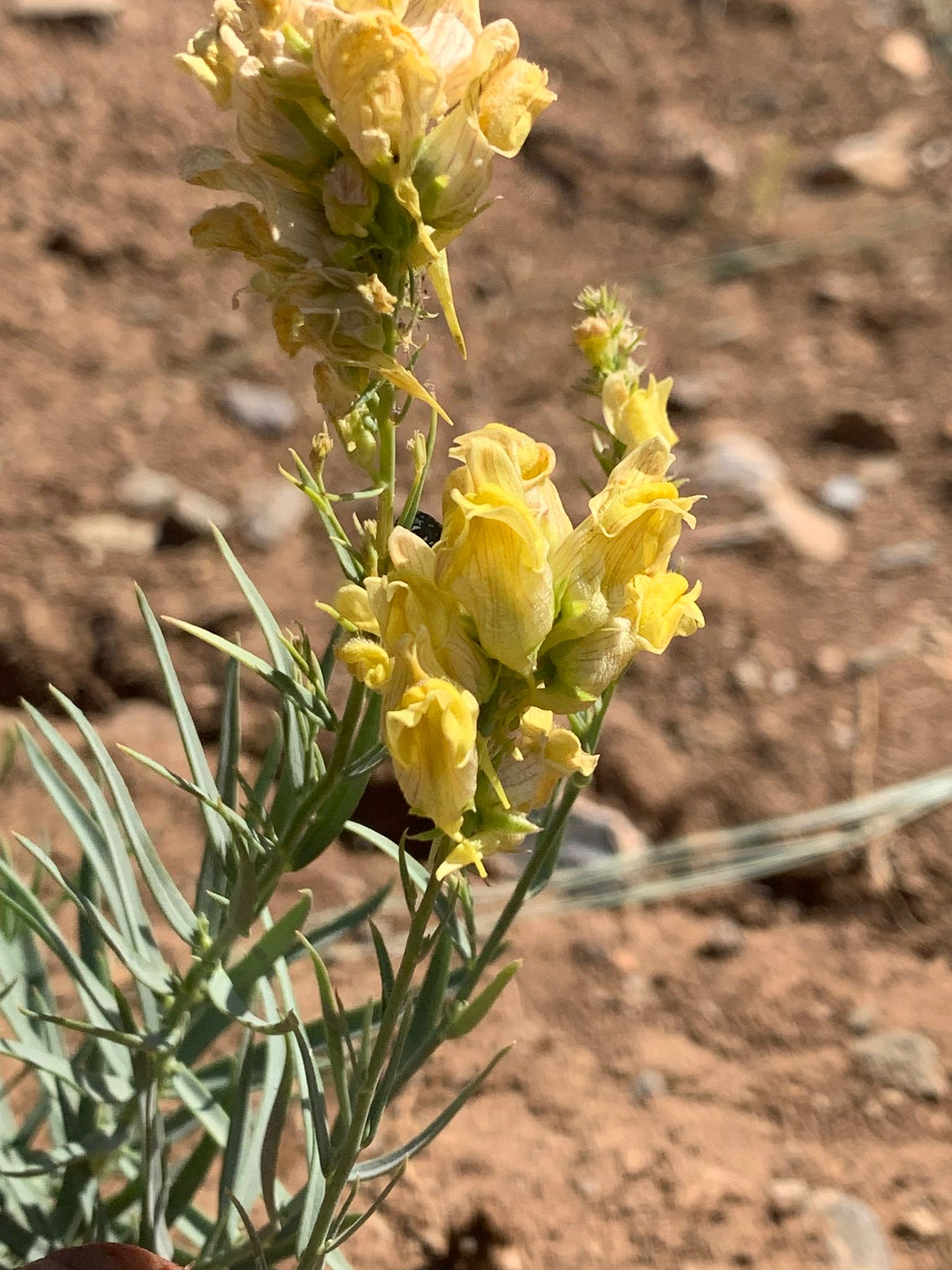
Linaria kurdica is a tall perennial with dense spikes of yellow, spurred flowers[1]. It grows wild from the Caucasus to Lebanon, Syria and Iran[2]. In Kurdistan it has been collected in North Kurdistan (Bakur)[3], South Kurdistan (Başûr)[4] and East Kurdistan (Rojhilat)[5]. It was described in 1844 from Mount Gara in Kurdistan[6], and its name means “Kurdish”.
The name
Edmond Boissier and Rudolph Friedrich Hohenacker published the name in 1844, in the fourth part of Boissier's Diagnoses Plantarum Orientalium Novarum[7]. They described it from a plant of Theodor Kotschy, found “on the limestone slopes of Mount Gara in Kurdistan”[6]. The holotype in Geneva was collected on 10 August 1841 “among fragments of limestone rock in the alpine zone of Mount Gara”, as Kotschy's number 391[8]; a duplicate is kept at Kew[9]. Kotschy's plants from Aleppo, Kurdistan and Mosul were distributed as a numbered set, edited by Hohenacker in 1843[10]. Boissier's later Flora Orientalis prints the number as 591[1]. Mount Gara lies in today's Dihok (Duhok) province[11]. Kurdica is Latin for “Kurdish”.
Description
An upright, hairless, grey-green perennial. The stems are one and a half to two feet tall (about 50–65 cm), leafy, and much branched near the top. The leaves are stalkless, broadly lance-shaped, stiff and pointed, with five veins, about two inches long and 3–4 lines wide (about 5 cm by 7–9 mm). The pale yellow corolla has a palate of the same colour with white hairs, and a curved spur as long as the corolla; with the spur it is 5–6 lines long (about 11–14 mm). The capsule is round and longer than the calyx, and the seeds are disc-shaped, slightly concave and margined[6]. Boissier's Flora Orientalis describes the flower spikes as dense at first and lengthening later, with a woolly palate and a straight, slender spur as long as the corolla, and notes forms with narrower leaves[1].
Where it grows
Boissier described it from limestone slopes[6], and later listed it from gravelly ground on Mount Gara, from Meletî (Malatya), Erzirom (Erzurum) and Bayburt, from Russian Armenia and Karabakh, and from Persian Azerbaijan[1].
In North Kurdistan, specimens at Kew come from 18 km west of Westan (Gevaş) in Wan (Van) province, at 1750 m[3], and from the Morinos valley near the Zap river in Colemêrg (Hakkâri, Turkey), at 1900 m[12], both collected in 1966.
In South Kurdistan, it was collected in 1955 at Sersing (Sarsing)[13], in 1957 at 1800–2200 m in the Qendîl (Qandil) mountains on the border with Rojhilat, among Astragalus scrub[4], and in the same year at 1800–2000 m in the limestone mountains near Sharanish, north of Zaxo (Zakho)[14].
In East Kurdistan, it was collected 33 km north-west of Dîwandere (Divandarreh) towards Seqiz (Saqqez), at 2100 m[5], and on the pass between Balanesh and Şino (Oshnavieh), at 1650–1900 m[15], both in 1974.
Flowering
The specimens from Kurdistan cited on this page were collected between 21 June, in the Zap valley[12], and 10 August, the type[8].
Kurdish names
No Kurdish folk name specific to Linaria kurdica has been found yet. The dictionary of Kurdish plant names by Ehmedê Dirihî (Ahmet Kasımoğlu, 2013) gives it dictionary names meaning “… of the Kurds”: belgîzera kurdan and hemîşebehara kurdan[16], and, from the source it calls İstanbul Kürt Enstitüsü, bengzerika kurdan[17]. Its Kurdish index also gives names of the genus Linaria, such as bilbizêk and newroz, for this species, without a source[18].
Subspecies and varieties
Kew's World Checklist accepts five subspecies, subsp. kurdica, subsp. aucheri, subsp. eriocalyx, subsp. pycnophylla and subsp. sintenisii, and two varieties, var. alagezica and var. razdanica. It includes the former subsp. araratica in subsp. kurdica[2]. The specimen from Westan[3] and the one from the Zap valley[12] were identified at Kew as subsp. araratica.
Sources
- 1.abcdEdmond Boissier (1879). Flora Orientalis, vol. 4. H. Georg, Geneva and Basel (Internet Archive), vol. 4, p. 371 (Linaria kurdica, no. 19). archive.orghttps://archive.org/details/floraorientaliss04bois/page/371/mode/1upaccessed 30 October 2026
- 2.abPlants of the World Online. Royal Botanic Gardens, Kew, Linaria kurdica Boiss. & Hohen.: distribution and accepted infraspecific taxa. powo.science.kew.orghttps://powo.science.kew.org/taxon/urn:lsid:ipni.org:names:804709-1archivedhttps://web.archive.org/web/20251119044905/https://powo.science.kew.org/taxon/urn:lsid:ipni.org:names:804709-1accessed 30 October 2026
- 3.abcRoyal Botanic Gardens, Kew – Herbarium Specimens. via GBIF, K004511307: near Pisvanik, 18 km W of Gevaş, 1750 m, 7 Jul 1966, P.H. Davis 45996 (as subsp. araratica). gbif.orghttps://www.gbif.org/occurrence/5200617478archivedhttps://web.archive.org/web/20261030040054/https://api.gbif.org/v1/occurrence/5200617478accessed 30 October 2026
- 4.abNatural History Museum Vienna (W) – Herbarium. via GBIF, W 1973-0002866: Qandil mountains above Perskhashan, Astragalus scrub, 1800–2200 m, 28 Jul 1957, K.H. Rechinger 11100. gbif.orghttps://www.gbif.org/occurrence/1701531052archivedhttps://web.archive.org/web/20261030035616/https://api.gbif.org/v1/occurrence/1701531052accessed 30 October 2026
- 5.abNatural History Museum Vienna (W) – Herbarium. via GBIF, W 2008-0005958: 33 km NW of Divandarreh towards Saqqez, 2100 m, 29 Jun 1974, K.H. Rechinger 48602. gbif.orghttps://www.gbif.org/occurrence/1701531596archivedhttps://web.archive.org/web/20261030035835/https://api.gbif.org/v1/occurrence/1701531596accessed 30 October 2026
- 6.abcdEdmond Boissier Diagnoses Plantarum Orientalium Novarum. series 1 (1842–1859), Internet Archive, ser. 1, no. 4, pp. 73–74 (Linaria kurdica, protologue). archive.orghttps://archive.org/details/e.-boissier-diagnoses-plantarum-orientalium-novarum-series-1-vol.-1-no.-1-7-1843-1846/page/n333/mode/1upaccessed 30 October 2026
- 7.↩International Plant Names Index. Royal Botanic Gardens, Kew, Harvard University Herbaria and Australian National Herbarium, Linaria kurdica Boiss. & Hohen., Diagn. Pl. Orient. ser. 1, 4: 73 (1844). ipni.orghttps://www.ipni.org/n/804709-1archivedhttps://web.archive.org/web/20261030023623/https://www.ipni.org/n/804709-1accessed 30 October 2026
- 8.abConservatoire et Jardin botaniques de Genève (G) – Herbarium. via GBIF, G00356832: holotype, Mount Gara, 10 Aug 1841, Th. Kotschy 391. gbif.orghttps://www.gbif.org/occurrence/1144716742archivedhttps://web.archive.org/web/20261030035350/https://api.gbif.org/v1/occurrence/1144716742accessed 30 October 2026
- 9.↩Royal Botanic Gardens, Kew – Herbarium Specimens. via GBIF, K000979915: original material, Mount Gara, Th. Kotschy 391. gbif.orghttps://www.gbif.org/occurrence/912706384archivedhttps://web.archive.org/web/20261030091252/https://api.gbif.org/v1/occurrence/912706384accessed 30 October 2026
- 10.↩Herbarium of Martin Luther University Halle-Wittenberg (HAL). via GBIF, HAL 0145830: isotype, Kotschy, Pl. alepp. kurd. moss., ed. Hohenacker 1843, no. 391. gbif.orghttps://www.gbif.org/occurrence/5895710737archivedhttps://web.archive.org/web/20261030092516/https://api.gbif.org/v1/occurrence/5895710737accessed 30 October 2026
- 11.↩Herbarium of the University of Coimbra (COI). via GBIF, COI00042503: Mount Gara, Th. Kotschy s.n. (georeferenced to Dohuk province). gbif.orghttps://www.gbif.org/occurrence/2598844019archivedhttps://web.archive.org/web/20261030091627/https://api.gbif.org/v1/occurrence/2598844019accessed 30 October 2026
- 12.abcRoyal Botanic Gardens, Kew – Herbarium Specimens. via GBIF, K004511309: Morinos Dere, 20 km from the bridge across the Zap, 1900 m, 21 Jun 1966, P.H. Davis 45319 (as subsp. araratica). gbif.orghttps://www.gbif.org/occurrence/5200648494archivedhttps://web.archive.org/web/20261030040246/https://api.gbif.org/v1/occurrence/5200648494accessed 30 October 2026
- 13.↩Royal Botanic Gardens, Kew – Herbarium Specimens. via GBIF, K004511339: Sersang, 14 Jul 1955, R. Wheeler Haines W489. gbif.orghttps://www.gbif.org/occurrence/5200628484archivedhttps://web.archive.org/web/20261030035505/https://api.gbif.org/v1/occurrence/5200628484accessed 30 October 2026
- 14.↩Natural History Museum Vienna (W) – Herbarium. via GBIF, W 1973-0002865: Sharanish, calcareous mountains N of Zakho, Zausta mountains, 1800–2000 m, 4 Jul 1957, K.H. Rechinger 12008. gbif.orghttps://www.gbif.org/occurrence/1701531053archivedhttps://web.archive.org/web/20261030035719/https://api.gbif.org/v1/occurrence/1701531053accessed 30 October 2026
- 15.↩Natural History Museum Vienna (W) – Herbarium. via GBIF, W 2008-0005963: pass between Balanesh and Oshnavieh, 1650–1900 m, 11 Jul 1974, K.H. Rechinger 49211. gbif.orghttps://www.gbif.org/occurrence/1701531632archivedhttps://web.archive.org/web/20261030035947/https://api.gbif.org/v1/occurrence/1701531632accessed 30 October 2026
- 16.↩Ahmet Kasımoğlu (Ehmedê Dirihî) (2013). Ferhenga Navên Nebatan a Kurdî (Dictionary of Kurdish Plant Names). Mardin Artuklu University, Institute of Living Languages in Turkey (ISBN 978-605-4202-12-6), p. 1120 (Latin index: Linaria kurdica).
- 17.↩Ahmet Kasımoğlu (Ehmedê Dirihî) (2013). Ferhenga Navên Nebatan a Kurdî (Dictionary of Kurdish Plant Names). Mardin Artuklu University, Institute of Living Languages in Turkey (ISBN 978-605-4202-12-6), p. 107 (bengzerika kurdan, source IS = İstanbul Kürt Enstitüsü, see p. 65).
- 18.↩Ahmet Kasımoğlu (Ehmedê Dirihî) (2013). Ferhenga Navên Nebatan a Kurdî (Dictionary of Kurdish Plant Names). Mardin Artuklu University, Institute of Living Languages in Turkey (ISBN 978-605-4202-12-6), pp. 119 (bilbizêk) and 568 (newroz), Kurdish index.
- Photo: Andre Hosper, CC BY 4.0, via iNaturalist. inaturalist.orghttps://www.inaturalist.org/observations/13937398
Last updated 30 October 2026