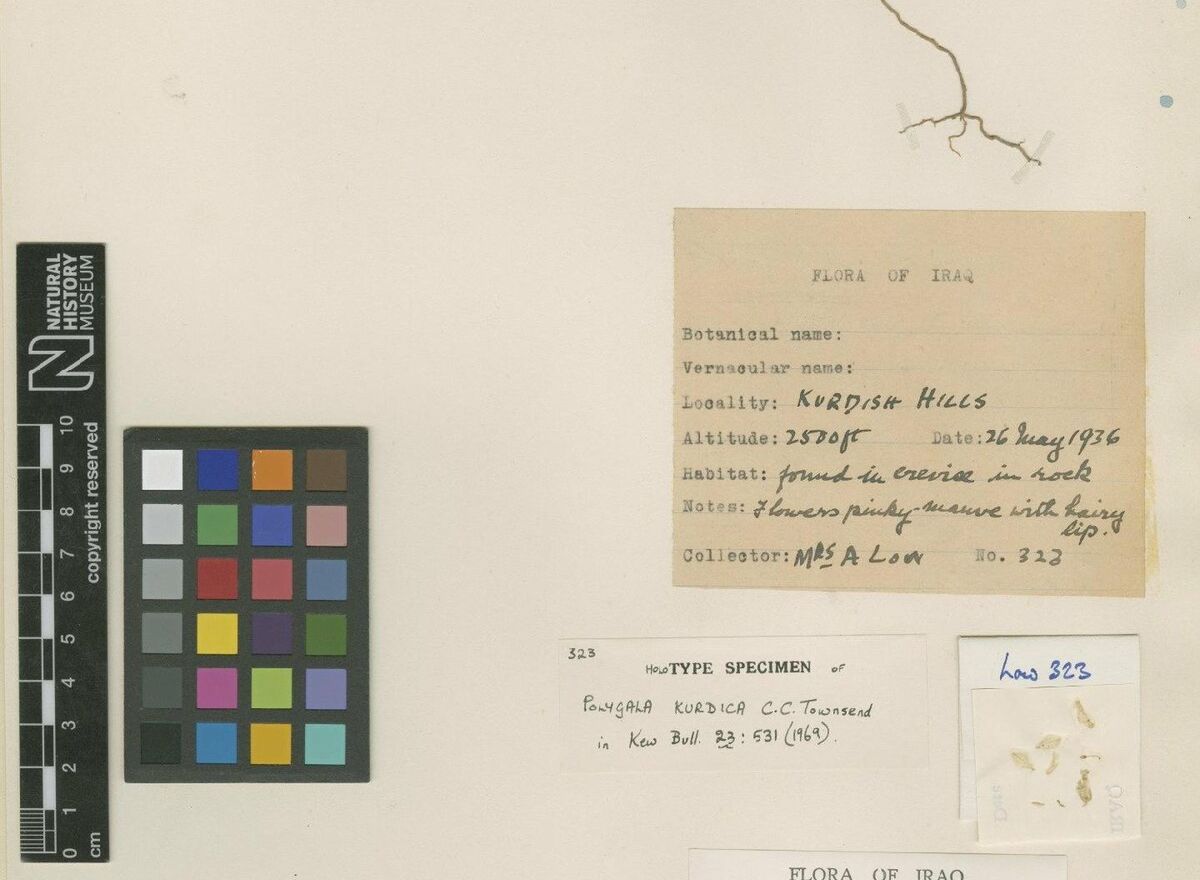
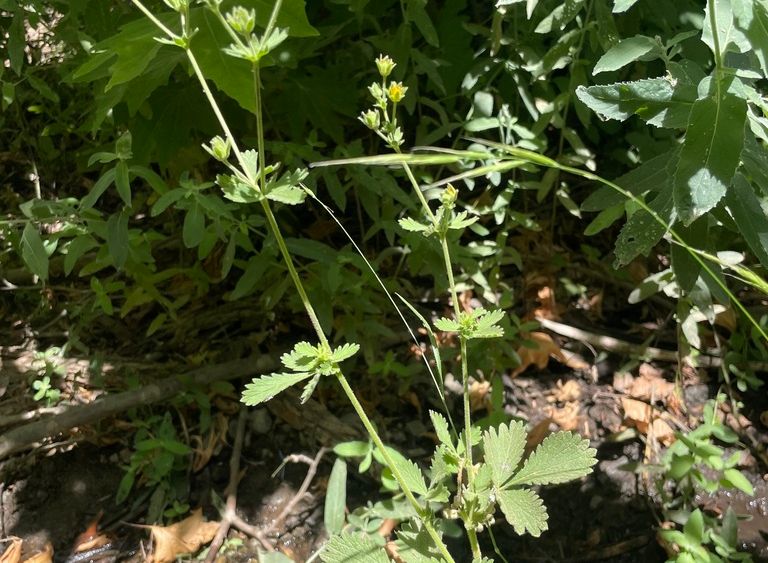
_Poa kurdistanica_ is a small, tufted grass known from a single mountain: Helgurd, in South Kurdistan (Başûr), close to the border with East Kurdistan (Rojhilat)[1][2]. Kew records it from nowhere else[1]. There is no observation of it on iNaturalist and not a single specimen record in GBIF, the global biodiversity database[3][4]. As far as the public record goes, this grass lives on paper: in a description printed in Geneva in 1970, and in the herbarium specimens behind it.
That makes it one of the quietest members of Kurdistan's flora, and a reminder of how much on these mountains is still barely documented.
How it got its name
- Named by
- Chrtek & Hadac, 1970Published in Candollea 25: 260
Two botanists from Prague
The species was named by Jindřich Chrtek (1930–2008) and Emil Hadač (1914–2003) in _Candollea_, the journal of the Geneva botanical garden, volume 25, page 260[5]. Its epithet, _kurdistanica_, simply means "of Kurdistan".
The story behind the name starts a decade earlier. Hadač, a botanist and ecologist remembered as a founder of Czech landscape ecology, spent 1959 to 1961 in Iraq. During that stay he described new plant species and plant communities, and he brought around 6,000 specimens back to the herbarium collections in Prague[6]. Most of his excursions there were made with A. D. Q. Agnew and Richard Wheeler-Haines; the plants he collected there are kept today in the National Museum in Prague[7].
Helgurd was one of his destinations. In June 1960 and again in May 1961 he was collecting at the foot of the mountain, at a place his labels call _"Sarcal"_, at about 2,200 metres, some of it on stream banks[7].
In Prague the material went to Chrtek, who taught plant morphology and taxonomy at Charles University from 1959 to 1976, then moved to the botany department of the National Museum and became its head in 1990. His obituary notes that he identified specimens from other botanists' collections, _"especially those from Iraq collected by E. Hadač"_, and it names _Poa_ among the genera in which he found critical taxa[8].
We have not been able to read the 1970 description itself, so where exactly, when and by whom its type specimen was collected is not stated here.
A small series of new plants
_Poa kurdistanica_ was not the pair's only new plant. Together they also described a fescue, _Festuca karadagensis_, as _"a new grass from Iraq"_ (1969)[9]; a second _Poa_, _Poa bulbillifera_, as _"a new species from the Iraqi Kurdistan"_ (1969)[10]; and, in 1974, _Tragopogon kurdistanicus_, _"a new species of Tragopogon from the Iraqi Kurdistan"_[11].
The timing mattered. Both _Poa_ species were described just after the botanist N. L. Bor published his account of the region's grasses in 1968, the grass volume of the _Flora of Iraq_[12][13], so they came too late to appear in it.
What it looks like
Kew's world grass database, GrassBase, gives the only description we could read[14]:
- a tufted perennial whose lowest leaf sheaths are thickened into a small bulb at the base;
- stems 20–30 cm long, bent at the base and then ascending;
- leaves mostly at the base, the blades 2.5–7 cm long and only 1–2 mm wide, rough to the touch;
- an open, elliptic flower head (panicle) 5–9 cm long;
- spikelets 4–5 mm long, each with two fertile florets;
- lemmas (the scale around each floret) 3–3.2 mm long, glaucous and purple;
- three anthers, 1.2–1.5 mm long.
The bulb is the interesting detail. Bulbs are a recurring theme in _Poa_, a genus of about 620 species: in a 2026 study centred on Turkey, Robert Soreng, Evren Cabi and Lynn Gillespie found that bulbs arose in at least four separate lineages[12]. They link them to climates with long, dry summers, where the bulb lets a plant lie dormant until the next growing season[12]. The bulbous _Poa bulbosa_ forms characteristic vegetation in the dry steppe of Iraq's plains and foothills, together with a sedge, _Carex stenophylla_, and _Ranunculus asiaticus_[15]. Whether _P. kurdistanica_ uses its bulb the same way on Helgurd has, as far as we could find, never been recorded.
Where it grows
Helgurd belongs to the Hasarost range in the Hewlêr (Erbil) governorate of the Kurdistan Region, near the border with Rojhilat, and at about 3,613 m it is widely considered the highest peak of South Kurdistan[2]. Some snow lies on it all summer[2]. A biodiversity survey in the summer of 2009 picked out two key habitats, mountain forest and thorn-cushion vegetation, and alpine-zone vegetation; about half of the site had no plant cover at all[2]. The mountain holds several regional endemics, such as _Astragalus helgurdensis_ and _Tulipa kurdica_, and the same survey lists land mines and hunting as threats[2].
Within the borders of Iraq, few plants are found nowhere else: 181 species, about 5.6% of its flora, and most of them grow in the northern mountains, the mountains of South Kurdistan[15]. On Kew's data, _Poa kurdistanica_ is one of them[1].
Which of Helgurd's habitats this grass prefers, at what height, and when it flowers, are not in any source we could open.
Kurdish names
No Kurdish name is recorded for this species. Ehmedê Dirihî's dictionary of Kurdish plant names gives names for the genus _Poa_ as a whole: _giyaziravk_, _korekek_ and _kurêkek_[16]. They belong to the genus, not specifically to this grass, and are still to be checked.
Sources
- 1.Plants of the World Online. Royal Botanic Gardens, Kew.
- abc(Kew): Poa kurdistanica, plant_name_id 436279. powo.science.kew.orghttps://powo.science.kew.org/taxon/urn:lsid:ipni.org:names:417327-1
- plant_name_id 436279. powo.science.kew.orghttps://powo.science.kew.org/taxon/urn:lsid:ipni.org:names:417327-1accessed 14 November 2026
- 2.abcdeNature Iraq, "Halgurd Mountain (IQ017)", site account in Key Biodiversity Areas of Iraq (©2009; surveys summer 2009). natureiraq.orghttp://www.natureiraq.org/uploads/9/2/7/0/9270858/halgurd_mt-iq017-oct-10-final.pdf
- 3.↩GBIF.org GBIF Backbone Taxonomy and occurrence records. species 4119460, occurrence search. api.gbif.orghttps://api.gbif.org/v1/occurrence/search?taxonKey=4119460&limit=0
- 4.↩iNaturalist. taxon 1112724. api.inaturalist.orghttps://api.inaturalist.org/v1/taxa/1112724
- 5.International Plant Names Index. Royal Botanic Gardens, Kew, Harvard University Herbaria and Australian National Herbarium.
- ↩urn:lsid:ipni.org:names:417327-1; author records 1637-1 (Chrtek, Jindřich (1930-2008)), 3527-1 (Hadač, Emil (1914-2003)). ipni.orghttps://www.ipni.org/n/417327-1
- urn:lsid:ipni.org:names:417327-1. ipni.orghttps://www.ipni.org/n/417327-1accessed 14 November 2026
- 6.↩Kovář, P., Möllerová, J. & Rambousková, H. (2015). Emil Hadač – a founder of Czech landscape ecology. Journal of Landscape Ecology 8(2). iale.czhttp://www.iale.cz/wp-content/uploads/2020/01/000878.pdf
- 7.abChrtek, J. & Hadač, E. (2002). A contribution to the Ranunculaceae of Iraq. Journal of the National Museum (Prague), Natural History Series 171: 125–130. publikace.nm.czhttps://publikace.nm.cz/en/periodicals/jotnmpnhs/171-1-4/a-contribution-to-the-ranunculaceae-od-iraq
- 8.↩Pouzar, Z. (2008). Jindřich Chrtek (1930–2008). Acta Musei Nationalis Pragae, Ser. B, Hist. Nat. 64(1): 3–4. nm.czhttps://www.nm.cz/file/58c541464d35e400c0f734d65aa5f9a3/15893/sbornik_B_1_08_1.pdf
- 9.↩Hadač, E. & Chrtek, J. (1969). Festuca karadagensis. a new grass from Iraq. Folia Geobot. Phytotax. 4(2): 211–213. doi:10.1007/BF02854605https://doi.org/10.1007/BF02854605
- 10.↩Chrtek, J. & Hadač, E. (1969). Poa bulbillifera. a new species from the Iraqi Kurdistan. Österr. Bot. Z. 117: 146–148; Chrtek, J. & Hadač, E. (1974). A new species of Tragopogon from the Iraqi Kurdistan. Folia Geobot. Phytotax. 9: 95–97; IPNI: Poa kurdistanica Chrtek & Hadač, Candollea 25: 260 (1970).
- 11.↩Chrtek, J. & Hadač, E. (1974). A new species of Tragopogon from the Iraqi Kurdistan. Folia Geobot. Phytotax. 9(1): 95–97. doi:10.1007/BF02851404https://doi.org/10.1007/BF02851404
- 12.abcSoreng, R. J., Cabi, E. & Gillespie, L. J. (2026). Phylogeny and taxonomy of Poa in Turkey (Part I): the Poa bulbosa complex, polyphyly, lineage relationships, and a new subgenus Alpinae. PhytoKeys 281: 159–279. doi:10.3897/phytokeys.281.209638https://doi.org/10.3897/phytokeys.281.209638
- 13.↩Scholz, H. (1998). Notes on Bromus danthoniae and relatives (Gramineae). Willdenowia 28: 143–150. bgbm-web.bgbm.fu-berlin.dehttps://bgbm-web.bgbm.fu-berlin.de/sites/default/files/documents/w28Scholz.pdf
- 14.↩Clayton, W. D., Vorontsova, M., Harman, K. T. & Williamson, H. GrassBase – The Online World Grass Flora (Kew), version 3 Feb 2016. kew.orghttps://www.kew.org/data/grasses-db/www/imp08331.htm
- 15.abGhazanfar, S. A. & McDaniel, T. (2016). Floras of the Middle East: a quantitative analysis and biogeography of the flora of Iraq. Edinburgh Journal of Botany 73(1): 1–24. doi:10.1017/S0960428615000244https://doi.org/10.1017/S0960428615000244
- 16.↩Ahmet Kasımoğlu (Ehmedê Dirihî) (2013). Ferhenga Navên Nebatan a Kurdî (Dictionary of Kurdish Plant Names). Mardin Artuklu University, Institute of Living Languages in Turkey (ISBN 978-605-4202-12-6).
Last updated 20 November 2026