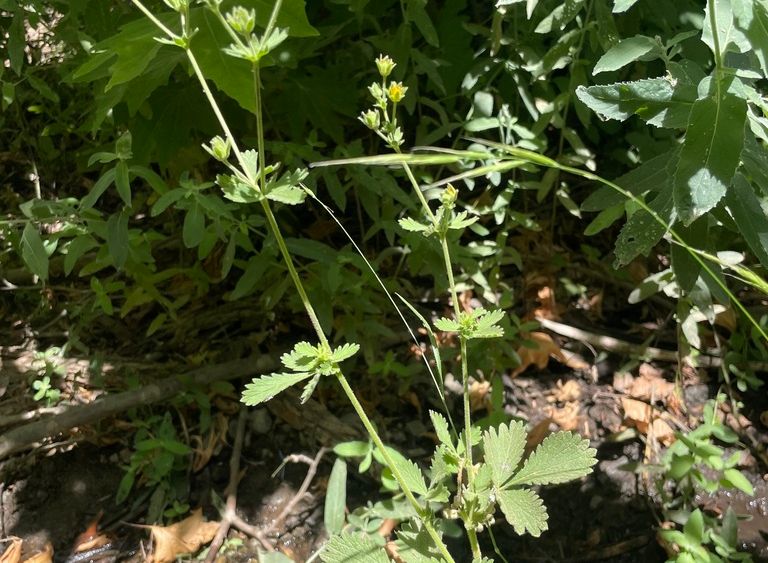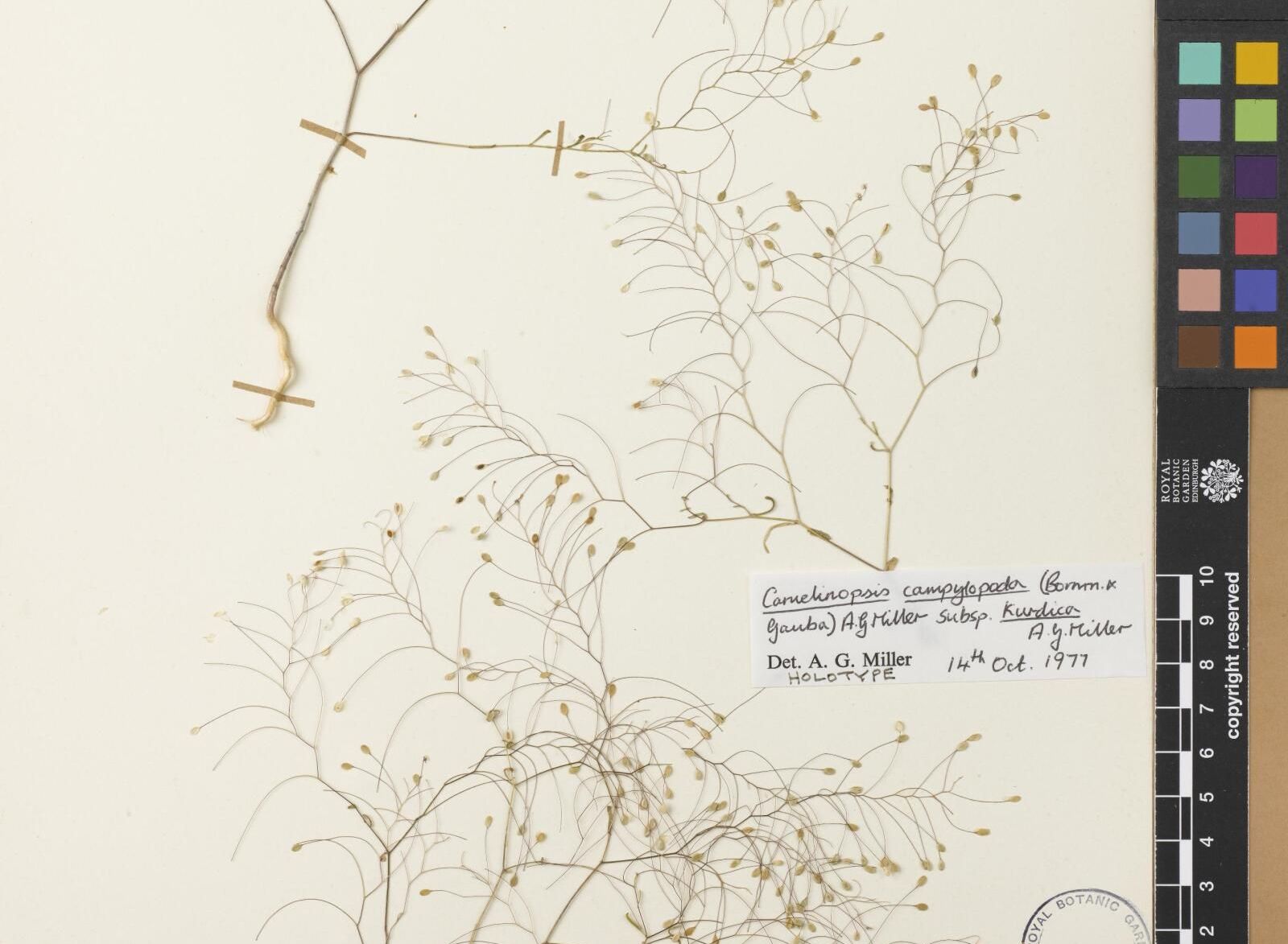
Polygala kurdica is a small perennial milkwort, a tufted plant under 10 cm tall with tiny leaves and short spikes of purple flowers[1][2]. It is one of the least known plants named after the Kurds. Kew's checklist gives it a native range in South Kurdistan (Başûr), in north-eastern Iraq, and, as a separate subspecies, in East Kurdistan (Rojhilat), in western Iran[1]. Just three herbarium sheets of it are in GBIF, collected in 1910, 1936 and 1961[3], and we have found no published photograph of a living plant.
How it got its name
- Named by
- C.C.Towns., 1969Published in Kew Bull. 23: 531
A crevice in the "Kurdish Hills"
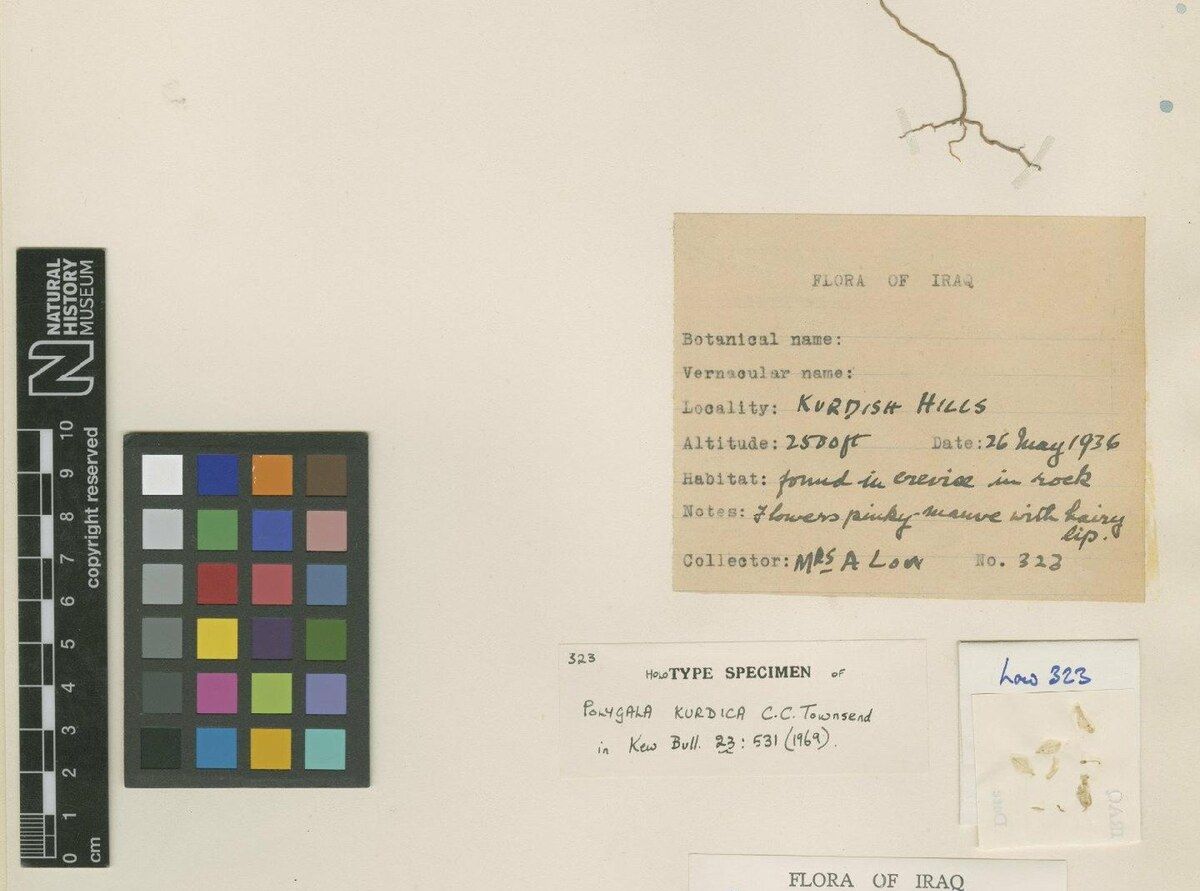
On 26 May 1936 a collector who signed herself Mrs A. Low found a small milkwort growing in a crack in a rock. On a printed "Flora of Iraq" label she filled in what she had seen[4]:
Locality: Kurdish Hills. Altitude: 2500 ft. Date: 26 May 1936. Habitat: found in crevice in rock. Notes: Flowers pinky-mauve with hairy lip. Collector: Mrs A Low. No. 323.[4]
Her 2,500 feet is about 760 metres. The lines for the plant's botanical and vernacular names she left empty[4].
We know her only from her plants. The Natural History Museum in London holds at least 25 of her sheets from Kurdistan and the rest of Iraq, all from 1936 and numbered from 67 to 403, from March to October[5]. Several carry the same words, "Kurdish Hills": one of them, from October, adds that it was "found at Shaqlawa in damp ground under trees", at 2,000 feet, so at least some of her "Kurdish Hills" were around Şeqlawe (Shaqlawa)[5]. The milkwort's own label does not say where in the hills it grew[4]. Three weeks before it, on 1 May 1936, she had also pressed an orchid that is now filed as another plant named after the Kurds, Cephalanthera kurdica[5].
Thirty-two years in a drawer
Mrs Low had left the name blank. It was only in the late 1960s that Clifford Charles Townsend (1926–2018)[6], a botanist at the Royal Botanic Gardens, Kew who later wrote the milkwort account of the Flora of Iraq[2], looked at it closely. His determination slip, on a "Flora of Iraq" label dated 9.4.1968, reads "Polygala kurdica C.C.T. sp. n.", a new species[4].
He published the name in the Kew Bulletin on 14 November 1969, with an illustration[6]. Mrs Low's sheet became the holotype, the one specimen to which the name is tied for good, and it is still in London with the slip "Holotype specimen of Polygala kurdica C.C. Townsend in Kew Bull. 23: 531 (1969)"[4]. The epithet kurdica means "Kurdish".
A second gathering is at Kew. On 29 May 1961 the botanist Emil Hadač (1914–2003)[6] and his companions collected the same small milkwort on the "northern slopes of Qopi Qaradagh", in the district of Silêmanî[7]: the Qeredax (Qaradagh) mountains near Silêmanî (Sulaimani). Its typed label, Hadač 5189, names it "Polygala kurdica C.C. Townsend"[7].
The Kerind plants: a subspecies from Rojhilat
The third sheet is older than both. On 10 May 1910 Theodor Strauss (1859–1911)[6] gathered a handful of small, tufted milkworts at "Kerind, in m. Kuh-i-Ritschab", in the mountains at Kerind (Kerend-e Gharb) in Kirmaşan (Kermanshah province) in Rojhilat[8]. His printed labels read "Plantae a Th. Strauss in Persia occid. lectae", plants collected by Strauss in western Persia between 1908 and 1910[8].
The botanist Joseph Bornmüller (1862–1948)[6] identified the plants as Polygala supina, and the sheet, with about thirteen little plants mounted on it, came to the herbarium in Vienna in 1916[8].
There it lay until the botanists Jindřich Chrtek (1930–2008) and Bohdan Křísa (1936–2025)[6] worked through the milkworts for Flora Iranica. Their slips on the sheet name Strauss's plants not P. supina but Townsend's P. kurdica, in a form of its own[8]. In 1977 they described it as Polygala kurdica subsp. bornmuelleri[6], an epithet that honours Bornmüller, the first to identify the sheet. The Strauss sheet in the Natural History Museum Vienna is its holotype[8].
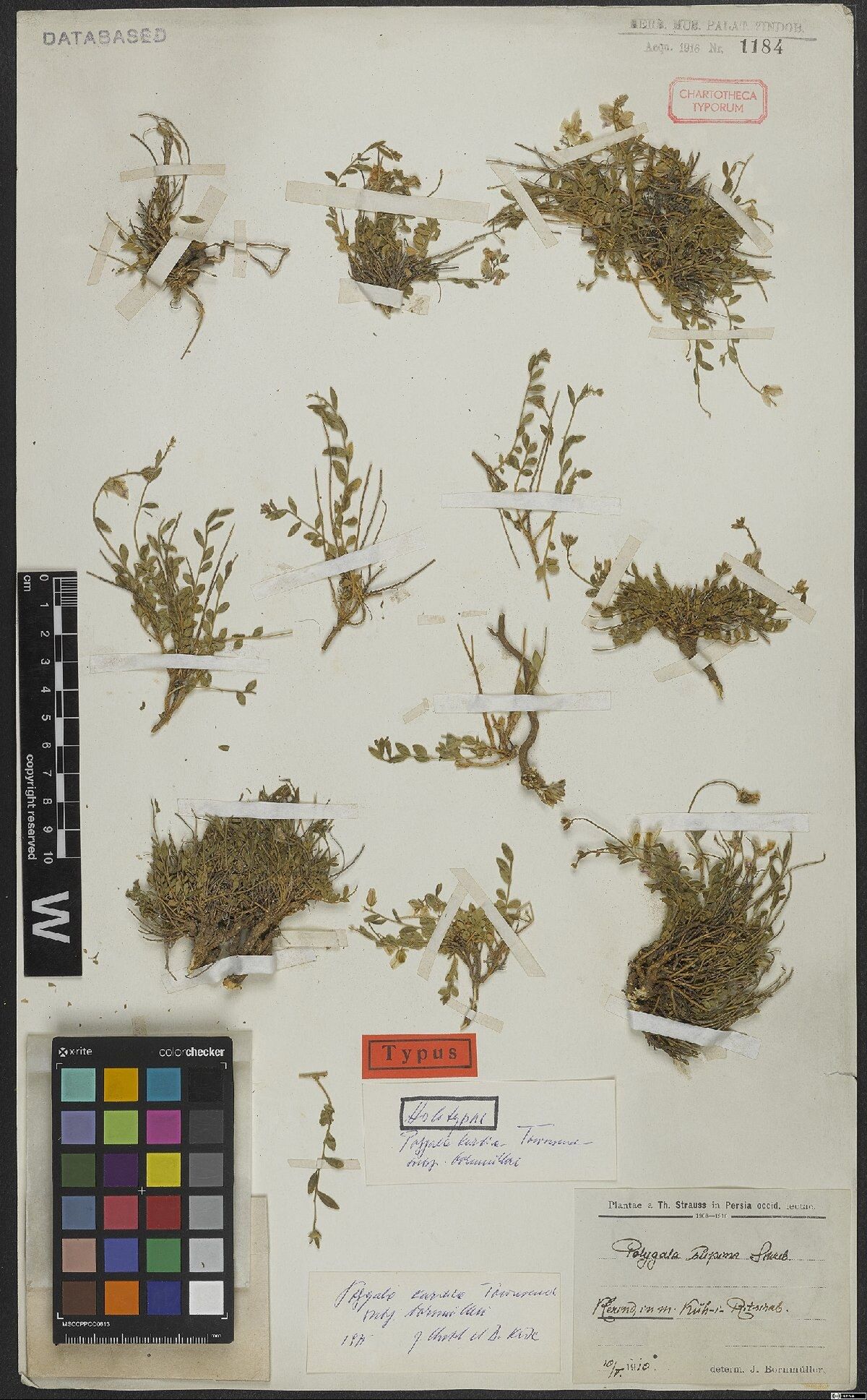
Kew's checklist accepts subsp. bornmuelleri, with a native range in western Iran[1]; Townsend's plant from Başûr is the typical subspecies, subsp. kurdica. A 2021 paper describing a new milkwort from Iran still counts P. kurdica among four Iranian species "with restricted growing areas"[2].
What it looks like
The three sheets show the same kind of plant: a low tuft of many short, leafy stems, with the flowers at their tips[4][7][8]. On Mrs Low's specimen the thin root is longer than the whole leafy part[4].
A comparison table in the 2021 study gives these details[2]:
- stems 7 to 9 cm tall;
- upper leaves elliptic to ovate or obovate, 6 to 10 mm long and 1.2 to 5.2 mm wide;
- flowers purple, in loose spikes 2.5 to 4 cm long;
- the two inner sepals (in a milkwort flower these are the large, petal-like "wings") white-lilac, with veins that do not join into a network; the outer sepals swollen and fringed with hairs;
- eight stamens;
- the fruit an obovate capsule with broad wings, sitting directly on its stalk.
Details like these separate it from its relatives: the milkwort the same paper describes from Guilan, P. guilanica, differs from P. kurdica in the netted veins of its inner sepals, its stamen filaments joined along their whole length, and its stalked, evenly winged capsule[2]. Mrs Low saw something no pressed specimen keeps: the colour, "pinky-mauve", and the "hairy lip"[4].
Where it grows
Everything known about its habitat comes from these labels[4][7][8]:
- Başûr: "Kurdish Hills", in a crack in a rock at about 760 m[4]; the northern slopes of Qeredax near Silêmanî[7].
- Rojhilat: the mountains at Kerind in Kirmaşan (Kermanshah) province[8].
All three gatherings were made in May, with the plants in flower: 10 May 1910, 26 May 1936 and 29 May 1961[4][7][8].
Kurdish names
No name was recorded with any of the three specimens: the "Vernacular name" line on Mrs Low's label is empty[4]. Ehmedê Dirihî's dictionary of Kurdish plant names (2013) lists two names for Polygala kurdica, şîrgiya and şîrgiyaya kurdan, neither with a source or region code[9]. Both are dictionary names, not names recorded in the field: şîrgiyaya kurdan is a dictionary name whose wording mirrors the Latin, and Dirihî gives şîrgiya for the common milkwort, Polygala vulgaris, too[9].
A plant waiting to be photographed
As far as we can find, Polygala kurdica has not been photographed alive: there is no observation of it on iNaturalist or GBIF, only the three pressed sheets[3]. It flowers in May, it is small and it likes rock crevices, so it is easy to walk past. Anyone who finds a tiny pink-purple milkwort on the rocks around Şeqlawe, Qeredax or Kerind may be looking at one of the least known plants of Kurdistan.
Sources
- 1.Plants of the World Online. Royal Botanic Gardens, Kew.
- abcPolygala kurdica; P. kurdica subsp. bornmuelleri.
- plant_name_id 2573071. powo.science.kew.orghttps://powo.science.kew.org/taxon/urn:lsid:ipni.org:names:691679-1accessed 14 November 2026
- 2.Sarvi, A., Faghir, M. B. & Shahi Shavvon, R. (2021). Polygala guilanica (Polygalaceae), a new species from Guilan Province, N Iran. Phytotaxa 513(2): 141–151. doi:10.11646/phytotaxa.513.2.5https://doi.org/10.11646/phytotaxa.513.2.5
- 3.abGBIF.org GBIF Backbone Taxonomy and occurrence records. occurrence search for Polygala kurdica (taxon 7293401) and iNaturalist (taxon 1107096), 15 November 2026. gbif.orghttps://www.gbif.org/
- 4.abcdefghijklmNatural History Museum, London: herbarium specimen BM000564438 (holotype of Polygala kurdica), A. Low 323, 26 May 1936. GBIF occurrence 1056855673.
- 5.abcNatural History Museum, London: herbarium specimens collected by A. Low in 1936 (via GBIF), incl. BM000941737 and BM000062362.
- 6.International Plant Names Index. Royal Botanic Gardens, Kew, Harvard University Herbaria and Australian National Herbarium.
- abPolygala kurdica C.C.Towns., Kew Bulletin 23(3): 531 (1969); author record for C. C. Townsend.
- cdeauthor records for Bornmüller, Th. Strauss and Hadač.
- fgPolygala kurdica subsp. bornmuelleri Chrtek & Křísa, Flora Iranica 124: 6 (1977).
- urn:lsid:ipni.org:names:691679-1. ipni.orghttps://www.ipni.org/n/691679-1accessed 14 November 2026
- 7.abcdefRoyal Botanic Gardens, Kew – Herbarium Specimens. via GBIF, Hadač et al. 5189, 29 May 1961. GBIF occurrence 4952001711. gbif.orghttps://www.gbif.org/dataset/cd6e21c8-9e8a-493a-8a76-fbf7862069e5
- 8.abcdefghiNatural History Museum Vienna (W) – Herbarium. via GBIF, herbarium specimen W 1916-0001184 (holotype of subsp. bornmuelleri), Th. Strauss, 10 May 1910. GBIF occurrence 1701543423.
- 9.abAhmet Kasımoğlu (Ehmedê Dirihî) (2013). Ferhenga Navên Nebatan a Kurdî (Dictionary of Kurdish Plant Names). Mardin Artuklu University, Institute of Living Languages in Turkey (ISBN 978-605-4202-12-6), p. 762.
- Natural History Museum (London), botanical collection (BM), specimen BM000564438, via GBIF occurrence 1056855673. GBIF occurrence 1056855673. api.gbif.orghttps://api.gbif.org/v1/occurrence/1056855673accessed 14 November 2026
Last updated 20 November 2026