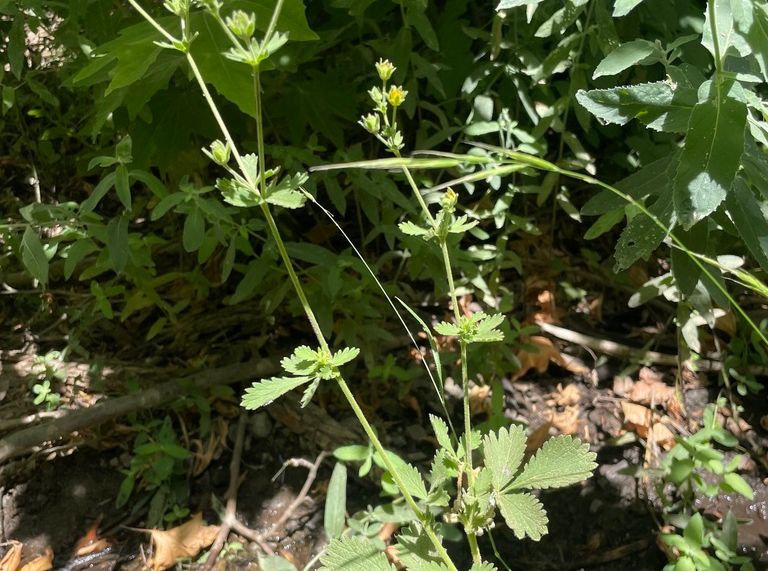
Potentilla kurdica is a tall, softly hairy cinquefoil of the mountains of Kurdistan. It grows by springs, streams and on mountain slopes in Başûr and Rojhilat, and it was first collected by a stream on Mount Gara in 1841[1][2][3][3]. What sets it apart from its relatives is something small: its pale yellow petals are so short that they barely reach past the green calyx[1][2].
How it got its name
- Named by
- Boiss. & Hohen., 1843Published in Diagn. Pl. Orient. 3: 4
By the springs of Mount Gara, July 1841
In the summer of 1841 the botanist Theodor Kotschy (1813–1866)[4] was collecting on Mount Gara in Başûr. In July he pressed a tall cinquefoil growing by the mountain's streams; in August, on the same mountain, he collected the plant that became the Kurdish hollyhock[5][6][7].
His dried plants were sent out to herbaria by Rudolph Friedrich Hohenacker (1798–1874)[4], whose name is printed on the labels as their editor, "Ed. Hohenacker 1843"[5]. The labels read "Ad rivulos m. Gara Kurdist.", "by the streams of Mount Gara, Kurdistan", and carry the number 407[5][6]; Boissier's description prints the same gathering as number 607[1]. In November 1843 the botanist Edmond Boissier (1810–1885) described the plant as new, under his own name and Hohenacker's: Potentilla kurdica Boiss. & Hohen.[1][4]. His Latin gives the place in a single line[1]:
Hab. ad fontes in monte Gara Kurdistaniæ.
It grows by springs on Mount Gara in Kurdistan.[1] (our translation)
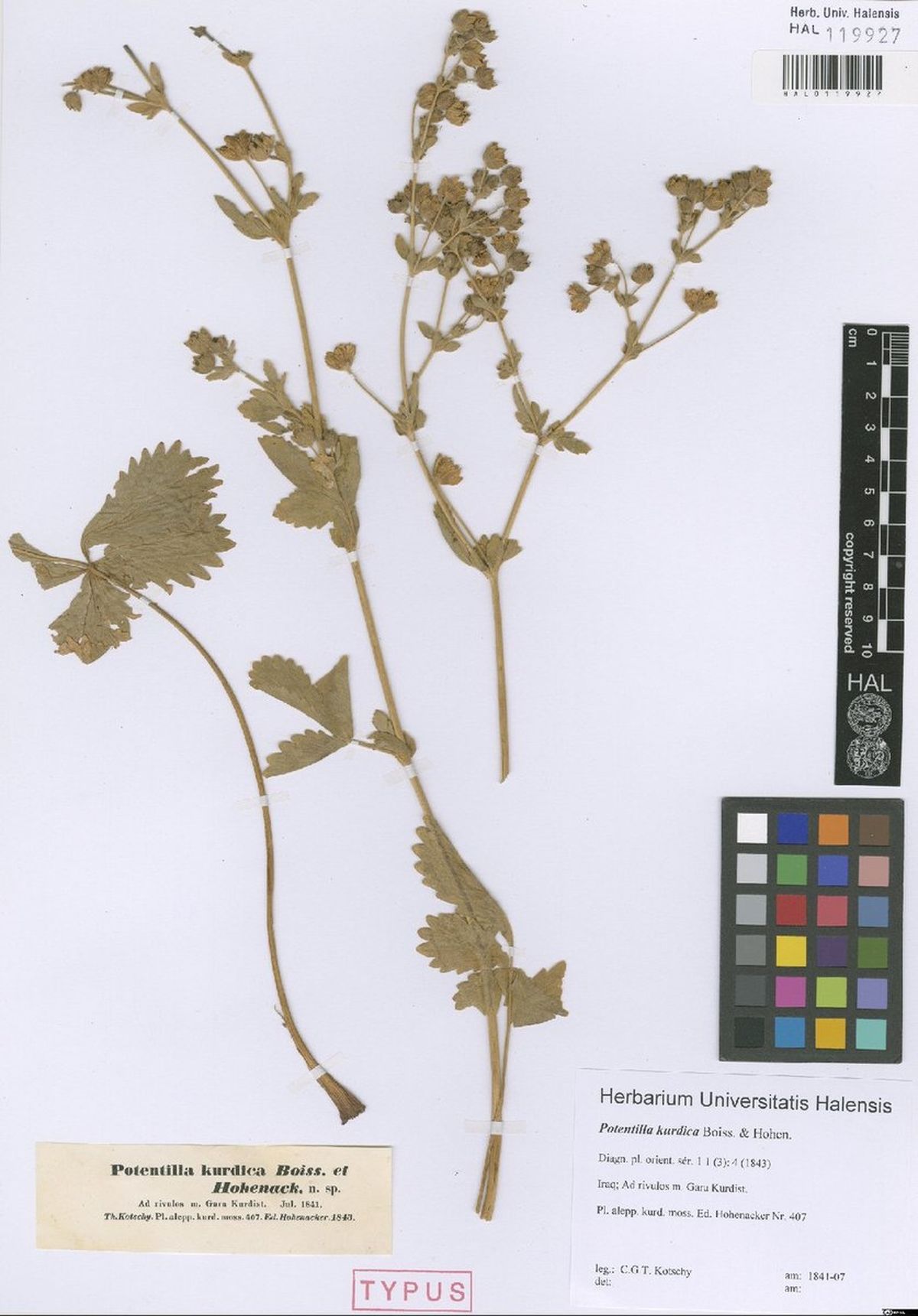
The name kurdica, "Kurdish", points to the land where Kotschy found it. When Boissier came back to it in his Flora Orientalis in 1872, he wrote that it grows in both "Turkish" and "Persian" Kurdistan, the Ottoman and the Qajar sides of the mountains[2].
A cinquefoil with tiny petals
Cinquefoils (Potentilla) belong to the rose family. Boissier's first description says this one can be told "at once" from Potentilla recta and all its other relatives by its tiny petals; only the northern P. norvegica comes close in that respect[1]. What to look for[1][2]:
- a perennial with an upright, round stem, two to three feet tall (roughly 60–90 cm), branching above into a loose, forked flowering shoot, with a longer-stalked flower sitting in each fork;
- the whole plant softly hairy, with short glandular hairs mixed with longer ones, a little sticky to the touch;
- lower leaves long-stalked and divided into five broad, wedge-shaped leaflets, each with 6 to 8 blunt teeth on either side, the middle leaflet the largest and often on its own short stalk; the leaflets of the lower leaves can be 5 cm long or more;
- upper leaves almost stalkless and divided into three;
- small flowers, about the size of those of P. norvegica, on stalks that stay straight in fruit;
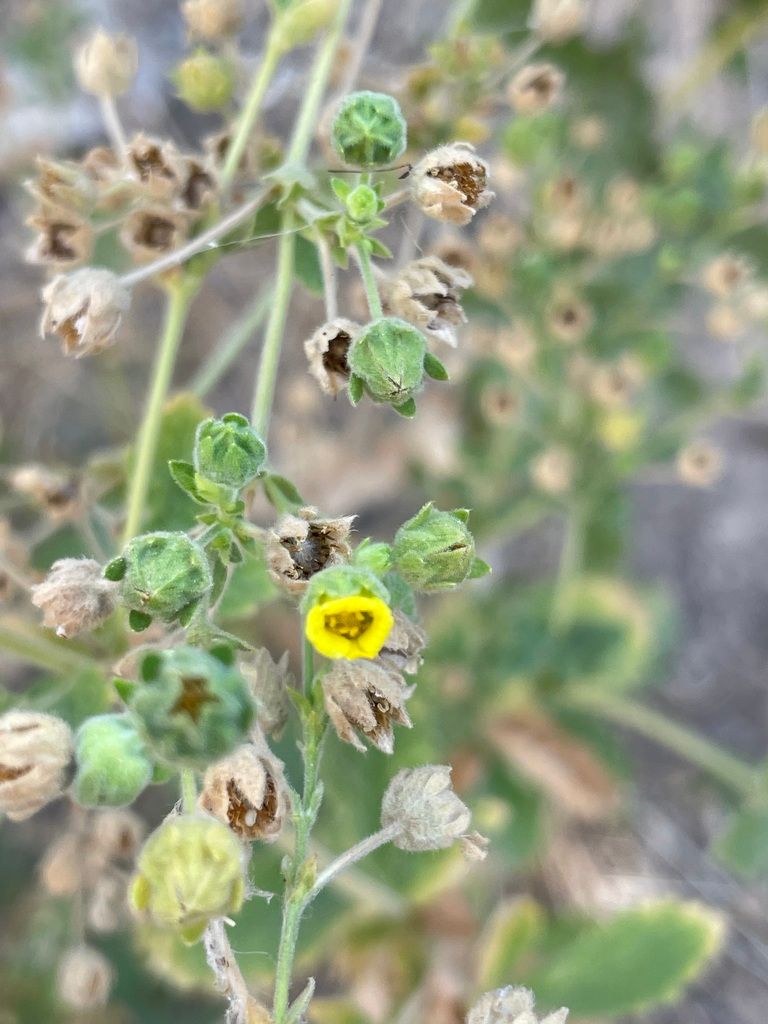
- small, oblong petals, pale cream-yellow when dried, barely as long as the calyx, their tips rolled back;
- small, kidney-shaped seeds, faintly wrinkled.
Boissier called those rolled-back petals the species' most striking feature[2]. A sheet that Carl Haussknecht (1838–1903)[4] collected in 1867 carries a note in Latin to the same effect: very small yellow flowers, the petals hardly longer than the calyx[8].
Its closest relative
Boissier also had an idea where the plant belonged. In Flora Orientalis he wrote that it should be placed "not far" from Potentilla persica[2], a cinquefoil that Haussknecht had found by streams above Juanro (Cwanro, Javanrud) in Rojhilat, and which, Boissier noted, has "the look of P. kurdica"[2].
More than 140 years later, DNA agreed with him. In 2014 the botanist Marzieh Beygom Faghir and her colleagues compared two stretches of DNA from the cinquefoils of Iran[9]. Their sample of P. kurdica had been collected by Maroufi on 1 June 2007 near the village of Hanagalan, Aral, in the Sine (Sanandaj) area[9]. In their nuclear-DNA and combined family trees, P. kurdica and P. persica came out as each other's closest relatives, and in the combined tree they formed one of two pairs within their group of cinquefoils, section Persicae; the chloroplast tree put them apart[9]. The two pairs also look different. P. kurdica and P. persica, both plants of the west of Iran, are covered in straight, sparse to moderately dense, silky hairs; the other pair, P. petraea and P. pannosa, in dense, short, stiff ones. The DNA result, the authors wrote, fits these hairs and where the plants grow[9]. A 2019 study from Başûr, which did not include P. persica, used a plant from Hasarost mountain, kept in the herbarium of Salahaddin University in Hewlêr (Erbil), and found it closest to P. hirta in two of its three family trees, while the third put it next to P. pannosa[10]. The same study looked at its pollen under the microscope: small, nearly round grains about a fiftieth of a millimetre across, with three openings and a surface of fine, fingerprint-like ridges[10].
Where it grows
Kew's checklist records it from Iran and Iraq[11]. In Kurdish terms it is a plant of Başûr and Rojhilat. The records we found, oldest first:
- Başûr, Mount Gara: by springs and streams, July 1841[1][5][6].
- Rojhilat, Hewraman (Avroman): July 1867, and near a place Haussknecht wrote as "Boriter", in thickets at 7,000 feet (about 2,100 m), August 1867[8][3]. Flora Orientalis prints the same place as "Boriler"[2].
- Başûr, Qeredax (Qaradagh): June 1957[3].
- Başûr, Hacî Omeran (Haji Omaran) and Helgurd: on mountain slopes in the Magar range near Hacî Omeran, at about 1,700–2,200 m, and on the Helgurd range at about 2,800 m, August and September 1957[3].
- Başûr, district of Silêmanî: in what the handwritten label seems to call walnut woodland ("Juglans forest"), at 1,550 m, June 1960[3].
- Başûr, near Çoman (Choman): on a rocky mountain slope 15 km south-east of the town, at 1,580–1,640 m, August 1976, where the collectors noted it as plentiful[3].
- Rojhilat: between Merîwan (Marivan) and Seqiz (Saqqez), at 1,580 m, in 1971, and on rocky slopes of a valley 30 km south of Mehabad (Mahabad), at 1,600 m, in 1974[3]; near Hanagalan, Aral, in the Sine (Sanandaj) area, June 2007[9].
- Başûr, recent: Hasarost mountain, June 2016[10]; photographs from near Helebce, August 2024, and from the province of Silêmanî, July 2025[12].
Where a height was noted, it lies between about 1,550 and 2,800 m. The plant grows on mountain slopes as well as by water[1][8][3][3], and has been found in flower in July and August[5][8][12].
The labels of the National Herbarium of Iraq, which collected most of the Başûr records, have a printed line for a "Colloquial Name". On every sheet we read, it is empty[3].
The species has not been assessed for the IUCN Red List[11].
A Kurdish plant in European gardens
Not long after it was named, the plant went into cultivation. Boissier wrote in 1872 that he had seen it both dried and growing in gardens[2]. Herbarium sheets record it in the garden of the Theresianum in Vienna in 1858, in Switzerland in 1890, in the botanic garden of Geneva in 1891, at the New York Botanical Garden in 1898 and in Munich in 1918[13]. It is still grown today: botanic gardens in Belgium, Germany and Austria list living plants[13].
Its name in Kurdish
No Kurdish name was written down with any of the specimens[3]. In print, P. kurdica has met Kurdish in one place, Ehmedê Dirihî's dictionary of Kurdish plant names (2013)[14]:
- Against Potentilla kurdica it lists gêjlokê kurdan, hêzgiyayê kurdan and gorcala bêteliyê kurdan[14]. These are dictionary names whose wording mirrors the Latin: each pairs a Kurdish name for cinquefoils with kurdan, "of the Kurds" (our translation). None of them has a place or informant code.
- Two entries with the code of a Kurdish dictionary from Paris, giyayê gulzer and giyayê hêzê, are also printed against P. kurdica[14]. The same names, with gêjlok, gorcala bêteli, helezê pêncbelg and hêzgiya, are given on the same pages for the creeping cinquefoil, P. reptans, and for the cinquefoils as a whole[14]. They are best read as names for cinquefoils in general.
- Two of those names carry a place: gorcala bêteli from Hênî and çarpelik from Mêrdîn, both given for the genus Potentilla[14].
Around Amêdî, near Mount Gara, a 2017 survey recorded teya fala for two other cinquefoils, P. recta and P. reptans. The leaves and roots were ground and boiled into a drink for fevers, diarrhoea and sores of the mouth and throat[15].
These are records of traditional use, not medical advice.
Sources
- 1.Boissier, E. (1843). Diagnoses Plantarum Orientalium Novarum, ser. 1, no. 1. Geneva. archive.orghttps://archive.org/details/e.-boissier-diagnoses-plantarum-orientalium-novarum-series-1-vol.-1-no.-1-7-1843-1846
- 2.Boissier, E. (1872). Flora Orientalis 2. Genève & Basel.
- 3.Royal Botanic Gardens, Kew – Herbarium Specimens. via GBIF. gbif.orghttps://www.gbif.org/dataset/cd6e21c8-9e8a-493a-8a76-fbf7862069e5
- 4.International Plant Names Index. Royal Botanic Gardens, Kew, Harvard University Herbaria and Australian National Herbarium.
- abcdPotentilla kurdica Boiss. & Hohen., and author records for Boissier, Hohenacker, Kotschy and Haussknecht.
- urn:lsid:ipni.org:names:728353-1. ipni.orghttps://www.ipni.org/n/728353-1accessed 14 November 2026
- 5.abcdeHerbarium of Martin Luther University Halle-Wittenberg, specimen HAL 0119927 (Kotschy 407, Mount Gara, 1841), via GBIF.
- 6.abcDuplicates of Kotschy 407 at the Royal Botanic Gardens, Kew (K000762340), the Natural History Museum, London (BM000622392), Missouri Botanical Garden (MO 1820614) and the Smithsonian Institution (US 2674450), via GBIF.
- 7.↩Schlechtendal, D. F. L. von (1843). Plantae Kotschyanae nonnullae, novae censitae. Linnaea 17: 124–128.
- 8.abcdHerbarium Haussknecht, Jena (JE), specimen records (JACQ) via GBIF. Jena, specimen JE 00024193 (Haussknecht, 1867), via GBIF. api.gbif.orghttps://api.gbif.org/v1/occurrence/3028980654
- 9.Faghir, M. B., Attar, F., Farazmand, A. & Kazempour Osaloo, S. (2014). Phylogeny of the genus Potentilla (Rosaceae) in Iran based on nrDNA ITS and cpDNA trnL-F sequences with a focus on leaf and style characters' evolution. Turkish Journal of Botany 38: 417–429. doi:10.3906/bot-1303-67https://doi.org/10.3906/bot-1303-67
- 10.abcHasan, H. H. & Sardar, A. Sh. (2019). Phylogenetic and palynological study of the genus Potentilla L. (Rosaceae) in Kurdistan Region-Iraq. Al-Kufa University Journal for Biology 11(1): 1–17. doi:10.36320/ajb/v11.i1.8043https://doi.org/10.36320/ajb/v11.i1.8043
- 11.Plants of the World Online. Royal Botanic Gardens, Kew.
- abWorld Checklist of Vascular Plants (Royal Botanic Gardens, Kew) and IUCN Red List status, via GBIF.
- plant_name_id 2955692. powo.science.kew.orghttps://powo.science.kew.org/taxon/urn:lsid:ipni.org:names:728353-1accessed 14 November 2026
- 12.abiNaturalist. observations 234702604 and 296011280 (Arya Aras, 2024 and 2025). inaturalist.orghttps://www.inaturalist.org/
- 13.abHerbarium and living-collection records of cultivated plants (B, BERN, BR, NY, BMO; SysTax botanic gardens; Meise Botanic Garden), via GBIF.
- 14.Ahmet Kasımoğlu (Ehmedê Dirihî) (2013). Ferhenga Navên Nebatan a Kurdî (Dictionary of Kurdish Plant Names). Mardin Artuklu University, Institute of Living Languages in Turkey (ISBN 978-605-4202-12-6).
- 15.↩Shimal Ahmed Tahir (2017). Plant biodiversity and ethnobotanical properties of various plants in Amedi (Duhok, N. Iraq). tez.yok.gov.trhttps://tez.yok.gov.tr/UlusalTezMerkezi/
- Boissier, E. (1843). Diagnoses Plantarum Orientalium Novarum, ser. 1, 1(3). Genève.
- Diagn. Pl. Orient. ser. 1, 3: 5 (description begins p. 4). archive.orghttps://archive.org/details/e.-boissier-diagnoses-plantarum-orientalium-novarum-series-1-vol.-1-no.-1-7-1843-1846/page/n205/mode/1upaccessed 14 November 2026
- Diagn. Pl. Orient. ser. 1, 3: 5. archive.orghttps://archive.org/details/e.-boissier-diagnoses-plantarum-orientalium-novarum-series-1-vol.-1-no.-1-7-1843-1846/page/n205/mode/1upaccessed 14 November 2026
- GBIF occurrence records of herbarium type specimens (per-record URL in each fact). occurrence 1259073163 (MO 1820614); also BM000622392 (Kotschy 407). api.gbif.orghttps://api.gbif.org/v1/occurrence/1259073163accessed 14 November 2026
Last updated 20 November 2026