Pseudocamelina kurdica is a slender, hairless little annual of the mustard family (Brassicaceae) with white petals and tiny pods on hair-thin stalks that curve back[1][2]. Few plants on this site are known from so little: every specimen we could trace comes from two gatherings on two mountains in the province of Silêmanî in South Kurdistan (Başûr), one made in 1957 and one in 1960[1][3]. Its first describer called it "restricted to the mountains of NE Iraq"[1], and the 2017 revision of its genus counts it as the one species of Pseudocamelina found in "Kurdistan Iraq"[2].
How it got its name
- Named by
- (A.G.Mill.) Esmailbegi & Al-Shehbaz, 2017Published in Phytotaxa 313: 127
A gravel ridge near Pêncwên, June 1957
On 19 and 20 June 1957 the botanist Karl Heinz Rechinger (1906–1998)[4] was collecting around Pêncwên (Penjwin), east of Silêmanî (Sulaymaniyah), on the journeys his labels call "Itinera orientalia 1956/57"[5]. On a ridge called Malakawa he gathered a fine, much-branched little crucifer and gave it the number 10435. The printed label reads:
IRAQ: Distr. Sulaimaniya (Kurdistan). In ditione pagi Penjwin, in glareosis serpentinicis jugi Malakawa, 1400 m.
In the territory of the village of Penjwin, on the serpentine gravels of the Malakawa ridge, 1,400 m.[5] (our translation)
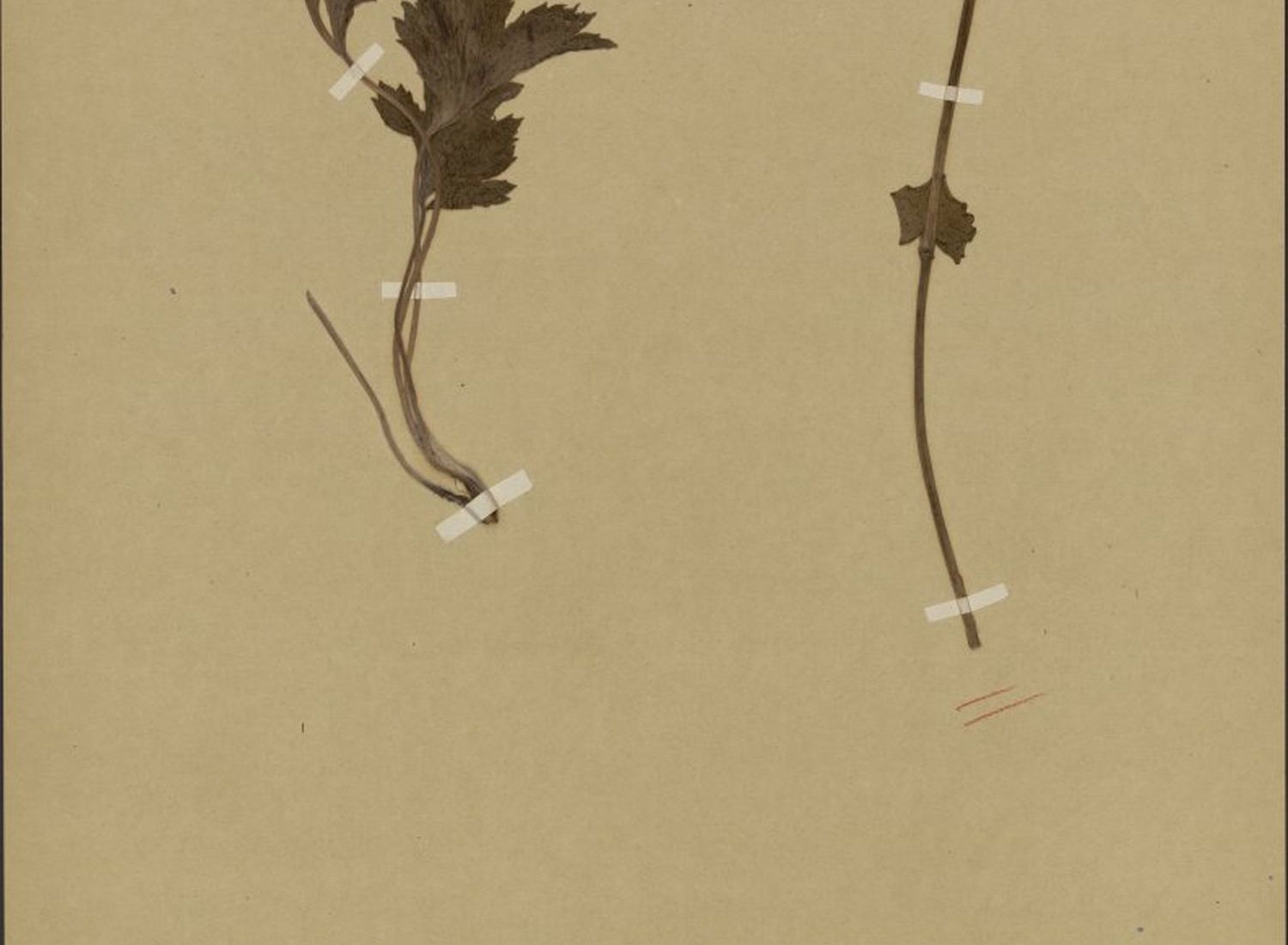
Duplicates of the gathering went to herbaria in Edinburgh, Geneva, Vienna and Kew[1][5][6][7].
One plant, five names
The labels on those sheets tell the plant's history like rings in a tree[5][6]:
- Rechinger's printed label calls it Cochlearia campylopoda, a species that Joseph Bornmüller and Erwin Gauba (1891–1964) had described in 1934 from the mountains above Karaj, in the Alborz range of northern Iran[1][4].
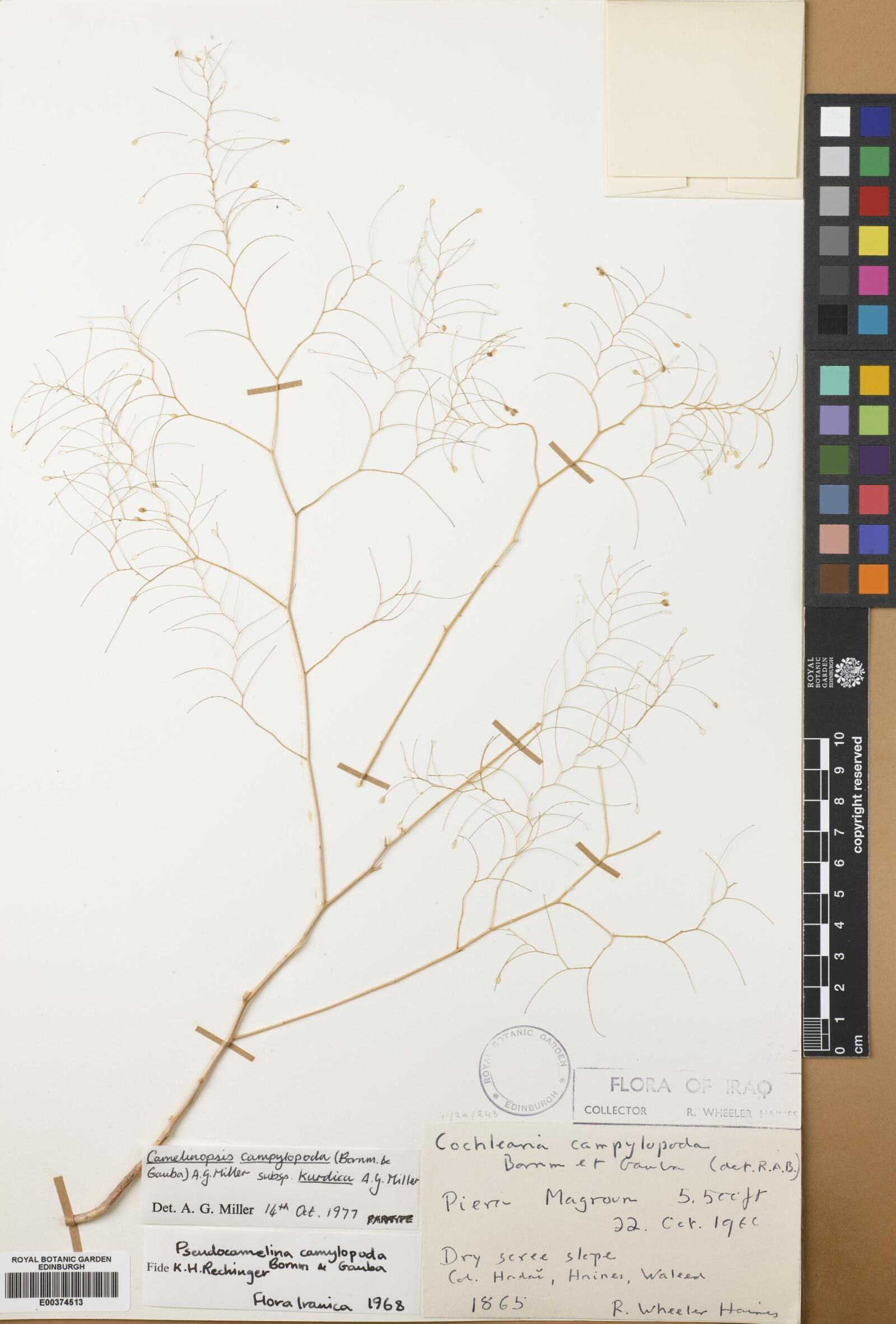
- On 30 September 1966 C. C. Townsend, determining plants for the Flora of Iraq, named it Pseudocamelina campylopoda, and a slip added for Flora Iranica in 1968 gives the same name on Rechinger's authority[5].
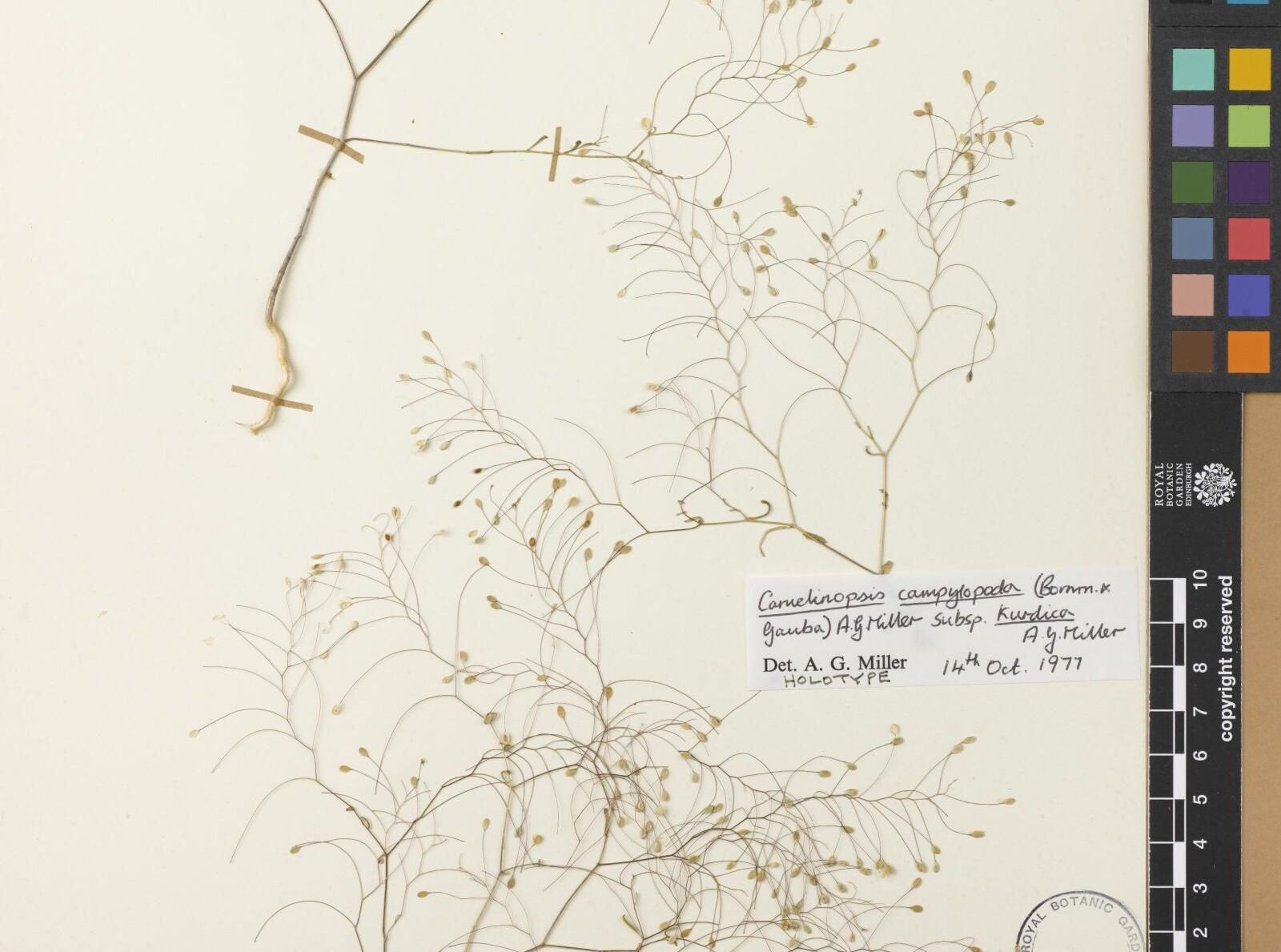
- On 14 October 1977 the botanist Anthony G. Miller (born 1951)[4] looked again, wrote "HOLOTYPE" on the Edinburgh sheet, and in 1978 published the Kurdish plant as a new subspecies, Camelinopsis campylopoda subsp. kurdica[1][5].
Miller's 1978 reassessment cut Pseudocamelina down to three species[1]. He found that the Alborz plant "differed in many significant respects from the rest of the genus", and that once another species had been moved out, "the position of Pseudocamelina campylopoda becomes completely anomalous". So he gave it a genus of its own, Camelinopsis[1]. Within it he separated the plants from Kurdistan from those near Karaj by their fruits: a narrower pod with a single seed in each of its two chambers, a stigma sitting directly on the pod without a style, and seeds that do not turn slimy when wet[1]. He called that last difference "a surprising one", since seed slime is normally used to tell apart much larger groups in the family, not two such close relatives[1].
In 2012 Ihsan Al-Shehbaz and Miller raised the Kurdish plant to a species, Camelinopsis kurdica[4]. In September 2016 the botanist Shokouh Esmailbegi revised the Vienna duplicate of Rechinger's gathering, and leaf material was taken from it for DNA study[6]. The next year Esmailbegi, Al-Shehbaz and colleagues found Camelinopsis so similar to Pseudocamelina that they merged the two genera again, and the plant became Pseudocamelina kurdica (A.G.Mill.) Esmailbegi & Al-Shehbaz[2][4]. Half a century after the Flora of Iraq label, it is back in that genus, now as a species of its own.
The epithet kurdica is Latin for "Kurdish", and the labels of its type sheets all place it in "(Kurdistan)"[5][6][7].
What to look for
From Miller's description of the genus and the 2017 revision[1][2]:
- a slender annual, hairless throughout;
- stems upright and zigzagging; on the pressed sheets they branch again and again into a cloud of thread-like stalks[5][5];
- lower leaves irregularly divided two or three times into narrow lobes;
- sepals held half-upright, not pouched at the base, with papery edges; petals white; the open flowers stand above the buds, not below them[1];
- fruit a small, flattened pod that splits open; in this species it is narrowly egg-shaped with the broad end up, holds one seed in each of its two chambers, and carries the stigma directly on top[1];
- fruit stalks strongly curved back, so that the pods hang down from markedly zigzag branches[1][2]. Miller called this look of the fruiting plant "the most characteristic feature" of his genus Camelinopsis: "The fruiting branches are always markedly flexuose with the fruits held pendant on delicately recurved pedicels"[1]. The old epithet campylopoda describes the same thing: in Greek it means "with curved feet" (our gloss).
Its closest relatives are the other Pseudocamelina species of Iran. P. kermanica, for example, has eight ovules in each ovary instead of two, undivided basal leaves and straight fruit stalks[2].
Where it grows
Kew's checklist gives its native range as north-eastern Iraq[8]. In Kurdish terms it is a plant of Başûr, and so far only of the mountains of Silêmanî province. The published records and herbarium sheets point to two places[1][3]:
- the Malakawa ridge near Pêncwên, on serpentine gravel at 1,400 m, 19–20 June 1957 (Rechinger 10435)[5];
- Pîremegrûn (Pira Magrun), on a dry scree slope at 5,500 feet (about 1,680 m), 22 October 1960, collected by the botanist Emil Hadač (1914–2003), R. Wheeler Haines and a third collector named on the label only as Waleed (Haines 1865)[4][5][7]. Miller gives the height as 1,650 m and also cites a sheet under Hadač's own number, 2849, in the Prague herbarium[1].
Both gatherings were made in fruit, in June and in October[5][5]. The sources we could read give no flowering months.
The genus has a second Kurdish member. In 2026 Pseudocamelina avromanica was described from alpine limestone rocks in Kurdistan Province in Rojhilat; its name points to the Hewraman (Avroman) mountains[9]. P. kurdica itself has not been reported from Rojhilat, and there is no photograph of a living plant on iNaturalist[3]. Anyone walking the screes of Pîremegrûn or the hills around Pêncwên could be the next person to see it.
Kurdish names
No Kurdish name has been recorded for this plant. Ehmedê Dirihî's dictionary of Kurdish plant names includes it in its Latin index, under Miller's name Camelinopsis campylopoda subsp. kurdica, but leaves the Kurdish column empty[10].
Sources
- 1.Miller, A. G. (1978). A reassessment of the genus Pseudocamelina. Notes from the Royal Botanic Garden Edinburgh 36(1): 23–34. doi:10.24823/nrbge.1978.3098https://doi.org/10.24823/nrbge.1978.3098
- 2.Esmailbegi, S., Lysak, M. A., Rahiminejad, M. R., Mirtadzadini, M., Mummenhoff, K. & Al-Shehbaz, I. A. (2017). A taxonomic revision of the genus Pseudocamelina (Brassicaceae, tribe Thlaspideae). Phytotaxa 313(1): 117–129. doi:10.11646/phytotaxa.313.1.8https://doi.org/10.11646/phytotaxa.313.1.8
- 3.abcGBIF.org GBIF Backbone Taxonomy and occurrence records. occurrence records for Pseudocamelina kurdica and its synonyms, and iNaturalist, consulted 15 November 2026. gbif.orghttps://www.gbif.org/
- 4.International Plant Names Index. Royal Botanic Gardens, Kew, Harvard University Herbaria and Australian National Herbarium.
- 5.Royal Botanic Garden Edinburgh Herbarium (E), specimen catalogue (via data.rbge.org.uk and GBIF). data.rbge.org.ukhttps://data.rbge.org.uk/herb/
- 6.abcdNatural History Museum Vienna (W) – Herbarium. via GBIF, herbarium specimen W 0276136 (isotype; Rechinger 10435), via GBIF.
- 7.abcRoyal Botanic Gardens, Kew – Herbarium Specimens. via GBIF, herbarium specimens K006437464 and K006437463, via GBIF. gbif.orghttps://www.gbif.org/dataset/cd6e21c8-9e8a-493a-8a76-fbf7862069e5
- 8.Plants of the World Online. Royal Botanic Gardens, Kew.
- ↩Pseudocamelina kurdica.
- plant_name_id 3229129. powo.science.kew.orghttps://powo.science.kew.org/taxon/urn:lsid:ipni.org:names:77176277-1accessed 14 November 2026
- 9.↩Advay, M. & Esmailbegi Kermani, S. (2026). Systematic assessment and description of a new species of Pseudocamelina (Brassicaceae) from alpine of Western Iran. Phytotaxa 773(1): 57–68. doi:10.11646/phytotaxa.773.1.5https://doi.org/10.11646/phytotaxa.773.1.5
- 10.↩Ahmet Kasımoğlu (Ehmedê Dirihî) (2013). Ferhenga Navên Nebatan a Kurdî (Dictionary of Kurdish Plant Names). Mardin Artuklu University, Institute of Living Languages in Turkey (ISBN 978-605-4202-12-6), p. 1082.
- Naturhistorisches Museum Wien, herbarium sheet W 0276136 (Camelinopsis campylopoda subsp. kurdica, isotype; Rechinger 10435), via GBIF.
- W 0276136 (isotype of Camelinopsis campylopoda subsp. kurdica). api.gbif.orghttps://api.gbif.org/v1/occurrence/5004426873accessed 14 November 2026
- W 0276136. api.gbif.orghttps://api.gbif.org/v1/occurrence/5004426873accessed 14 November 2026
- W 0276136; RBGE E00374513 (1676 m). api.gbif.orghttps://api.gbif.org/v1/occurrence/5004426873accessed 14 November 2026
Last updated 20 November 2026