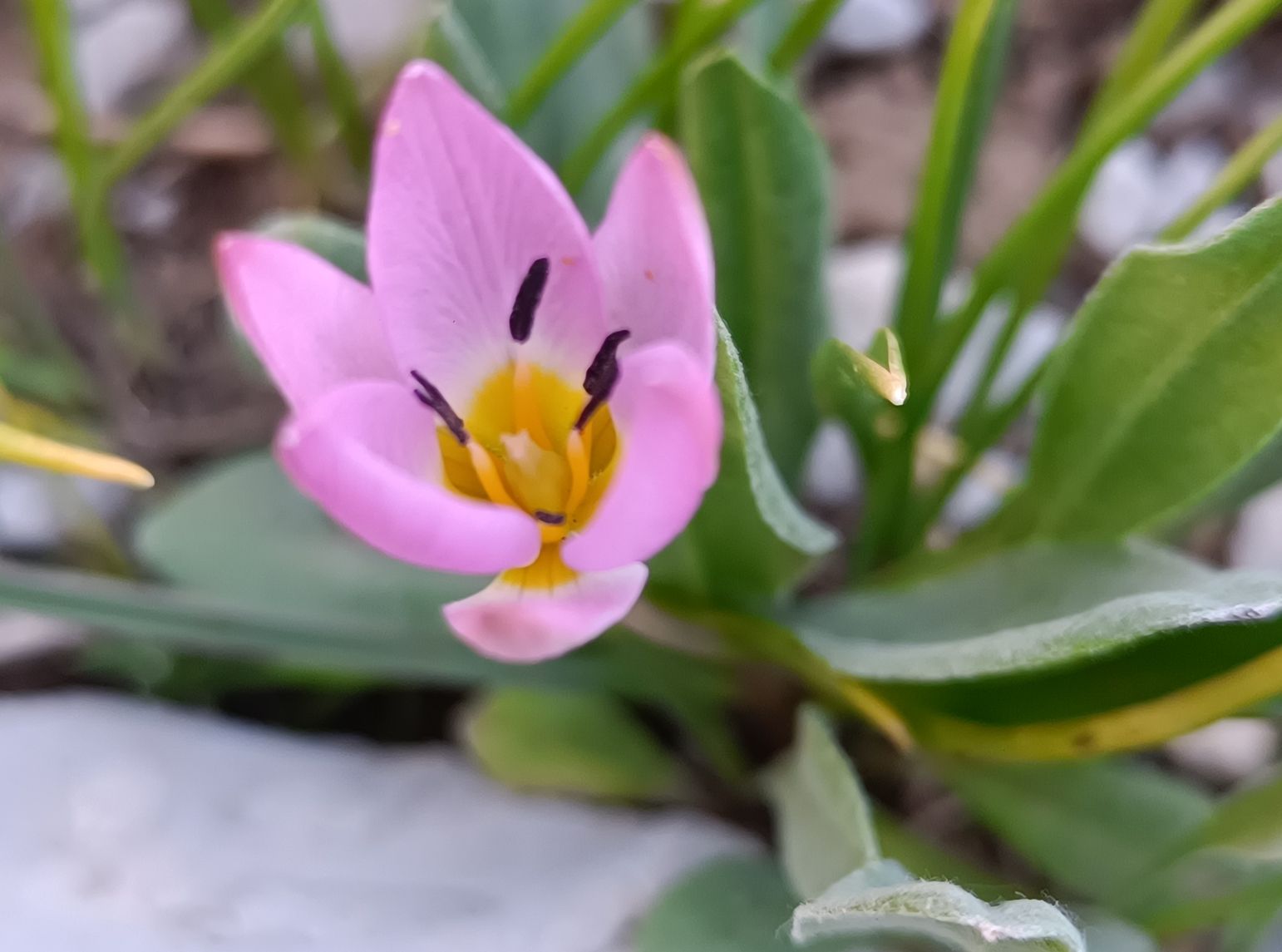
Tulipa humilis is a tiny wild tulip: a flower stalk only a few centimetres high, three or four grey-green leaves spread almost flat on the ground, and a very pale purple flower with a bright yellow heart[1]. It grows on the high mountains of Kurdistan and far beyond, and it flowers late, from the end of April into June[2], sometimes right beside the melting snow, as on Helgurd[3]. One of its forms was first described from Helgurd in South Kurdistan (Başûr), and carries the Kurds in its name: Tulipa humilis var. kurdica[4][3].
How it got its name
- Named by
- Herb., 1844Published in Edwards's Bot. Reg. 30(Misc.): 30
"This beautiful little Tulip"
The species reached science through a garden in Yorkshire. In April 1844 a tiny tulip flowered at Spofforth, in the garden of William Herbert (1778–1847)[1][4]. He had it from Theodor Kotschy (1813–1866)[4], who had collected it on the Alborz ("Mount Elburz") in northern Iran[1]. It is the same Kotschy whose dried plants from Mount Gara gave the Kurdish hollyhock its name.
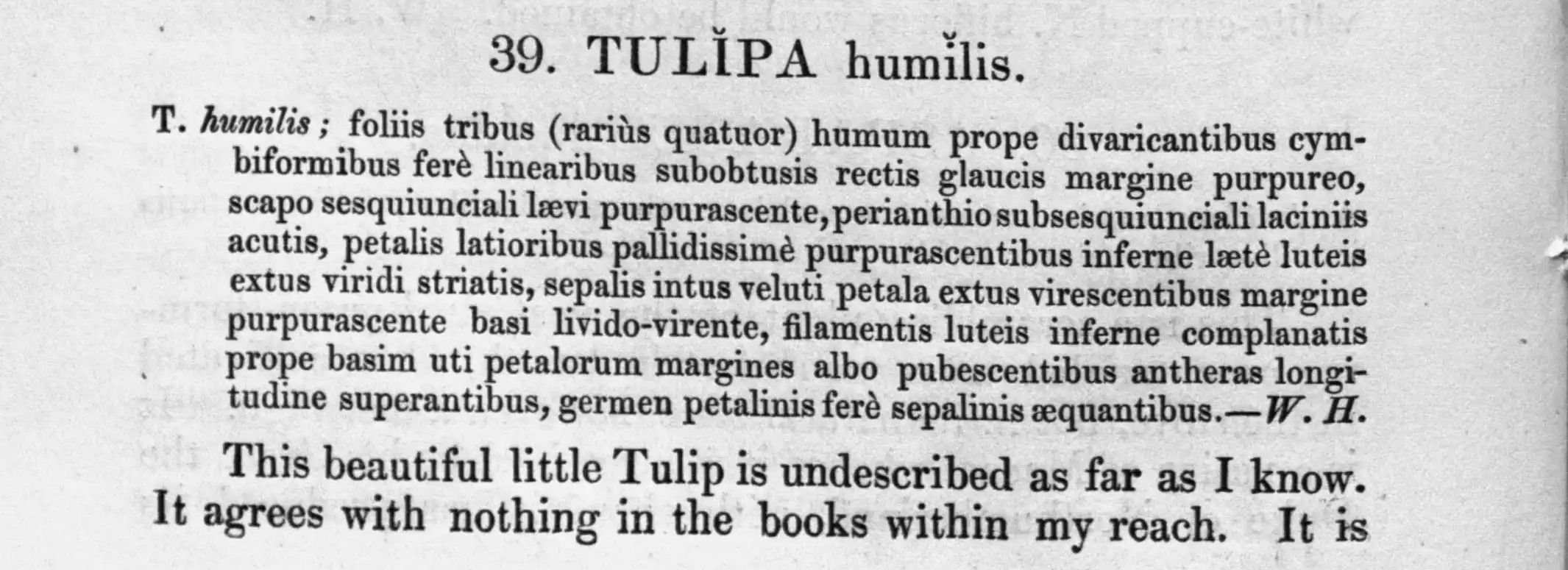
Herbert wrote it up the same year in Edwards's Botanical Register:
This beautiful little Tulip is undescribed as far as I know. It agrees with nothing in the books within my reach.[1]
He called it Tulipa humilis, the "low" or "humble" tulip[1]. Its flower stalk, he noted, was only an inch and a half long[1].
What to look for
Herbert's Latin description is still a good field guide to the species[1] (our translation):
- three leaves, rarely four, spreading almost on the ground, keeled like a little boat, nearly linear and blunt, grey-green (glaucous) with a purple edge;
- a smooth, purplish flower stalk;
- a flower just under 1.5 inches (almost 4 cm) long with pointed segments; the three inner ones broader, very pale purple, bright yellow at the base and striped green on the outside; the three outer ones like the inner ones within, but greenish outside with a purple margin;
- yellow stamen filaments, flattened near the base and fringed there with white hairs.
Later botanists added the bulb: a modern Iranian description of the typical form gives it lilac flowers, yellow anthers and pollen, thin papery bulb tunics, and a ring of hairs around the base of the bulb[5].
Snow melting on Helgurd, June 1960
More than a century after Herbert, in June 1960, the botanist Emil Hadač (1914–2003)[4] was collecting on the high slopes of Helgurd, the mountain above Çoman (Choman)[3][6]. He and the botanist Andrew D. Q. Agnew (born 1929)[4] studied the plant communities of Helgurd and published them together in 1963[6].
On 5 June 1960 a small tulip was gathered there under number 2232[3][7]. Hadač's typed label gives the place in Latin:
Ad nives tabescentes sub cacumine cotae 2.450 m, supra locum Sarcal dictum ad montem Helgurd Curdistaniae Irakensis.
By the melting snows below the summit of the height of 2,450 m, above the place called Sarcal, on Mount Helgurd in Iraqi Kurdistan.[3]
A sheet with the same number and date at Edinburgh, filed under Agnew's name, reads simply "S.W. slope of Helgurd", with a note that it is a fruiting specimen from 8,000 feet[7]. The day before, also at Sarcal, Hadač had collected a dame's-violet that he later described with František Dvořák as another new "Kurdish" plant, Hesperis kurdica[6].
The tulip waited fourteen years. In 1974 the botanist Per Wendelbo (1927–1981) described it as a new species, Tulipa kurdica, in the Swedish journal Botaniska Notiser[4][4]. Duplicates of the type gathering are kept at Gothenburg and Edinburgh[3][7]. The Gothenburg sheet still carries a little paper packet of loose petals[3].
A species, a variety, or something else?
In 2013 a team led by Maarten Christenhusz published a new checklist of all the world's tulips, and treated T. kurdica not as a species but as a variety of T. humilis: Tulipa humilis var. kurdica (Wendelbo) Christenh.[4][8]. Kew's World Checklist accepts it under that name today[9].
A botanist from Silêmanî (Sulaimani) looked at the question more closely. Hoshman Omar Majeed Sarthis, who teaches at the Faculty of Agricultural Sciences of the University of Sulaimani[10], made the "status of Tulipa kurdica" part of his doctoral thesis at the University of Reading[11]. He studied wild-collected plants with DNA and with careful measurements, and came to two conclusions[11]:
- the plants sold in the bulb trade as T. kurdica do not match the wild plants;
- the wild T. kurdica may be closer to T. pulchella than to T. humilis, with which it had been merged.
Garden catalogues show why the first point matters. The Royal Horticultural Society's plant profile describes garden T. kurdica as bright red with a blue-black blotch at the base[12]. Kew keeps a pressed DNA voucher of a garden plant grown under that name, whose origin is recorded as "unknown"[13].
The bigger picture is just as unsettled. In Turkey, a 2014 revision of the genus keeps T. pulchella as a species of its own, not a synonym of T. humilis[14]. And a 2026 DNA study covering about 86% of the genus's species, with the botanist Mehmet Fırat among its authors, found the samples of T. humilis falling into two different branches of the tulip tree; the authors drew no conclusions from this yet, but count it among the species that remain unresolved[15]. For now the borders of T. humilis are still being drawn.
Where it grows
Kew's checklist gives the range of T. humilis as south-eastern Turkey to the Anti-Lebanon and Afghanistan, with records from the North Caucasus and Transcaucasus, Iran, Iraq, Syria and Lebanon, and Turkey[9]. In Kurdistan it grows on the high mountains of Bakur, Başûr and Rojhilat.
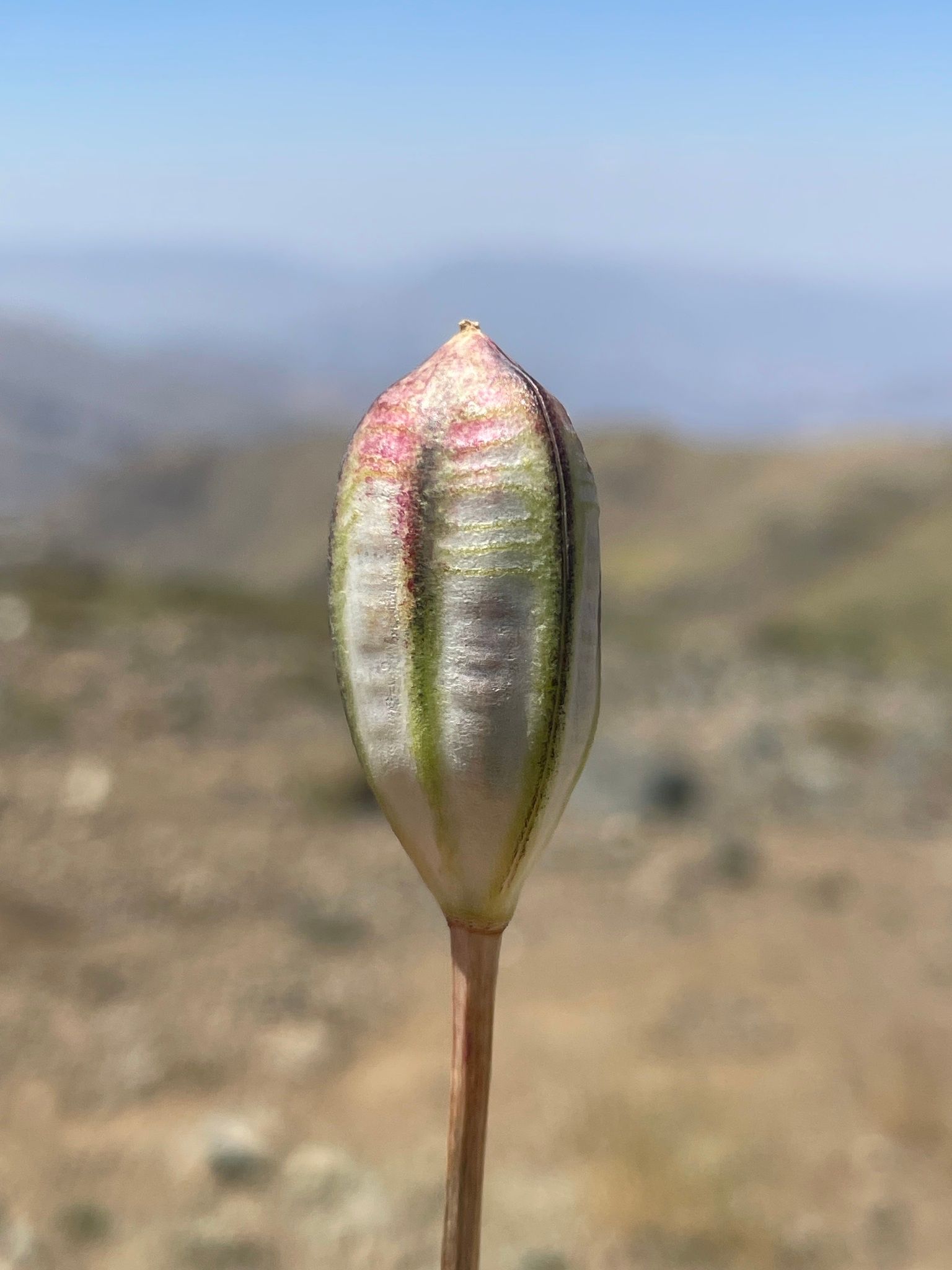
- Başûr: Helgurd is the type locality of var. kurdica[4][3][7]. In July 2025 a naturalist photographed its seed capsules near Çoman, below the mountain, identified as var. kurdica and confirmed by a second observer[2].
- Bakur: naturalists have photographed it in flower in May and June around Colemêrg (Hakkâri) and Gever (Yüksekova), and in the mountains of the Wan (Van) region[2].
- Rojhilat and beyond: in 2025 it was photographed near Shahin Dezh in West Azerbaijan province[2], and a dark-flowered form, subsp. matinae, was described in 2001 from Kuh-e Alvand near Hamadan[5].
The species has not been assessed for the IUCN Red List[16].
Tulips on the table
Small wild tulips are not only for looking at. In 2019 a team of ethnobotanists interviewed Muslim and Kakai (Yarsan) Kurds in twelve villages of southern Başûr, between the Nineveh Plains and the Garmian region of Kelar (Kalar)[17]. Among the raw snacks people gather, Muslim Kurds in particular named the bulbs of wild tulips, called melaqa, which are eaten on the spot for their sweetish, crunchy taste. The researchers identified them as the mountain tulip T. montana "and possibly other Tulipa spp."[17]. The authors note that wild tulip bulbs were once eaten across the region, and that, to their surprise, tulips are not much grown as ornamentals in village gardens there, where the crown imperial is the favourite bulb[17].
Its names in Kurdish
The common Kurdish words for a tulip belong to the whole genus. Edîb Polat's list of Kurdish plant names gives alal, hilale, mêlaq, lale and helal for Tulipa[18], and Weysî Silêman Elî's tulip lesson uses lale and gul-lale[19]. Ehmedê Dirihî's dictionary records qaqincêk for tulips from Pasûr[20].
For T. humilis itself, Dirihî gives bilîz, taken from the Kurmanji journal of the Kurdish Institute of Paris; the same name is also listed there for another small tulip, T. boeotica[20]. For the variety from Helgurd he lists laleya kurdan and qaqincêka kurdan (also spelled qaqinceka kurdan)[20]. These are dictionary names whose wording mirrors the Latin kurdica, rather than names collected from people who know the plant.
Sources
- 1.Herbert, W. (1844). Tulipa humilis. Edwards's Botanical Register 30, Misc.: 30–31.
- 2.abcdiNaturalist. observations of Tulipa humilis from Başûr, Bakur and Rojhilat (2006–2026). inaturalist.orghttps://www.inaturalist.org/
- 3.abcdefghHerbarium GB, University of Gothenburg, specimen GB-0047960 (isotype of Tulipa kurdica, Hadač 2232), via GBIF.
- 4.International Plant Names Index. Royal Botanic Gardens, Kew, Harvard University Herbaria and Australian National Herbarium.
- aghiTulipa kurdica Wendelbo, Bot. Not. 127: 276 (1974); Tulipa humilis var. kurdica (Wendelbo) Christenh., Bot. J. Linn. Soc. 172: 314 (2013).
- bcdefauthor records for Herbert, Kotschy, Wendelbo, Hadač and Agnew.
- urn:lsid:ipni.org:names:542952-1. ipni.orghttps://www.ipni.org/n/542952-1accessed 14 November 2026
- 5.abZojajifar, Sh. & Sheidai, M. (2001). A new subspecies of the genus Tulipa (Liliaceae) from Iran. Iranian Journal of Botany 9(1): 65–67, p. 66.
- 6.abcDvořák, F. & Hadač, E. (1964). Hesperis kurdica Dvořák et Hadač sp. nova. Preslia 36: 307–308. preslia.czhttps://preslia.cz/article/pdf?id=10559
- 7.abcdRoyal Botanic Garden Edinburgh Herbarium (E), specimen catalogue (via data.rbge.org.uk and GBIF). specimen E00373785 (isotype of Tulipa kurdica, Agnew 2232). data.rbge.org.ukhttps://data.rbge.org.uk/herb/
- 8.↩Christenhusz, M. J. M., Govaerts, R., David, J. C. et al. (2013). Tiptoe through the tulips – cultural history, molecular phylogenetics and classification of Tulipa (Liliaceae). Botanical Journal of the Linnean Society 172(3): 280–328. doi:10.1111/boj.12061https://doi.org/10.1111/boj.12061
- 9.Plants of the World Online. Royal Botanic Gardens, Kew.
- abWorld Checklist of Vascular Plants / Plants of the World Online (Royal Botanic Gardens, Kew): Tulipa humilis and var. kurdica.
- plant_name_id 289584. powo.science.kew.orghttps://powo.science.kew.org/taxon/urn:lsid:ipni.org:names:542952-1accessed 14 November 2026
- 10.↩University of Sulaimani, staff page of Hoshman Omar Majeed.
- 11.abSarthis, H. O. M. (2015). The phylogeny of Tulipa (Liliaceae) and status of Tulipa kurdica. PhD thesis, University of Reading.
- 12.↩Royal Horticultural Society, plant profile: Tulipa kurdica.
- 13.↩Royal Botanic Gardens, Kew – Herbarium Specimens. via GBIF, specimen K003947270 (DNA voucher, cultivated Tulipa kurdica), via GBIF. gbif.orghttps://www.gbif.org/dataset/cd6e21c8-9e8a-493a-8a76-fbf7862069e5
- 14.↩Eker, İ., Babaç, M. T. & Koyuncu, M. (2014). Revision of the genus Tulipa L. (Liliaceae) in Turkey. Phytotaxa 157(1): 1–112, p. 3.
- 15.↩Wilson, B., Christenhusz, M. J. M., Walker-Hale, N. et al. (2026). Phylogenomic insights into the genus Tulipa (Liliaceae): taxonomy, evolution, and biogeography. American Journal of Botany: e70232, pp. 1, 9, 13, 16. doi:10.1002/ajb2.70232https://doi.org/10.1002/ajb2.70232
- 16.↩IUCN Red List status via GBIF: Not Evaluated.
- 17.Andrea Pieroni, Hawre Zahir, Hiwa M. Ahmed, Renata Sõukand (2019). Where tulips and crocuses are popular food snacks: Kurdish traditional foraging reveals traces of mobile pastoralism in Southern Iraqi Kurdistan. doi:10.1186/s13002-019-0341-0https://doi.org/10.1186/s13002-019-0341-0
- 18.↩Edîb Polat (2006). Flora Kurdistanê (I). institutkurde.orghttps://www.institutkurde.org/publications/kurmanci/
- 19.↩Weysî Silêman Elî (2025). Kulîlk û Gul bi Kurdî, lesson 3.
- 20.Ahmet Kasımoğlu (Ehmedê Dirihî) (2013). Ferhenga Navên Nebatan a Kurdî (Dictionary of Kurdish Plant Names). Mardin Artuklu University, Institute of Living Languages in Turkey (ISBN 978-605-4202-12-6).
- 21.Catalogue of Life, vernacular names via the GBIF Backbone Taxonomy. api.gbif.orghttps://api.gbif.org/v1/species/5299366/vernacularNamesaccessed 14 November 2026
Last updated 20 November 2026