How it got its name
- Named by
- Malin., 1908Published in Bull. Herb. Boissier , sér. 2, 8: 623
A small plant with "Kurdistan" in its name
Crucianella kurdistanica is a slender annual of the family Rubiaceae[1]. Its thin stems carry narrow leaves in whorls of six and end in loose spikes, from which long, narrow flowers stick out like little trumpets[2]. It is easy to overlook, but its story is not: it was named after Kurdistan by a botanist who did not say where in Kurdistan it grew, and it had already been sitting in herbaria, under the wrong name, for twenty years[2][3].
Kew's checklist gives its range as south-eastern Turkey to Iraq[1]. In Kurdish terms it is a plant of North Kurdistan (Bakur) and South Kurdistan (Başûr), and every record we could place comes from inside Kurdistan[4][5][6][6][6][6][6][6][6][6].
"A new species of Crucianella from Kurdistan"
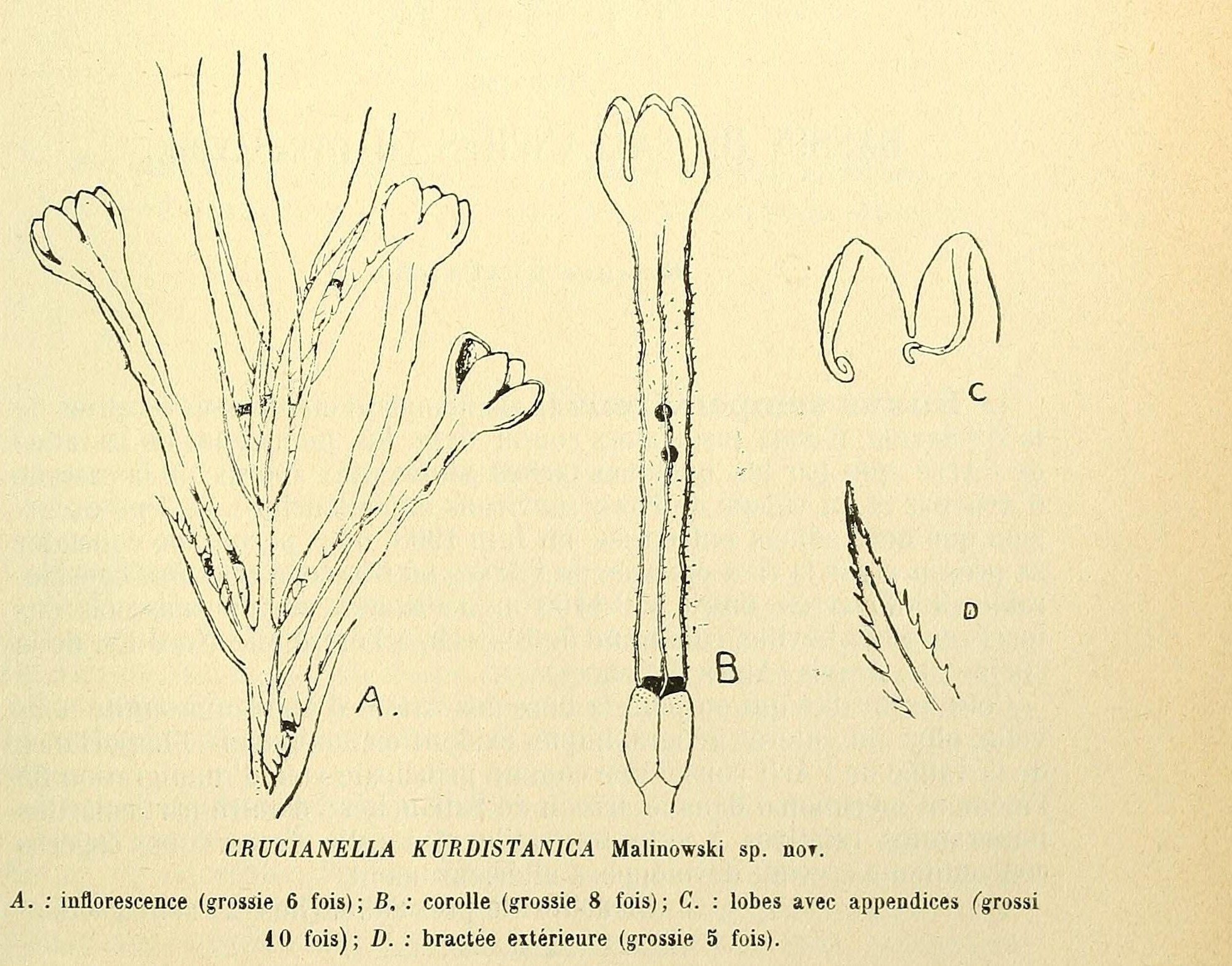
In 1908 a young botanist, Edmund Malinowski (1885–1979), then in his early twenties, published a two-page note in the Bulletin de l'Herbier Boissier. Its title says it all: Une nouvelle espèce de Crucianella du Kurdistan, "A new species of Crucianella from Kurdistan"[2][7]. He gave a short Latin description and an engraving of the flowers, and said that his type specimens were in the Barbey-Boissier herbarium and in Berlin[2].
Where it grew, he wrote, was simply this:
Distr. geogr. Kurdistan. Hab.: « in declivibus montium ».
Distribution: Kurdistan. Habitat: "on mountain slopes".[2]
No town, no collector, no date. Malinowski divided the genus into a western group (Spain, southern France, Italy, the Balkans, Asia Minor, Egypt, Morocco) and an eastern one (Kurdistan, Armenia, Arabia, Persia, Afghanistan), and placed his new plant in the eastern group[2].
A plant that had been hiding in plain sight
Three years later, in a paper printed in 1912, the German botanist Joseph Bornmüller (1862–1948)[7], who had collected nearly every species of the genus himself, published a sharp reply[3]. He thought the new species a good one, "an excellent new species", but he had little patience with the description. It said nothing about the lower part of the plant, not even whether it was an annual, and nothing about where in Kurdistan it came from, who found it, or when[3].
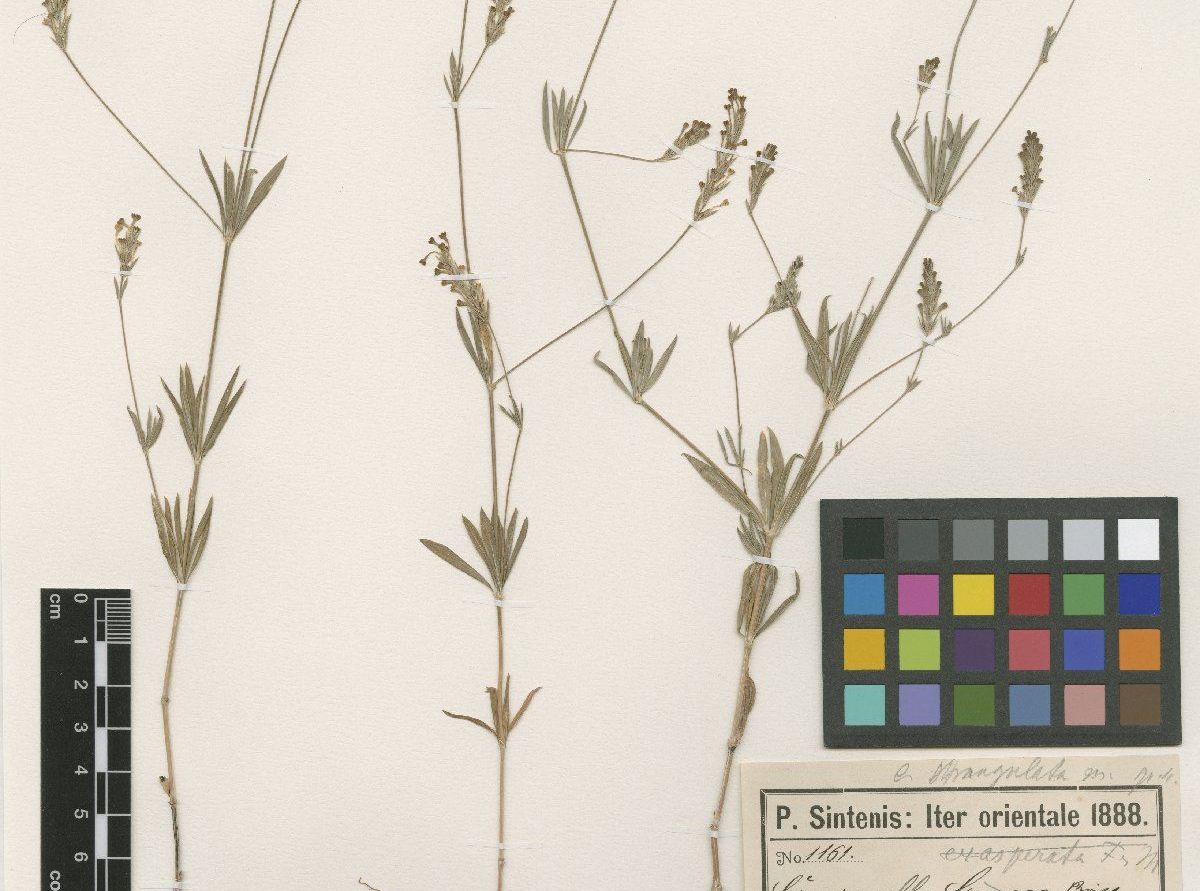
And yet, Bornmüller wrote, the plant was "probably to be found in every larger herbarium"[3] (our translation). The collector Paul Sintenis (1847–1907)[7] had gathered it in quantity near Mêrdîn (Mardin) on 25 June 1888, and distributed it in fine, instructive specimens as number 1161 of his Iter orientale 1888, but under the wrong name, Crucianella graeca[3].
His labels still survive, and the one printed word on them for where the plant came from is Kurdistania[4][5]. Bornmüller placed Mardin "in northern Mesopotamia"[3]; Sintenis's labels put it in Kurdistan.
Four names for one plant
The mix-up had not gone unnoticed. Bornmüller had seen the wrong name on his own specimen "many years ago" and wrote to the botanist Heinrich Haussknecht (1838–1903) about it. Haussknecht replied that he had already marked the Sintenis plant in his own herbarium as a new species, Crucianella strangulata, after the botanist Otto Stapf (1857–1933) had named it wrongly[3][7]. And in Vienna, Heinrich von Handel-Mazzetti (1882–1940) had also spotted an undescribed species among the "false C. graeca from Mardin" and called it pectinata in a letter[3][7]. Neither name had been published[3].
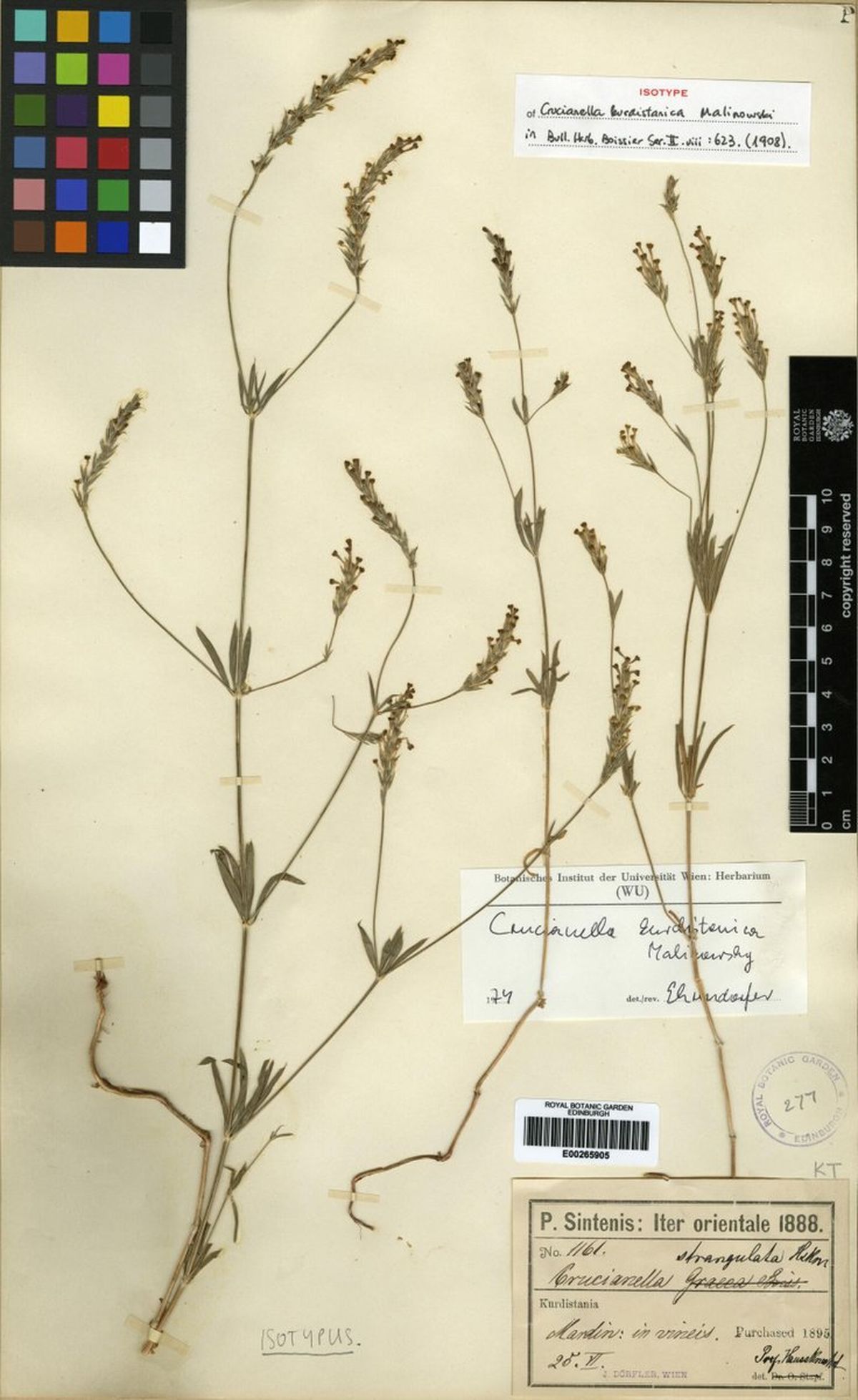
The specimens tell the same story. On an Edinburgh sheet of number 1161 the name Crucianella Graeca is corrected: "Graeca" is struck through and "strangulata Hskn." written above it, and "det. Dr. O. Stapf" crossed out and replaced by "Prof. Haussknecht"[5]. On the sheet in Haussknecht's own herbarium, now at Jena, a pencil note above the label reads "C. strangulata m."[4].
Sintenis's plant, Bornmüller concluded, "agrees exactly" with Malinowski's description and drawing, and he left open whether Malinowski's own specimens came from the same gathering[3]. Bornmüller's paper put both unpublished names into print in 1912[7], and today C. strangulata and C. pectinata are listed as synonyms of C. kurdistanica[1]. Several of Sintenis's sheets from Mêrdîn, in Jena, Meise, Lund and Edinburgh, are marked as isotypes, duplicates of the type[4][5].
Flowers that open at night
What makes the plant unmistakable, Bornmüller wrote, are its long corolla tubes, which when dried show raised veins and "quite peculiar knotty constrictions"[3] (our translation). Malinowski measured them at 8–10 mm, twice as long as the bracts, with five lobes that each run out into a thin, curled tip[2]. The rest of the plant is modest: a smooth stem, leaves in sixes, 2–2.5 cm long, ovate-lance-shaped with rough, rolled-back edges, and loose spikes 2–3.5 cm long[2].
Those curled tips have a story too. Most Crucianella species, Bornmüller explained, flower at night: by day they fold their corolla lobes or roll them up in a spiral, and at night they spread them wide like a star[3]. In a later paper (1910) Malinowski had used the curled tips as a feature of his eastern group; for Bornmüller the curling was simply what the flowers do by day[3]. He described the genus as having "very inconspicuous, mostly pale yellowish or dirty-white flowers" that open in the evening[3] (our translation). The collectors' notes on C. kurdistanica agree: "Fl. pale" near Duhok in 1947[6], "white" at Atrush in 1955[6].
Where it grows
Mêrdîn is treated as the type locality: Sintenis's sheets from there are filed as isotypes[4][5]. Since then the plant has been gathered again and again in Başûr, and once more in Bakur:
- Bakur: on the slopes near Mêrdîn, and in its vineyards, as the handwritten localities on different sheets of Sintenis's number say[4][5]; and between Farqîn (Silvan) and Sêrt (Siirt), in oak scrub, where Peter Davis gathered it on 24 June 1954; his label calls it an annual[6].
- Başûr: on Jebel Baykhair near Zaxo (Zakho) in June 1934, and again on the same mountain at 750 m[6][6]; near Duhok at 1,000 m in May 1947[6]; at Atrush at 3,500 feet (about 1,070 m) in June 1955[6]; near Bamerny, as the label spells it, at 1,300 m in 1976[6]; and north of Swara Tuka at 1,070 m in 1979[6].
The labels describe the same kind of country each time: mountain slopes[2][4], stony and rocky ground and cracks in the rock, clay soil on a mountainside, and, again and again, oak: "among oak on limestone slopes", "dry stony amongst oak", "in Quercus scrub"[6][6][6][6][6]. It has been gathered between mid-May and mid-July, at about 750 to 1,300 m[6][6][6][6][6][6][6][6], and three of the labels call it common[6][6][6].
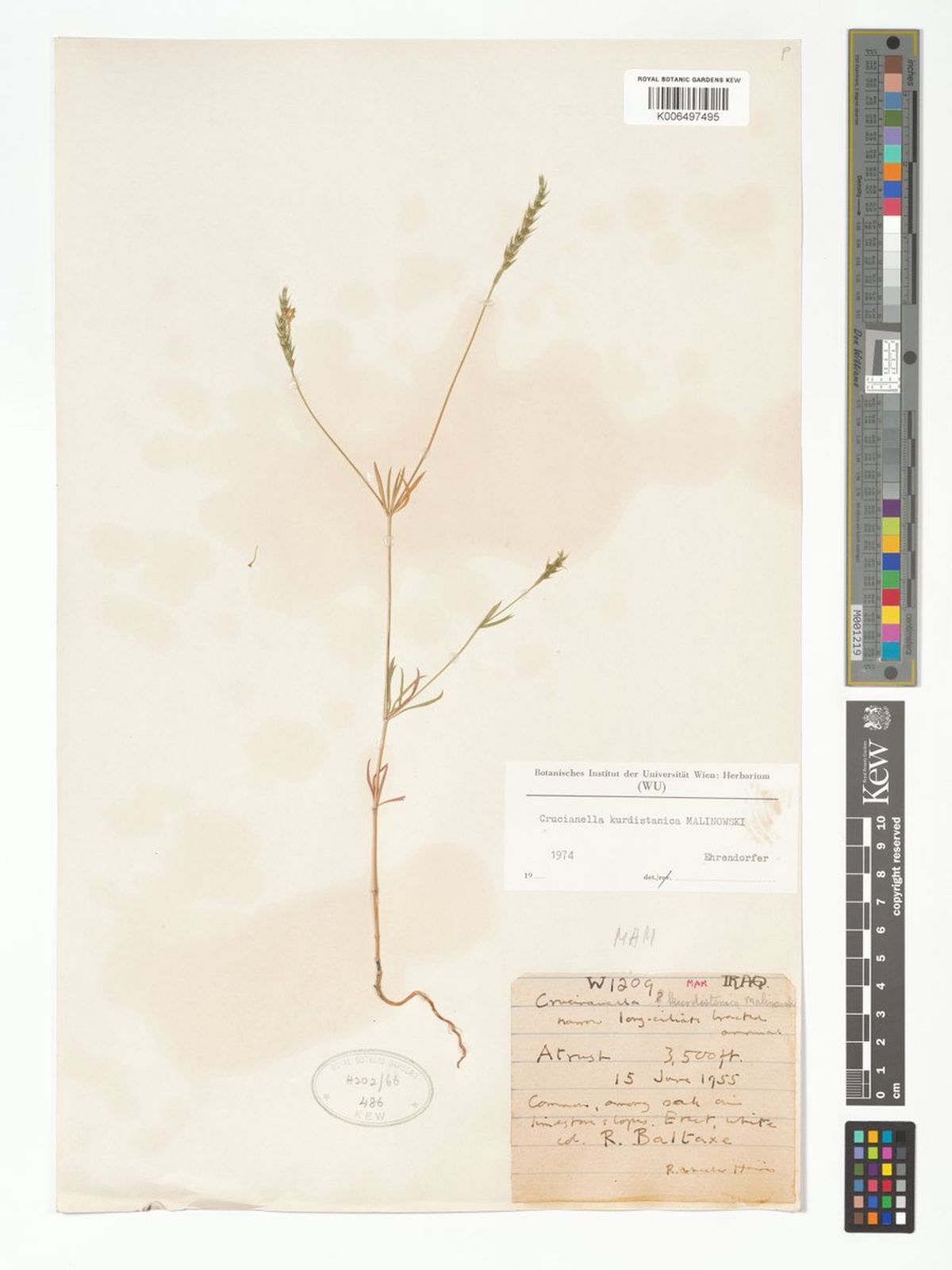
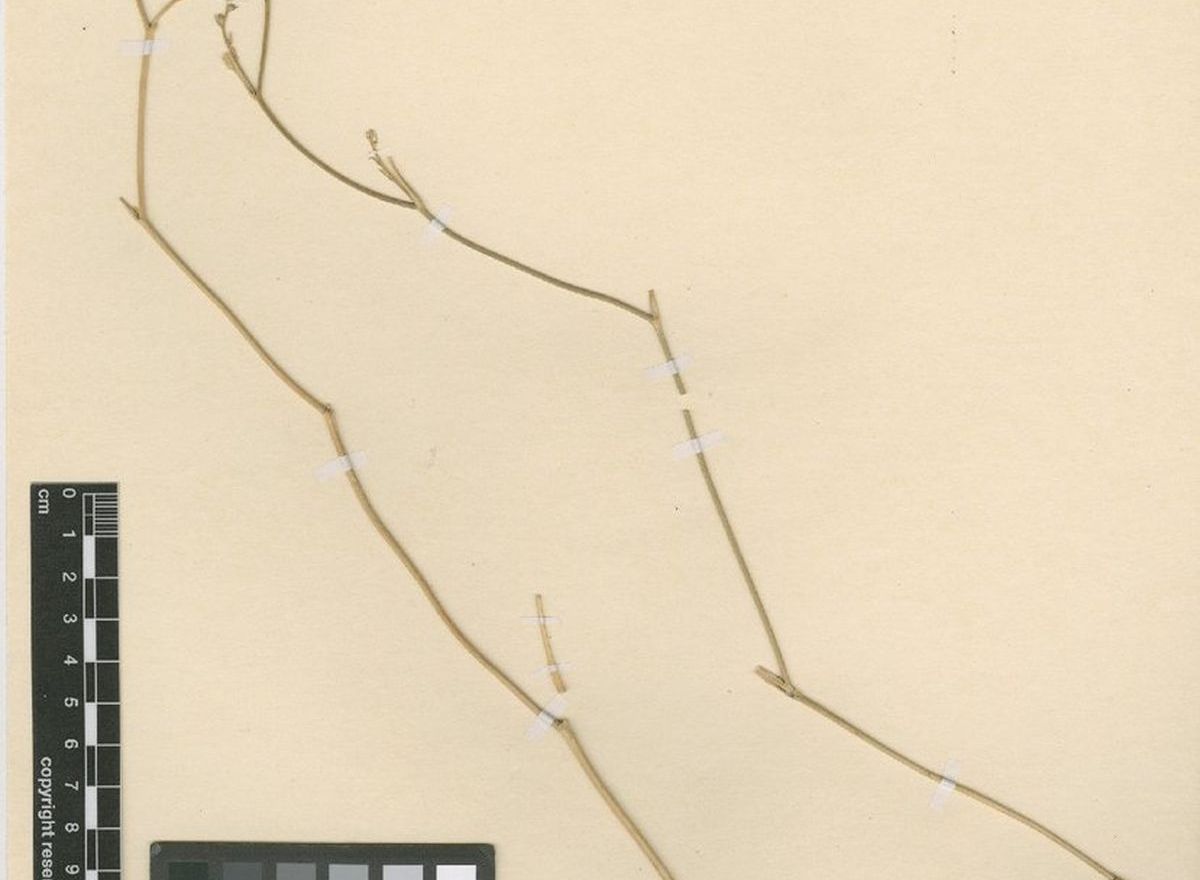
The plant has not been assessed for the IUCN Red List[8], and we could find no photograph of a living plant: so far, every picture of it is of a pressed specimen[4][5][6][6][6][6][6][6][6][6].
A name in Kurdish
The National Herbarium of Iraq printed a line for the "Colloquial Name" on its labels. On every sheet of this plant we read, that line was left empty[6][6][6].
Ehmedê Dirihî's dictionary of Kurdish plant names lists it under a dictionary name, spîneşê kurdistan, whose wording mirrors the Latin kurdistanica, as does the Turkish name printed beside it, kürdistan haçotu[9]. The entry gives no region or informant. On the same page the dictionary gives spîneş for another Crucianella, C. gilanica, and another dictionary name, spîneşê kurdan, for its subspecies carduchorum[9]. Fittingly, the dictionary itself was published in 2013 by Mardin Artuklu University, in the very town where Sintenis gathered the plant in 1888[9].
Sources
- 1.Plants of the World Online. Royal Botanic Gardens, Kew.
- abcCrucianella kurdistanica.
- plant_name_id 51669. powo.science.kew.orghttps://powo.science.kew.org/taxon/urn:lsid:ipni.org:names:747905-1accessed 14 November 2026
- 2.Malinowski, E. (1908). Une nouvelle espèce de Crucianella du Kurdistan. Bulletin de l'Herbier Boissier, sér. 2, 8: 623-624.
- 3.Bornmüller, J. (1912). Zur Gattung Crucianella. Mitteilungen des Thüringischen Botanischen Vereins, N.F., 29: 27–36.
- 4.abcdefghHerbarium Haussknecht, Jena (JE), specimen records (JACQ) via GBIF. Jena, specimen JE 00005281 (isotype; via GBIF). api.gbif.orghttps://api.gbif.org/v1/occurrence/3028980654
- 5.abcdefgRoyal Botanic Garden Edinburgh Herbarium (E), specimen catalogue (via data.rbge.org.uk and GBIF). herbarium specimen E00265905 (via GBIF). data.rbge.org.ukhttps://data.rbge.org.uk/herb/
- 6.Royal Botanic Gardens, Kew – Herbarium Specimens. via GBIF. gbif.orghttps://www.gbif.org/dataset/cd6e21c8-9e8a-493a-8a76-fbf7862069e5
- alwahherbarium specimen K006497491 (via GBIF).
- bjorxaeaiherbarium specimen K006497495 (via GBIF).
- cinyajapherbarium specimen K006497493 (via GBIF).
- dpszafakaqherbarium specimen K006497496 (via GBIF).
- eqtaaagalarherbarium specimen K006497490 (via GBIF).
- fuabamherbarium specimen K006497494 (via GBIF).
- gkvacanherbarium specimen K006497498 (via GBIF).
- hmadaoherbarium specimen K006497488 (via GBIF).
- 7.International Plant Names Index. Royal Botanic Gardens, Kew, Harvard University Herbaria and Australian National Herbarium.
- 8.↩GBIF.org GBIF Backbone Taxonomy and occurrence records. IUCN Red List category for Crucianella kurdistanica. gbif.orghttps://www.gbif.org/
- 9.Ahmet Kasımoğlu (Ehmedê Dirihî) (2013). Ferhenga Navên Nebatan a Kurdî (Dictionary of Kurdish Plant Names). Mardin Artuklu University, Institute of Living Languages in Turkey (ISBN 978-605-4202-12-6).
- GBIF occurrence records of herbarium type specimens (per-record URL in each fact). occurrence 3029005462 (JE 00005281). api.gbif.orghttps://api.gbif.org/v1/occurrence/3029005462accessed 14 November 2026
Last updated 20 November 2026