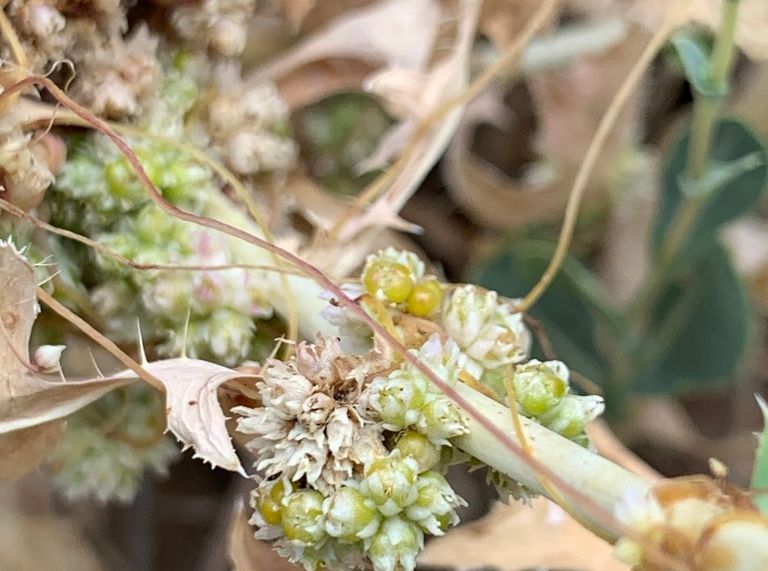
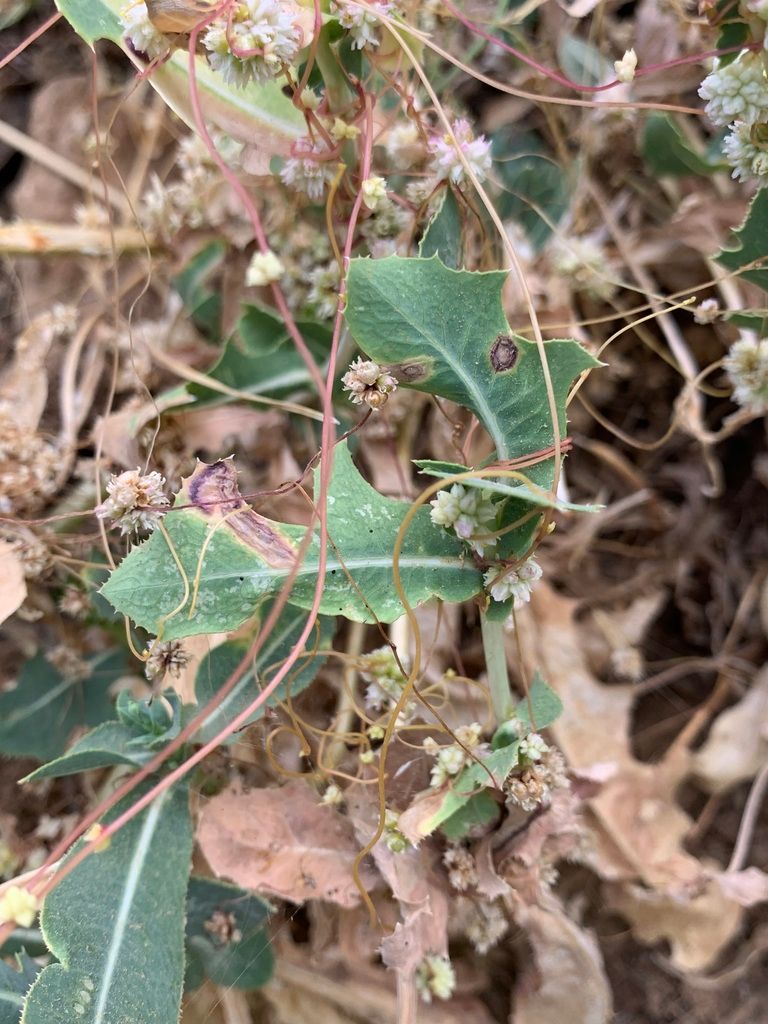
Cuscuta kurdica is a dodder: a plant without proper leaves, which lives by winding its thread-thin stems around other plants and drawing its food from them. In the mountains of Kurdistan it flowers in high summer, in tight little balls of small, pale flowers strung along the threads[1][2][3]. Every specimen its author saw came from Kurdistan, and its name says so: kurdica, "Kurdish"[1][2].
How it got its name
- Named by
- Engelm., 1859Published in Trans. Acad. Sci. St. Louis 1: 470
A plant made of thread
Dodders are among the strangest flowering plants. In his 1932 world monograph of the genus, the botanist Truman G. Yuncker (1891–1964)[4] described them in a few lines: "herbaceous parasites", whose stems are "filiform, twining about woody or herbaceous hosts from which they obtain nourishment by means of haustoria", with leaves "reduced to small, functionless scales"[2]. Kew's checklist calls C. kurdica a "holoparasitic annual"[5]: a plant that takes everything it needs from its host and lives for a single season.
Even the seed is odd. George Engelmann (1809–1884)[4], the physician-botanist who named this species (his byline reads "George Engelmann, M.D."), opened his account of the genus by noting that the dodder embryo is "rather a minute plant than an embryo in the usual form", a tiny shoot "without cotyledons proper", the seed leaves that other seedlings unfold first[1].
There are about 220 species of Cuscuta worldwide[5]. Cuscuta kurdica is one of the Kurdish ones.
Found on Mount Gara, 10 August 1841
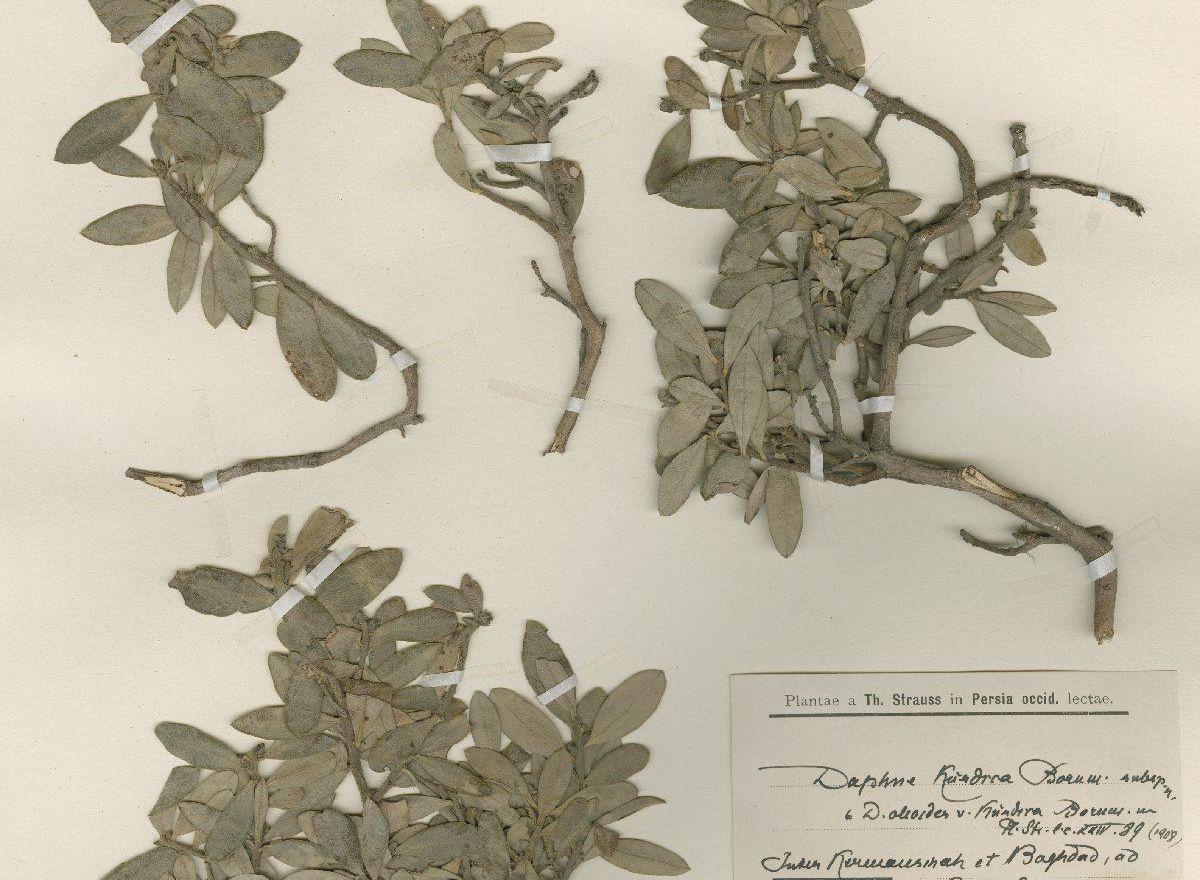
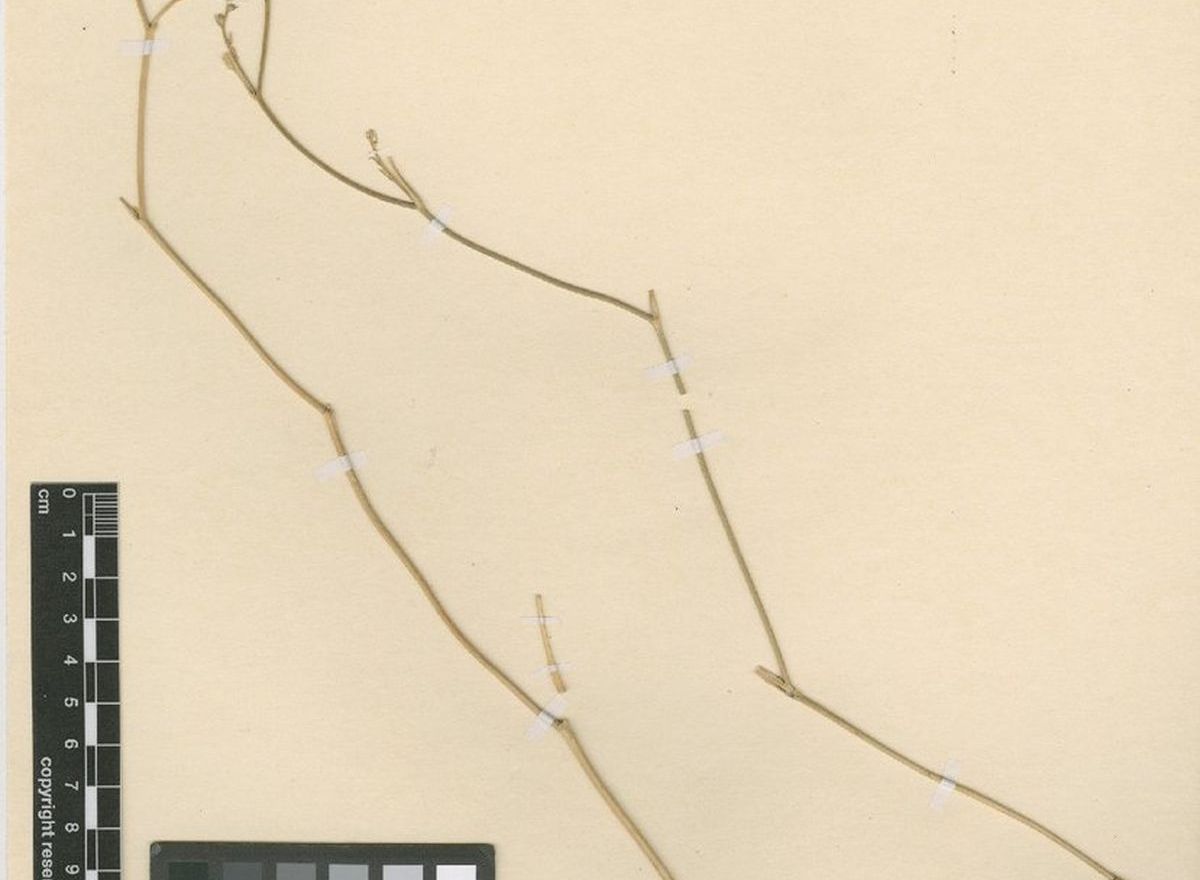
The first known gathering was made by the traveller and botanist Theodor Kotschy (1813–1866)[4] on 10 August 1841, "in monte Gara Kurdistaniae versus cacumen": on Mount Gara in Kurdistan, towards the summit[6]. Gara rises in Başûr. Kotschy's handwritten label calls his collection "Pl. Mesopot. Kurdistan. & Mossul.", plants of Mesopotamia, Kurdistan and Mosul[6].
At first nobody took it for a new species. The dodder was given out under borrowed names: as Cuscuta minor on the printed labels, and as C. alpina by the man who distributed Kotschy's sets, Rudolph Friedrich Hohenacker (1798–1874)[1][4][6]. Hohenacker sent them out in 1843 under the number 388 b[6][7], and today sheets of this one gathering lie in at least nine herbaria, from Kew, Paris and Geneva to Göttingen, Vienna, Harvard and New York[7].
A second early specimen came from James Brant, the British consul at Erzurum[6][8]. In the summer of 1838 Brant had travelled through "a part of Kurdistan" in Bakur, by way of Palo (Palu), Xarpêt (Kharput), Mûş, Bedlîs (Bitlis) and Wan (Van), and published his notes of the journey[8]. His dodder sheet at Kew carries only one word for a locality, "Kurdistan", and the note "W. H. F. Strangways, 1840"[6]. Where exactly he found it, the label does not say.
Named in St. Louis
Engelmann saw Brant's plant "in Hb. Hooker", Hooker's herbarium[1]. The Kew sheet of Kotschy's gathering still carries the stamps of two private herbaria it passed through, "Herbarium Benthamianum 1854" and "Herbarium Hookerianum 1867", and a small slip that reads "Cuscuta kurdica n. sp. Engelm 1857"[6]. Engelmann had picked out the new species on the sheet two years before he published it.
In 1859 he published the name in his monograph of the genus, which Yuncker would call "the very excellent monograph of Engelmann describing seventy-seven species"[2]. Number 8 in Engelmann's list is C. kurdica, "n. sp.", with two localities: "On the Gara mountain, Kurdistan, Kotschy!" and "Kurdistan, J. Brant!"[1]. The exclamation marks are a botanist's shorthand: I have seen this specimen myself.
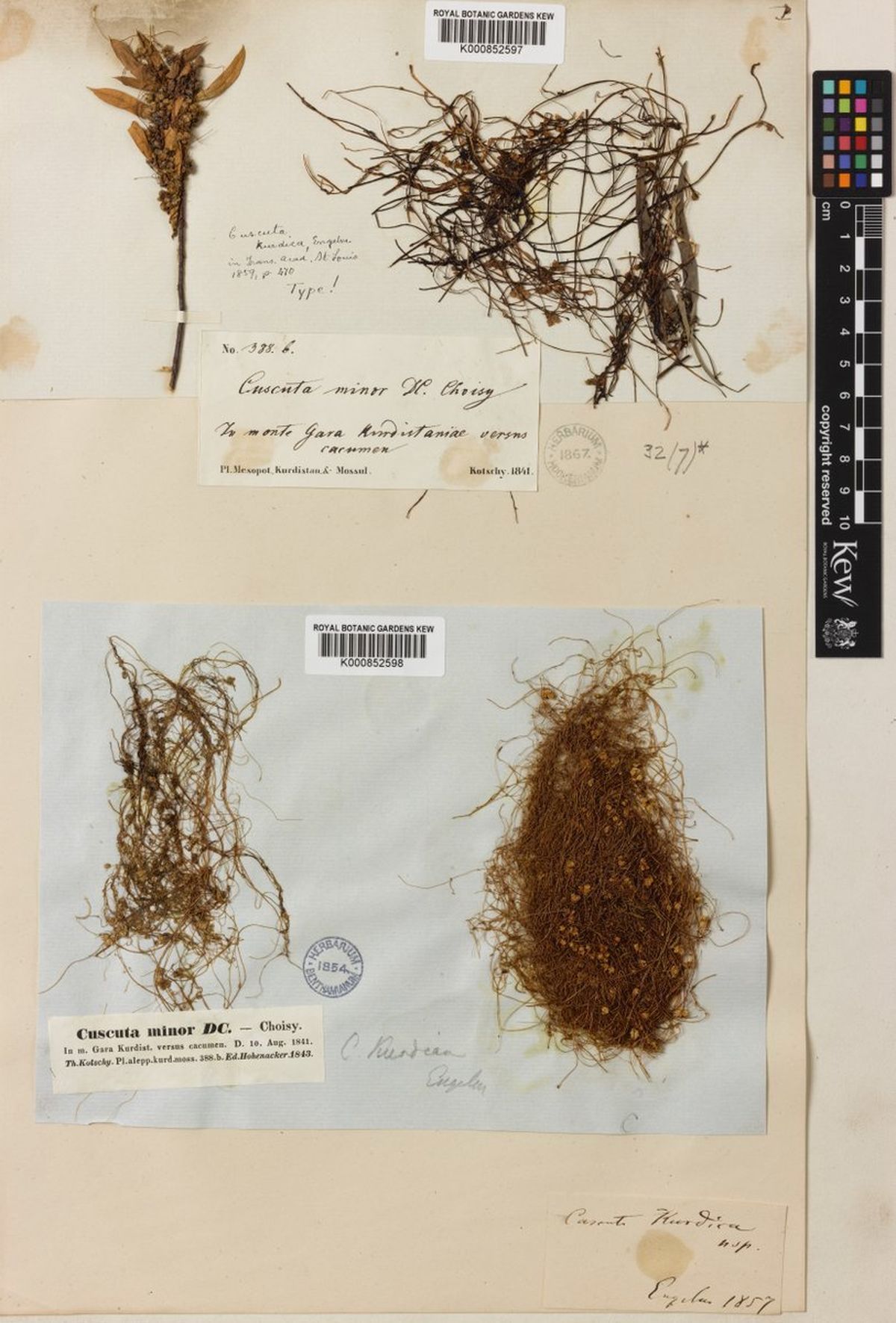
The Vienna copy of Kotschy's gathering reads like a logbook of everyone who has puzzled over dodders since[7]. Yuncker annotated it in 1952, and a fragment went to his own Cuscuta herbarium "with permission"; Tania Béliz of the University of California, Berkeley, studied it in 1986–1989 and marked it as part of the type; and in 1997 M. A. García confirmed it once more as "Type material of Cuscuta kurdica"[7].
How to recognise it
Dodders are hard to tell apart, and C. kurdica is close to the common European dodder, C. europaea[1][9][2]. What sets it apart, according to Engelmann, Boissier and Yuncker[1][9][2]:
- stems very thin, "capillaceous", hair-like;
- flowers stalkless, packed into small, few-flowered balls, each ball sitting on a pointed bract;
- flowers about 2–3 mm long, mostly with their parts in fours rather than fives, though most balls hold at least one five-parted flower;
- calyx and corolla lobes pointed, not blunt: the main difference from C. europaea;
- the corolla stays on and swells into a little globe that wraps the whole ripening capsule, rather than just capping its top;
- styles very short and slender;
- seeds large for the size of the flower, about 1.25 mm, mostly four in each capsule.
Collectors' notes add the colours: "thready pink stems, pink and white flowered clusters" near Sine (Sanandaj) in Rojhilat[6].
What it feeds on
A dodder is only as good as its host, and the labels on old herbarium sheets keep a record of the Kurdish dodder's choice of plants:
- On Mount Gara, Boissier noted that it grows on a Daphne[9].
- On a mountainside the label calls "Chia-i-Mandali (nr. Walza)", at about 7,000 feet, the collector Evan Guest found it on 18 July 1932 on an Eryngium and on a Campanula, a sea holly and a bellflower[6].
- North of Sine, on 27 July 1962, the collector P. Furse found "a dodder growing on eringium" on stony slopes at 6,500 feet[6].
- And on 19 July 1932, "among rocks on top of the ridge" at 9,000 feet, Guest found it growing on Galium kurdicum, a bedstraw also named after the Kurds[6].
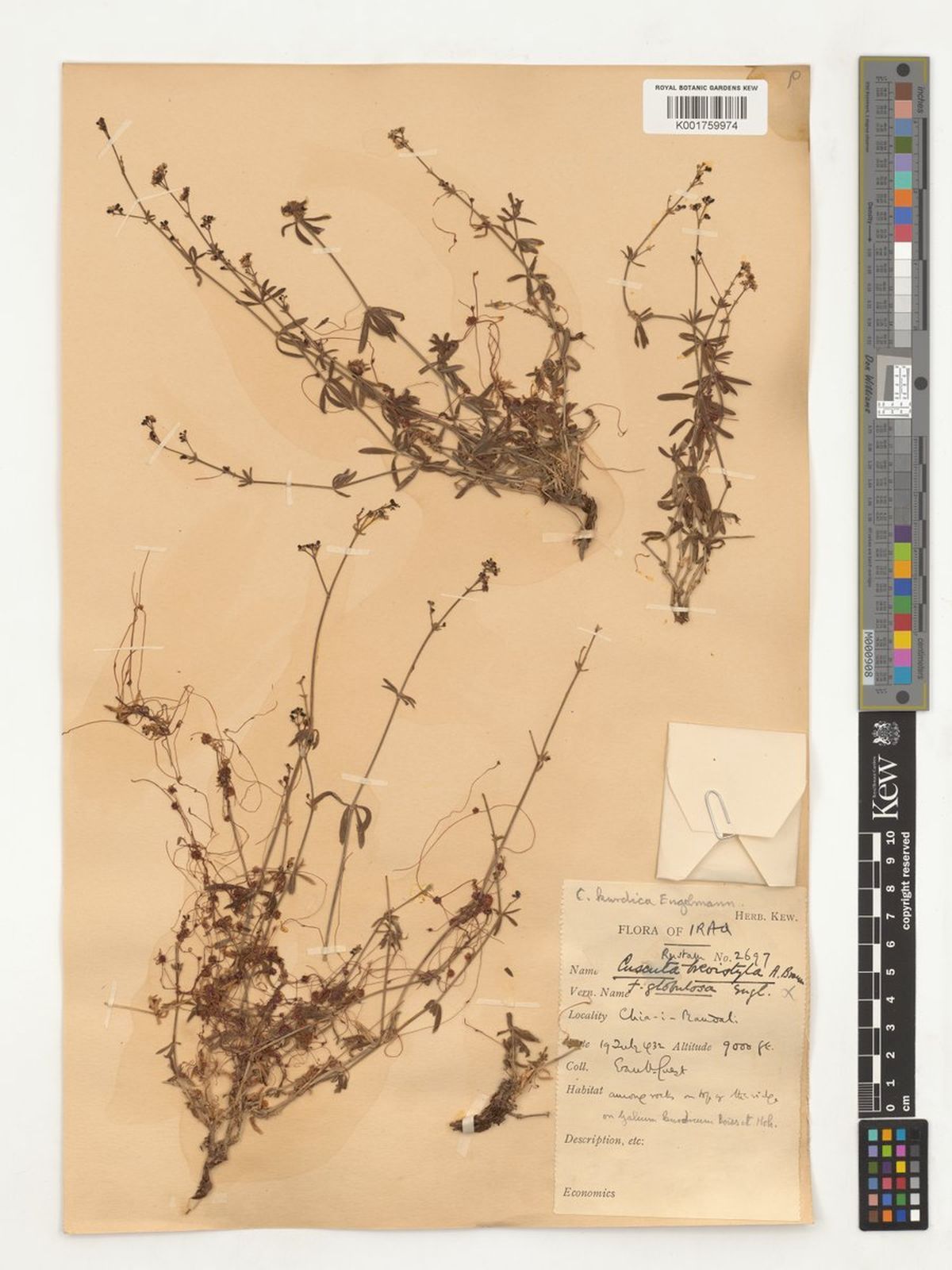
The Guest sheet shows how slippery these plants are. Its label first named it Cuscuta brevistyla; the name was crossed out and C. kurdica written above[6]. The 1962 gathering near Sine was labelled C. europaea by its collector[6]. And in 1967, on Sat Dağ above Gever (Yüksekova) in Colemêrg (Hakkari), Bakur, a dodder gathered together with C. approximata on a sage, Salvia microstegia, left the botanist Uzi Plitmann[4] torn between two names: "C. kurdica (but flowers & styles longer)", or "? C. approximata (but 4-merous)"[10].
High in the mountains of Kurdistan
Kew gives its range by state, from eastern Turkey to Afghanistan, with records from Iran, Iraq, Turkey and Afghanistan[5]. In Kurdish terms, the gatherings we could trace are all from the mountains of Başûr, Rojhilat and Bakur, and most of them are high:
- Başûr: Mount Gara, towards the summit, the type locality[6]; the northern side of Helgurd, at about 2,800 m, gathered by Ali Al-Rawi and I. Serhang for the National Herbarium of Iraq[6]; mountain ridges at 7,000 and 9,000 feet in 1932[6]; and Barankani in 2023, the only photographs of a living plant we found[3].
- Rojhilat: the botanist Heinrich Haussknecht (1838–1903)[4] collected it on Şaho and in Hewraman (Avroman), up to the snow, which Boissier and Yuncker give as 12,000 feet[9][2]; Boissier also names Cwanro (Javanrud) for this gathering[9]. Furse found it north of Sine (Sanandaj) at 6,500 feet[6].
- Bakur: Kotschy also gathered it "in dst. Warto", in the district of Gimgim (Varto) in the province of Mûş[2].
All the dated gatherings were made between mid-July and early September[6][6][6][10][3].
Fourteen chromosomes
The first chromosome count for C. kurdica was published only in 2022, more than 160 years after Engelmann described it. A karyological study of dodders by Taşar and colleagues counted 2n = 14, the same number as in C. europaea and several other dodders[11].
Kurdish names
No source we read records a Kurdish name that people use for this particular species in the field. Ehmedê Dirihî's dictionary of Kurdish plant names (2013) lists several dictionary names for Cuscuta kurdica, each made of a dodder name and kurdan, "of the Kurds"[12]:
- agirokê kurdan and mergvaşê kurdan[12];
- pêçekê kurdan[12], rêzilê kurdan[12] and riyezilê kurdan[12];
- zîncilê kurdan, with agiroka kurdan and gurikê kurdan[12].
For the dodders as a group, the same dictionary gives a long list of names: agirok, çor, giyakelegurge, hebênek, lerizîn, mergvaş, pêçok, porik, rêzil, riyezil, rizik, vaşo bêkok, zengereki and zerzerok[12]. Agirok is listed with the place code Amedîye, and riyezil with Pali[12]. These are names for dodders in general, not for this species alone.
Sources
- 1.Engelmann, G. (1859). Systematic arrangement of the species of the genus Cuscuta. Transactions of the Academy of Science of St. Louis 1 (C. kurdica on p. 470).
- 2.Yuncker, T. G. (1932). The genus Cuscuta. Memoirs of the Torrey Botanical Club 18: 113 ff.
- 3.abciNaturalist. observation 181240837 (Arya Aras, 2023). inaturalist.orghttps://www.inaturalist.org/
- 4.International Plant Names Index. Royal Botanic Gardens, Kew, Harvard University Herbaria and Australian National Herbarium.
- 5.Plants of the World Online. Royal Botanic Gardens, Kew.
- abcCuscuta kurdica; Cuscuta.
- plant_name_id 485145. powo.science.kew.orghttps://powo.science.kew.org/taxon/urn:lsid:ipni.org:names:267507-1accessed 14 November 2026
- 6.Royal Botanic Gardens, Kew – Herbarium Specimens. via GBIF. gbif.orghttps://www.gbif.org/dataset/cd6e21c8-9e8a-493a-8a76-fbf7862069e5
- abcdgnrherbarium specimens K000852597 and K000852598 (Kotschy 388 b, Mount Gara, 1841), via GBIF.
- efherbarium specimen K000852596 (J. Brant, Kurdistan), via GBIF; Harvard University Herbaria, GH 00054368.
- hjmqtherbarium specimen K001759971 (P. Furse 3450, 1962), via GBIF.
- iklpsherbarium specimens K001759975, K001759974 and K001759973 (E. Guest, Rustam Herbarium, 1932), via GBIF.
- oherbarium specimen K001759972 (A. Rawi & I. Serhang, National Herbarium of Iraq 24793, Helgurd), via GBIF.
- 7.abcdNatural History Museum Vienna (W) – Herbarium. via GBIF, herbarium specimen W 0050662 (Kotschy 388 b), via JACQ and GBIF; duplicates in other herbaria via GBIF.
- 8.abBrant, J. (1840). Notes of a journey through a part of Kurdistan, in the summer of 1838. Journal of the Royal Geographical Society of London 10: 341 ff.
- 9.Edmond Boissier (1879). Flora Orientalis, vol. 4. H. Georg, Geneva and Basel (Internet Archive).
- 10.abRoyal Botanic Garden Edinburgh Herbarium (E), specimen catalogue (via data.rbge.org.uk and GBIF). herbarium specimen E00388313 (Duncan & Tait 70a, 1967), via GBIF. data.rbge.org.ukhttps://data.rbge.org.uk/herb/
- 11.↩Taşar, N., Tekbudak, İ. K., Demir, İ., Açar, M. & Kürşat, M. (2022). Comparative karyological analysis of some Turkish Cuscuta L. (Convolvulaceae). Caryologia 75(3): 145–157. doi:10.36253/caryologia-1831https://doi.org/10.36253/caryologia-1831
- 12.Ahmet Kasımoğlu (Ehmedê Dirihî) (2013). Ferhenga Navên Nebatan a Kurdî (Dictionary of Kurdish Plant Names). Mardin Artuklu University, Institute of Living Languages in Turkey (ISBN 978-605-4202-12-6).
Last updated 20 November 2026