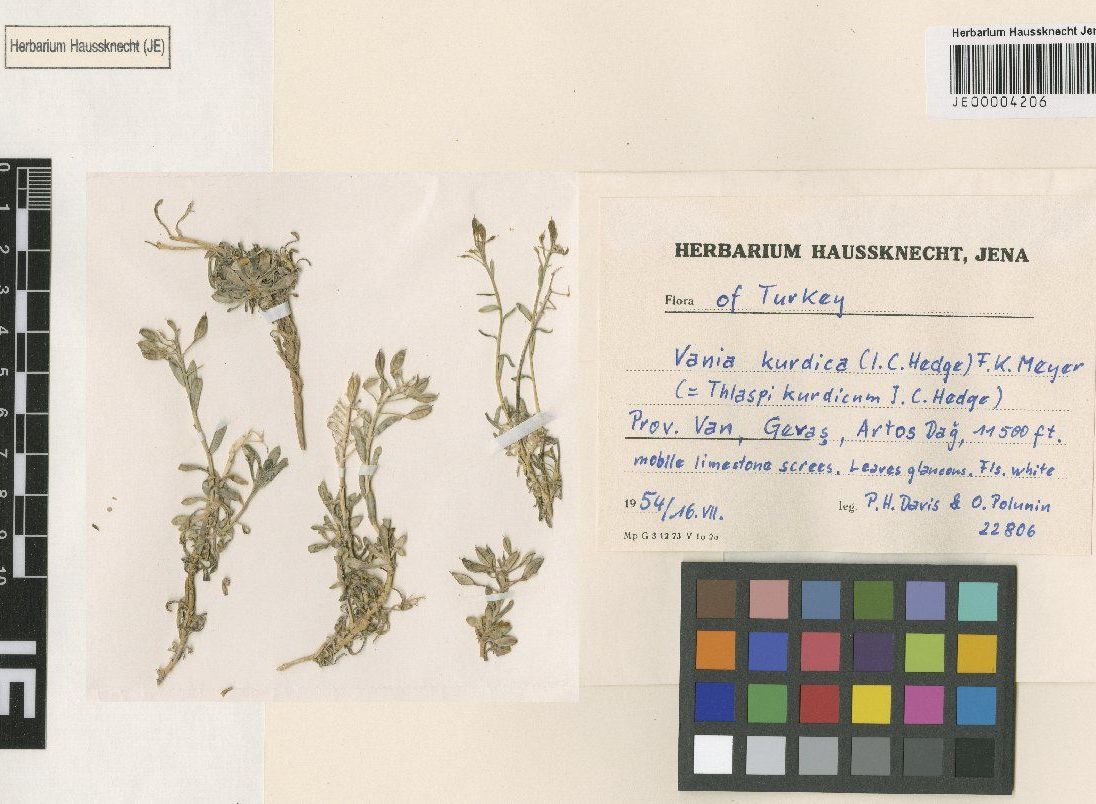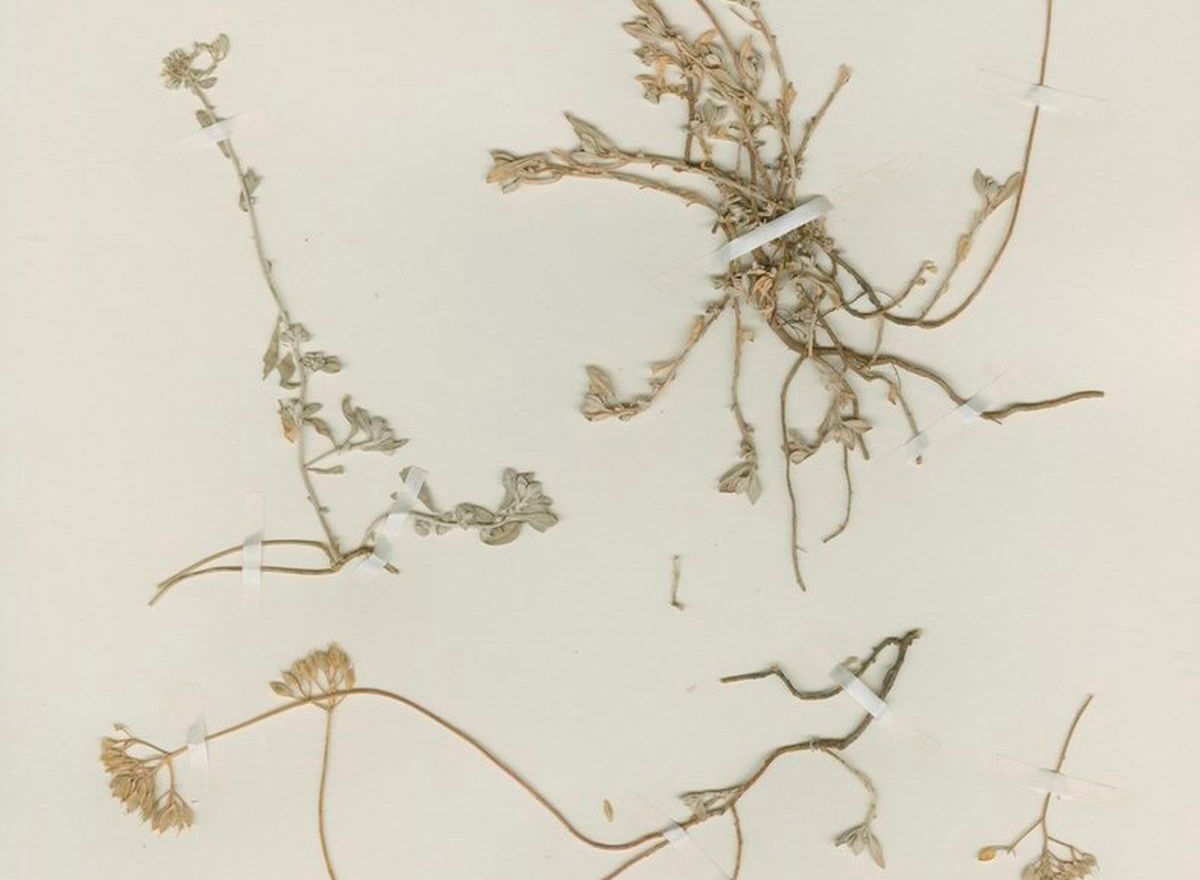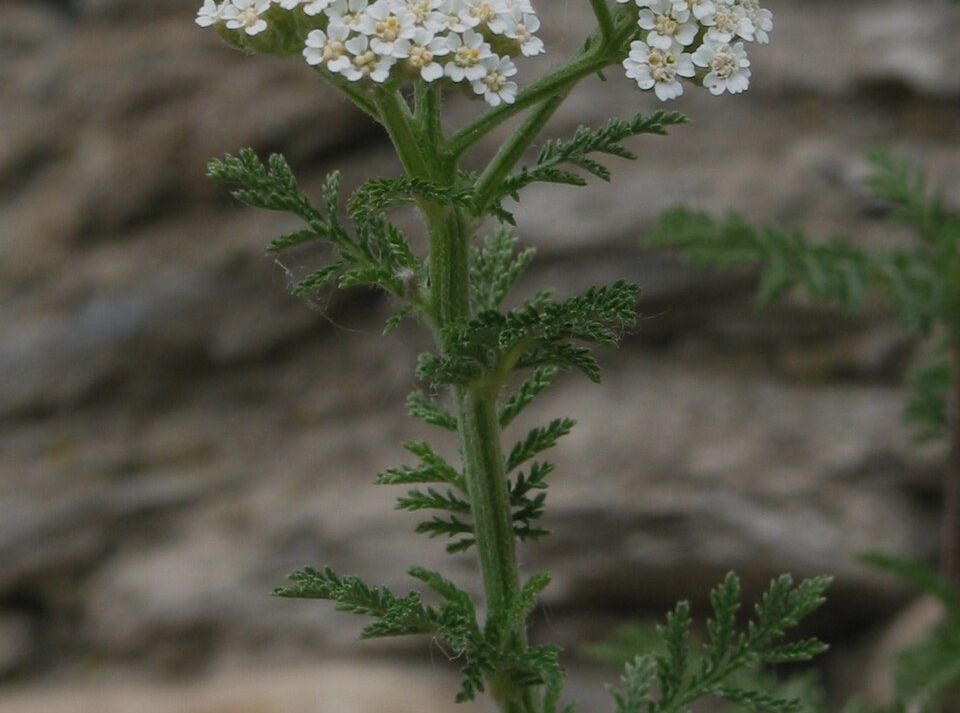
Noble yarrow is a white-flowered yarrow that old botanists knew by its smell of camphor[1], with a range that runs from Spain to Siberia[2]. In North Kurdistan (Bakur) it has a form of its own, Achillea nobilis subsp. kurdica, described in 1974 from rocky slopes in Agirî (Ağrı)[3]. Almost everything known about it still comes from a handful of herbarium sheets collected in the 1950s, 60s and 70s[4][5][6].
How it got its name
- Named by
- L., 1753Published in Sp. Pl. : 899
A yarrow that was "noble" before Linnaeus
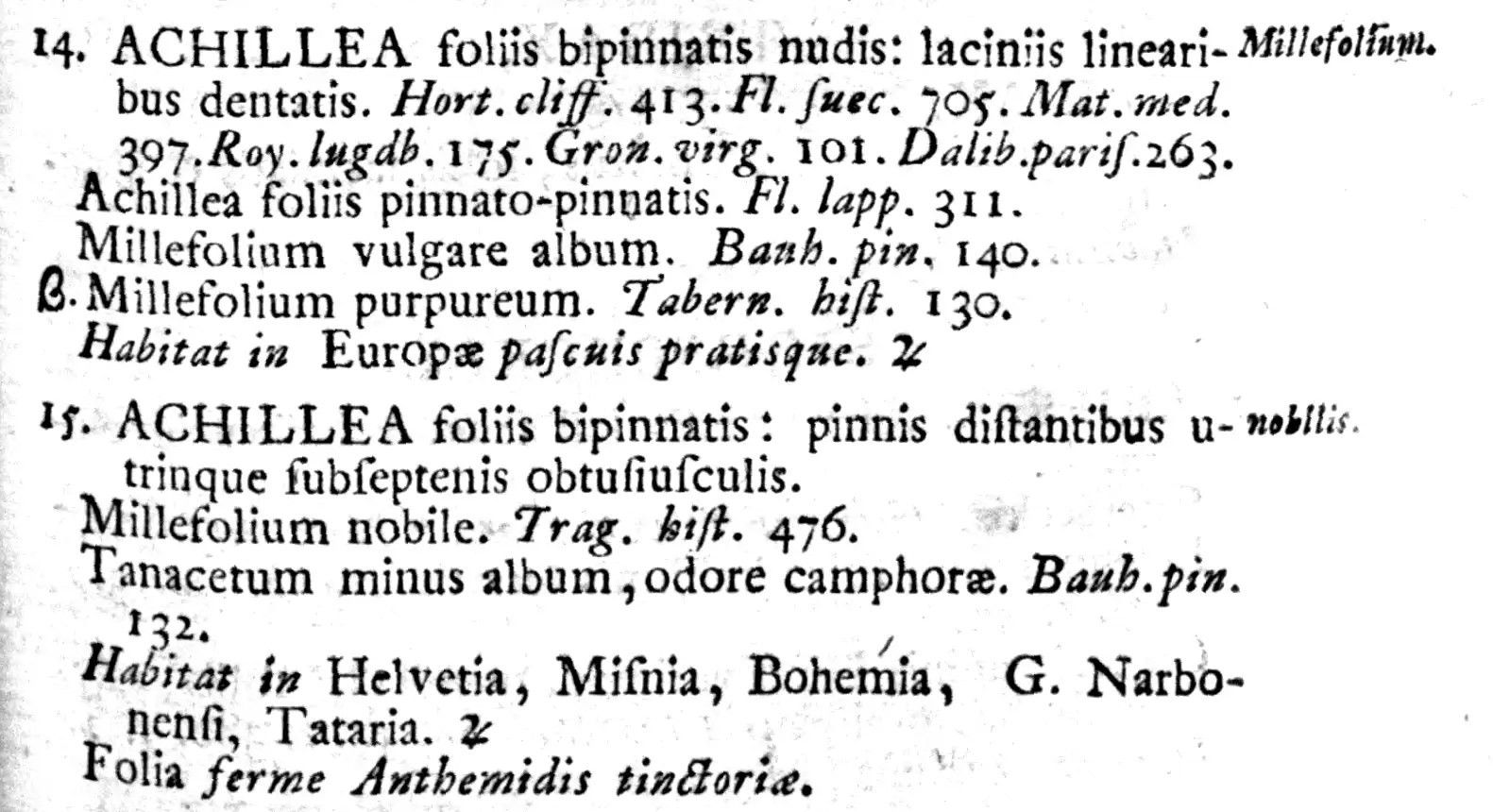
When Carl Linnaeus sorted the yarrows in his Species Plantarum of 1753, he gave this one the epithet nobilis and, as was his habit, listed the older names it had gone by. The first was Millefolium nobile, "noble milfoil" (our translation), from Tragus. The second, from Bauhin, is the more vivid: Tanacetum minus album, odore camphorae, "the lesser white tansy, with a smell of camphor"[1].
Linnaeus knew it from Switzerland, Meissen, Bohemia, the south of France and "Tartary", and added that its leaves were almost those of dyer's chamomile. On the same page, one entry above, stands its far better-known cousin, the common yarrow Achillea millefolium[1].
Achilles' herb, and a thousand leaves
Long before Linnaeus, Pliny the Elder wrote in his Natural History that Achilles, "the pupil of Chiron", discovered a plant that heals wounds, called achilleos after him, and that with it he cured Telephus. The Romans, Pliny added, called it millefolium[7]: "thousand leaves", which his 19th-century translators thought "probably identical" with the common yarrow[7].
Kurdish has a name built the same way. Ehmedê Dirihî's dictionary of Kurdish plant names gives hezarbelg for the common yarrow[8], from hezar, "thousand", and belg, "leaf" (our translation).
Found on the road to Tutak
On 2 June 1966 the botanist Peter Hadland Davis (1918–1992)[9], who compiled the series Materials for a Flora of Turkey[3], was collecting in Agirî[4]. Between 5 and 10 km out of Hamur on the road to Tutak, at 1,650 m, he gathered a yarrow on "rocky igneous slopes" and gave it his number 44111[3][4]. The next day he found it again 2 km south-west of Hamur, in the valley of the Murat, at 1,700 m[6].
Over the next two weeks the same yarrow turned up all along his route[3][6]:
- on dry meadows on the south shore of Lake Erçek in Wan (Van), at 1,900 m (5 June);
- on steppe between Gürpınar, which the label also calls Havasor, and Xoşab (Hoşap), at 1,850 m (10 June);
- on steppe slopes 26 km from Gever (Yüksekova) towards Şemzînan (Şemdinli), in Colemêrg (Hakkâri), at 2,000 m (15 June).
Only part of that last gathering is the new yarrow: the description cites Davis's number 45114 p.p., pro parte, "in part", so only some of the plants under that number belong to it[3].
The yarrows were worked up by Arthur Huber-Morath (1901–1990) of Basel, who was preparing a revision of the yarrows of Turkey[3][9]. He saw in these plants a new subspecies of noble yarrow, placed it in the section Millefoliatae, and named it kurdica, "Kurdish". It appeared in 1974 in Davis's Materials for a Flora of Turkey, a series for new or misunderstood plants, as one of "four new species and a new subspecies" of Achillea in a single issue[3]. That issue brought together the work of 13 botanists, published ahead of the Flora of Turkey's volume on the daisy family[3]. Davis 44111 became the holotype, the one specimen the name is tied to: it is kept at the Royal Botanic Garden Edinburgh, with a duplicate (isotype) at Kew[3][4][5].
What to look for
Huber-Morath's Latin description paints a sturdy, woolly plant (our translation)[3]:
- a perennial growing in loose tufts from a creeping rootstock, with several stems 35–70 cm tall, usually branched near the top, densely woolly with flat-lying hairs, finely ridged and up to 4.5 mm thick at the base;
- leaves two or three times finely divided into small pointed lobes; the basal leaves oblong, up to 10 cm long and 2 cm wide, cut not into a regular comb but irregularly, into lobes only 0.3–0.7 mm wide; the stem leaves elliptic or ovate in outline, up to 5 cm long and 2.5 cm wide;
- many small flower heads packed into a dense, compound, flat-topped cluster up to 7 cm across, itself covered in soft spreading hair;
- each head only 3–3.5 mm long and 2–2.5 mm wide, its bracts edged with a narrow brown rim, with about 15 disc florets 2 mm long and just 4 or 5 tiny ray florets, about 1 mm long and 1–1.2 mm wide, cream above and white beneath.
His entry does not say how it differs from the other subspecies of noble yarrow; he promised a full revision of the Turkish yarrows for a Swiss journal[3]. Today five subspecies of A. nobilis are accepted, kurdica among them[10].
Where it grows
Kew's checklist gives the species a wide range, from Europe to Siberia and the Caucasus, including Turkey, and so Bakur[2]. The Kurdish subspecies is known from far less. The herbarium sheets filed under its name come from[3][6]:
- Bakur: Agirî, Wan and Colemêrg (Davis, 1966, see above), and Dêrsim (Tunceli), 10 miles out on the road to Pülümür at 1,000 m, collected by Davis and I. C. Hedge on 7 June 1957[6];
- outside Kurdistan: one sheet at Edinburgh, gathered by the botanist Karl Heinz Rechinger (1906–1998)[9] on 14 July 1971 near Mianeh in Iranian Azerbaijan, at 900 m[6]. Kew's checklist does not list Iran for the species at all[2], so this record deserves a second look.
Put together, the records describe a yarrow of steppe, dry meadows and rocky igneous slopes between 900 and 2,000 m, collected in June and July[3][6]. As of November 2026, no one has posted a photograph of the subspecies to iNaturalist[11]. A photo from the hills around Agirî, Wan or Colemêrg in early summer would be the first.
Yarrows in Kurdish
No source we could open gives a Kurdish name for noble yarrow itself, but yarrows as a group have many names across Kurdistan:
- Bêjan, bêwîjan, gula mêş, gulikê maran, pûjang, printed under a photo of Achillea in the Kurdish Institute of Paris's Kurmancî in 2007[12]; three of them (bêwîjan, pûjang, gulikê maran) appear for the common yarrow in the same journal a year earlier[13]. Gulikê maran reads as "little flower of the snakes", gula mêş as "fly flower" (our translations).
- gulîlk mîsh, written down at Duhok in May 1932 for a yarrow that R. A. Blakelock of Kew described in 1949 as a new species, Achillea densa, noting that it was "not considered important for grazing"[14];
- buîzhan, recorded near Amêdî (Amadia) in 1932 for Achillea vermicularis[14];
- borchan and kevek, names for the common yarrow in Amêdî, where a decoction of the plant is taken as a tonic and for ulcers, colds and coughs[15];
- bomaran, the common yarrow's name in the Lilakh region of East Kurdistan (Rojhilat), where students named its flowering tops as a remedy for stomach complaints[16];
- hezarbelg, "thousand leaves", in Dirihî's dictionary[8].
These are records of traditional use of other yarrows, not of noble yarrow, and not medical advice.
Sources
- 1.abcLinnaeus, C. (1753). Species Plantarum. 2: 899. Biodiversity Heritage Library, page 358920.
- 2.Plants of the World Online. Royal Botanic Gardens, Kew.
- abcAchillea nobilis.
- plant_name_id 3110044. powo.science.kew.orghttps://powo.science.kew.org/taxon/urn:lsid:ipni.org:names:2332-2accessed 14 November 2026
- 3.abcdefghijklmHuber-Morath, A. (1974). Achillea. In: Davis, P. H. (comp.), Materials for a Flora of Turkey XXX: Compositae, I. Notes from the Royal Botanic Garden Edinburgh 33(2): 207–264 (pp. 208–211).
- 4.Royal Botanic Garden Edinburgh Herbarium (E), specimen catalogue (via data.rbge.org.uk and GBIF).
- abcdherbarium specimen E00181054, holotype of A. nobilis subsp. kurdica (via GBIF).
- barcode E00181054. api.gbif.orghttps://api.gbif.org/v1/occurrence/574874480accessed 14 November 2026
- 5.abRoyal Botanic Gardens, Kew – Herbarium Specimens. via GBIF, herbarium specimen K002332685, isotype (via GBIF). gbif.orghttps://www.gbif.org/dataset/cd6e21c8-9e8a-493a-8a76-fbf7862069e5
- 6.abcdefgHerbarium specimens of A. nobilis subsp. kurdica at Edinburgh (E00577887, E00577587, E00577847) and Kew (K002333071, K002332686, K002332684, K002332687), via GBIF.
- 7.Pliny the Elder. The Natural History, book 25, ch. 19. Trans. J. Bostock & H. T. Riley, vol. 5 (London: Bohn, 1856), p. 94.
- 8.abAhmet Kasımoğlu (Ehmedê Dirihî) (2013). Ferhenga Navên Nebatan a Kurdî (Dictionary of Kurdish Plant Names). Mardin Artuklu University, Institute of Living Languages in Turkey (ISBN 978-605-4202-12-6).
- 9.International Plant Names Index. Royal Botanic Gardens, Kew, Harvard University Herbaria and Australian National Herbarium.
- abcauthor records for Huber-Morath, P. H. Davis and K. H. Rechinger.
- urn:lsid:ipni.org:names:2332-2. ipni.orghttps://www.ipni.org/n/2332-2accessed 14 November 2026
- Achillea nobilis L. and A. nobilis subsp. kurdica Hub.-Mor.
- 10.↩GBIF.org GBIF Backbone Taxonomy and occurrence records. Backbone Taxonomy (from WCVP): subspecies of Achillea nobilis. gbif.orghttps://www.gbif.org/
- 11.↩iNaturalist. Achillea nobilis and A. nobilis subsp. kurdica, observation counts (November 2026). inaturalist.orghttps://www.inaturalist.org/
- 12.↩Ehmedê Dirihî (2007). Flora Kurdistanê (II). institutkurde.orghttps://www.institutkurde.org/publications/kurmanci/
- 13.↩Edîb Polat (2006). Flora Kurdistanê (I). institutkurde.orghttps://www.institutkurde.org/publications/kurmanci/
- 14.abBlakelock, R. A. (1949). The Rustam Herbarium, 'Iraq. Systematic List. Part II. Kew Bulletin 4(1): 41–42.
- 15.↩Shimal Ahmed Tahir (2017). Plant biodiversity and ethnobotanical properties of various plants in Amedi (Duhok, N. Iraq). tez.yok.gov.trhttps://tez.yok.gov.tr/UlusalTezMerkezi/
- 16.↩Adel Mohammadi, Zhina Bagheri (2025). Ethnobotanical study focused on students' awareness of medicinal plants in the Lilakh region, Kurdistan (in Persian). doi:10.22091/ethc.2025.12812.1056https://doi.org/10.22091/ethc.2025.12812.1056
- 17.F. Hooshidari (2009). Medicinal plants of Kurdistan province (گیاهان دارویی استان کردستان). ijmapr.areeo.ac.irhttps://ijmapr.areeo.ac.ir/article_7319.html
- 18.Catalogue of Life, vernacular names via the GBIF Backbone Taxonomy. api.gbif.orghttps://api.gbif.org/v1/species/3120024/vernacularNamesaccessed 14 November 2026
Last updated 20 November 2026