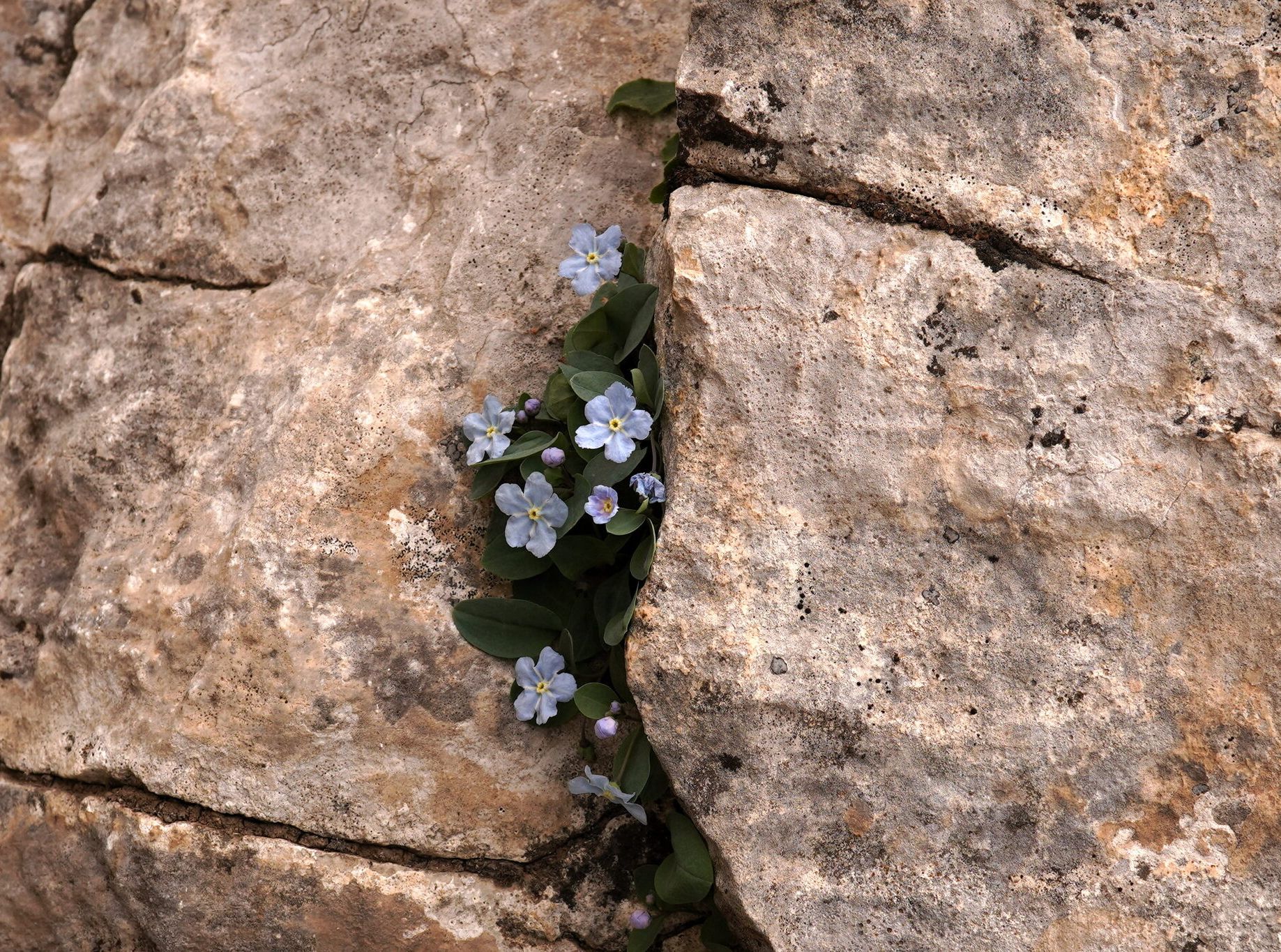
Omphalodes luciliae is a small, blue-flowered relative of the forget-me-nots that grows out of cracks in limestone cliffs, high in the mountains from Greece to the Zagros[1][2]. Its scientific name honours a woman who crossed Anatolia with her husband in 1842, and one of its five subspecies is named after Kurdistan: subsp. kurdica, first collected on the Qendîl range in Başûr in 1951 and known from a handful of high cliffs in Başûr, Bakur and the Zagros[2][3][4].
How it got its name
- Named by
- Boiss., 1844Published in Diagn. Pl. Orient. 4: 41
A flower for a fearless companion
In 1842 the Swiss botanist Edmond Boissier travelled through Greece and Anatolia with his young wife, Lucile Butini, whom he had married in June 1840[5][6]. She took, in the words of his obituary, "the keenest part in his endeavours" (our translation)[5]. In June 1842 Boissier collected in the alpine zone of Mount Cadmus (Honaz Dağı) in southwestern Anatolia, where a forget-me-not-like plant covered the cliffs[1][2].
He published it in 1844 as Omphalodes luciliae, "Lucile's Omphalodes", and closed his description with a dedication[1]:
Dicavi dulcissimæ conjugi in itinere longo difficilique indefessæ impavidæque sociæ, in detegendis colligendisque plantis Anatolicis utilissimæ adjutrici.
I have dedicated it to my dearest wife, my tireless and fearless companion on a long and difficult journey, and a most valuable helper in finding and collecting the plants of Anatolia.[1] (our translation)
She died young. In 1849, on a second journey to Spain, she died of a fever in Granada, on 8 July[5][6].
Boissier based the name on three gatherings: two of his own from Mount Cadmus in 1842 and one by the collector Pinard from Caria[2]. Because the species varies from place to place, the botanist J. R. Edmondson chose one of the Cadmus gatherings as its type in 1977, so that the name luciliae would stay with the narrow-leaved plant "which is widely cultivated in rock gardens"[2].
Carpets on the cliffs
Boissier was taken with the plant. He called it "a most beautiful species, a striking ornament of the Alps of southern Anatolia, growing out of the clefts in the rocks and clothing their walls with broad, dense carpets" (our translation)[1]. On Cadmus it grew on vertical, slightly damp rock faces that look north[1]. Later he described the same habit in his Flora Orientalis: breaking out of the fissures of vertical walls, often forming very wide, compact cushions[7].
Botanists call such plants chasmophytes, plants of rock crevices. Omphalodes luciliae is "a distinctive member of the chasmophyte community in the mountains of central Greece, W & S Anatolia, N Iraq and W Iran", and it grows almost only in limestone crevices[2]. Its genus, Omphalodes, has some 29 species in Europe and western Asia, Japan and North America; in English they are called navelworts or navel seeds[8].
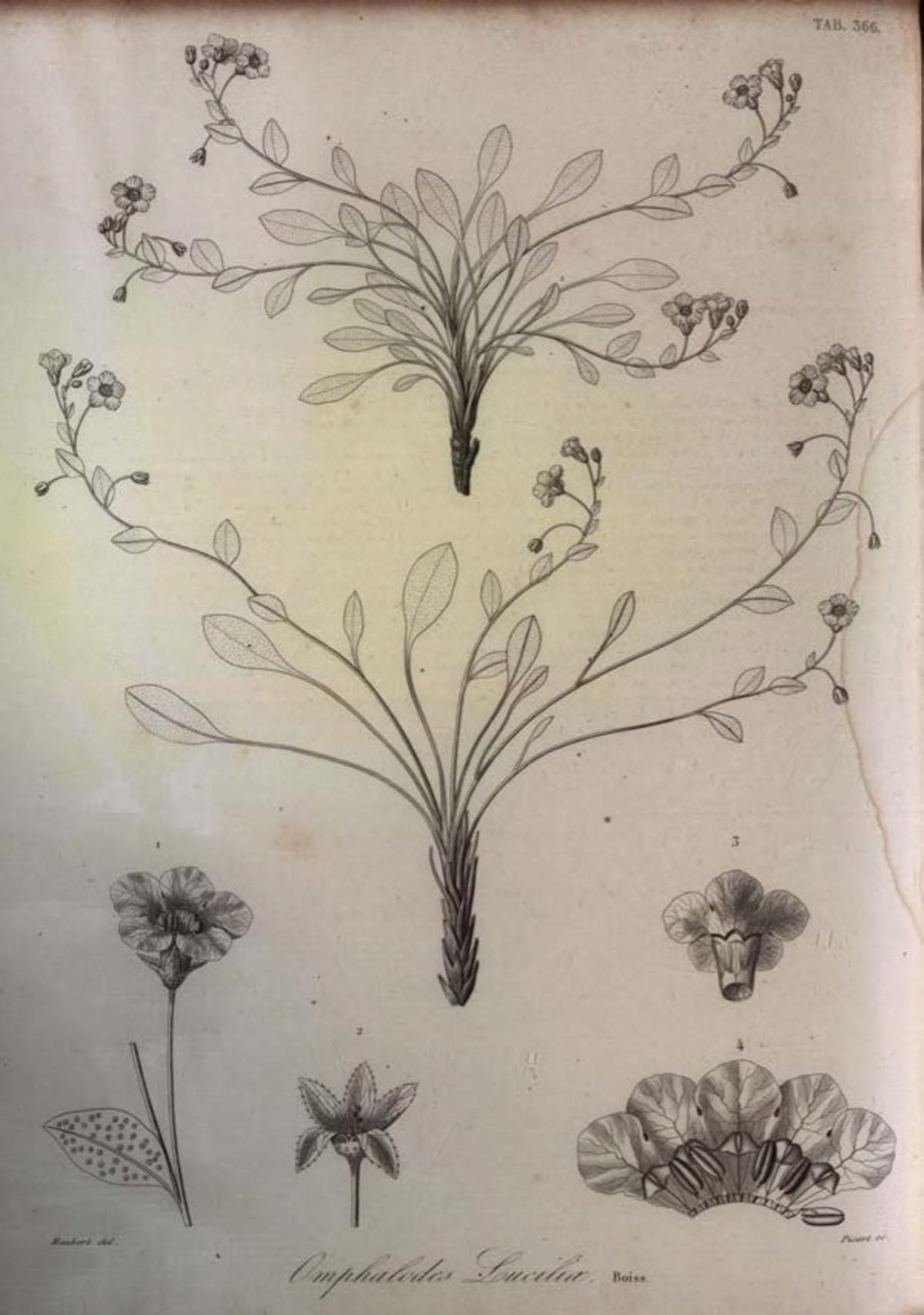
A few years after Boissier, the French botanists Hippolyte Jaubert and Édouard Spach gave the plant a full plate in their Illustrationes plantarum orientalium, drawn from Anatolian specimens in the Paris herbarium[9]:
Five subspecies, one of them Kurdish
The species turned out to be widespread but patchy: central Greece, western and southern Anatolia, northern Iraq and western Iran[2]. Botanists split it into subspecies that differ only slightly, in the shape of the leaves, the tiny bumps on the calyx and the shape of the small nutlets that hold the seeds[2][3]. In 1977 Edmondson recognised four, "weakly differentiated" and more or less separated by geography; one of them, subsp. scopulorum, he described himself in the same paper[2]. A fifth, subsp. pisidica, followed in 2011[3]. Five are accepted today: subsp. luciliae, cilicica, scopulorum, pisidica and kurdica[3][10].
The Kurdish one was named by Karl Heinz Rechinger (1906–1998) and H. Riedl, in the Boraginaceae volume of Flora Iranica in 1967[11]. Riedl had already written the name kurdica on the specimen in 1960, on a slip of the herbarium of Vienna's Natural History Museum[4]. The epithet kurdica, "Kurdish", points to where that specimen was found.
Thesiger on the Qendîl range
On 11 July 1951 the traveller Wilfred Thesiger was collecting plants in the Qendîl range on the frontier with Rojhilat, east of Qeladizê (Qala Diza)[4]. From 1950 he travelled in Iraq and Kurdistan[12]. A notebook of his at Eton College follows a later part of the same summer's journey "through Iraqi Kurdistan" day by day, from 23 July 1951, "commenting on the villages he passed through and the mountains he climbed"[13]; the Qendîl plants were pressed a little before it begins.
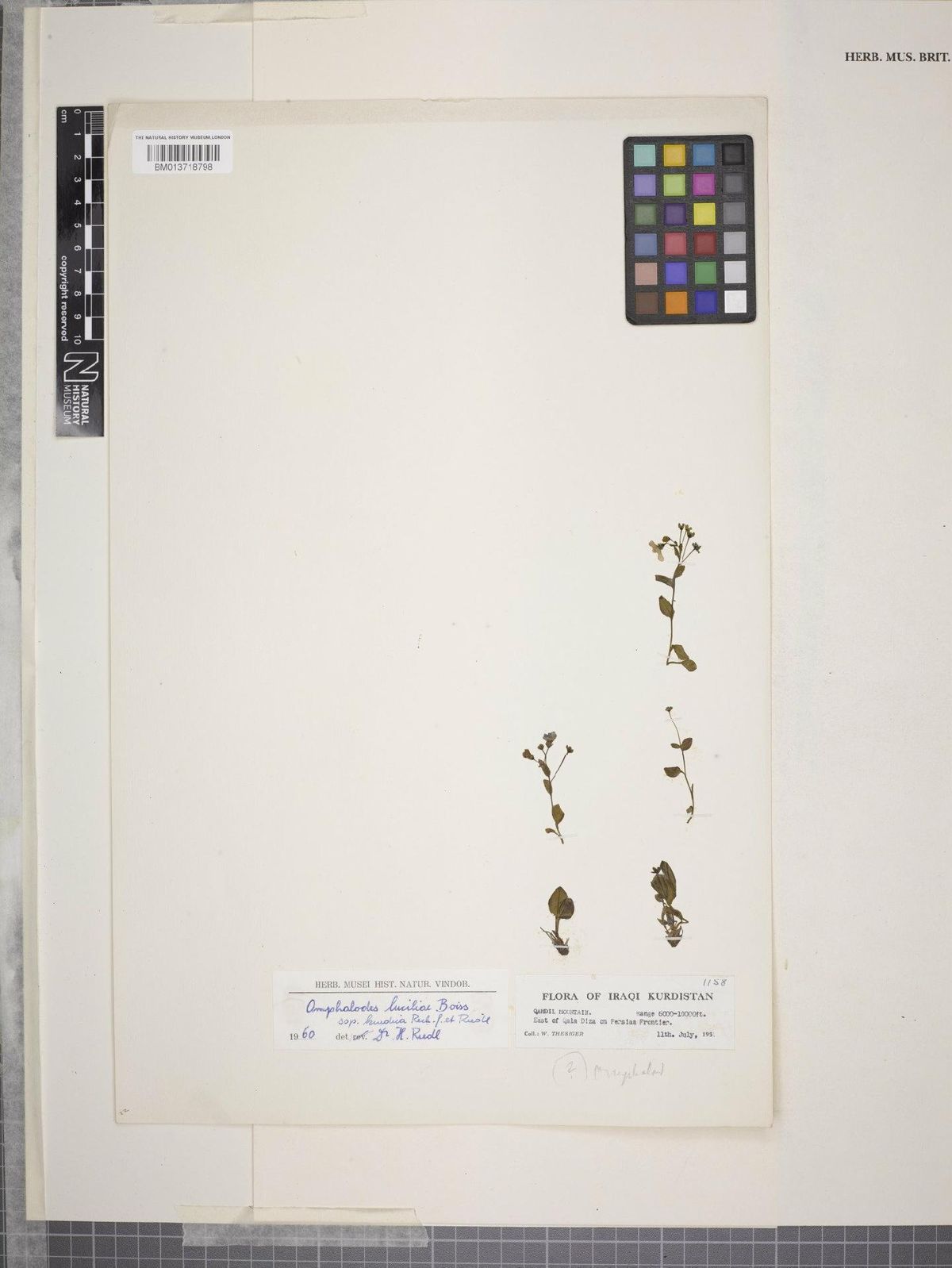
He pressed the small blue-flowered plant under the number 1158, on a label printed "Flora of Iraqi Kurdistan": "Qandil Mountain. Range 6000–10000 ft. East of Qala Diza on Persian Frontier"[4]. Edmondson later gave this as 1,800–3,000 m[2]. The same day, on the same mountain, he pressed number 1153, which later became the type of Crepis kurdica, another plant named after Kurdistan[14].
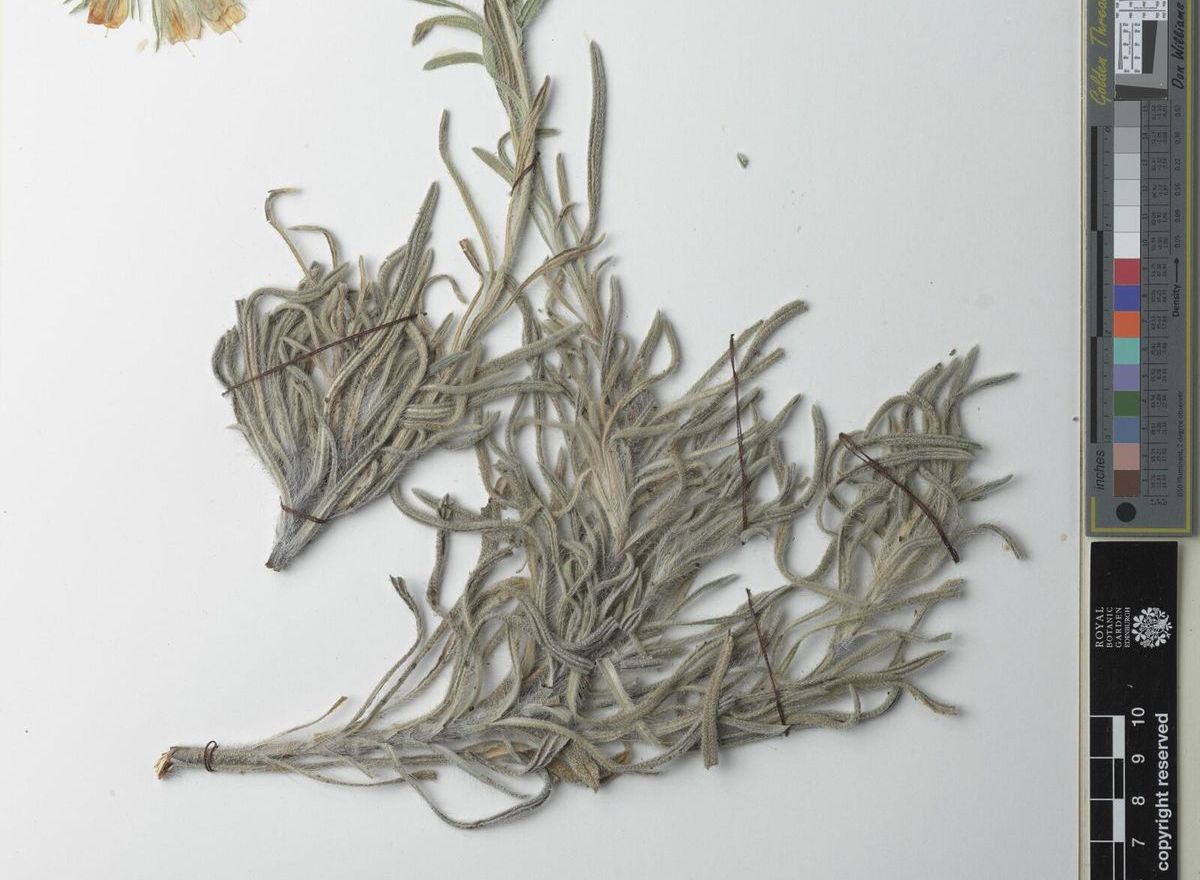
Sheet 1158 is now in the Natural History Museum in London. It is the holotype, the single specimen the name subsp. kurdica is tied to for good[2][4]:
"An inexplicable choice"
Rechinger and Riedl separated subsp. kurdica by two characters: basal leaves that are cut straight across at the base instead of narrowing into the stalk, and a much shorter corolla tube, about 3 mm against 6–7 mm[2]. Ten years later Edmondson, then a research assistant on the Flora of Turkey at the Royal Botanic Garden Edinburgh, revised the species and agreed with the leaves, but not with the tube[2]. In the typical subspecies he never found a tube longer than about 4 mm: 3–3.5 mm in pressed specimens, about 4 mm in living plants grown in the Edinburgh garden. He called the tube character "an inexplicable choice"[2]. He also noted that their diagnosis made no mention of subsp. cilicica, which has the same straight-cut leaf base[2].
The subspecies still stood, on its leaves and on its nutlets: triangular-ovate, clearly broader than long, with a pointed tip and only a narrow, indistinct rim, about 0.4 mm[2]. Edmondson saw those nutlets on a mainly fruiting specimen from the Zagros, Archibald 3048; the plants from the Qendîl range and the Sat mountains matched it in habit, so he put all three under kurdica, a subspecies "weakly delimited from subsp. cilicica[2]". Even so, the lines were not easy to draw. In August 1976 Edmondson put a slip on a Kew sheet of Fedden and McColl's plants from the Sat mountains naming them subsp. cilicica[14]; in his paper the following year he placed their gathering under kurdica[2].
What to look for
- A low, hairless, tufted perennial with a thick rootstock, forming dense cushions in rock crevices[1][7].
- Long-stalked basal leaves, oblong and blunt, the blade about 2–3 cm long on a stalk of about 5 cm, dotted with small chalky specks[1]. In subsp. kurdica (with measurements Edmondson's key gives for three of the subspecies together) the blade is ovate, (1.5–)2–4.5 cm long and (0.8–)1.2–3.5 cm wide, green or only slightly bluish-grey, cut straight across at the base and narrowing abruptly into the stalk; the oldest leaves usually carry well-developed chalky, bristly bumps[2].
- Many simple, leafy stems, mostly 2.5–7.5 cm long, barely longer than the leaves, with loose clusters of 5–7 flowers on stalks that arch back in fruit[1].
- Blue flowers, twice as large as those of the spring navelwort (Omphalodes verna) or more[1][7]; occasional white-flowered plants have been reported[2]. On the Kurdish cliffs, collectors noted them as "pale blue"[15][14], or "blue (and pink, in some plants)" on plants 3–6 inches tall in the Sat mountains[14].
- In fruit, a small calyx, only about 6 mm across, with its lobes curved inward, and nutlets with an entire, untoothed rim[2].
Where it grows
Its home is high limestone: cliffs, gullies and screes. The eastern records that Edmondson brought together took the species to 3,200 m in Bakur, up to 3,000 m in Başûr and over 4,000 m in the Zagros[2]. Mill gives the Kurdish subspecies a range in the far southeast of Turkey, the northwest of Iran and the north of Iraq[3]. The specimens actually cited are from the mountains of Bakur and Başûr, and from the Bakhtiari Zagros outside Kurdistan; we found no published record from Rojhilat itself, although the Qendîl type was gathered on its border[2][4]. The specimens:
- Başûr: the Qendîl range east of Qeladizê, Thesiger's type, 11 July 1951[4].
- Bakur: the Sat mountains, which Dirihî's dictionary calls Çiyayê Satê, in Colemêrg (Hakkâri), at 3,200 m, "growing in shady rocky clefts", July 1965, collected by R. Fedden and P. M. McColl[2][14][16]. Near Gever (Yüksekova), at Vadinasor Tepe, 22 km northeast of the town, at 2,000 m, on "large shaded limestone walls" at the head of a mountain gully, June 1977[15]; and on Suryan Tepe, 24 km northeast of Gever, at 2,750–3,000 m, on bare limestone screes, "common, local", June 1966, a gathering named only to the species[14].
- Further down the Zagros: in the Bakhtiari mountains, on Zardeh Kuh and at Tang-e Sirdan, at 4,140 m, collected by J. C. Archibald in August 1966, the first records from Iran[2][15].
The Kurdish plants were found in flower from mid-June to mid-July[4][14][15][14]; in Anatolia Boissier gave June[1].
No Kurdish name yet
None of the Kurdish sources we checked records a name for this plant. Ehmedê Dirihî's dictionary of Kurdish plant names lists the Kurdish subspecies, but in place of a name its Kurdish column reads Çiyayê Satê, "the Sat mountains", where the plant grows[16]. The same dictionary uses that column for places elsewhere too: for one oak it notes Çiyayê Cîloyê û Çiyayê Satê hene, "they are on the Cîlo and Sat mountains" (our translation, to be checked by a Kurdish reader)[16]. If you know a Kurdish name for this little cliff flower, we would like to hear it.
Sources
- 1.Boissier, E. (1844). Diagnoses Plantarum Orientalium Novarum, ser. 1, 1(4). Genève.
- abcdefghijk
- Diagn. Pl. Orient. ser. 1, 4: 41. archive.orghttps://archive.org/details/e.-boissier-diagnoses-plantarum-orientalium-novarum-series-1-vol.-1-no.-1-7-1843-1846/page/n301/mode/1upaccessed 14 November 2026
- p. 41. archive.orghttps://archive.org/details/e.-boissier-diagnoses-plantarum-orientalium-novarum-series-1-vol.-1-no.-1-7-1843-1846/page/n301/mode/1upaccessed 14 November 2026
- 2.Edmondson, J. R. (1977). Omphalodes. In: Davis, P. H. (comp.), Materials for a Flora of Turkey XXXIV: Boraginaceae, Gentianaceae, Solanaceae. Notes from the Royal Botanic Garden Edinburgh 35(3): 300–302.
- 3.Mill, R. R. (2011). A new subspecies of Omphalodes luciliae (Boraginaceae) from Turkey. Edinburgh Journal of Botany 68(2): 159–163. doi:10.1017/S0960428611000035https://doi.org/10.1017/S0960428611000035
- 4.abcdefghNatural History Museum, London, herbarium specimen BM013718798, Thesiger 1158 (holotype of subsp. kurdica, via GBIF).
- 5.Ascherson, P. (1886). Edmond Boissier. Berichte der Deutschen Botanischen Gesellschaft 4: XIII–XVI.
- 6.González Bueno, A. (2010). El viaje botánico de Pierre Edmond Boissier por el sur de España (1837). Acta Botanica Malacitana 35: 5–21.
- 7.abcEdmond Boissier (1879). Flora Orientalis, vol. 4. H. Georg, Geneva and Basel (Internet Archive), 4: 267. archive.orghttps://archive.org/details/floraorientaliss04bois
- 8.↩Otero, A., Jiménez-Mejías, P., Valcárcel, V. & Vargas, P. (2014). Molecular phylogenetics and morphology support two new genera (Memoremea and Nihon) of Boraginaceae s.s. Phytotaxa 173(4): 241–277, p. 242. doi:10.11646/phytotaxa.173.4.1https://doi.org/10.11646/phytotaxa.173.4.1
- 9.↩Jaubert, H. F. & Spach, E. (1850). Illustrationes plantarum orientalium. 4, plate 366.
- 10.↩GBIF.org GBIF Backbone Taxonomy and occurrence records. Backbone Taxonomy: Omphalodes luciliae, accepted subspecies. gbif.orghttps://www.gbif.org/
- 11.International Plant Names Index. Royal Botanic Gardens, Kew, Harvard University Herbaria and Australian National Herbarium.
- ↩Omphalodes luciliae Boiss. and subsp. kurdica Rech.f. & H.Riedl.
- urn:lsid:ipni.org:names:119475-1. ipni.orghttps://www.ipni.org/n/119475-1accessed 14 November 2026
- 12.↩Middle East Centre Archive, St Antony's College, Oxford: Wilfred Thesiger Collection (GB165-0545), catalogue.
- 13.↩Eton College Archives (1951). MS 433/06/04/02: Wilfred P. Thesiger's Iraq, Kurdistan, Marshes notebook.
- 14.Royal Botanic Gardens, Kew – Herbarium Specimens. via GBIF. gbif.orghttps://www.gbif.org/dataset/cd6e21c8-9e8a-493a-8a76-fbf7862069e5
- 15.Royal Botanic Garden Edinburgh Herbarium (E), specimen catalogue (via data.rbge.org.uk and GBIF). data.rbge.org.ukhttps://data.rbge.org.uk/herb/
- 16.Ahmet Kasımoğlu (Ehmedê Dirihî) (2013). Ferhenga Navên Nebatan a Kurdî (Dictionary of Kurdish Plant Names). Mardin Artuklu University, Institute of Living Languages in Turkey (ISBN 978-605-4202-12-6).
- Plants of the World Online. Royal Botanic Gardens, Kew, plant_name_id 2390256. powo.science.kew.orghttps://powo.science.kew.org/taxon/urn:lsid:ipni.org:names:119475-1accessed 14 November 2026
Last updated 20 November 2026