Noccaea kurdica is a small, blue-grey perennial of the high mountains of Kurdistan. It creeps through loose stone on woody underground shoots and sends up short stems of white flowers[1][2]. It has been collected on a handful of high mountains in Bakur, in the provinces of Wan (Van) and Colemêrg (Hakkari), and on Helgurd and Qendîl in Başûr, always between about 2,600 and 3,600 metres[1][2][2][3][3]. In half a century botanists have moved it through four different genera, and the man who named it admitted from the start that its limits were a puzzle[1][4].
How it got its name
- Named by
- (Hedge) Al-Shehbaz, 2014Published in Harvard Pap. Bot. 19: 41
In the scree on Artos, July 1954
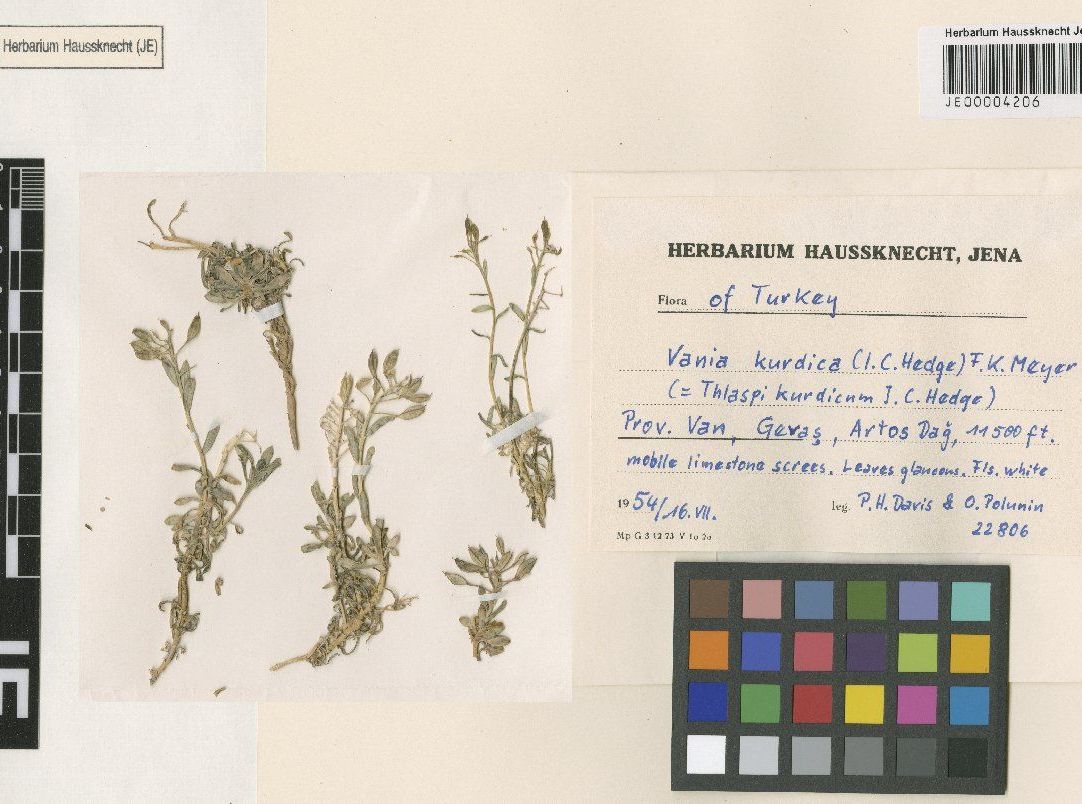
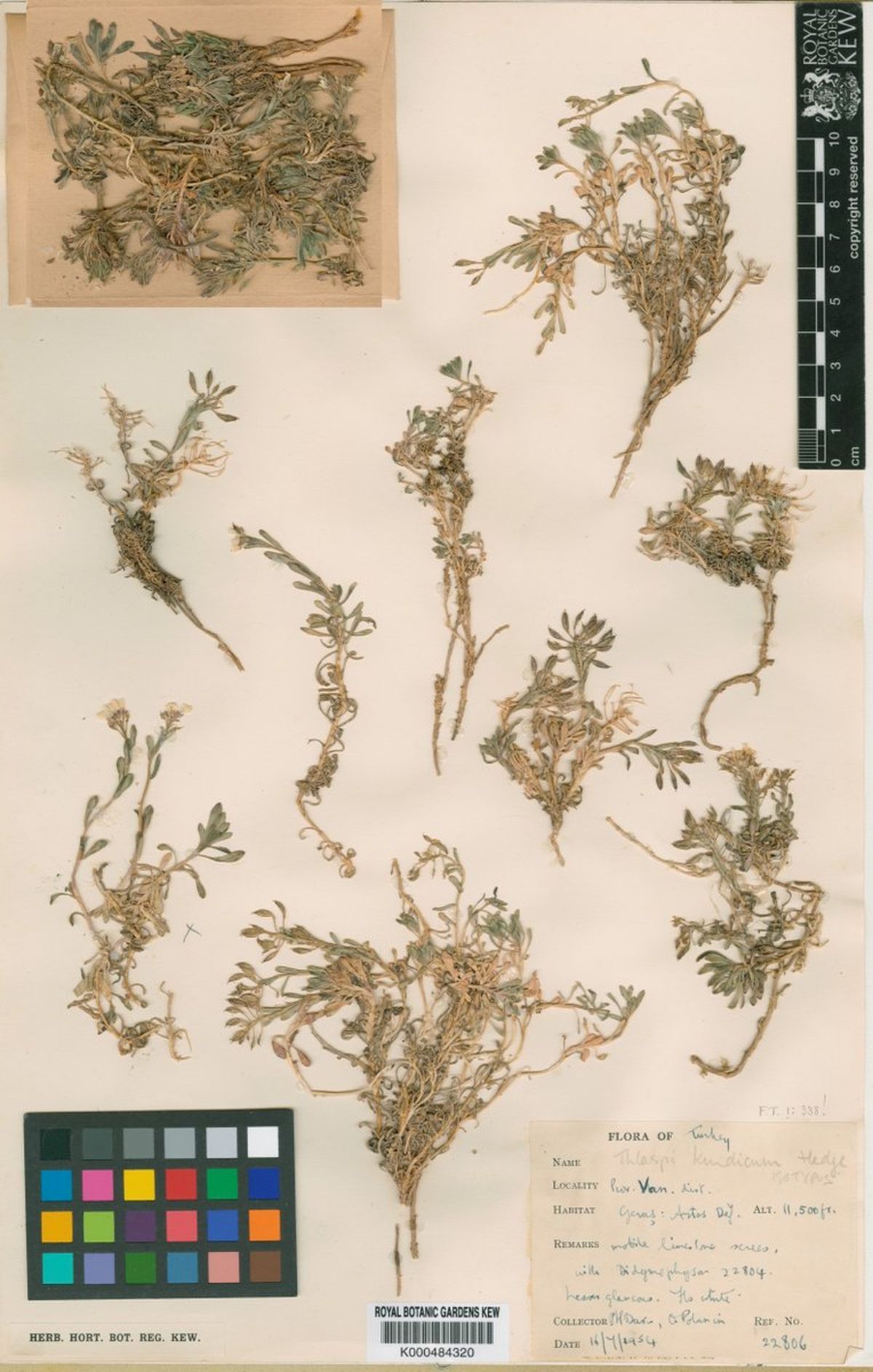
In July 1954 the botanists Peter Hadland Davis (1918–1992)[4] and Oleg Polunin were collecting in the mountains of Wan. On Artos, in the district of Westan (Gevaş), at 11,500 feet (about 3,500 m) by their label, they found a little plant growing in mobile limestone scree, together with Didymophysa. Their label adds just two notes: "Leaves glaucous. Fls white."[2][3]. Glaucous means covered in a fine waxy bloom, the blue-grey sheen of a plum.
A week later they found the same kind of plant on the screes of Kavuşşahap Dağ in the district of Şax (Çatak), at 3,200 metres[1], and on 31 July on the summit scree of Ispiriz Dağ in the district of Elbak (Başkale), at 3,500 metres[2]. The Artos gathering, number 22806, was split between herbaria: the main sheet went to Edinburgh, duplicates to Kew, the Natural History Museum in London and Jena[1][2][3][5].
A plant nobody could quite place
The specimens went to Ian Charleson Hedge (1928–2022)[4] at the Royal Botanic Garden Edinburgh. In 1961 he described them as a new species, Thlaspi kurdicum[1]. The epithet means "Kurdish", after the land where it was found: Hedge wrote of "the three Davis specimens from Kurdistan" and of how little herbarium material of this group had come "from the high alps of Kurdistan"[1]. Thlaspi is the genus of the pennycresses, among them Thlaspi arvense[6].
Hedge was candid about his doubts. He placed it among a group of dwarf species around Thlaspi pumilum, and noted that it also looked like another plant, Eunomia caespitosum, "especially in fruit shape"[1]. Still, he concluded that "it has all the technical characters of a Thlaspi"[1]. He put it in a section of the genus called Apterygium, "the wingless ones", and then noticed that the not quite ripe fruit of his main specimen had "a slight but distinct wing at the upper part", though he pointed out that a European member of the same section, Thlaspi rotundifolium, varies in just the same way[1]. The three gatherings did not even agree with each other in the way the seedling root lies folded inside the seed[1]. He kept only two of them in the species, left a third "of unknown status", and ended with a sentence that still reads like an invitation[1]:
Only more gatherings and field observations can elucidate the problem.
Four genera in fifty years
What followed proved him right to be careful:
- 1961: Thlaspi kurdicum Hedge[1][4].
- 1973: The botanist Friedrich Karl Meyer (1926–2012), who split several genera off Thlaspi[7], created a new one, Vania, for this group. Under it he named three species: Vania kurdica and two new ones, V. campylophylla and V. pulvinata[4]. In other words, what Hedge had treated as one plant became three[8]. Meyer's own handwriting, Vania kurdica, is still on the Jena duplicate[5], and he re-determined the Edinburgh holotype in 1969[3].
- 2013: The botanist Vladimir Dorofeev moved it to Apterigia, a genus first named in 1970[4].
- 2014: Ihsan Al-Shehbaz moved it, with Meyer's two other species, into the large genus Noccaea, as Noccaea kurdica[4]. That is the name Kew's checklist accepts today[9].
The argument is not over. A 2019 study of the genus's DNA called Noccaea "taxonomically one of the most problematic genera of the Brassicaceae", the cabbage family, and noted that some botanists still treat the old splinters of Thlaspi as separate genera, while others fold them all into Noccaea[10]. DNA has since been read from a plant of this species collected on Ispiriz[11], and Kew has banked material from the Helgurd sheet below for DNA work[2].
What to look for
Hedge's description and Davis's labels give the field marks[1][2]:
- a perennial with a woody rootstock and long, creeping underground shoots;
- short flowering stems, only a few centimetres high;
- narrow, oblong leaves with smooth, untoothed edges, those of the basal rosettes about 1 cm long;
- the whole plant covered in a blue-grey waxy bloom;
- small white flowers, with a calyx of about 3 mm;
- small, flattened seed pods.
The narrow, untoothed leaves and the bloom over every part of the plant were what Hedge used to tell it apart from all its relatives[1].
On Helgurd and Qendîl, 1957
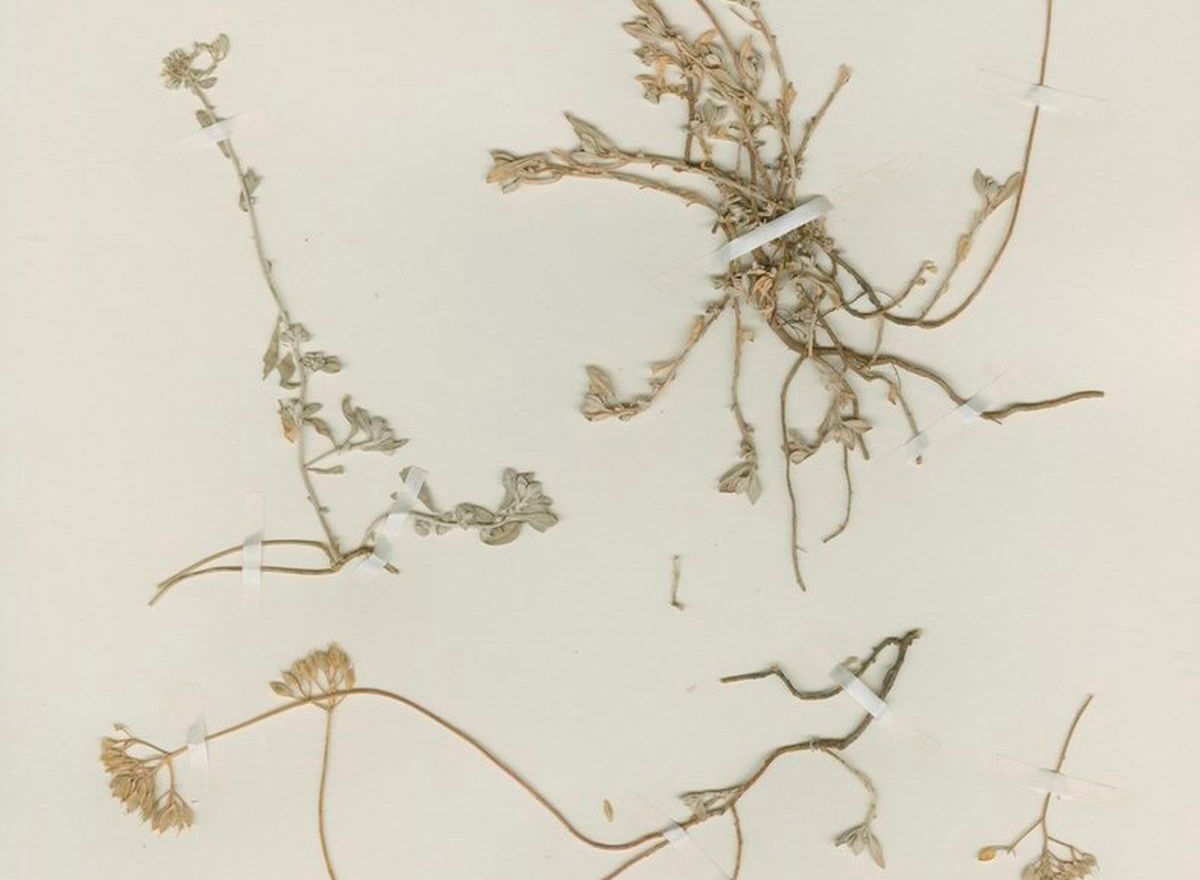
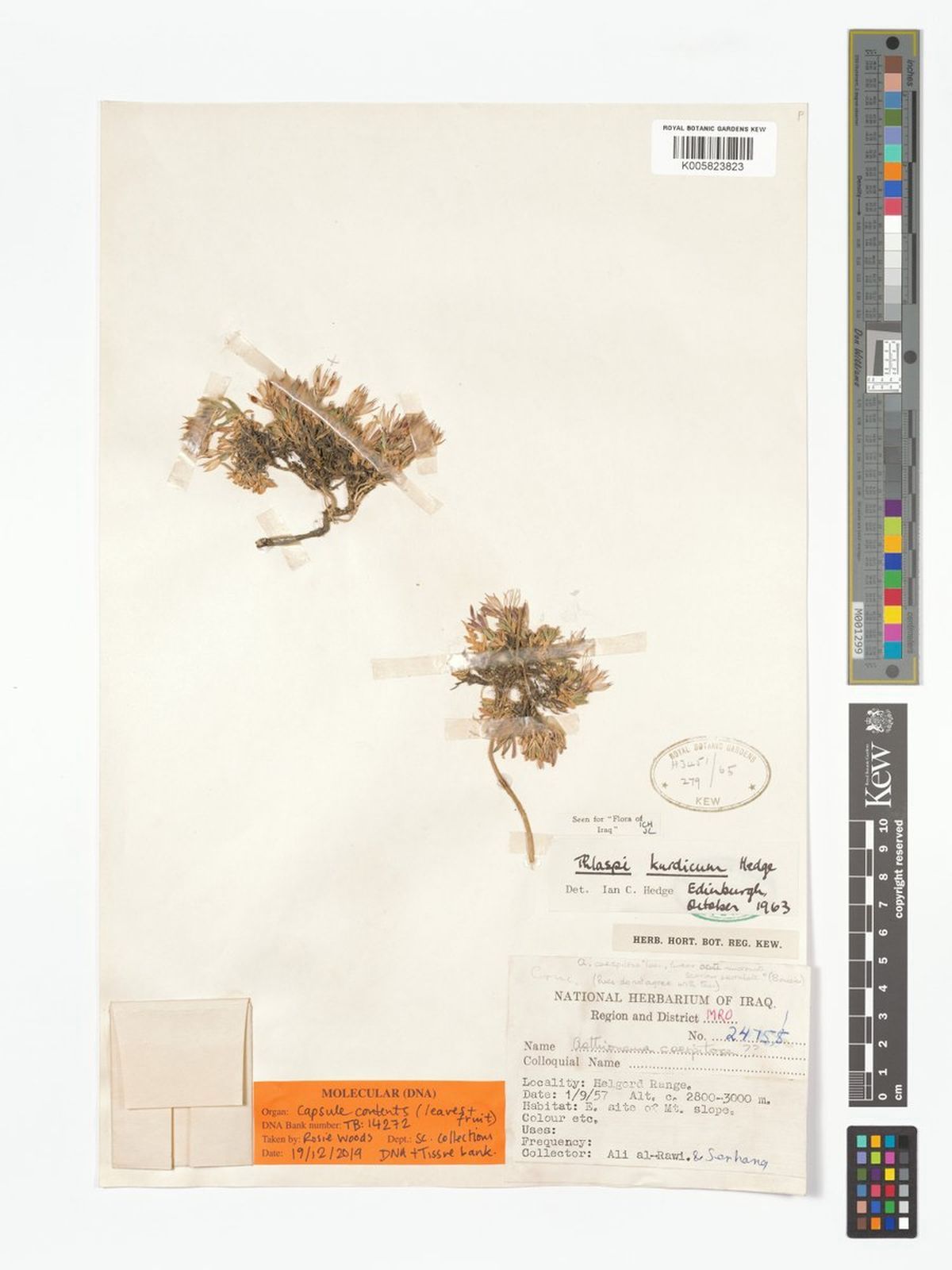
Three years after Davis and Polunin, the plant turned up across the mountains in Başûr. In late summer 1957 the botanist Ali al-Rawi[4] and Serhang, collecting for the National Herbarium of Iraq, worked high in these mountains. On 26 August they pressed a small tuft on a mountainside north-east of Qendîl (Qandil), at 2,850–3,100 m, and on 1 September another on the east side of a slope in the Helgurd range, at 2,800–3,000 m[2].
Their printed labels have a line for "Colloquial Name", and on both it is blank. On the Helgurd sheet the line for the scientific name holds only a faint, hesitant guess, Aethionema caespitosa, followed by two question marks[2]. Hedge, too, had noted a likeness to a plant with the same second name, Eunomia caespitosum[1]. Both sheets ended up at Kew; in October 1963, in Edinburgh, Hedge himself named them Thlaspi kurdicum[2]. In 2019 Kew took material from the Helgurd tuft for its DNA bank[2].
Where it grows
Kew's checklist gives its range as eastern Turkey, recorded from Turkey and Iraq, and calls it a perennial of subalpine climates[9]. In Kurdish terms, it is a plant of the high mountains of Bakur and Başûr. The records we found:
- Bakur, around Wan: Artos in the district of Westan (Gevaş), limestone scree, about 3,500 m (1954)[1][2]; Kavuşşahap Dağ in the district of Şax (Çatak), 3,200 m (1954)[1]; Ispiriz Dağ in the district of Elbak (Başkale), summit scree, 3,500 m (1954)[2]; the north side of the Güzeldere pass on the road from Wan to Colemêrg, in fissures and crevices of gneiss at 2,700 m (1985), and again on a hilltop by the pass at 2,750–2,900 m (2002)[3][12].
- Bakur, Colemêrg (Hakkari): Mor Dağ, 3,250 m (1967)[3].
- Başûr: north-east of Qendîl, 2,850–3,100 m, and the Helgurd range, 2,800–3,000 m (both 1957)[2].
So it is not only a limestone plant: on the Güzeldere pass it was found in cracks of gneiss[3]. What the places share is height, loose rock and a short summer.
In July 2025 an iNaturalist user posted photographs of a dried plant as Noccaea kurdica, from the mountains near Çoman (Choman)[13]. No one else has confirmed the identification yet, so it is a lead, not a record. If it holds, the plant is still where al-Rawi and Serhang found it almost seventy years ago.
The species has not been assessed for the IUCN Red List[14].
A second life in rock gardens
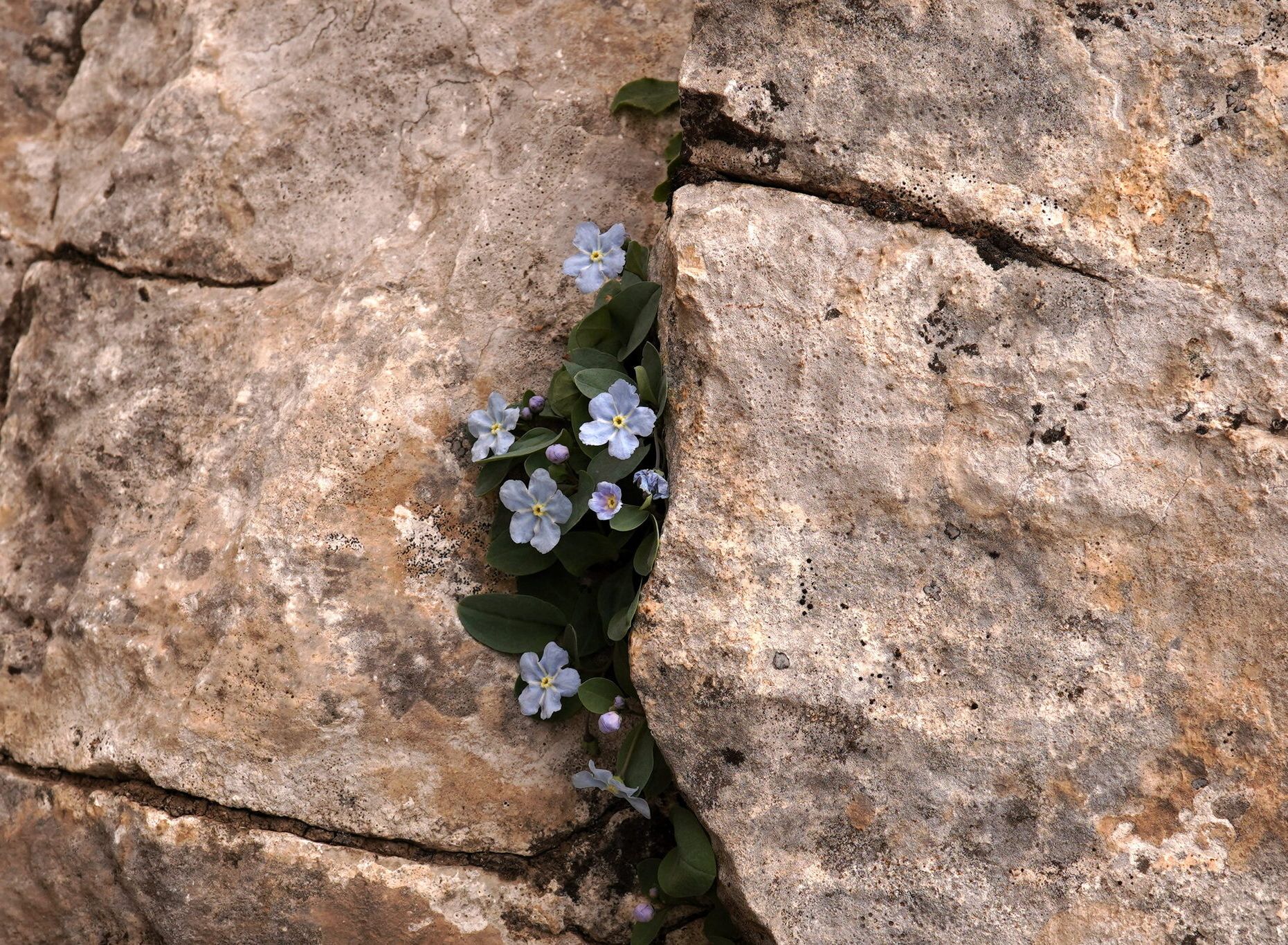
Alpine gardeners have grown it too. The Royal Botanic Garden Edinburgh lists living accessions collected on Kavuşşahap in 1993, and the Jardin botanique de Montréal one collected on Artos in 2006[3]. The photograph at the top of this page shows a cultivated plant in Montréal in early spring, its flower buds still tinged pink.
Its name in Kurdish
No Kurdish name was written down with any of the specimens: on the Iraqi labels the "Colloquial Name" line is empty[2].
In print, the name Thlaspi kurdicum has met Kurdish in two places:
- The plant list Flora Kurdistanê by Edîb Polat (2006) gives nanê çûçê, nançivîk, nançûk, nançûçik against "Thlapsi kurdicum". Its English column next to these names says "field penny-cress", and the line above gives nançivîk for "pennycress", Thlapsi arvense[6]. These look like names for penny-cresses in general rather than for this rare mountain plant.
- Ehmedê Dirihî's dictionary of Kurdish plant names (2013) lists nançûkê kurdan and nanê mîrçikanî kurdan (on another page spelled nanê mîrçikanê kurdan) for Thlaspi kurdicum; its index adds giyagenîyê kurdan, nançivîkê kurdan and nanikê çûçê kurdan[15]. These are dictionary names whose wording mirrors the Latin: each pairs a pennycress name with kurdan, "of the Kurds". Nançivîk, nanê mîrçikan, nanikê çûçê and giyagenî are all given in the same dictionary for Thlaspi arvense[15], and nançûk is in Polat's list[6].
Sources
- 1.Hedge, I. C. (1961). Materials for a Flora of Turkey: V. Notes from the Royal Botanic Garden Edinburgh 23: 547–557.
- 2.Royal Botanic Gardens, Kew – Herbarium Specimens. via GBIF. gbif.orghttps://www.gbif.org/dataset/cd6e21c8-9e8a-493a-8a76-fbf7862069e5
- 3.Royal Botanic Garden Edinburgh Herbarium (E), specimen catalogue (via data.rbge.org.uk and GBIF).
- afghherbarium specimens E00376259 and E00269461 (via GBIF).
- biliving collection records 19950166 and 19941077; Jardin botanique de Montréal, accession 362-2007 (via GBIF).
- cdeherbarium specimen E00059923, holotype of Thlaspi kurdicum.
- barcode E00059923; GBIF occurrence 574695869. data.rbge.org.ukhttps://data.rbge.org.uk/herb/E00059923accessed 14 November 2026
- barcode E00059923. api.gbif.orghttps://api.gbif.org/v1/occurrence/574695869accessed 14 November 2026
- barcode E00059923, verbatimElevation. api.gbif.orghttps://api.gbif.org/v1/occurrence/574695869accessed 14 November 2026
- 4.International Plant Names Index. Royal Botanic Gardens, Kew, Harvard University Herbaria and Australian National Herbarium.
- abcdefghThlaspi kurdicum, Vania, Vania kurdica, V. campylophylla, V. pulvinata, Apterigia, Apterigia kurdica, Noccaea kurdica and related names; author records for Hedge, P. H. Davis, F. K. Meyer, Al-Shehbaz, Dorofeev and Al-Rawi.
- urn:lsid:ipni.org:names:60466591-2. ipni.orghttps://www.ipni.org/n/60466591-2accessed 14 November 2026
- 5.abHerbarium Haussknecht, Jena (JE), specimen records (JACQ) via GBIF. ianum, Jena, specimen JE 00004206, and Natural History Museum, London, specimen BM000582803 (via GBIF). api.gbif.orghttps://api.gbif.org/v1/occurrence/3028980654
- 6.abcEdîb Polat (2006). Flora Kurdistanê (I). institutkurde.orghttps://www.institutkurde.org/publications/kurmanci/
- 7.↩Meyer, F. K. (2003). Kritische Revision der „Thlaspi“-Arten Europas, Afrikas und Vorderasiens, Spezieller Teil, IV. Haussknechtia 9: 61–113, p. 62.
- 8.↩German, D. A. (2018). On the identity of some endemic SW Asian Cruciferae. I. Thlaspi s. l. Turczaninowia 21(1): 180–187, p. 183. doi:10.14258/turczaninowia.21.1.18https://doi.org/10.14258/turczaninowia.21.1.18
- 9.Plants of the World Online. Royal Botanic Gardens, Kew.
- abNoccaea kurdica.
- plant_name_id 3000381. powo.science.kew.orghttps://powo.science.kew.org/taxon/urn:lsid:ipni.org:names:60466591-2accessed 14 November 2026
- 10.↩Özüdoğru, B., Özgişi, K., Tarıkahya-Hacıoğlu, B., Ocak, A., Mummenhoff, K. & Al-Shehbaz, I. A. (2019). Phylogeny of the genus Noccaea (Brassicaceae) and a critical review of its generic circumscription. Annals of the Missouri Botanical Garden 104(3): 339–354. doi:10.3417/2019347https://doi.org/10.3417/2019347
- 11.↩European Nucleotide Archive, sequence MN275127 (Vania kurdica, voucher HUB Fırat 31009, Ispiriz).
- 12.↩Natural History Museum Vienna (W) – Herbarium. via GBIF, specimen W 2016-0003592 (Kürschner & Parolly 02-43; via GBIF).
- 13.↩iNaturalist. observation 299114470 (near Çoman, 18 July 2025; identification unconfirmed). inaturalist.orghttps://www.inaturalist.org/
- 14.↩GBIF.org GBIF Backbone Taxonomy and occurrence records. IUCN Red List category for Noccaea kurdica (accessed 15 November 2026). gbif.orghttps://www.gbif.org/
- 15.abAhmet Kasımoğlu (Ehmedê Dirihî) (2013). Ferhenga Navên Nebatan a Kurdî (Dictionary of Kurdish Plant Names). Mardin Artuklu University, Institute of Living Languages in Turkey (ISBN 978-605-4202-12-6).
Last updated 20 November 2026