Odontarrhena kurdica is a small, grey perennial of the mustard family (Brassicaceae) with a woody base and clusters of small, scaly pods[1][2]. Everything known about it comes from a single day: on 27 July 1841 the botanist Theodor Kotschy collected it on Mount Gara in South Kurdistan (Başûr)[3]. As far as the published records go, no one has collected it since[4][5].
How it got its name
- Named by
- (Boiss.) Španiel, Al-Shehbaz, D.A.German & Marhold, 2015Published in Pl. Syst. Evol. 301: 2485
A label in Kotschy's hand
In the summer of 1841 Theodor Kotschy (1813–1866)[6] was collecting in Kurdistan, near Mosul. On Mount Gara he gathered a low, grey-leaved alyssum, and on the label he wrote, in Latin[7]:
In latere meridionali montis Gara in Kurdistania prope Mossul.
On the southern side of Mount Gara in Kurdistan, near Mosul.[7]
He left the day blank: "Die … Julio 1841"[7]. The printed labels of the same gathering are more precise. They give "In cacumine m. Gara Kurdist.", "on the summit of Mount Gara in Kurdistan", and the date 27 July 1841[3][2].
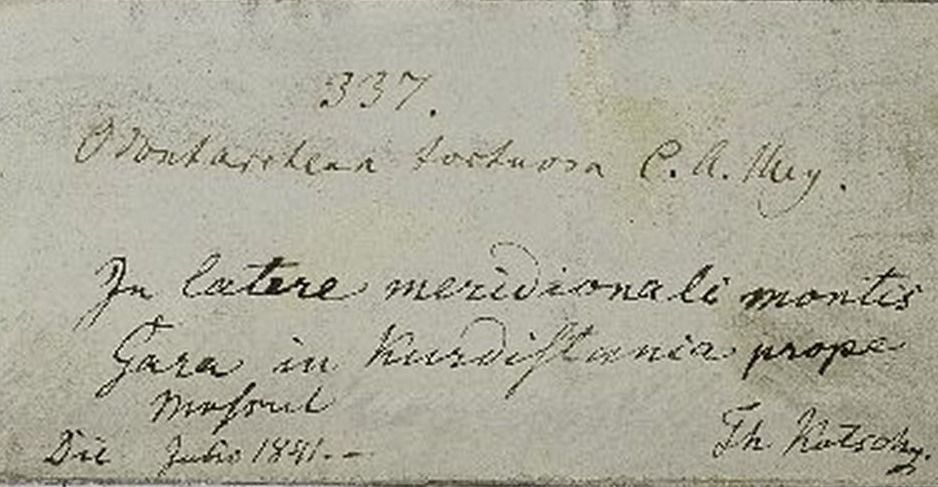
The plants were distributed to herbaria as a numbered set, "Plants of Aleppo, Kurdistan and Mosul", edited by Hohenacker in 1843; this one was number 337[2]. Kotschy filed it under Odontarrhena tortuosa, a name the botanist C. A. Meyer had published in 1831[6][7]. Sheets of no. 337 are now kept in eight herbaria, from Geneva and Vienna to Edinburgh, Kew, London, Paris, the Netherlands and Harvard[3].
Gara gave Kotschy more than one Kurdish plant. About a week later, on 3 August 1841, he collected the hollyhock that became Alcea kurdica in its high rocky ravines[8].
Four names for one plant
The name Kotschy used did not last. In 1867 Edmond Boissier (1810–1885)[6], who had the sheet in his herbarium in Geneva, decided that it was a Kurdish form of Alyssum oxycarpum, a species from the mountains of Cappadocia[1][3]. He named it variety kurdicum, "the Kurdish one", and gave it one line[1]:
β. Kurdicum. Siliculæ squamis lepidotis adspersæ.
Variety kurdicum. Pods sprinkled with small scales.[1] (our translation)
The typical A. oxycarpum has pods that become almost bare[1]. Boissier was not even sure that A. oxycarpum differed enough from the species before it in his list, adding "an satis?", "is that enough?"[1].
In 1949 the botanist E. I. Nyárády (1881–1966), who had been describing new alyssums since the 1920s[9], raised the Kurdish plant to a species of its own, Alyssum kurdicum[6].
Then came T. R. Dudley of the Arnold Arboretum at Harvard, who was revising the whole genus[9]. In May 1961 he looked at the Vienna sheet and confirmed it as the type of A. kurdicum[7]. Three years later he changed his mind. On the Harvard sheet he wrote "= Alyssum singarense"[10], and in his 1964 synopsis of the genus A. kurdicum is no longer listed, while A. singarense is[9]. That plant had been described by Boissier from a gathering Heinrich Haussknecht made in 1867 on chalky ground on Şengal (Sinjar) mountain[11][4].
In 2015 a team led by Stanislav Španiel, working through the whole alyssum tribe, re-established Odontarrhena as a genus of its own, with 77 new name combinations[12]. Both Kurdish plants went into it as separate species: Odontarrhena kurdica from Gara and O. singarensis from Şengal[6]. So after 174 years the plant carries again the genus name Kotschy wrote on his label in 1841[6][7].
What makes an Odontarrhena
Meyer's Odontarrhena dates from 1831[6]. Boissier kept it as a section of Alyssum, and his definition still holds: each half of the pod holds a single ovule, and the stamen filaments carry teeth or small appendages[1]. Dudley adds that the plants are perennial and the petals yellow[9].
The group is famous for something else. As Alyssum section Odontarrhena it forms one of the largest groups of nickel hyperaccumulators in the whole mustard family[13]: plants that take up more than 1,000 micrograms of nickel per gram of dry leaf without harm, most of them on nickel-rich serpentine soils[13]. Whether the Kurdish species can do this has, as far as we could find, never been tested.
What to look for
With so little material, the description is short. Boissier described A. oxycarpum and gave the Kurdish variety only its scaly pods, so the rest of this list is his description of the species[1]:
- a perennial, grey all over with tiny scales, woody at the base, the stems upright;
- leaves spoon-shaped and very blunt;
- fruits in short, crowded clusters that look almost like umbels;
- small, elliptic, pointed pods, narrowed at the base and tipped with a style a quarter of their length, sprinkled with tiny scales: the feature that set the Kurdish plant apart for Boissier;
- seeds without a wing.
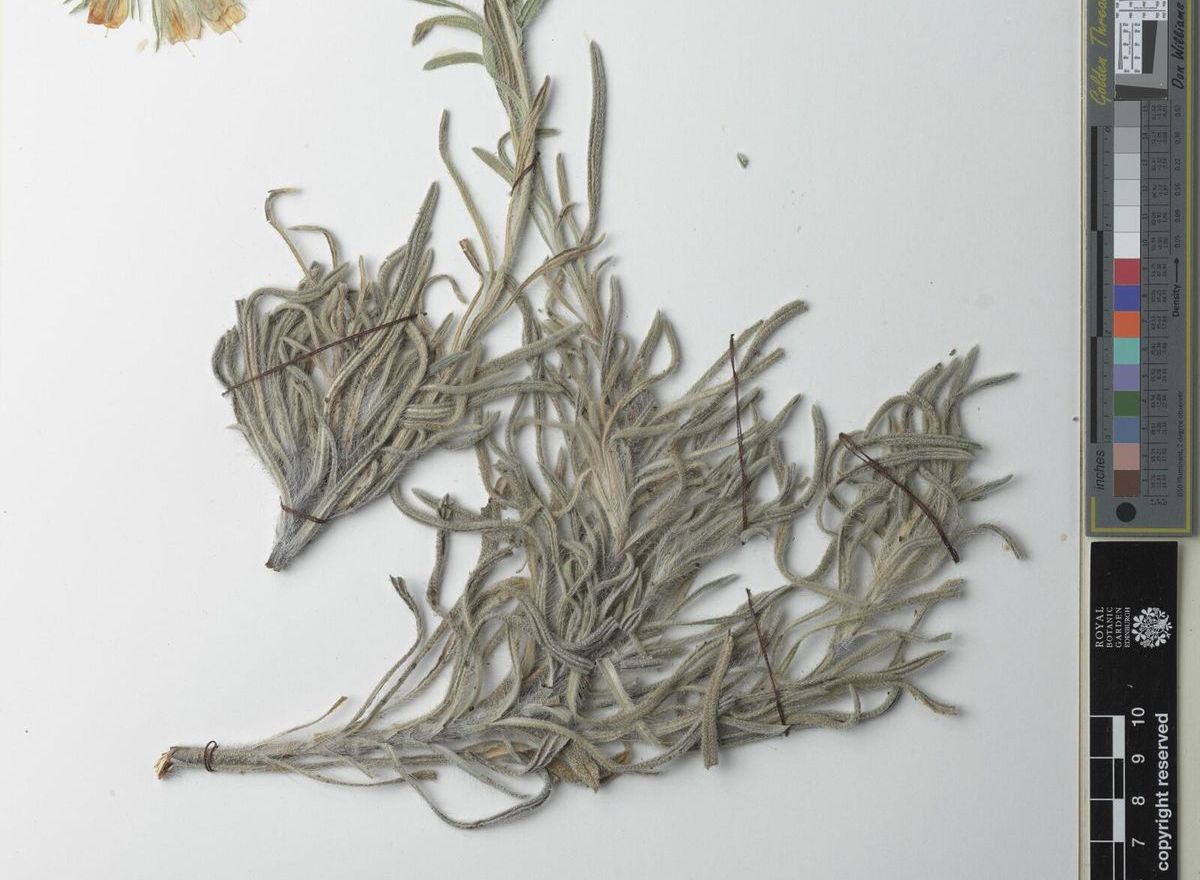
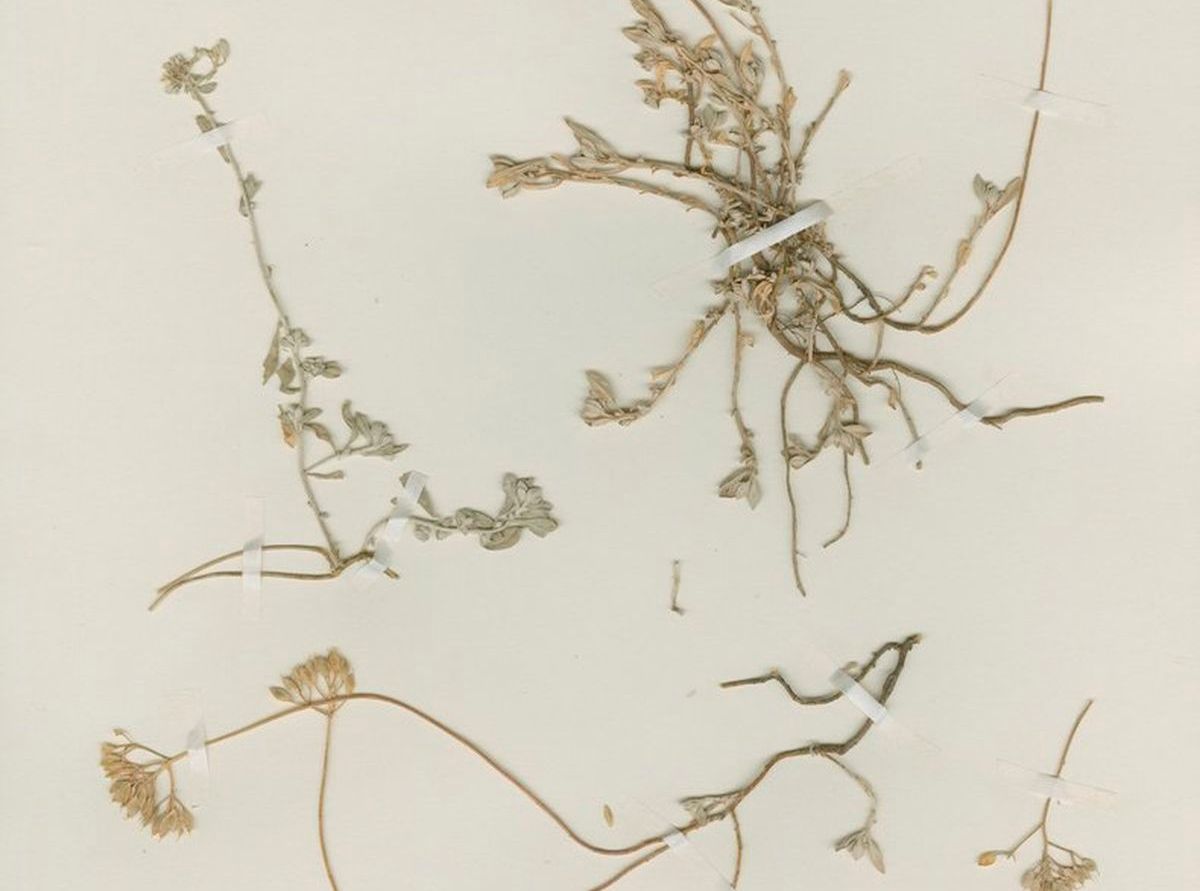
The 1841 sheets show the habit well: a tuft of grey leaves on woody shoots, with long, wiry stems that each end in a dense head of fruits. The plants on them are mainly in fruit[7][2].
Where it grows
Kew's checklist gives its native range as northern Iraq, and nothing more[14]. In Kurdish terms it is an endemic of Başûr, known from one mountain: Gara in Kurdistan, "near Mosul" as Kotschy put it[1][3][7].
Its close relative O. singarensis is much more widespread in Kurdistan. Besides Şengal, herbarium sheets record it from the Zawita pass between Mosul and Zaxo (Zakho), near Şino (Ushnu), north of Sine (Sanandaj) and near the southern tip of Lake Ûrmiye (Urmia)[4].
A plant to look for again
Every herbarium record of Odontarrhena kurdica in GBIF is a duplicate of Kotschy's gathering of 1841[4]. There are no photographs of it on iNaturalist[5], and no one has assessed its conservation status[4]. It may simply have been overlooked, or filed under another name: as its own history shows, even specialists have disagreed on how to tell these small grey alyssums apart. Whoever finds a grey alyssum with scaly pods on Gara would be the first, as far as the records go, to see it in 185 years.
Kurdish names
No Kurdish name has been recorded for Odontarrhena kurdica itself. Ehmedê Dirihî's dictionary of Kurdish plant names lists several names for the genus Alyssum as a whole, in the wide sense that once included Odontarrhena: darhelezk, with elîsoma şirîn, gula alîsom, gulçît, harhelezk and werdêney kêfî[15][15]. For Alyssum murale, now Odontarrhena muralis and so a relative of the Kurdish plant[4], it gives werdêne[15]. These are names for the group, not for this species.
Sources
- 1.Boissier, E. (1867). Flora Orientalis, vol. 1. Basel & Geneva: H. Georg.
- 2.abcdNaturalis Biodiversity Center, herbarium specimen WAG0004273 (Kotschy 337), via GBIF.
- 3.abcdeAl-Shehbaz, I. A. & Barriera, G. (2019). Typification of Edmond Boissier's Cruciferae (Brassicaceae) names enumerated in Flora Orientalis. Boissiera 72: 1–193 (p. 36).
- 4.GBIF.org GBIF Backbone Taxonomy and occurrence records. gbif.orghttps://www.gbif.org/
- 5.abiNaturalist. observation search for Odontarrhena kurdica (accessed 15 November 2026). inaturalist.orghttps://www.inaturalist.org/
- 6.International Plant Names Index. Royal Botanic Gardens, Kew, Harvard University Herbaria and Australian National Herbarium.
- 7.abcdefghNatural History Museum Vienna (W) – Herbarium. via GBIF, herbarium specimen W 0003826 (Kotschy 337), via GBIF.
- 8.↩Alefeld, F. (1862). Ueber die Malveen. Oesterreichische Botanische Zeitschrift 12: 246–261.
- 9.Dudley, T. R. (1964). Synopsis of the genus Alyssum. Journal of the Arnold Arboretum 45: 358–373.
- 10.↩Harvard University Herbaria, herbarium specimen A00018570 (Kotschy 337), via GBIF.
- 11.↩Boissier, E. (1888). Flora Orientalis, Supplementum: 49. Genève & Basel.
- 12.↩Španiel, S., Kempa, M., Salmerón-Sánchez, E. et al. (2015). AlyBase: database of names, chromosome numbers, and ploidy levels of Alysseae (Brassicaceae), with a new generic concept of the tribe. Plant Systematics and Evolution 301: 2463–2491. doi:10.1007/s00606-015-1257-3https://doi.org/10.1007/s00606-015-1257-3
- 13.abCecchi, L., Gabbrielli, R., Arnetoli, M., Gonnelli, C., Hasko, A. & Selvi, F. (2010). Evolutionary lineages of nickel hyperaccumulation and systematics in European Alysseae (Brassicaceae): evidence from nrDNA sequence data. Annals of Botany 106: 751–767. doi:10.1093/aob/mcq162https://doi.org/10.1093/aob/mcq162
- 14.Plants of the World Online. Royal Botanic Gardens, Kew.
- ↩Odontarrhena kurdica.
- plant_name_id 3009881. powo.science.kew.orghttps://powo.science.kew.org/taxon/urn:lsid:ipni.org:names:77152030-1accessed 14 November 2026
- 15.Ahmet Kasımoğlu (Ehmedê Dirihî) (2013). Ferhenga Navên Nebatan a Kurdî (Dictionary of Kurdish Plant Names). Mardin Artuklu University, Institute of Living Languages in Turkey (ISBN 978-605-4202-12-6).
Last updated 20 November 2026