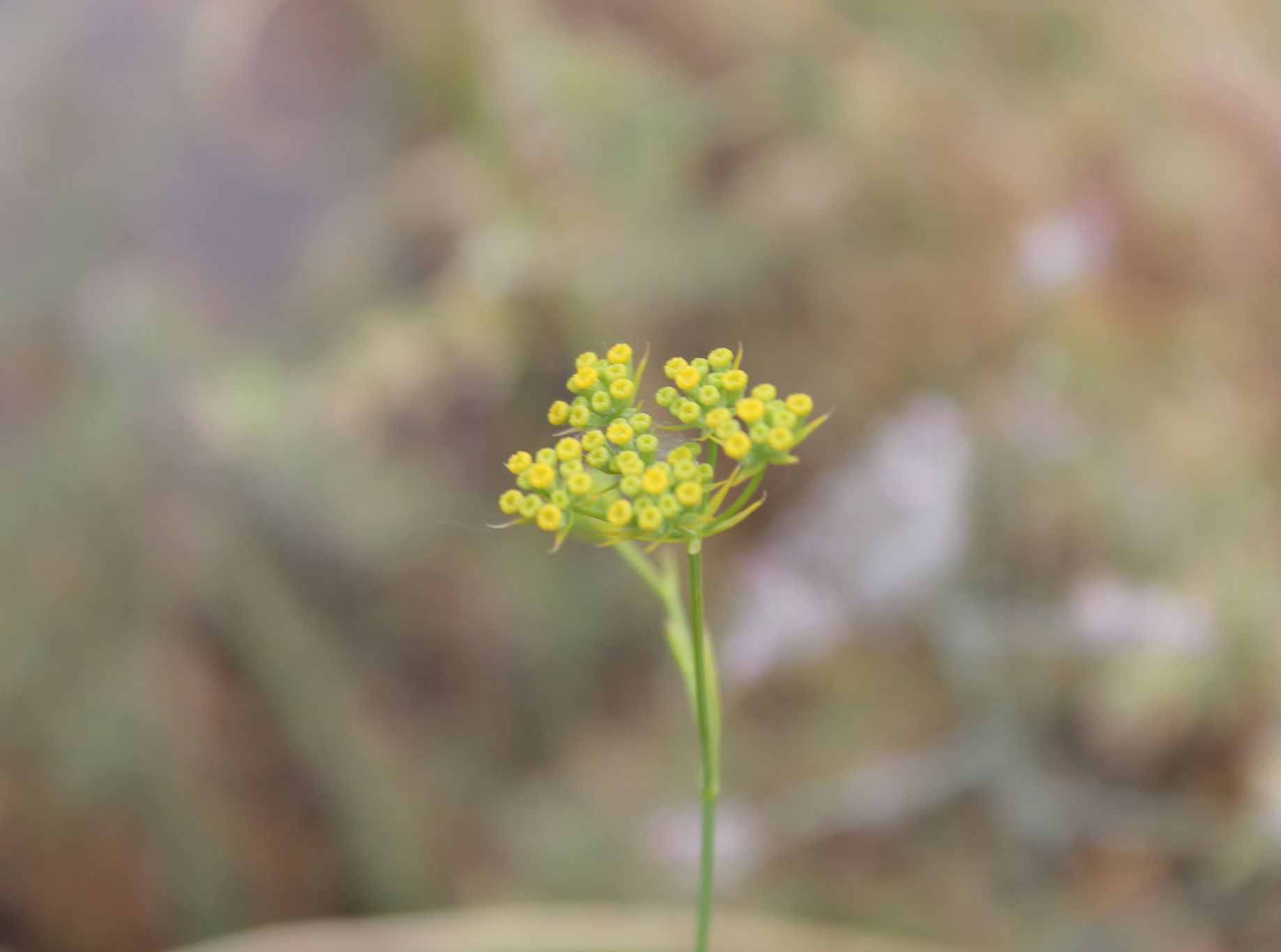
Bupleurum kurdicum is a slender summer annual of the parsley family, a wiry, blue-green plant with narrow grass-like leaves and small umbels of strikingly golden flowers[1][2]. It belongs to the hare's-ears, the genus Bupleurum[2], and it grows across the oak hills and foothills of Kurdistan, from Bakur through Başûr into Rojhilat[3][2][4]. It was named in 1844 from a single dried gathering labelled only "Persian Kurdistan"[5][6].
How it got its name
- Named by
- Boiss., 1844Published in Ann. Sci. Nat., Bot. , sér. 3, 1: 146
A plant from "Persian Kurdistan"
In 1844 the botanist Edmond Boissier of Geneva[7] was working through a large collection of dried plants from the Ottoman and Persian lands. They had been gathered by Rémi Aucher-Éloy (1793–1838), who travelled and collected there from 1830 until his death in 1838[7]. Boissier published them in instalments as Plantae Aucherianae, "Aucher's plants", and on page 146 of the 1844 instalment he reached the hare's-ears[5].
Number 73 was new. Boissier called it Buplevrum kurdicum (the old spelling of the genus) and gave its home in four words: "Aucher, n° 3728 in Kurdistano Persico", Aucher's number 3728, from Persian Kurdistan, which today is Rojhilat[5]. The epithet kurdicum simply means "Kurdish".
His description is short. An annual with an upright, finely grooved stem, branched only a little; narrow leaves that clasp the stem at their base, each with about seven veins; umbels of about seven rays; little bracts under the umbels that are short, oval and drawn out into a long point; yellow flowers. The stems, he wrote, were half a foot to a foot tall. He compared it with Bupleurum gerardii, a widespread hare's-ear of southern Europe and western Asia[2]: its little umbels are slightly larger, and it is easily told apart by its habit and by its short, differently shaped bracts[5].
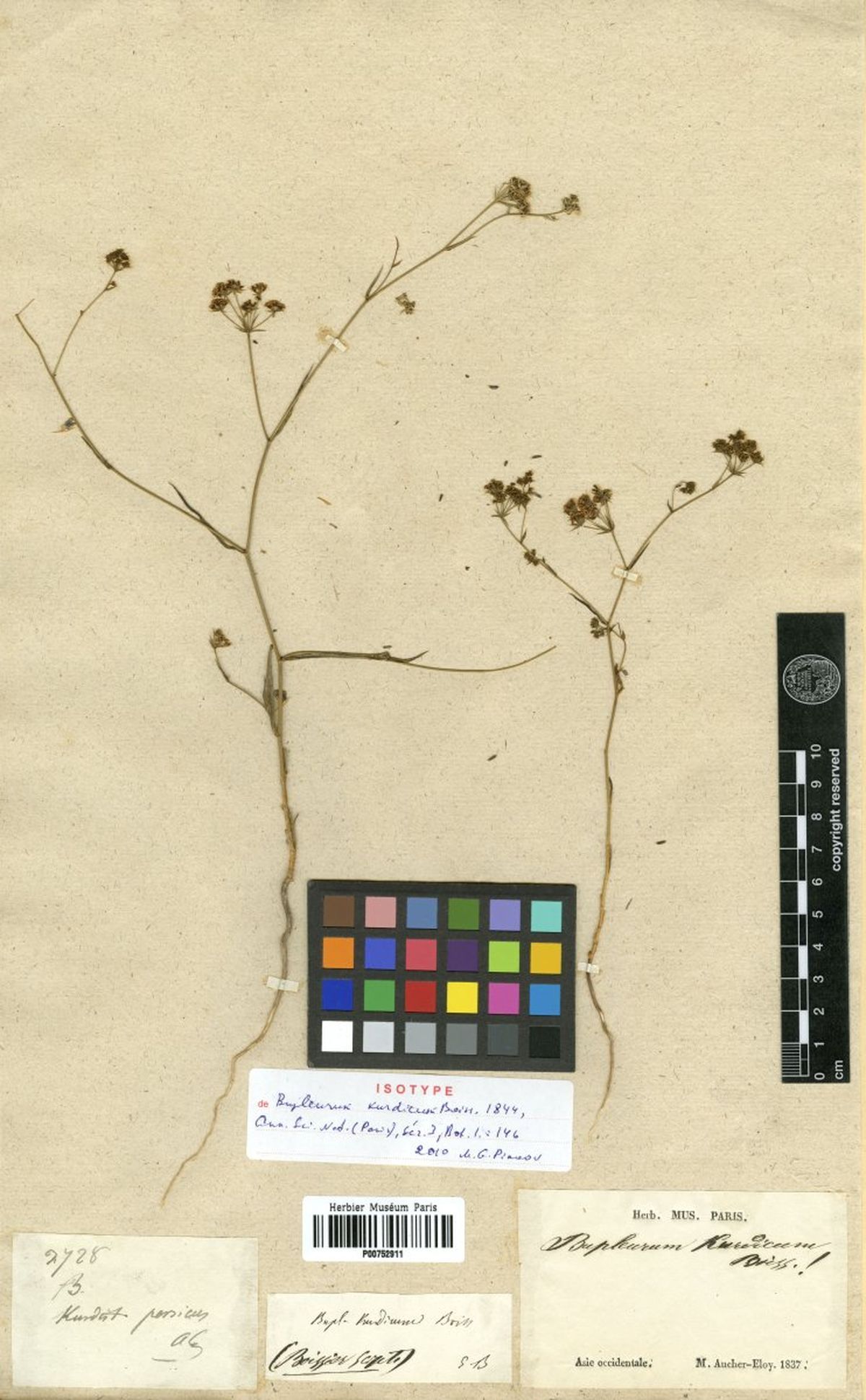
Duplicates of that gathering survive in Paris, Geneva and Montpellier, each now labelled an isotype, a duplicate of the specimen on which the name rests[8]. One of the Paris sheets carries Aucher's own slip, "3728 … Kurdist. persicus", and a second slip that a later hand has marked Boissier scripsit, "written by Boissier"[8]. The printed museum label adds a year, 1837, but neither Boissier nor the labels say where in Rojhilat, or when, the plants were picked[5][8].
A summer road through Rojhilat
Aucher-Éloy's travel notes were published after his death, and they show the kind of country he crossed. In February 1835 he set out alone again, went by Aleppo to Baghdad, and from there east to Kirmaşan (Kermanshah), Hamadan and Isfahan[7]. In June 1835 his caravan climbed out of the Mesopotamian plain towards Kirmaşan, past a river "that comes from the mountains of Kurdistan"[7] and the camp of Kurdish farmers near Serpoul (today Sarpol-e Zahab), below a mountain he calls the Nâlkou, covered in gall oaks and terebinth[7].
On 11 June he walked up to the snowy summits of the Nâlkou and made, in his words, "the first excellent botanising of my whole journey". On the way down he came to the Kurds' tents in the plain, where his hosts brought out large wooden cups of sour milk to refresh the travellers. When he tried to pay, everyone laughed at him: it would have been shameful, he explains, to take money from strangers who came to rest under their tent[7].
We cannot say that number 3728 was gathered on this road: the labels do not tell us, and Aucher-Éloy made a second, longer journey through Persia in 1837–1838, which took him past Lake Urmia[7]. That journey ended in illness. After a last excursion into the Bakhtiari mountains in July 1838, he died at the convent of Julfa in Isfahan on 6 October 1838[7], six years before the plant was named.
Hare's ears, oxen and ribs
Bupleurum is an old Greek plant name built from bous, ox, and pleura, rib[2]. English calls the genus hare's-ear or thorow-wax, and the Arabic udhn al-arnab, "hare's ear", seems to be just a translation of the English[2]. Some 150 species grow across Europe, Asia, Africa and North America, nine of them in Iraq[2].
Kurdish has the same comparison. The plant-name dictionary of Ehmedê Dirihî records goşê hargûşan from Dêrsim for the round-leaved hare's-ear, B. rotundifolium, and lists giya kergûşk for Bupleurum kurdicum itself, without a region[9]. Read word by word these look like "hares' ears" and "hare grass" (our reading, to be checked). Since Dirihî gives no region for giya kergûşk, it may, like the Arabic name, be a translation rather than a name heard in the field.
How to recognise it
Bupleurum kurdicum is easy to overlook: a hare's-ear has none of the lacy white umbels of its parsley-family cousins. Look for these together[5][3][1][2]:
- Habit: an annual, usually about 30 cm tall in Başûr, sometimes up to 60 cm[2], though Hermann Wolff measured plants up to 75 cm[1]. The whole plant is glaucous, a dull blue-green[3][1]. The thin, wiry stem branches from about halfway up, and the branches stand out widely, often at right angles; they are sharply ridged or even four-angled[2].
- Leaves: few and grass-like, broadly linear, with many parallel veins, clasping the stem at the base and ending in a short point. The lower leaves have usually withered by the time it flowers[1][2].
- Umbels: small, with about six (5–10) rays of nearly equal length[3][2]. Under each umbel sit three or four narrow bracts, and under each small umbel four to six bracteoles with three veins and a very narrow, finely toothed, transparent edge[2].
- Flowers: tiny, 6 to 12 in each little umbel[1][2]. Wolff called the petals eximie aurea, "strikingly golden"[1].
- Fruit: narrow, parallel-sided and about 2–3.5 mm long, with thick, prominent ribs and deep grooves, and sometimes a waxy bloom[3][1][2]. Boissier thought the fruit set it apart from all its relatives[3].
Its closest look-alike is still the plant Boissier compared it with in 1844. B. gerardii is usually shorter, rarely over 25 cm, and its bracteoles have no clear transparent edge and usually stand out beyond the fruiting umbel[2]. In 2020 a DNA study of four hare's-ears from the Kurdistan Region, based on specimens at Salahaddin University in Hewlêr (Erbil), placed B. kurdicum and B. gerardii side by side as each other's closest relatives among the four[10]. Boissier's eye was right.
A name from the labels of Theodor Kotschy's 1859 collections, B. armenum Boiss. & Kotschy, is now counted as the same species[3][4]. Kotschy's number 304 was gathered on 16 August 1859 at Gumgum (Gimgim, today Varto) in the province of Mûş, at the southern foot of the Bingöl mountains, where the plant was "frequent, in rich soil"[3][11]. In 1910 Wolff sorted the species' many shapes into four forms[1], including a tall, much-branched one named after Joseph Bornmüller, who had collected it in 1893 on the plain at Ankawa near Hewlêr and on the mountain Handren near Rewandiz (Rowanduz)[1][11]. Today these forms are no longer kept apart[4].
Where it grows
Kew's checklist gives its range as eastern Turkey to north-western Iran, recorded from Turkey, Iraq, Iran, and Syria and Lebanon[4]. In Kurdish terms that is a plant of Bakur, Başûr and Rojhilat, and the first records already read like a map of Kurdistan[3][1]:
- Bakur: Mêrdîn (Mardin), where Boissier placed one of Kotschy's 1841 gatherings, although its label says only "Kurdistan & Mossul"[3][11]; Gumgum (Gimgim, Varto) in the province of Mûş[3][11]; and in the west Mereş (Maraş)[3][12]. Beyond Kurdistan it reaches west to the Amanus mountains, the western limit of its range[1].
- Başûr: Hewlêr (Erbil)[3]; the plain at Ankawa, the road to Rewandiz and the mountain Handren near Rewandiz[2][11]; and, in the twentieth century, Zaxo (Zakho), the Bekher mountain, Zawita, Sarsang, Rayat, Galala and Salahaddin[2]. Flora of Iraq calls it common in the north-west of the lower forest zone[2]. It has also been photographed in flower north-east of Duhok, in June 2022[13].
- Rojhilat: Aucher-Éloy's "Persian Kurdistan"[5], and the vineyards of Sine (Sanandaj) and Kirmaşan (Kermanshah), where Carl Haussknecht collected it in August and September 1867[3][14]. Outside Kurdistan it reaches north to the Tehran area and south down the Zagros into the Bakhtiari mountains[3][15].
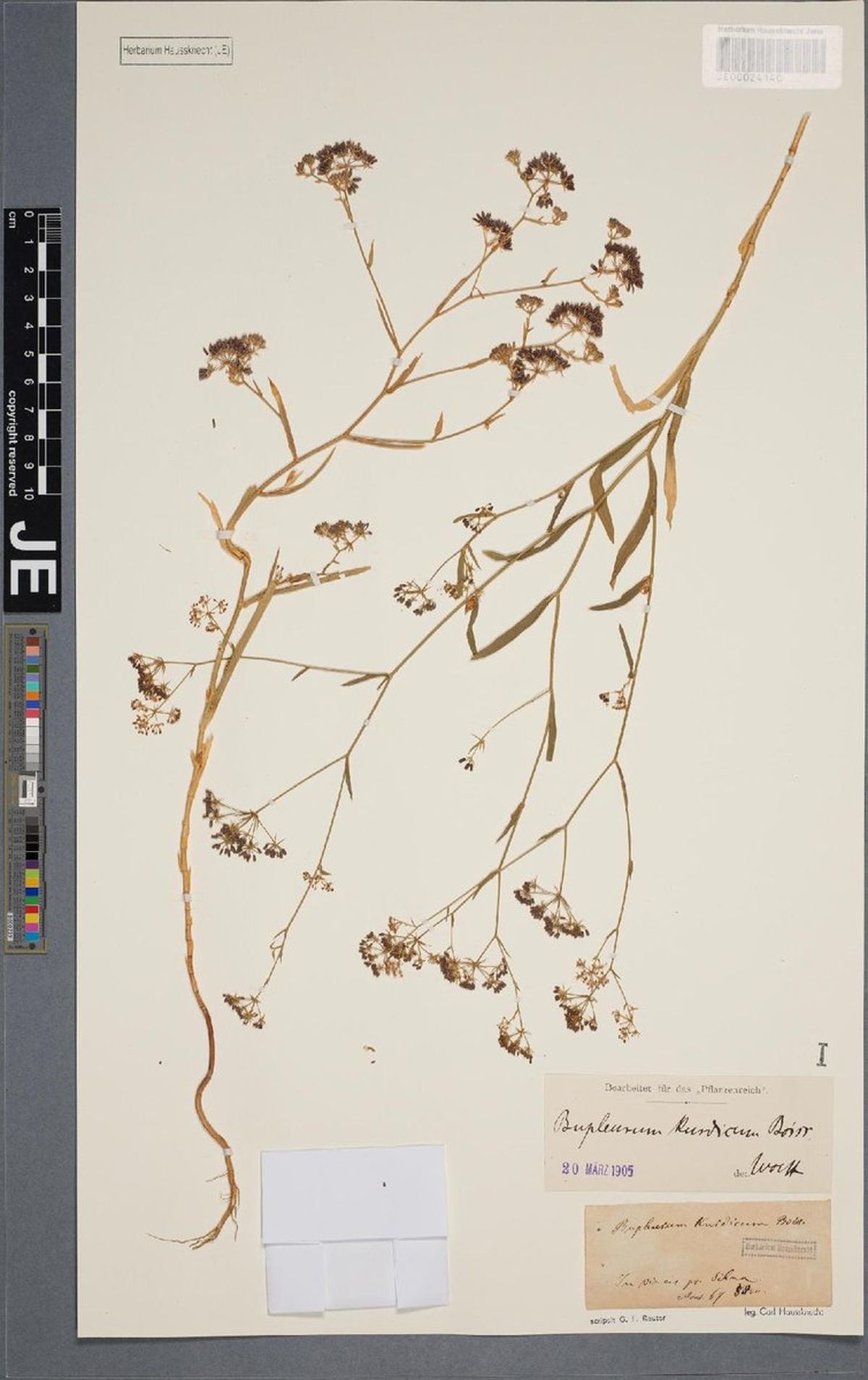
It is a plant of open, sunny, disturbed ground. Flora of Iraq finds it on lower mountain slopes, in oak scrub that has been cut back, on a rocky plateau, sometimes by streams, and often in fields and on waste land[2]. Post saw it on roadsides and in grassy places[12], and Wolff lists steppes, dry hills, scrub, rocky slopes and vineyards[1]. Haussknecht's labels from Sine and Kirmaşan both say simply in vineis, "in the vineyards"[14].
In Başûr it grows mostly between 400 and 800 m, at the extremes from 250 to 1,300 m[2]. Further east it climbs higher: Haussknecht's label at Sine gives 5,800 feet, roughly 1,800 m[14], Wolff gives about 2,000 m as its upper limit[1], and specimens from the Bakhtiari mountains were collected at 1,820 and 2,200 m[15].
Summer flowers
This is a summer plant. It flowers and fruits in June and July in Başûr[2], and Wolff gives June to August across its range[1]. Boissier's Flora Orientalis gives "Fl. Jul.", flowering in July[3], and the plant in the photograph above was in full flower on 24 June[13].
Kurdish names
No name has been recorded in the field for Bupleurum kurdicum itself in the sources we have read. Ehmedê Dirihî's Ferhenga Navên Nebatan a Kurdî (2013) lists dara pepû, buxurî meryem and giya kergûşk for it, without a region[9]. Dirihî also gives dictionary names built on the Latin, such as gagireya kurdan, "the Kurds' gagire" (our gloss), from gagire, his name for B. rotundifolium[9].
Its relatives in Başûr do have field-recorded names. Flora of Iraq prints[2]:
- GIYĀ BIRNÎK for B. brevicaule, recorded at Mahad near Şêxan (Shaikhan), then in the province of Mosul, and noted as "a good fodder plant" (p. 144);
- GULA BEWUZHNA for B. lancifolium, recorded at Hewlêr (p. 143);
- KHANJARŪK for B. gerardii, the closest relative of B. kurdicum in the 2020 study, recorded in the Amêdî (Amadiya) district (p. 145).
We have found no record of the plant being used, as food, fodder or medicine, in the sources we read.
Sources
- 1.abcdefghijklmnoWolff, H. (1910). Umbelliferae-Apioideae-Bupleurum, Trinia et reliquae Ammineae heteroclitae. In A. Engler (ed.), Das Pflanzenreich IV. 228 (Heft 43): 87–89.
- 2.Ghazanfar, S.A. & Edmondson, J.R. (eds) (2013). Flora of Iraq, Volume 5, part 2: Lythraceae to Campanulaceae. Royal Botanic Gardens, Kew. ISBN 978-1-84246-493-9.
- 3.Boissier, E. (1872). Flora Orientalis 2. Genève & Basel.
- 4.Plants of the World Online. Royal Botanic Gardens, Kew.
- abcdBupleurum kurdicum Boiss.
- plant_name_id 2686810. powo.science.kew.orghttps://powo.science.kew.org/taxon/urn:lsid:ipni.org:names:839224-1accessed 14 November 2026
- 5.Boissier, E. (1844). Plantae Aucherianae orientales enumeratae. Annales des Sciences Naturelles, Botanique, sér. 3, 1: 146–147.
- 6.International Plant Names Index. Royal Botanic Gardens, Kew, Harvard University Herbaria and Australian National Herbarium.
- ↩Bupleurum kurdicum Boiss.
- urn:lsid:ipni.org:names:839224-1. ipni.orghttps://www.ipni.org/n/839224-1accessed 14 November 2026
- 7.Aucher-Éloy, R. (1843). Relations de voyages en Orient, de 1830 à 1838. ed. Comte Jaubert. Vol. 1. Paris: Roret.
- 8.abcIsotypes of Bupleurum kurdicum (Aucher-Éloy 3728): Muséum national d'Histoire naturelle, Paris, P00752911, P00752912; Conservatoire et Jardin botaniques de Genève, G00359444, G00359445; Université de Montpellier, MPU018912 (via GBIF).
- 9.abcAhmet Kasımoğlu (Ehmedê Dirihî) (2013). Ferhenga Navên Nebatan a Kurdî (Dictionary of Kurdish Plant Names). Mardin Artuklu University, Institute of Living Languages in Turkey (ISBN 978-605-4202-12-6), pp. 181, 238, 281, 303.
- 10.↩Al-Edhari, A. H., Kaizal, A. F. & Sardar, A. Sh. (2020). Molecular study for the genus Bupleurum L. (Apiaceae) in Iraq. Plant Archives 20(2): 4312–4314.
- 11.Royal Botanic Gardens, Kew – Herbarium Specimens. via GBIF. gbif.orghttps://www.gbif.org/dataset/cd6e21c8-9e8a-493a-8a76-fbf7862069e5
- 12.Post, G.E. (1896). Flora of Syria, Palestine and Sinai. Beirut: Syrian Protestant College.
- ab
- p. 341. biodiversitylibrary.orghttps://www.biodiversitylibrary.org/page/18086455accessed 14 November 2026
- 13.abiNaturalist. observation 132031744 (I. Hirory, Duhok, 2022). inaturalist.orghttps://www.inaturalist.org/
- 14.abcHerbarium Haussknecht, Jena (JE), specimen records (JACQ) via GBIF. Jena, herbarium sheets JE00024137, JE00024140 (via GBIF). api.gbif.orghttps://api.gbif.org/v1/occurrence/3028980654
- 15.abGhahremaninejad, F., Hoseini, E. & Mozaffarian, V. (2014). Fruit anatomy of the genus Bupleurum L. (Apiaceae) in Iran. Iranian Journal of Botany 20(1): 51–70. doi:10.22092/ijb.2014.6157https://doi.org/10.22092/ijb.2014.6157
Last updated 20 November 2026