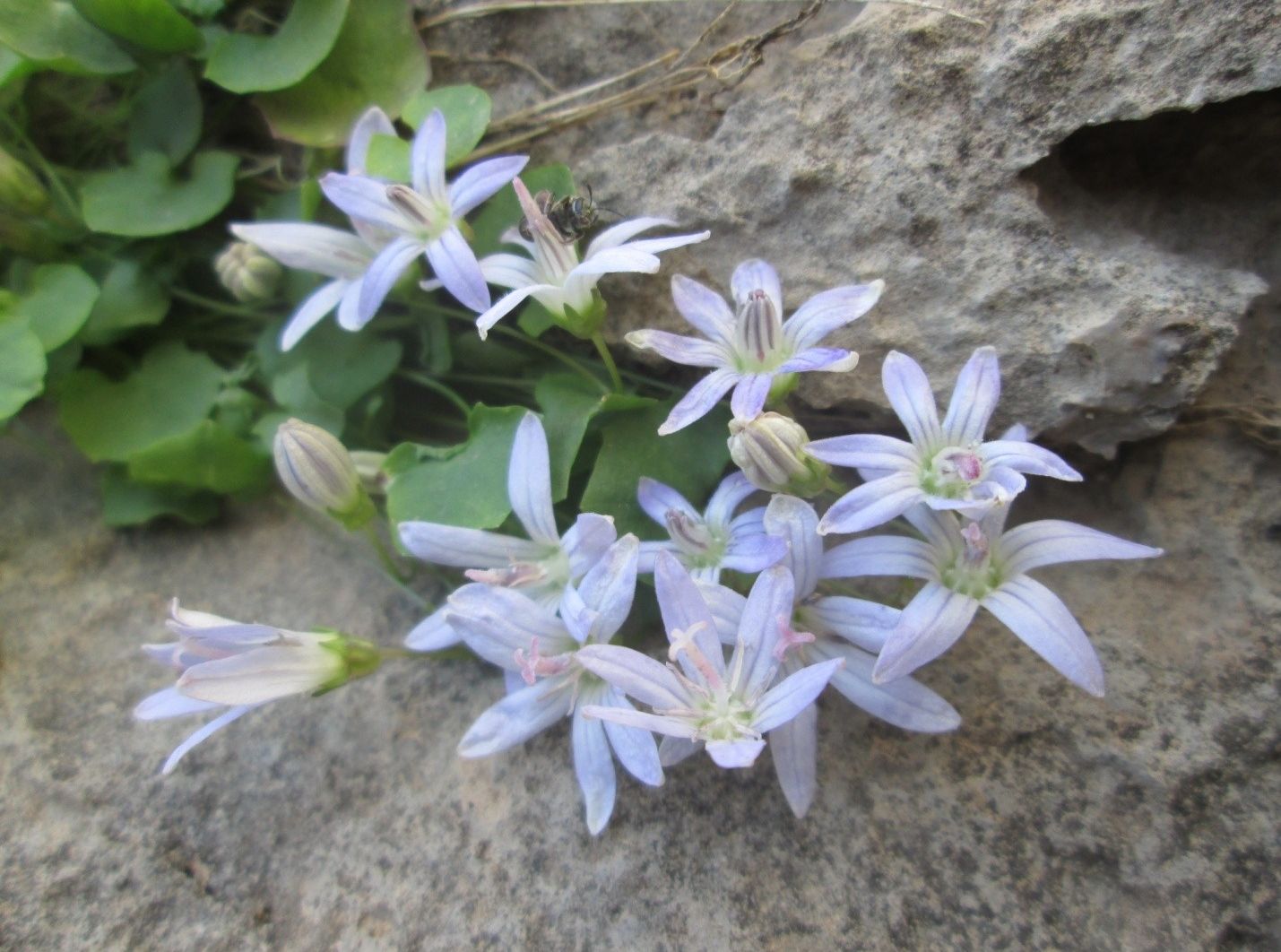
Campanula kurdistanica is a bellflower you could cover with one hand: a tufted, fragile little plant no more than 11 cm tall, tucked into cracks in shaded limestone cliffs on Şaho (Shahoo), a high mountain between Merîwan (Marivan) and Pawe (Paveh), next to the Hewraman (Avroman) mountains, in East Kurdistan (Rojhilat)[1][2]. It was named for science only in 2015, it is known from that one mountain, and apart from the photograph in its original paper, shown at the top of this page, no picture of it has been published online[1][3][4].
How it got its name
- Named by
- Advay & Maroofi, 2015Published in Iran. J. Bot. 21: 36
- Type collected by
- Advay6 June 2014
Where it grows in Kurdistan
At 1800–3000 m above sea level.
Found in a bundle of bellflowers
The plant was not discovered on a dramatic expedition but at a herbarium table. While Mahfouz Advay and Hossein Maroofi were identifying "recently collected plant materials of Campanulaceae from Shahoo Mountain", one specimen stood out, and it proved to be new to science[1]. The gathering that became its type was made by Advay on 6 June 2014, on the north to north-west slopes of the mountain at 1,800–3,000 m[1][5]. The holotype is kept in the herbarium of Maroofi's institute, the agricultural and natural-resources research centre of Kurdistan province in Sine (Sanandaj), with a duplicate in the TARI herbarium[1][5].
They published it in June 2015 in the Iranian Journal of Botany under the title "A new species of Campanula from Kurdistan, west of Iran"[1][5]. The paper gives no explanation of the name, but the meaning is plain: kurdistanica is Latin for "of Kurdistan", the land of its only known home[1].
It is not the only Kurdish plant Maroofi has put on the map. The International Plant Names Index gives, as his example name, a yellow crocus he and Mostafa Assadi named Crocus danfordiae subsp. kurdistanicus in 2002[5], and in 2016 he and Hiva Ghaderi described Pentanema kurdistanicum, a daisy relative of the same mountains[2].
Şaho, a mountain of cliffs
Şaho is a mountain of limestone[1], and Campanula kurdistanica lives in its shade: in the paper's words it "grows on limestone [crevices] of shady cliffs at 1800–3000 m above sea level"[1]. It flowers in May and June[1].
The mountain keeps turning up new plants. The Pentanema of 2016 was described from cliffs near the village of Bendol, about 30 km south to south-east of Merîwan, at 2,600 m, and is known only from small populations on Şaho and the Hewraman (Avroman) mountains between 2,500 and 2,700 m[2]. In 2024 Advay, this time with the botanist Martyn Rix, described a new fritillary from the region, Fritillaria shahuensis[6]. For botanists, Şaho and Hewraman are clearly not finished yet.
A star that changes colour
Bellflowers usually live up to their name, with flowers shaped like a bell. Campanula kurdistanica hardly does: its corolla is "broadly campanulate-rotate", a shallow bell opening almost flat like a wheel, and it is split about three-quarters of the way down into five, or rarely seven, narrow pointed lobes that spread out like a star[1]. That deep split is the main character that sets it apart from its relatives[1].
The flowers also change colour as they age. The lobes open white and turn blue or violet when mature, and the flowers are described as white, lilac-pinkish, or blue to violet. Pressed in a herbarium they fade to a creamy colour[1].
What to look for, from the description[1]:
- a tufted, hairless perennial, many-branched from the base and lying close to the rock, up to 11 cm tall, "slender, fragile";
- a rosette of small leaves, 4–10 mm long, on thin stalks 1.5–4.8 cm long, longer than the leaf itself, shaped anything from kidney- or heart-shaped to round, ovate or rarely triangular, usually with 5–7 angular teeth;
- smaller leaves of the same kind up the stems;
- 1 to 6 flowers in a loose cluster in the leaf axils, each corolla only 4.5–9 mm long;
- white anthers, and a style 6–7 mm long that stays inside the flower, about as long as the corolla or slightly shorter, densely covered with tiny purple papillae, with three stigmas;
- a round capsule 3–4 mm long with small, shiny brown seeds.
A cousin from the west
Advay and Maroofi placed it in section Saxicolae[1], the "rock-dwellers" (from Latin saxum, rock). In 2008, before this plant was known, Aghabeigi and Assadi listed ten species of the section in Iran[7]. Advay and Maroofi also give the section ten species there, and say that all but two of them, C. conferta and C. strigosa, grow nowhere else[1]. Their closest match for it, though, grows further west: Campanula cymbalaria, a bellflower of Turkey and Lebanon[1].
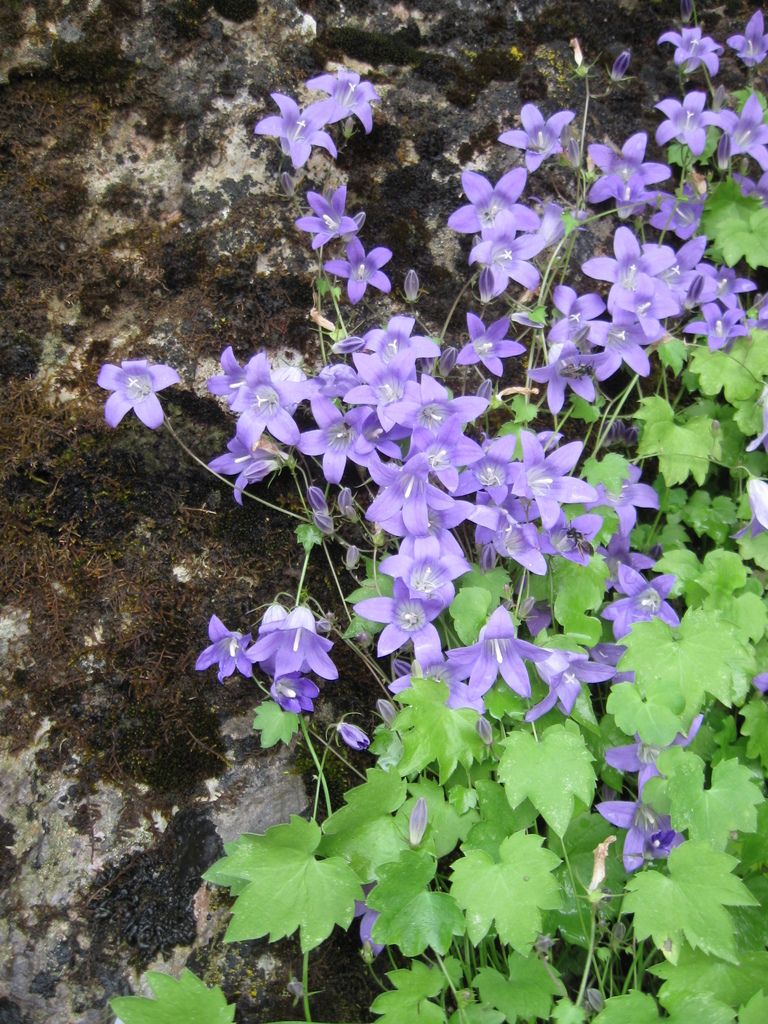
The family likeness is in the open, star-like flowers. But the Şaho plant is a miniature: stems up to 11 cm against 10–30 (sometimes 40) cm, calyx lobes up to 1.5 mm against 3–6 (to 10) mm, and corollas 4.5–9 mm against 10 mm. Above all, its petals are split about three-quarters of the way down, where those of C. cymbalaria are split only a third to a half[1].
Closer to home, they also compare it with four relatives from Iran: C. perpusilla, C. escalerae, C. hermannii and C. humillima. C. perpusilla has a tubular corolla with the style sticking out of it, and C. escalerae has hairy flower stalks and calyx lobes twice as long as the calyx tube[1]. In their comparison table, the other two have tiny corolla lobes, only about 1.5 mm long, where those of C. kurdistanica are 4–6.5 mm: C. hermannii stands 2–3 cm tall with a bell-shaped corolla 6 mm long, and C. humillima up to 8 cm with a narrow, funnel-shaped corolla 4 mm long[1].
Where it grows
Kew's checklist gives its range as "NW. Iran"[8]. In Kurdish terms that is a single mountain in Rojhilat. Its authors call it endemic, and the only place they give is Şaho, from Merîwan to Pawe[1]. With it, they counted 46 kinds of bellflower in Iran, about 14 of them found nowhere else[1].
Since 2015 it has hardly been seen again, at least in public: the Global Biodiversity Information Facility (GBIF) holds no record of it at all, and nobody has posted it on iNaturalist[3][4]. The species has not been assessed for the IUCN Red List[3]. For anyone walking Şaho's shaded cliffs in May or June, a photograph of a tiny star-flowered bellflower, white turning violet, would be a real addition to what is known of it. Please leave the plant where it grows.
Its name in Kurdish
No Kurdish name has been recorded for this species: its authors give none[1], and none of the name sources we checked lists it.
For bellflowers as a group, Kurdish has many names. Ehmedê Dirihî's Kurdish plant-name dictionary lists gezîze, gulborî, gule zengil, kulîlka kaşan, sinbêlok, şêlima çolê, vilika kaşan, zengilka qatirbêrî and zengilok against the genus Campanula[9], and his earlier plant list in the journal Kurmancî gives zengilok for the genus[10]. Several of these are built on zengil, "bell" (our translation), just as the Latin Campanula means "little bell". The dictionary also prints zengilok against Campanula cymbalaria, the Şaho plant's nearest relative[9].
These are names for the genus as a whole, not names of Campanula kurdistanica itself.
Sources
- 1.Advay, M. & Maroofi, H. (2015). A new species of Campanula from Kurdistan, west of Iran. Iranian Journal of Botany 21(1): 35–38.
- acdefghijklmnoqruvw
- bp. 38.
- pstp. 36. ijb.areeo.ac.irhttps://ijb.areeo.ac.ir/article_101449_c30485a4462d55a1cde7b148d223e2ad.pdf?lang=faaccessed 14 November 2026
- Iran. J. Bot. 21(1): 36. ijb.areeo.ac.irhttps://ijb.areeo.ac.ir/article_101449_c30485a4462d55a1cde7b148d223e2ad.pdf?lang=faaccessed 14 November 2026
- 2.abcMaroofi, H. & Ghaderi, H. (2016). Pentanema kurdistanicum (Inuleae, Asteraceae), a new species from subalpine cliffs of Kurdistan, Iran. Phytotaxa 253(3): 223-226. doi:10.11646/phytotaxa.253.3.7https://doi.org/10.11646/phytotaxa.253.3.7
- 3.abcGlobal Biodiversity Information Facility (GBIF): Campanula kurdistanica (species 9638160), occurrences and IUCN category, accessed 15 November 2026.
- 4.iNaturalist. inaturalist.orghttps://www.inaturalist.org/
- 5.International Plant Names Index. Royal Botanic Gardens, Kew, Harvard University Herbaria and Australian National Herbarium.
- abcdCampanula kurdistanica Advay & Maroofi; author records for M. Advay and H. Maroofi.
- urn:lsid:ipni.org:names:77150070-1. ipni.orghttps://www.ipni.org/n/77150070-1accessed 14 November 2026
- 6.↩Advay, M. & Rix, M. (2024). Fritillaria shahuensis (Liliaceae), a new species from western Iran. Phytotaxa 662(3): 279–286. doi:10.11646/phytotaxa.662.3.7https://doi.org/10.11646/phytotaxa.662.3.7
- 7.↩Aghabeigi, F. & Assadi, M. (2008). The genus Campanula (Campanulaceae) in Iran. Edinburgh Journal of Botany 65(3): 375–385, p. 382. doi:10.1017/S0960428608004848https://doi.org/10.1017/S0960428608004848
- 8.Plants of the World Online. Royal Botanic Gardens, Kew.
- ↩Campanula kurdistanica.
- plant_name_id 495823. powo.science.kew.orghttps://powo.science.kew.org/taxon/urn:lsid:ipni.org:names:77150070-1accessed 14 November 2026
- 9.Ahmet Kasımoğlu (Ehmedê Dirihî) (2013). Ferhenga Navên Nebatan a Kurdî (Dictionary of Kurdish Plant Names). Mardin Artuklu University, Institute of Living Languages in Turkey (ISBN 978-605-4202-12-6).
- 10.↩Ehmedê Dirihî (2007). Flora Kurdistanê (II). pp. 2, 8. institutkurde.orghttps://www.institutkurde.org/publications/kurmanci/
Last updated 20 November 2026