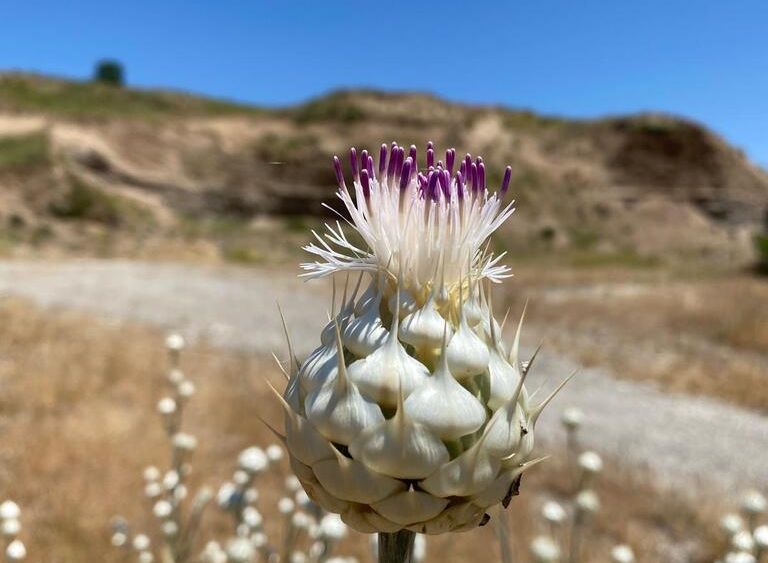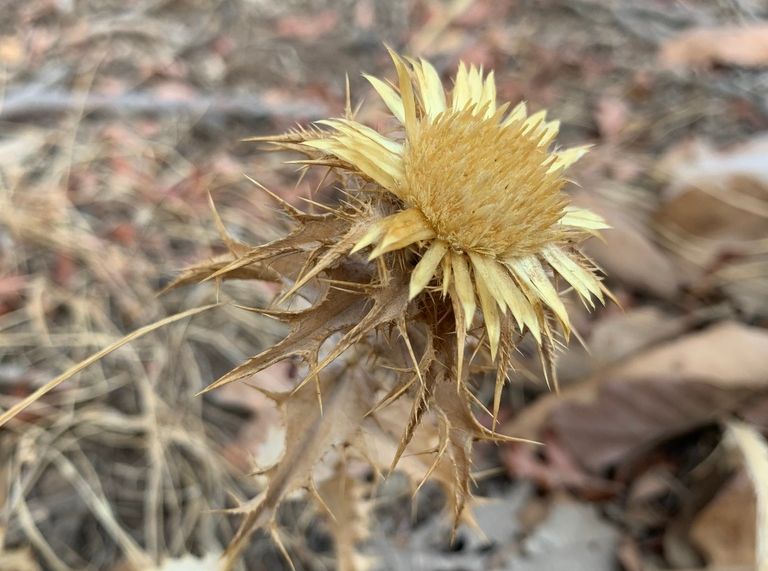
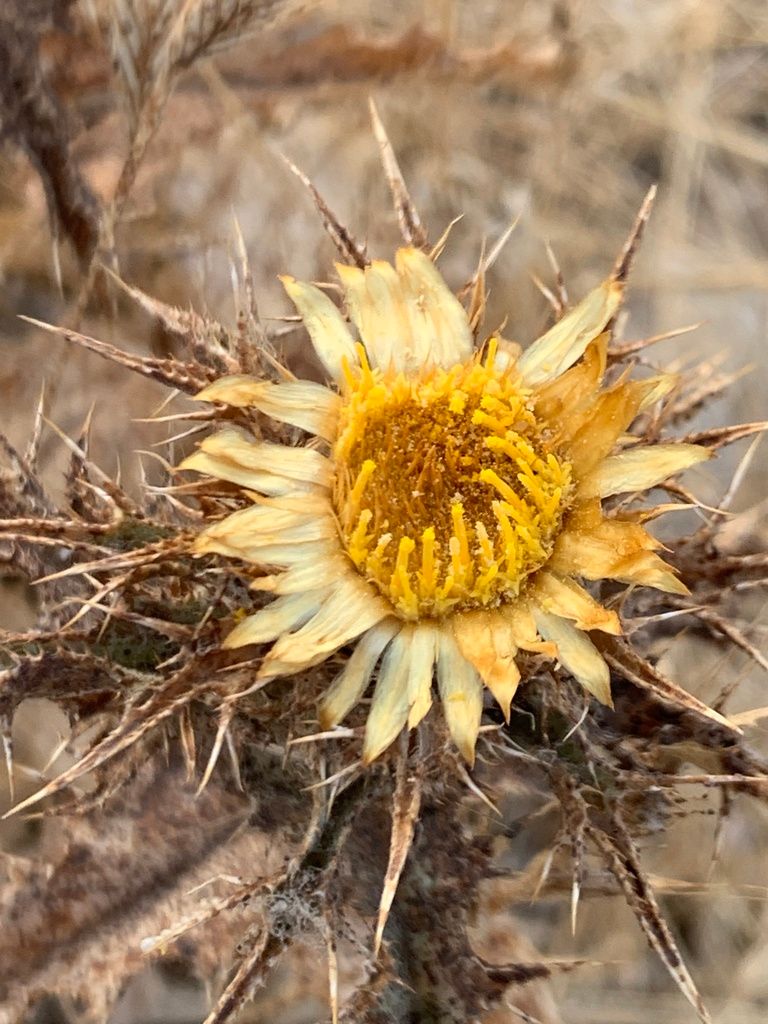
Carlina kurdica is a small, stiff carline thistle of the mountains of South Kurdistan (Başûr). It flowers at the end of summer, from July to September, when the grass on the limestone slopes has long turned to straw, and its flower heads are ringed by yellow, papery bracts that look like petals but are dry to the touch[1]. Every specimen and photograph of it we could find comes from the Kurdish mountains, and its name says so: kurdica, "Kurdish"[1][2].
How it got its name
- Named by
- Meusel & Kästner, 1972Published in Feddes Repert. 83: 231
Where it grows in Kurdistan
At 300–1400 m above sea level.
A flower that is already dry
Carline thistles play a trick with their flower heads. The real flowers are the small yellow florets packed into the centre. What looks like a ring of petals around them is a ring of inner bracts, long, narrow and papery, "yellow, straw-coloured or reddish", radiating outwards and much longer than the florets[1]. Outside those sits a rough collar of leafy, spiny outer bracts.
The bright ring is dry, papery tissue from the start, a fitting display for a plant that blooms in the heat of a Kurdish August. The iNaturalist observer Ibrahim Hirory photographed Carlina kurdica at the same site twice in 2023: in June it was a green, fiercely spiny young plant; by early September it stood in flower among bleached grass and stones[3][3].
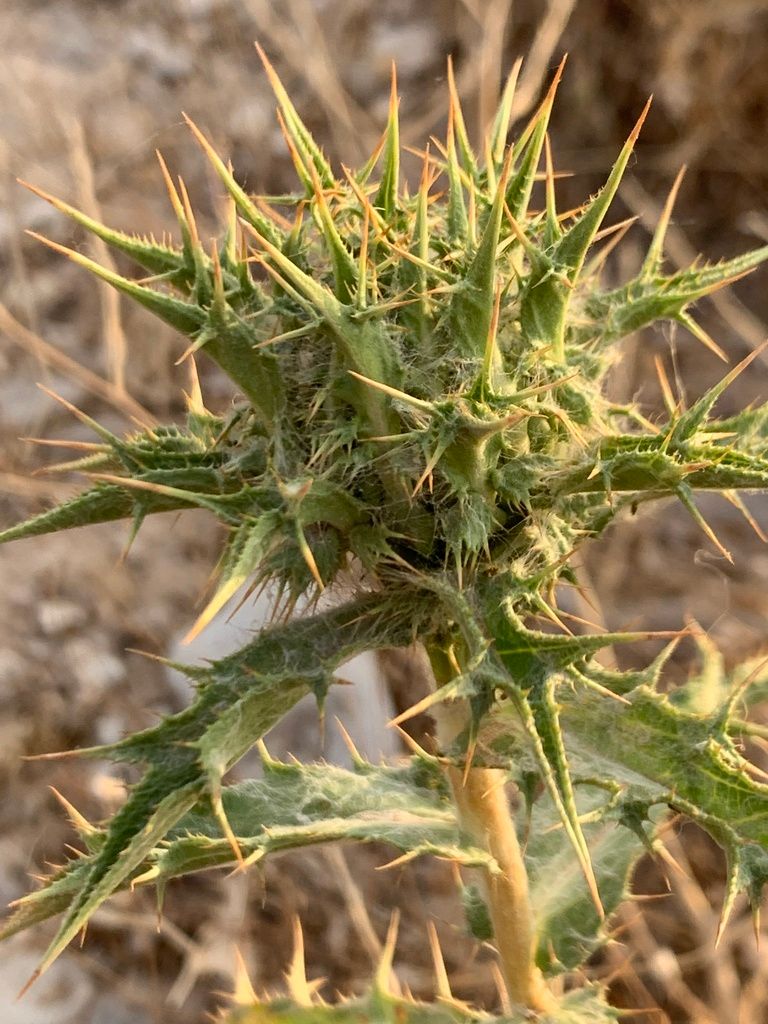
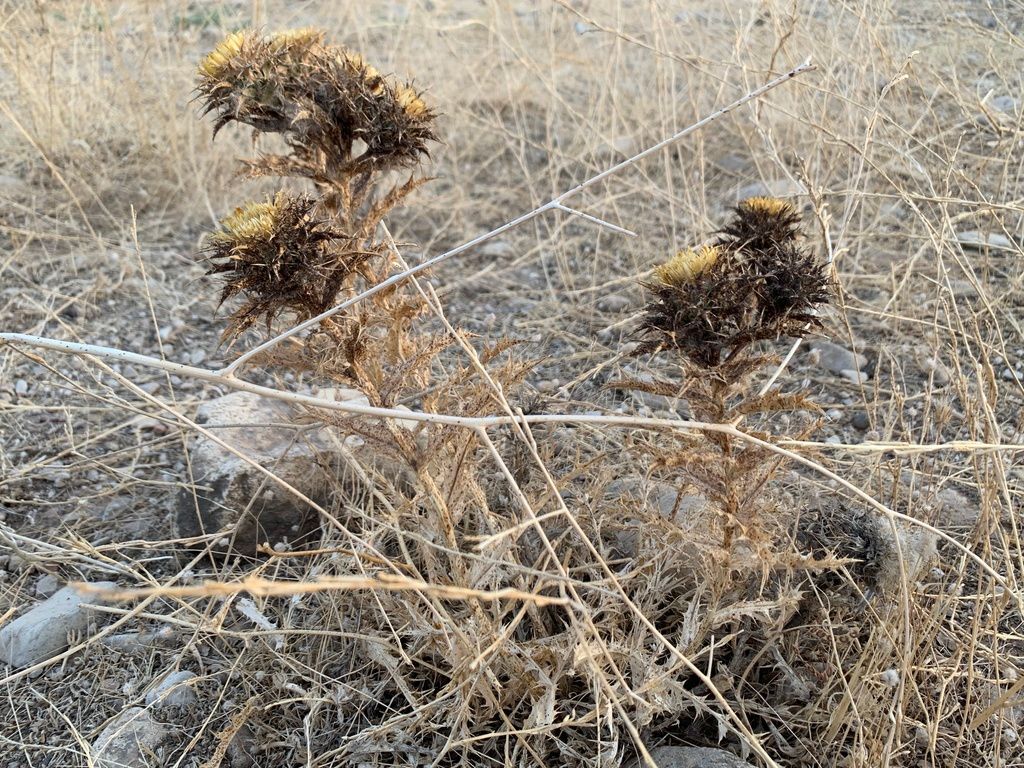
The papery bracts also move. In their monograph on the genus, the same two botanists who named this species in 1972 describe "moisture dependent movements" in carline thistles during flowering and fruiting: the inner bracts bend outwards and inwards as the air dries or dampens, worked by the swelling of cell walls in dead tissue[4]. A flower head that moves with the weather, without a living cell to do it.
Four labels, one new species
For years nobody knew this thistle was a species of its own. The herbarium sheets tell the story.
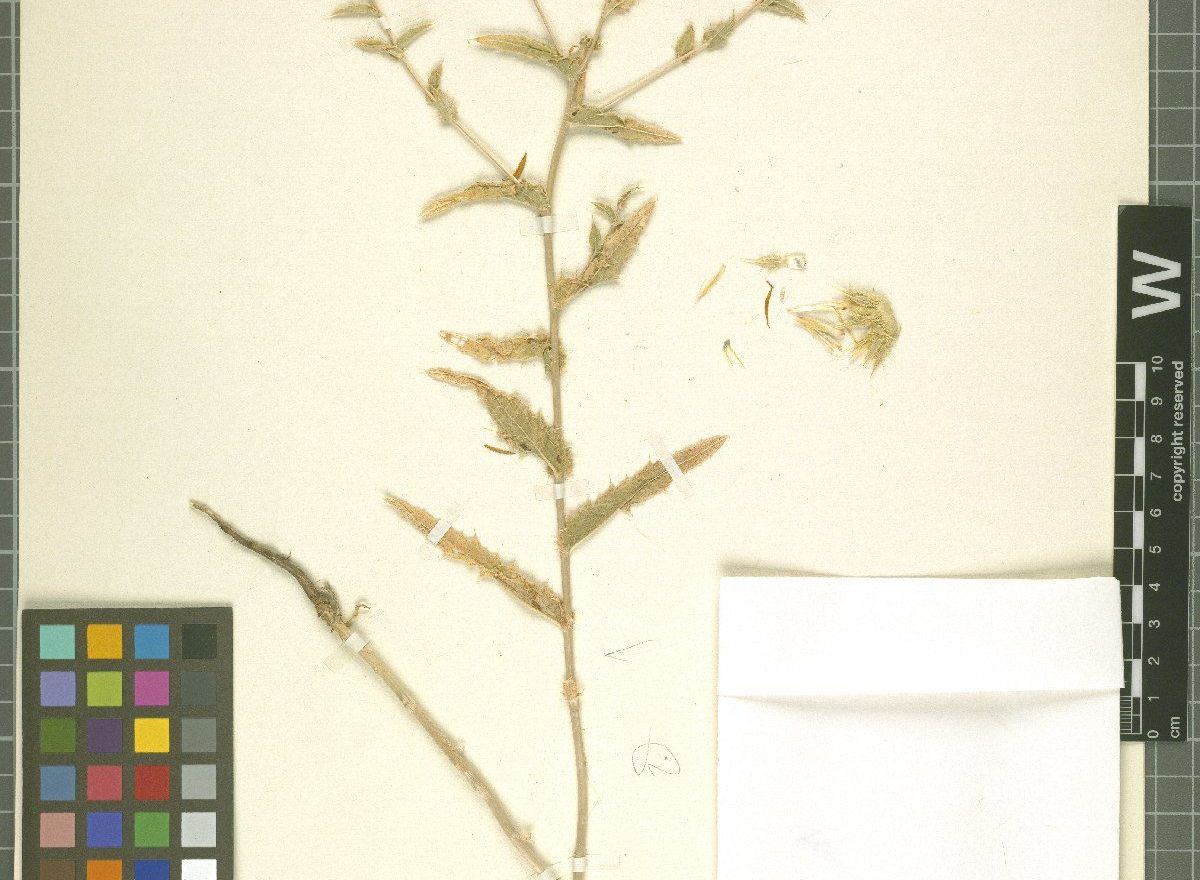
- On 2 September 1957, the botanist R. W. Haines collected it near Dihok and noted on his label that it was "Frequent on dry grassy open hillside". The label first read Carlina lanata; lanata was crossed out and corrected to corymbosa "in the broad sense"[5][6].
- In early July of the same year, the botanist Karl Heinz Rechinger (1906–1998)[2], on a collecting journey his labels call Itinera orientalia 1956/57, had gathered it on the limestone rocks of Jabal Khantur, at 1,400 m, and labelled it only "Carlina"[7].
- On 3 September 1959, Ali Al-Rawi and colleagues of the National Herbarium of Iraq gathered it near Zaxo (Zakho) and wrote "Carlina corymbosa L." on the form[5]. In a 1964 bulletin of Iraq's agriculture department, Al-Rawi still published it under that name[1].
But Carlina corymbosa is a plant of the central Mediterranean[4]. The sheets were eventually studied at the institute of botany in Halle by Hermann Meusel (1909–1997) and Arndt Kästner (born 1936)[2], who were working through the whole genus[4]. On 29 January 1972 they went through the Kurdish material and pinned the same new slip to sheet after sheet: Carlina kurdica, "det./corr. H. Meusel & A. Kästner, Inst. Bot. Univ. Halensis"[7][5][5][5]. On Rechinger's sheet they added two more words: spec. nov., a species new to science[7].
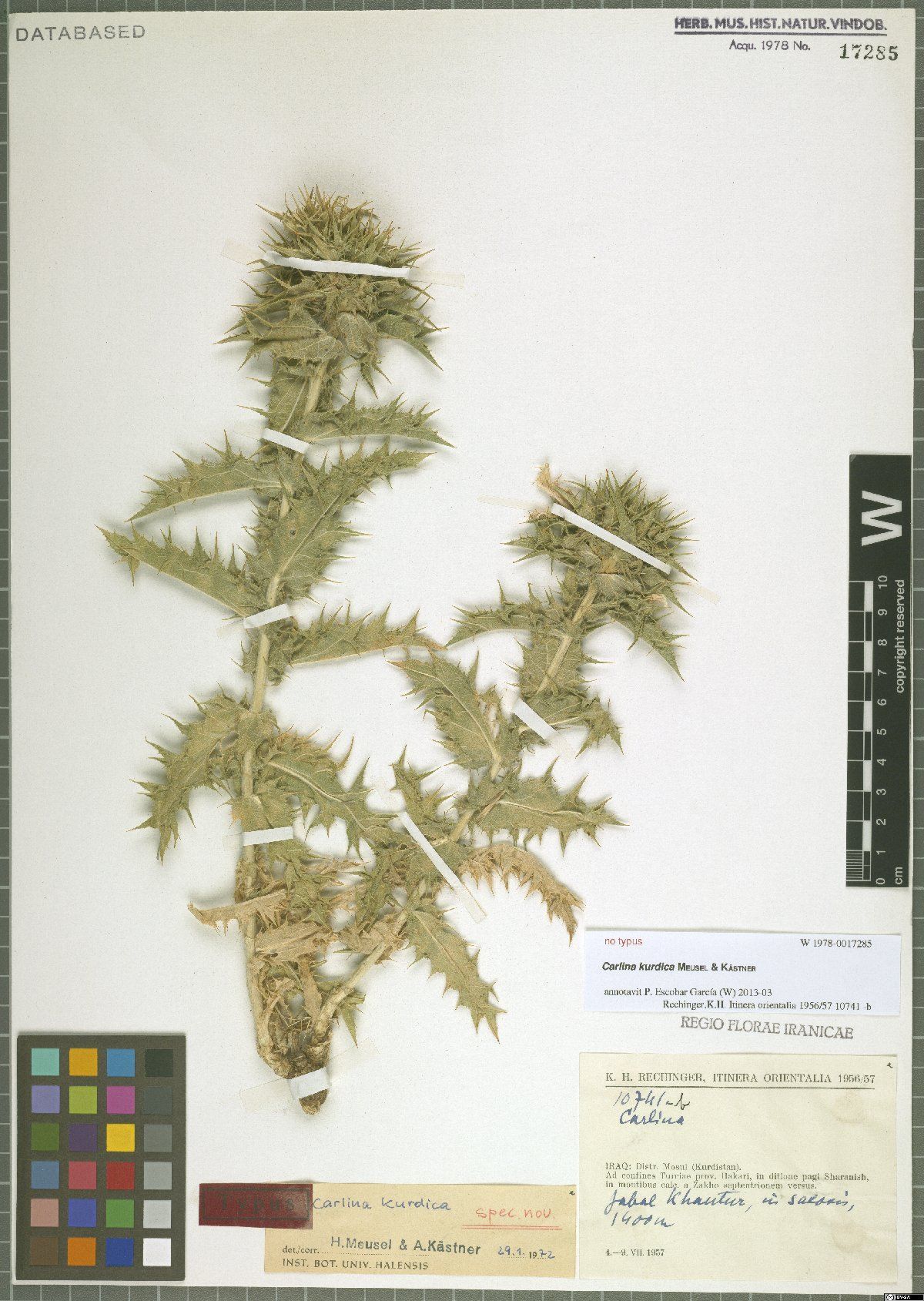
Rechinger's printed label is a small piece of Kurdish geography in Latin:
IRAQ: Distr. Mosul (Kurdistan). Ad confines Turciae prov. Hakari, in ditione pagi Sharanish, in montibus calc. a Zakho septentrionem versus.
IRAQ: Mosul district (Kurdistan). On the border of Turkey's province of Hakari, in the lands of the village of Sharanish, in the limestone mountains north of Zakho.[7] (our translation)
The province he means is Colemêrg (Hakkari) in North Kurdistan (Bakur), just across the border. The species was published in 1972 in Feddes Repertorium[2], and its holotype, the specimen the name is tied to, is a sheet at Kew collected by Al-Rawi on the same mountain: "Jabal Khantur near Sharanish, Rawi 23290"[1]. Rechinger's sheet in Vienna, from the same slopes, is not part of the type: a curator's slip of 2013 says so plainly, "no typus"[7].
The epithet kurdica means "Kurdish": named after the land where all of these plants were found.
Charlemagne's thistle
The genus name has a legend attached. According to the Flora of Iraq, Carlina is "named after Emperor Charlemagne (c.742–814), who is said to have cured an epidemic in his army by the use of C. acaulis", the stemless carline thistle[1]. There are about 30 species, from Europe and North Africa to temperate Asia[1].
Meusel and Kästner placed the Kurdish plant in the section Corymbosae, beside C. corymbosa, C. hispanica and C. graeca[4], a group they call "a typical Circum-Mediterranean taxon", with its own chromosome number (2n = 18)[4]. Within that Mediterranean group, Carlina kurdica is the one of the Kurdish mountains.
Their account of the section's range reads from west to east. Its species replace one another in sectors across the whole Mediterranean: C. hispanica in the west, C. corymbosa in the centre, C. graeca and C. libanotica in the east, and finally C. kurdica[4]. They file the section as a whole under a circum-Mediterranean type of range, one that often reaches out to the Canary Islands and Madeira and to "the Kurdish mountains" (in den Kurdischen Gebirgen[4]). Carlina kurdica itself they class as an endemic of what they call the Quercus brantii type, named after an oak: plants of the mountains of the eastern Mediterranean, Kurdistan and south-west Iran[4].
How to recognise it
In the Flora of Iraq, written by Meusel and Kästner themselves, the species is[1]:
- a perennial, 15–25 cm tall (rarely to 30 cm), growing from a woody, branched rootstock;
- stems upright and mostly unbranched;
- stem leaves 4.5–6 cm long, half-clasping the stem, the upper ones triangular, with 6–7 spiny segments and a terminal spine of 1.5–2 cm;
- flower heads 2–2.5 cm across, the spiny outer bracts 2.8–3.5 cm long and only slightly longer than the yellow, radiating inner bracts.
The Flora of Iraq treats only one other carline thistle: Carlina lanata, found "once or twice in the extreme N mountain region". It is an annual with purple or silvery-purple inner bracts, so the two are easy to tell apart: yellow ring and a woody rootstock means C. kurdica[1].
Where it grows
The Flora of Iraq calls it "widespread in the mountain-forest region", "just extending to the adjacent dry steppe", at 300 to 1,400 m, on dry fields, dry grassy and stony limestone slopes and in open oak forest[1]. Its records trace the mountain arc of Başûr from the north-west to the south-east[1][3]:
- Around Dihok and Zaxo: Jabal Khantur near Sharanish, the type locality; near Zaxo; and Dihok, where it was photographed again in 2023[1][3][3];
- In the Hewlêr (Erbil) mountains: Şêrwana Mezin (Shirwan Mazin); between Sîdekan (Sidakan) and Diyana (Diana); Mount Heybet Sultan (Haibat Sultan) near Koye (Koi Sanjaq)[1];
- Around Silêmanî (Sulaymaniyah) and Kerkûk (Kirkuk): the Bazyan pass (Darband-i Basian); Pêştaşan village north-east of Ranye (Rania); the road from Kerkûk to Koye[1]; and, in recent photographs, the hills around Derbendîxan[3].
The Flora counts it as endemic to Iraq[1], which in practice means endemic to the Kurdish mountains. Kew's world checklist also lists it for north-central Syria[8], a record we have not been able to trace to a published specimen.
Kurdish names
No Kurdish name has been recorded for Carlina kurdica itself. Ehmedê Dirihî's dictionary of Kurdish plant names gives pîrejin for the genus Carlina as a whole, from a dictionary of the Paris Kurdish Institute[9]. It is a name for the genus, not one recorded for this species.
In the herbal shops of Silêmanî, a 2016 survey recorded carline-thistle roots sold under the name Çawbazele and used in a decoction as a diuretic. The study identified them as Carlina acaulis, the European stemless carline thistle, not as the Kurdish species[10], and Dirihî's dictionary also records çawbazele for that species[9].
These are records of traditional use, not medical advice.
Sources
- 1.Meusel, H. & Kästner, A. (2019). Carlina L. In: Ghazanfar, S. A., Edmondson, J. R. & Hind, D. J. N. (eds), Flora of Iraq 6 (Compositae): 13–15. Royal Botanic Gardens, Kew.
- 2.International Plant Names Index. Royal Botanic Gardens, Kew, Harvard University Herbaria and Australian National Herbarium.
- abcdCarlina kurdica Meusel & Kästner, Feddes Repertorium 83(4): 231 (1972); author records for Meusel, Kästner and K. H. Rechinger.
- urn:lsid:ipni.org:names:189263-1. ipni.orghttps://www.ipni.org/n/189263-1accessed 14 November 2026
- 3.iNaturalist. inaturalist.orghttps://www.inaturalist.org/
- 4.Meusel, H. & Kästner, A. (1990). Lebensgeschichte der Gold- und Silberdisteln. Monographie der mediterran-mitteleuropäischen Compositen-Gattung Carlina. Band I. Denkschriften der Österreichischen Akademie der Wissenschaften, Math.-Nat. Klasse 127. Springer, Wien.
- 5.Royal Botanic Gardens, Kew – Herbarium Specimens. via GBIF. gbif.orghttps://www.gbif.org/dataset/cd6e21c8-9e8a-493a-8a76-fbf7862069e5
- 6.↩Royal Botanic Garden Edinburgh Herbarium (E), specimen catalogue (via data.rbge.org.uk and GBIF). herbarium specimen E00460224 (R. W. Haines 1217, 1957), via GBIF. data.rbge.org.ukhttps://data.rbge.org.uk/herb/
- 7.abcdeNatural History Museum Vienna (W) – Herbarium. via GBIF, herbarium specimen W 1978-0017285 (K. H. Rechinger 10741-b, 1957), via JACQ and GBIF.
- 8.Plants of the World Online. Royal Botanic Gardens, Kew.
- ↩Carlina kurdica.
- plant_name_id 3040049. powo.science.kew.orghttps://powo.science.kew.org/taxon/urn:lsid:ipni.org:names:189263-1accessed 14 November 2026
- 9.Ahmet Kasımoğlu (Ehmedê Dirihî) (2013). Ferhenga Navên Nebatan a Kurdî (Dictionary of Kurdish Plant Names). Mardin Artuklu University, Institute of Living Languages in Turkey (ISBN 978-605-4202-12-6).
- 10.↩Hiwa M. Ahmed (2016). Ethnopharmacobotanical study on the medicinal plants used by herbalists in Sulaymaniyah Province, Kurdistan, Iraq. doi:10.1186/s13002-016-0081-3https://doi.org/10.1186/s13002-016-0081-3
- Ghazanfar, S.A., Edmondson, J.R. & Hind, D.J.N. (eds) (2019). Flora of Iraq, Volume 6: Compositae. Royal Botanic Gardens, Kew. ISBN 978-1-84246-685-8, p. 14. kew.iro.bl.ukhttps://kew.iro.bl.uk/server/api/core/bitstreams/4f012cdf-8c78-42a4-8b06-666b032a15c1/content#page=23accessed 14 November 2026
Last updated 20 November 2026