Carex kurdica is a tough, grey-green sedge that grows in great tussocks on the banks of Kurdistan's rivers. It was first found in August 1910 along the Botan and the Tigris (Dîcle) between Sêrt (Siirt) and Cizîr (Cizre) in North Kurdistan (Bakur), where, its discoverer wrote, it formed "large tussocks growing out into the river"[1]. The name kurdica means "Kurdish": the plant is named after the land where it was found.
How it got its name
- Named by
- Kük. ex Hand.-Mazz., 1914Published in Ann. K. K. Naturhist. Hofmus. 28: 23
Where it grows in Kurdistan
At 500–650 m above sea level.
Tussocks in the river
The botanist Heinrich von Handel-Mazzetti (1882–1940)[2] reached the Botan in August 1910, travelling for the Naturwissenschaftlicher Orientverein, a natural-science society in Vienna, on an expedition to Mesopotamia and Kurdistan[3][4]. In his account of the journey he drew the line between the two lands with care: Kurdistan was the rainier, wooded mountain country of the north, Mesopotamia the dry, nearly treeless plain, and they met "where by and large the Kurdish and Arab populations meet"[3].
On 17 and 18 August he worked his way down the Botan below Sêrt and then down the Tigris as far as Finik, above Cizîr, at 500 to 650 m[1]. Along the whole stretch he found a sedge that was "very widespread", growing out from single groups of rocks into the water and forming big clumps in the current[1][3]. In his survey of the region's vegetation he picked it out of the riverside flora by name: "particularly remarkable"[3].
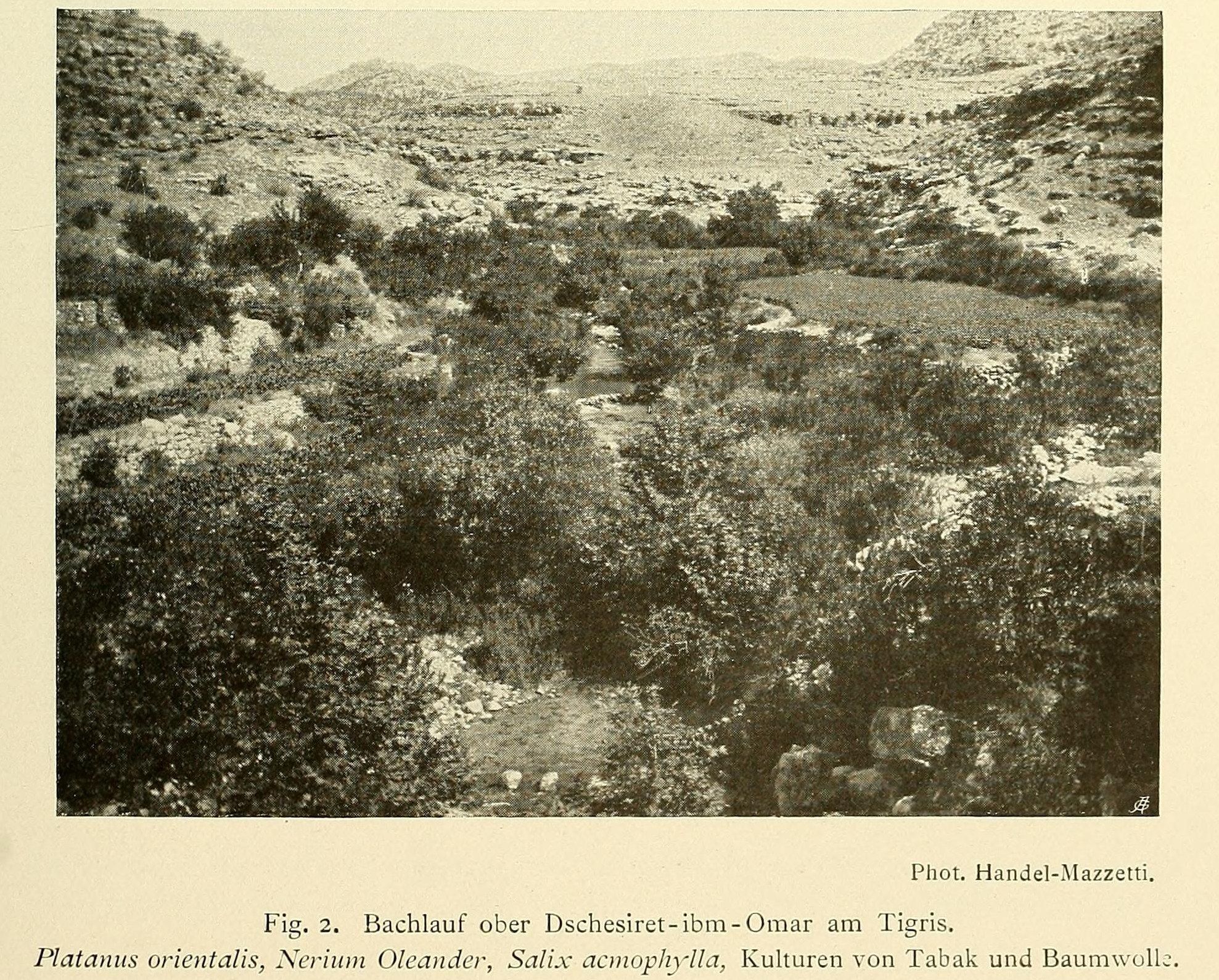
Plants of this habitat (stream and river banks, marshes and small springs) are listed in the same survey: willows, figs, tamarisk and oleander, rushes, reeds and other sedges, and mosses, among them one named Amblystegium kurdicum[3]. The same list includes Galium kurdicum, another plant named after the Kurds[3].
"A lot of head-scratching"
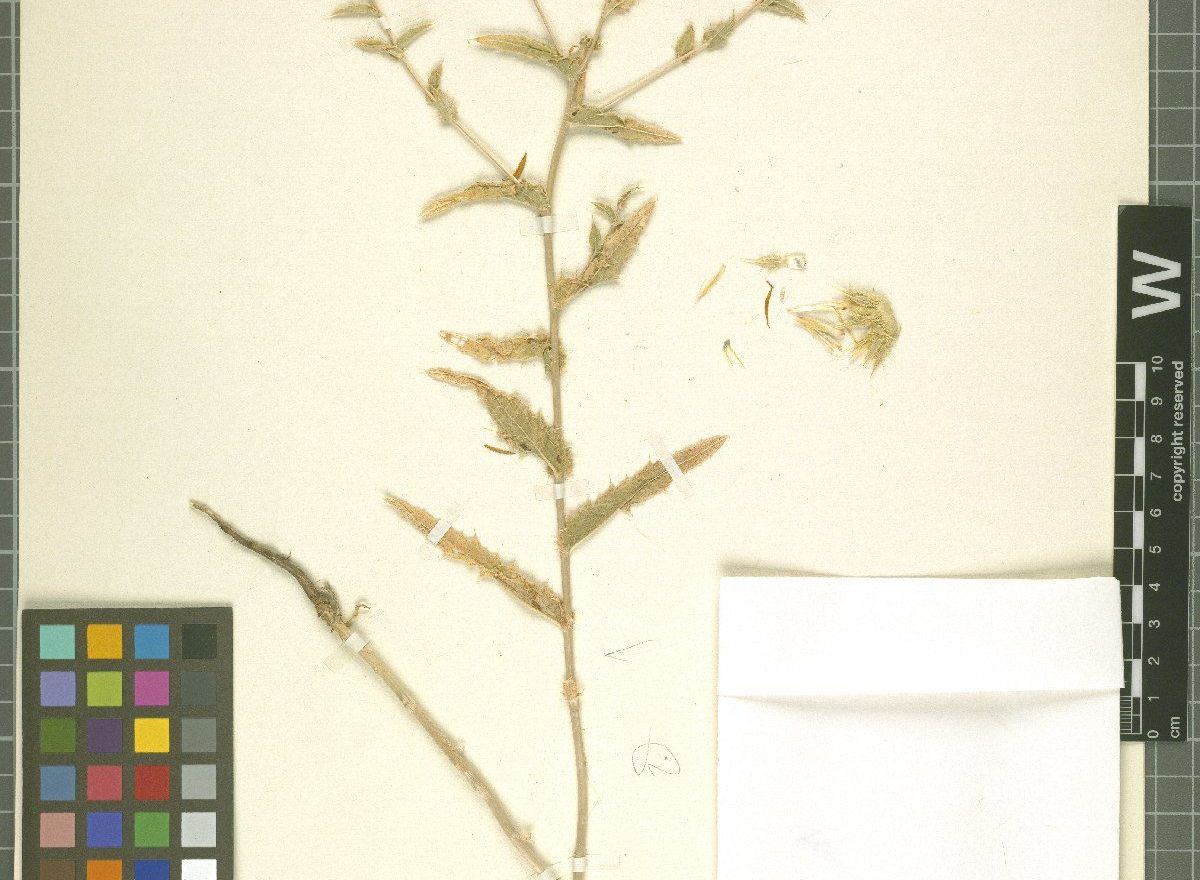
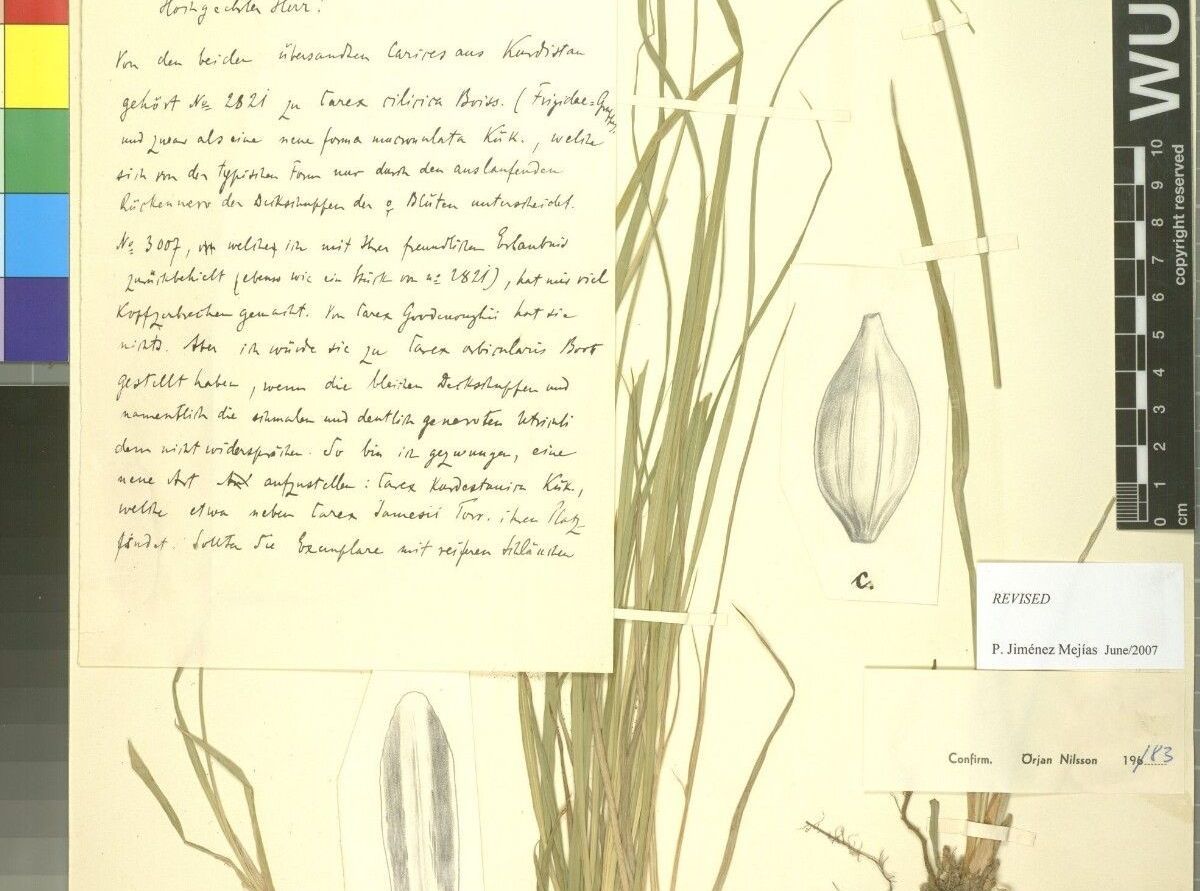
Handel-Mazzetti pressed two numbers of the sedge, 2991 from the Botan and 3007 from the Tigris[1], and sent sedges from the trip to Georg Kükenthal (1864–1955)[2] in Coburg, who named the expedition's sedges[1]. Kükenthal's answer is still attached to the sheet of no. 3007 in the herbarium of the University of Vienna[4]. It is dated Coburg, 13 January 1913, and opens: "Of the two Carices from Kurdistan you sent me…"[4] (our translation).
One of the two, Kükenthal wrote, was a known mountain sedge, Carex cilicica, in a new form[4]; he published it in 1914 as forma mucronulata, from wet rock ledges at 2,750 m on Mount Meleto in Sasûn (Sason)[1]. The other, no. 3007, was harder:
No. 3007 … has given me a lot of head-scratching. It has nothing of Carex Goodenoughii. But I would have put it with Carex orbicularis Boott, if the small scales and above all the narrow, clearly veined utricles did not speak against it. So I am forced to set up a new species.[4] (our translation of the handwritten letter)
In the letter he called the new species by a slightly different name, which we read as "Carex kurdestanica Kük."[4]. By the time it was printed in 1914 it had become Carex kurdica[1].
The published note still shows the puzzle. Its habit, Kükenthal wrote, would place it in the group of stiff sedges around C. orbicularis: strong rhizome, rather rigid three-angled stems, stiff leaves rolled under at the edge, short bracts. But its utricles (the little sacs around each fruit) are only weakly convex on both faces, not swollen, and clearly veined on both sides, and they point to a different group. He placed it between C. goodenoughii and C. jamesii[1]. In the letter he had written that it had "nothing" of C. goodenoughii and had already put it next to C. jamesii; in print it ended up as the neighbour of both[1][4].
Because the name was published in Handel-Mazzetti's paper with Kükenthal's description, botanists write its author as "Kük. ex Hand.-Mazz."[2][5].
The drawing and the sheet
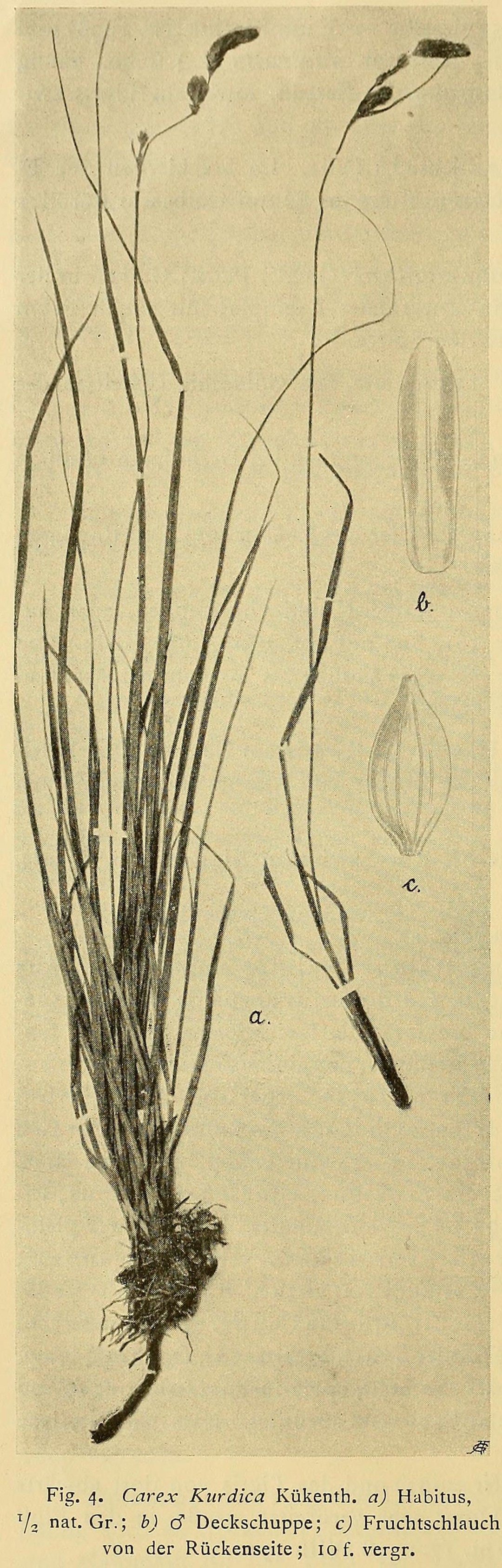
The published description came with a figure: the whole plant at half size, a scale from a male flower, and a utricle seen from the back, ten times enlarged[1]. The two small drawings of the scale and the utricle are pasted on the Vienna sheet itself, next to the plant they were drawn from[4].
What it looks like
Kükenthal's Latin description gives a good picture[1]:
- it forms wide tussocks, and its rhizome sends out strong runners;
- the stems are 35–85 cm tall, straight and slender but firm, three-angled, a little rough near the top and leafy at the base;
- the leaves are shorter than the stems, 2–4 mm wide, rather stiff, keeled and long-tapering, with the edges rolled under, and grey-green; the leaf sheaths are brown, with small knot-like cross-veins;
- each stem carries 3 to 5 spikes: one male spike at the top, about 2 cm long, and below it female spikes 12–25 mm long, densely flowered and stalkless;
- the lowest bract is leafy and as long as the stem or shorter;
- the scales of the female flowers are dark at the edges, and the utricles, almost 3 mm long, are reddish straw-coloured with several veins on each side and a short, pale beak;
- each flower has two stigmas.
A plant hidden under another name
For decades the name was mixed up with a better-known sedge, Carex acuta. In a 2014 study Pedro Jiménez-Mejías and colleagues called C. acuta as it had been used a "taxonomic hotchpotch": the name had been applied loosely to similar plants[6]. They studied 101 specimens from 19 herbaria, including the type material, and moved some populations that had been called C. acuta to C. kurdica[6]. The Vienna sheet carries his slip, "REVISED P. Jiménez Mejías June/2007"[4].
They also found that the specimen chosen to carry the name (the lectotype) was immature, and proposed a second specimen, an epitype, to fix the name's meaning alongside it[6].
The same study recorded C. kurdica as new for eastern Europe and for Mediterranean Anatolia[6]. In 2019 two of the same authors, with colleagues, collected it in northern Albania, near Shkodër, in wet, peaty meadows with butterwort and black bog-rush[7].
Where it grows
Kew's checklist gives its native range as stretching from Albania and north-western Greece to eastern Turkey and north-western Afghanistan[5]. In Kurdish terms, the herbarium record covers three parts of Kurdistan:
- Bakur: the Botan and the Tigris between Sêrt and Cizîr, the type area, at 500–650 m[1][4].
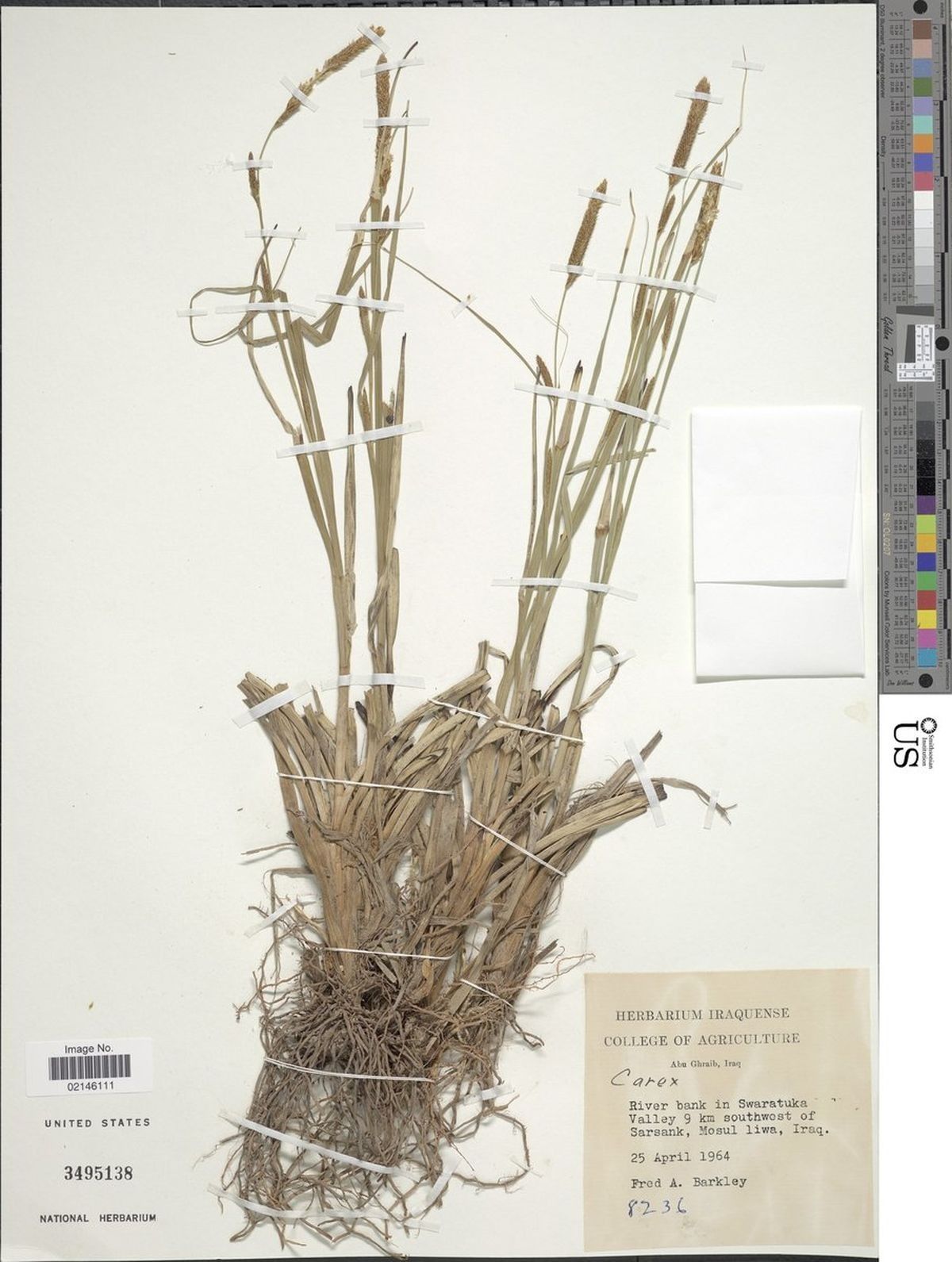
- Başûr: a river bank in the Swaratuka valley, 9 km south-west of Sersing (Sarsang), collected by Fred A. Barkley on 25 April 1964[8]. His label says only "Carex"; the specimen was identified as C. kurdica much later[8].
- Rojhilat: several gatherings by Amini Rad in May 2006 around Sine (Sanandaj), at 1,300–2,360 m where the labels give a height, and between Merîwan (Marivan) and Pawe (Paveh)[9]. One of them, from 45–50 km along the road from Sine to Tangi-Sar, is filed in the Seville herbarium as a type[9].
All the records with a habitat we read are from wet places: river banks, where it can stand in the current[1][3][8], and in Albania a wet meadow[7].
The species has not been assessed for the IUCN Red List[10].
Its name in Kurdish
No Kurdish name was recorded with any of the early collections. Ehmedê Dirihî's dictionary of Kurdish plant names lists names for it formed after the Latin, "… of the Kurds", such as botê kurdan and zîlê kurdan[11]. They are dictionary names, built on words the same dictionary gives for sedges in general, such as bot and zil (genus names, still to be checked)[11], rather than names collected from people who know this particular plant.
Sources
- 1.Kükenthal, G. in Handel-Mazzetti, H. (1914). Pteridophyta und Anthophyta aus Mesopotamien und Kurdistan sowie Syrien und Prinkipo. I. Annalen des K. K. Naturhistorischen Hofmuseums 28: 23–24.
- 2.International Plant Names Index. Royal Botanic Gardens, Kew, Harvard University Herbaria and Australian National Herbarium.
- abcCarex kurdica Kük.; author records for Kükenthal and Handel-Mazzetti.
- urn:lsid:ipni.org:names:300494-1. ipni.orghttps://www.ipni.org/n/300494-1accessed 14 November 2026
- 3.Handel-Mazzetti, H. (1914). Die Vegetationsverhältnisse von Mesopotamien und Kurdistan. Annalen des K. K. Naturhistorischen Hofmuseums 28. Plate VI.
- 4.abcdefghijHerbarium of the University of Vienna (WU), specimen WU 0039032 (Handel-Mazzetti 3007), with G. Kükenthal's letter of 13 January 1913 (via GBIF).
- 5.Plants of the World Online. Royal Botanic Gardens, Kew.
- abCarex kurdica Kük. ex Hand.-Mazz.
- plant_name_id 227846. powo.science.kew.orghttps://powo.science.kew.org/taxon/urn:lsid:ipni.org:names:300494-1accessed 14 November 2026
- 6.abcdJiménez-Mejías, P., Martín-Bravo, S., Amini-Rad, M. & Luceño, M. (2014). Disentangling the taxonomy of Carex acuta s.l. in the Mediterranean basin and the Middle East: re-evaluation of C. panormitana Guss. and C. kurdica Kük. ex Hand.-Mazz. Plant Biosystems 148(1): 64–73. doi:10.1080/11263504.2012.758675https://doi.org/10.1080/11263504.2012.758675
- 7.abUPOS Herbarium, Universidad Pablo de Olavide, Seville: specimen 13350-1, Albania, 2019 (via GBIF).
- 8.abcSmithsonian Institution, US National Herbarium, specimen US 3495138 (F. A. Barkley 8236, 1964) (via GBIF).
- 9.abUPOS Herbarium, Universidad Pablo de Olavide, Seville: specimens collected by Amini Rad in East Kurdistan, May 2006 (via GBIF).
- 10.↩GBIF.org GBIF Backbone Taxonomy and occurrence records. IUCN Red List category for Carex kurdica (Not Evaluated). gbif.orghttps://www.gbif.org/
- 11.abAhmet Kasımoğlu (Ehmedê Dirihî) (2013). Ferhenga Navên Nebatan a Kurdî (Dictionary of Kurdish Plant Names). Mardin Artuklu University, Institute of Living Languages in Turkey (ISBN 978-605-4202-12-6).
- Handel-Mazzetti, H. (1914). Pteridophyta und Anthophyta aus Mesopotamien und Kurdistan sowie Syrien und Prinkipo. I. Annalen des K. K. Naturhistorischen Hofmuseums Wien 28: 1-48 (Carex kurdica Kük., p. 23), p. 23. archive.orghttps://archive.org/details/annalendeskknatu28kkna/page/n34/mode/1upaccessed 14 November 2026
Last updated 20 November 2026