How it got its name
- Named by
- Hanelt, 1963Published in Feddes Repert. Spec. Nov. Regni Veg. 67: 82
A yellow thistle from the hills of Zaxo
Carthamus curdicus is a spiny, yellow-flowered annual of dry hills and fallow fields, and the Flora of Iraq calls it "very rare"[1]. It belongs to the same small genus as safflower, an ancient crop of the Fertile Crescent, and it is known from only a handful of herbarium sheets. The first two were gathered near Zaxo (Zakho) in Behdînan, South Kurdistan (Başûr)[1][2][3][3][2].
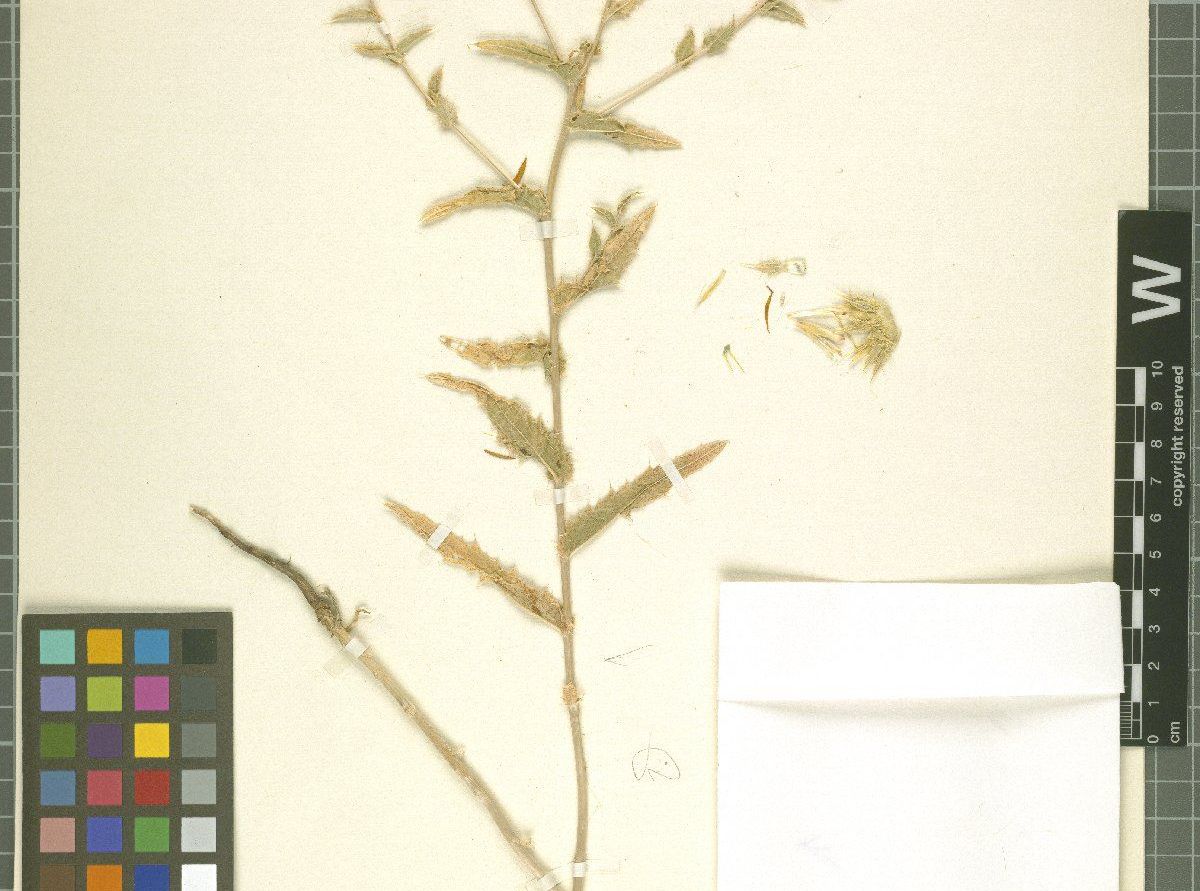
It flowers in July[1], and for now its portrait is a pressed one: every picture of it we could find is of a dried specimen.
Two collectors in one week
In the first days of July 1957 the botanist Karl Heinz Rechinger, on the expedition his labels call Itinera orientalia 1956/57, pressed a yellow Carthamus on a hill called Dagh al Radzijem, between Zaxo and Sharanish, close to the border, and wrote the place down in Latin[2]:
IRAQ: Distr. Mosul (Kurdistan). … in ditione oppidi Zakho; substr. calc. Dagh al Radzijem inter Zakho et Sharanish, in collibus siccis.
In the district of the town of Zakho; on limestone. Dagh al Radzijem between Zakho and Sharanish, on dry hills.[2] (our translation)
Even this label, which files the place under Iraq's Mosul district, adds "Kurdistan" in brackets.
On 4 July 1957, about 20 km north-east of Zaxo, Ali Rawi of the National Herbarium of Iraq collected the same plant at the foot of a hill, at 550 m, still the only altitude the Flora of Iraq has for it[1][3]. His printed label has a line for "Colloquial Name", the local name of the plant. It was left empty[3].
Nine days later and some 350 km to the north-west, the botanists Peter Davis and Ian Hedge found a yellow Carthamus in fallow fields at Pertek in Dersim (Tunceli), North Kurdistan (Bakur), at 1,000 m: "Annual. Flower lutea", yellow[3]. Someone later wrote curdicus Hanelt on the sheet at Kew, and the Flora of Iraq calls this gathering "indistinguishable from the Iraqi material"[1][3].
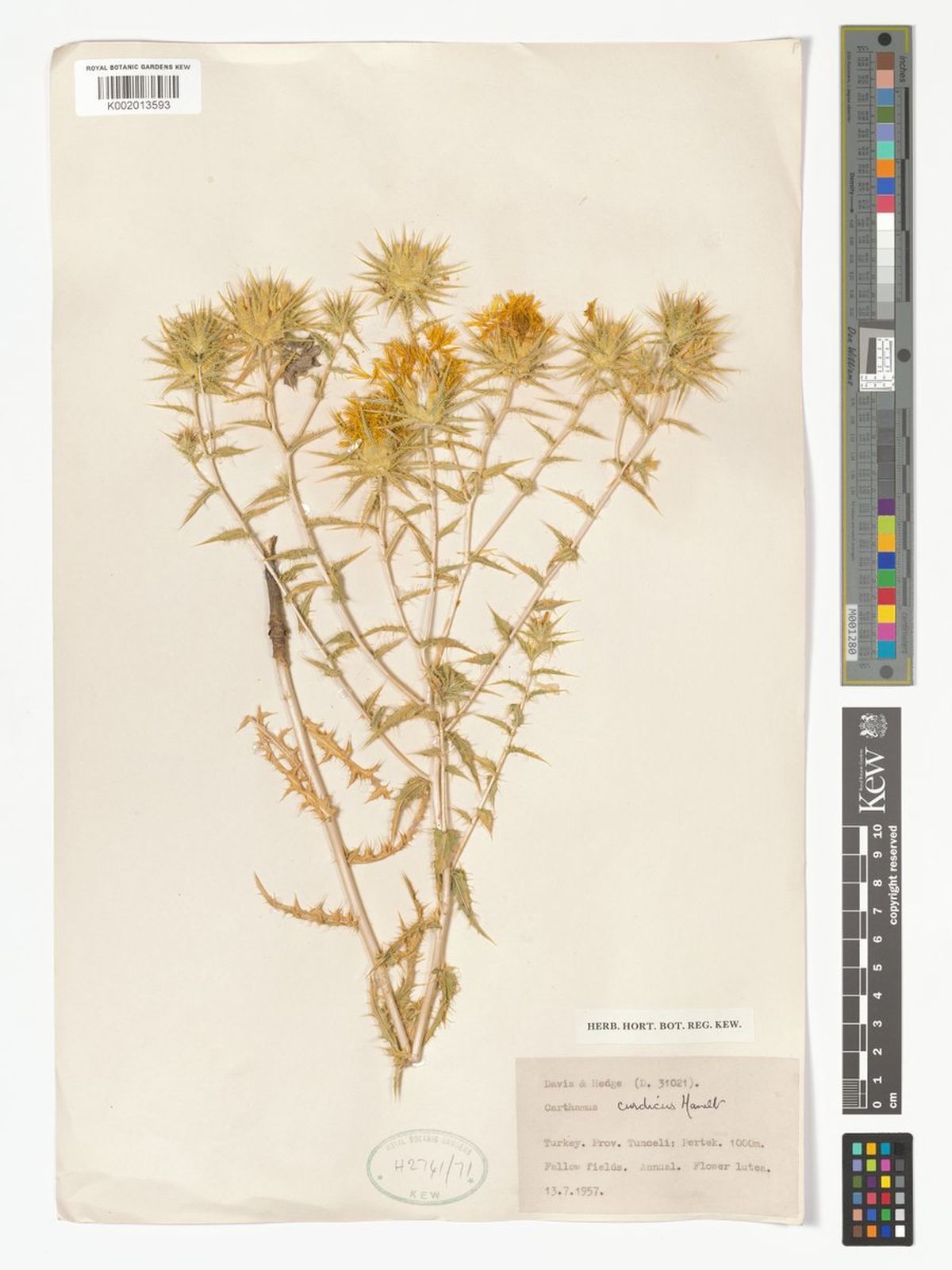
Nobody knew yet that these were all the same plant, or that it had no name.
A new species, or a hybrid?
At first the specimens were filed under the names of its relatives: Rawi's label says Carthamus persicus, and a 1965 revision slip on the same sheet calls it Carthamus flavescens[3].
The botanist who sorted it out was Peter Hanelt, who was working through the whole genus. On 4 October 1960 he added a handwritten slip to Rechinger's specimen in the Natural History Museum in Vienna. It begins "Carthamus curdicus Han., sp. nov. (an hybr.?)", "a new species (or a hybrid?)", and explains his doubt[2] (our translation):
The plant combines characters of C. persicus (the shape of the leaves and bracts, the shape of the fruits, the pappus) with those of C. gypsicolus (the shape and size of the heads, the hairs, the spines), and in its overall look it is closer to C. gypsicolus. But C. gypsicolus is so far known only from the lowlands of Central Asia and from Transcaucasia, which for now argues against a hybrid origin.
The slip also marks the sheet "Holotypus!": this specimen is the holotype, the one the name hangs on[2]. Hanelt published Carthamus curdicus in 1963, on page 82 of his monograph of the genus[4][5]. He spelled the epithet with a c: curdicus, Latin for "Kurdish".
The question he raised has never quite gone away. In 2019 the Flora of Iraq found the hybrid idea "rather improbable", since the plant appears to be fertile and C. gypsicolus is known only from Transcaucasia and Central Asia. Its author went further: given how much C. persicus varies in Turkey, he thought it "much more likely that C. curdicus will eventually be reduced to synonymy under that variable species"[1]. For now Kew's checklist still accepts it as a species of its own[6].
The safflower family
Carthamus is a small genus, about fourteen species around the Mediterranean and in south-western and central Asia, seven of them in Iraq. Its name comes from the Arabic name for safflower, qurṭum[1].
Safflower (Carthamus tinctorius) is the genus's famous member: an orange-flowered thistle used for colouring food, also called "bastard saffron"[1]. It is thought to have been domesticated more than 4,000 years ago somewhere in the Fertile Crescent[7]. In Baghdad, a strip of land on the left bank of the Tigris was once called Za'faraniya after the bastard saffron grown there, before the growing city swallowed it[1].
Safflower's closest wild relatives form a tight group, all with 24 chromosomes, and C. curdicus is one of them, alongside C. persicus, C. oxyacanthus, C. gypsicolus (which Chapman and Burke spell gypsicola) and C. palaestinus[7]. Being a wild cousin of a crop is what brought this rare Kurdish thistle into a genetics laboratory.
A herbarium sheet that gave its DNA
In May 1961 the botanist Howard C. Stutz collected a yellow Carthamus on conglomerate and mud hills north-east of Baquba, at about 400 feet (some 120 m). The sheet ended up in Vienna, and in April 1963 Hanelt identified it as Carthamus curdicus, noting on it that this was the second specimen of the species, after Rechinger's type[2].
Forty-two years later the same sheet was opened again. Two slips record that in 2005 material was taken from it for DNA work: one for Mark Chapman in Nashville, one for Roser Vilatersana in Barcelona[2].
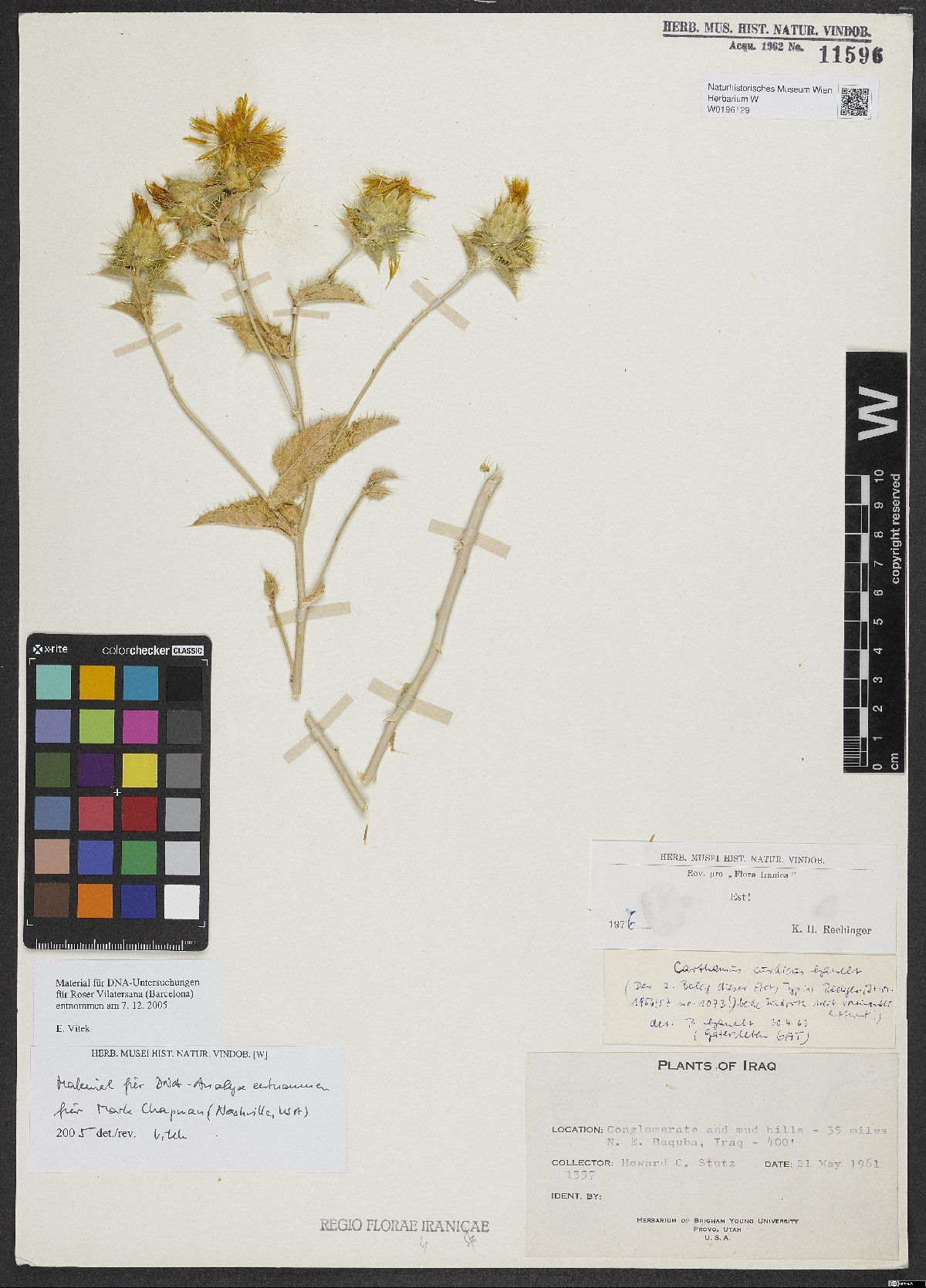
Chapman's study, published with John Burke in 2007, compared seven genes across safflower and its wild relatives to find safflower's ancestor. Its single C. curdicus sample came from the Vienna herbarium. The paper lists it under 12361, the type sheet's number, yet the 2005 slip for Chapman is on Stutz's sheet. From the records alone we can't tell which of the two sheets the DNA came from[2][2][7]. The answer to the big question was C. palaestinus, a wild species of the deserts of southern Israel and western Iraq[7], which the Flora of Iraq counts as part of the variable C. persicus[1]. C. curdicus was not the ancestor, but in one of the family trees it grouped with C. persicus and one C. palaestinus plant at the base of the C. palaestinus branch[7]. A chloroplast gene sequenced from Stutz's sheet (Vienna accession 1962/11596) is in the public DNA databases too[2][8].
So a plant known from a handful of pressed sheets has still taken part in the search for the origin of one of the oldest crops of the Middle East.
What to look for
The Flora of Iraq describes it like this[1]:
- an annual, 40–60 cm tall, with whitish, hairless stems that send out a few slender, upward-pointing branches above the middle;
- lower leaves cut into about five pairs of narrow, weakly spiny segments; upper leaves stalkless, clasping the stem with small "ears", finely toothed with yellow spines, and quickly getting smaller up the branches;
- flower heads egg-shaped, the middle and inner bracts thickly covered in tiny glands and a little cobwebby;
- the outer, leaf-like bracts narrow, 15–20 mm long, each with 10–13 yellowish spines along each edge, and much shorter than the florets;
- florets bright yellow; fruits whitish with a brown upper rim, topped by a straw-coloured, bristly pappus up to 7–8.5 mm long.
The bracts are how the Flora tells it from its look-alike C. persicus, whose outer bracts are as long as the florets or longer and carry only 4–9 spines on each edge[1].
Where it grows
Kew's checklist gives its range as eastern Turkey to northern Iraq[6]. On the ground that means the dry limestone hills near Zaxo and the foot of a hill north-east of it, a site north of Kani Masi, and the fallow fields of Pertek in Dersim[1][2][3][3][3]. The Flora of Iraq calls it "very rare", with two collections from dry hills in the northernmost mountains and one in the foothills[1]. Stutz's sheet from the hills north-east of Baquba adds one more place[2].
If it still grows on the hills of Zaxo, it is waiting to be photographed.
A name still to be found
No Kurdish name for Carthamus curdicus turns up in any of the sources we checked, and the one label that asked for a local name was left blank[3]. For the genus as a whole, Ehmedê Dirihî's dictionary of Kurdish plant names gives kaxillî and kaxlî, both for Carthamus, with the Turkish aspir, safflower[9]. These are genus names, still to be checked, not names for this species. If you know this yellow thistle from the hills around Zaxo or Pertek, and know what it is called, we would like to hear from you.
Sources
- 1.abcdefghijklmnTownsend, C. C. (2019). Carthamus L. In: Flora of Iraq 6: 105–111. Ministry of Agriculture (Iraq) & Royal Botanic Gardens, Kew.
- 2.Natural History Museum Vienna (W) – Herbarium. via GBIF.
- 3.Royal Botanic Gardens, Kew – Herbarium Specimens. via GBIF. gbif.orghttps://www.gbif.org/dataset/cd6e21c8-9e8a-493a-8a76-fbf7862069e5
- 4.International Plant Names Index. Royal Botanic Gardens, Kew, Harvard University Herbaria and Australian National Herbarium.
- ↩Carthamus curdicus Hanelt, Feddes Repert. Spec. Nov. Regni Veg. 67: 82 (1963).
- urn:lsid:ipni.org:names:189471-1. ipni.orghttps://www.ipni.org/n/189471-1accessed 14 November 2026
- 5.↩Hanelt, P. (1963). Monographische Übersicht der Gattung Carthamus L. (Compositae). Feddes Repertorium 67: 41–180.
- 6.Plants of the World Online. Royal Botanic Gardens, Kew.
- abCarthamus curdicus Hanelt.
- plant_name_id 3046949. powo.science.kew.orghttps://powo.science.kew.org/taxon/urn:lsid:ipni.org:names:189471-1accessed 14 November 2026
- 7.abcdeChapman, M. A. & Burke, J. M. (2007). DNA sequence diversity and the origin of cultivated safflower (Carthamus tinctorius L.; Asteraceae). BMC Plant Biology 7: 60. doi:10.1186/1471-2229-7-60https://doi.org/10.1186/1471-2229-7-60
- 8.↩GBIF.org GBIF Backbone Taxonomy and occurrence records. sequence record: Carthamus curdicus voucher W-1962/11596, ndhF gene (INSDC ON304290). gbif.orghttps://www.gbif.org/
- 9.↩Ahmet Kasımoğlu (Ehmedê Dirihî) (2013). Ferhenga Navên Nebatan a Kurdî (Dictionary of Kurdish Plant Names). Mardin Artuklu University, Institute of Living Languages in Turkey (ISBN 978-605-4202-12-6), pp. 429.
- GBIF occurrence records of herbarium type specimens (per-record URL in each fact).
- occurrence 1230516995 (W 0012361). api.gbif.orghttps://api.gbif.org/v1/occurrence/1230516995accessed 14 November 2026
- occurrence 912588685 (K000772831). api.gbif.orghttps://api.gbif.org/v1/occurrence/912588685accessed 14 November 2026
- Ghazanfar, S.A., Edmondson, J.R. & Hind, D.J.N. (eds) (2019). Flora of Iraq, Volume 6: Compositae. Royal Botanic Gardens, Kew. ISBN 978-1-84246-685-8, p. 111. kew.iro.bl.ukhttps://kew.iro.bl.uk/server/api/core/bitstreams/4f012cdf-8c78-42a4-8b06-666b032a15c1/content#page=120accessed 14 November 2026
Last updated 20 November 2026