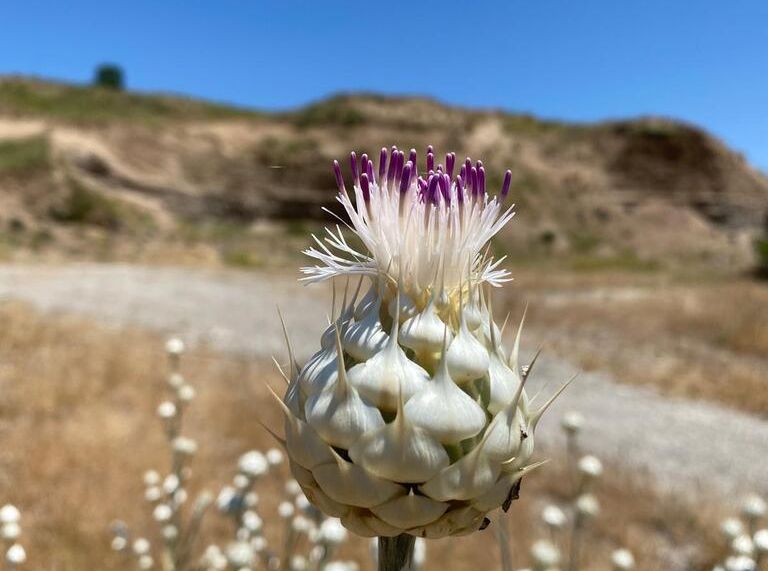
Centaurea kurdica is a stately relative of the cornflowers and knapweeds from North Kurdistan (Bakur). In summer it carries big round flower heads, each wrapped in glossy white scales that end in a thin spine, with a tuft of pink flowers on top[1][2]. It grows on rocky slopes, steppe and fallow fields between about 700 and 1,500 m, and is known only from the country around Mûş (Muş), Çewlîg (Bingöl), Dêrsim (Tunceli), Xarpêt (Elazığ) and Amed (Diyarbakır)[2]. It was described in 1863 from seeds gathered on the banks of the Murat river, and the name it was given, kurdica, means "Kurdish"[1].
How it got its name
- Named by
- Reichardt, 1863Published in Verh. K. K. Zool.-Bot. Ges. Wien 13: 1042
Seeds from the banks of the Murat, 1859
In the summer of 1859 the botanist Theodor Kotschy (1813–1866)[3] travelled through Kurdistan with a painter as his companion. In letters home he described how they left Erzurum on 10 August, crossed the Bingöl Dagh, "a mountain over 10,000 feet high", and spent fifteen days botanising from Gimgim (Varto) in the valley below[4].
Later he made an excursion to the village of Boglan, where he found "many fine oaks, among them the splendid Quercus regia, which covers wide stretches". In this country the Murat ran so strong, he wrote, "that it can only be crossed on bridges", a river stronger than the Euphrates (Firat) it flows into[4]. At a place called Angag, on the banks of the Murat near Boglan, he collected the seeds of a large knapweed at the beginning of September[1]. Boglan is today's Bongilan (Solhan), in the province of Çewlîg[5].
Kotschy was not only pressing plants. He was gathering seed for gardens, and in October he wrote that he had "about 300 kinds of good plant seeds from Kurdistan, which make a considerable addition to the gardens"[4] (our translation). He was back in Vienna on 8 December[4].
One flower head in a dry summer
Of these, nearly 200 kinds were sown in the botanic garden in Vienna[1]. It fell to a 28-year-old botanist there, Heinrich Wilhelm Reichardt (1835–1885)[3], to name the plants as they came into flower. Most of them had already been named by Kotschy and Boissier, he wrote, but two "stately" knapweeds turned out to be new to science[1]. He presented them to the Zoological-Botanical Society in Vienna on 5 August 1863[1]: a yellow-flowered one from the foot of the Bingöl Dagh, which he named Centaurea fenzlii after his teacher Eduard Fenzl, and a pink-flowered one from the Murat, which he named Centaurea kurdica[1].
The summer of 1863 had not been kind to it. Reichardt added an apology to his Latin description:
Unfortunately, because of the unusual drought, only a single flower head of this species came into bloom; the reader will kindly forgive me if the description shows a gap here and there.[1] (our translation from the German)
His note on where the plant came from uses the geography of his time:
Hab. in Kurdistaniae armenae provincia Musch ad pagum Boglan, loco Angag dicto, ad ripas fluvii Murad-Tschai.
In "Armenian Kurdistan", in the province of Mûş, near the village of Boglan, at the place called Angag, on the banks of the Murat river.[1] (our translation)
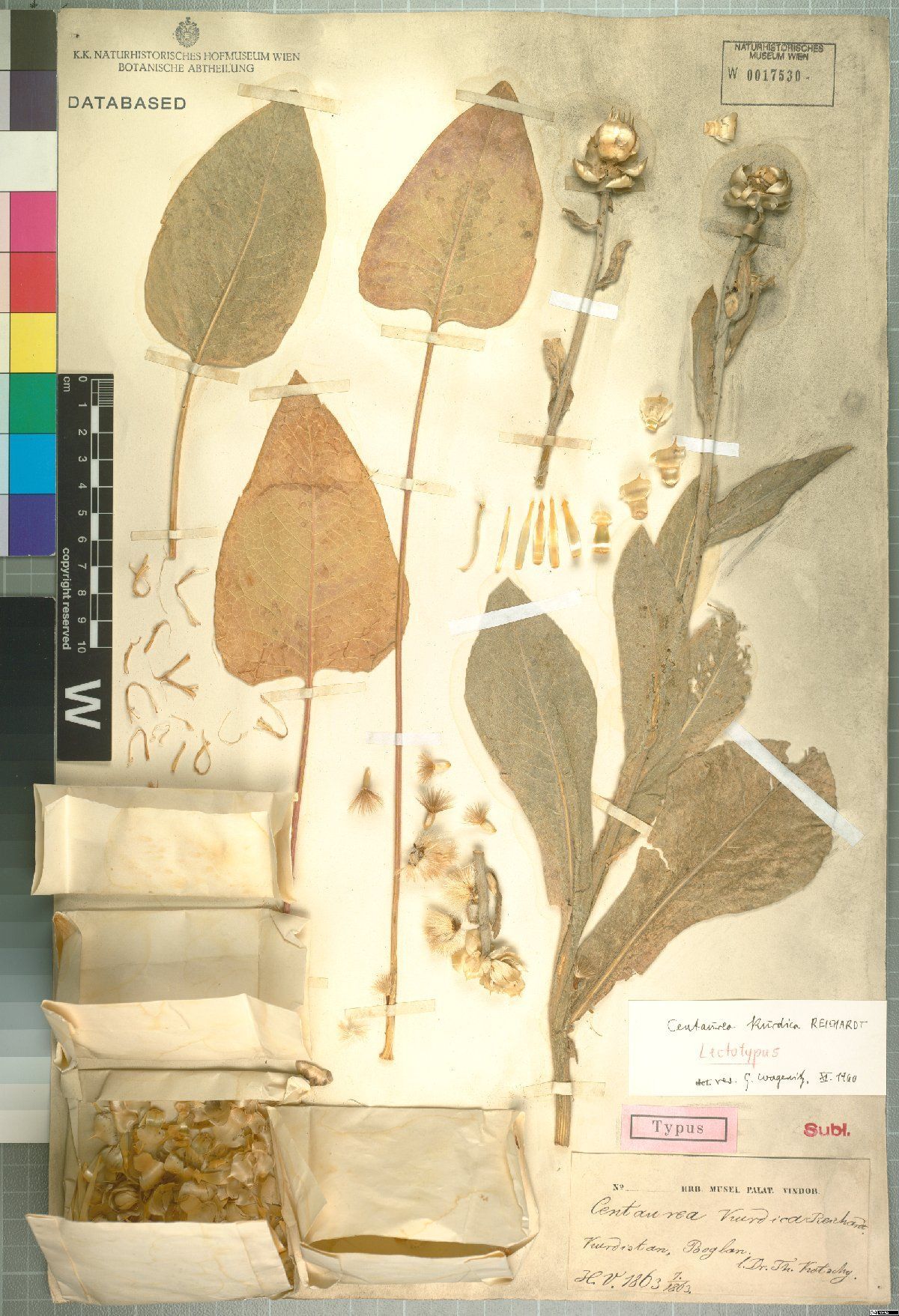
The plant Reichardt described still survives as herbarium sheets in Vienna. One of them, in the herbarium of the Natural History Museum, labelled "Kurdistan, Boglan … H.V. 1863" (H.V. for Hortus Vindobonensis, the Vienna garden), was chosen in 1960 by the botanist Gerhard Wagenitz (1927–2017)[3] as the specimen to which the name is tied for good, the lectotype[2][5].
Two metres tall at Valeyres
Kotschy's seed went further than Vienna. The botanist Edmond Boissier saw the same plant growing from Kotschy's seed in the garden at Valeyres, and when he wrote it up for his Flora Orientalis in 1875, he described a far bigger plant than Reichardt's single drought-stricken head[6]. Reichardt had measured a stem of a foot and a half to two feet[1]. Boissier's Flora Orientalis gives "Planta 6-7-pedalis", a plant six to seven feet tall, about two metres, with lower leaves eight to nine inches long and as wide[6].
The two men did not agree on how long it lives either. Reichardt saw a root that branched into several crowns and called it perennial[1]. Boissier marked it as biennial, with a question mark[6]. Today's botanists treat it as a biennial[2][7], 40–80 cm tall[2].
What to look for
The 2018 revision of its group and the early descriptions agree on its main features[1][6][2]:
- Leaves: the lowest ones large, broadly heart-shaped and on long stalks, with undivided, almost smooth edges; the middle and upper ones without a stalk, their bases running down the stem;
- Stem: upright, cobwebby with fine hairs, simple or branching from low down, with usually 5 to 10 flower heads on short stalks;
- Flower heads: very large and globe-shaped, 1½–2 inches (about 4–5 cm) across[1][6]. The scales around them end in large, hard, shining white, roundish appendages that completely hide the green scales underneath, each tipped with a thin, straight spine[1][2];
- Flowers: pink, the outer ones sterile[2]. Reichardt saw them as pale purple[1], and on dried specimens they can turn orange[2].
The artichoke-like knapweeds
Reichardt placed his plant in a group of knapweeds that Boissier had set apart for their unusually large heads, section Cynaroides, "the ones like Cynara", the artichoke and cardoon genus[1][6]. The 2018 revision by Kazem Negaresh and Mohammad Reza Rahiminejad counts 37 species in it[2].
Its closest relative, Reichardt thought, was Centaurea sclerolepis[1]. That plant had been collected by Kotschy too, between Riha (Urfa) and Sêwreg (Siverek)[6]. The two share the big white appendages and pink flowers, but C. sclerolepis has lobed lower leaves on short stalks, while C. kurdica keeps its lower leaves whole and long-stalked[6][2].
Where it grows
Kew's checklist gives its range as east-central and southeastern Turkey[7]. In Kurdish terms it is a plant of Bakur, and of one corner of it: the revision records it only from the provinces of Mûş, Çewlîg, Dêrsim, Xarpêt and Amed, and notes that within Turkey it is more widespread than the other species of its section[2].
After Kotschy, botanists found it again and again in the same country[2][8]:
- in June 1954 between Maden and Erxenî (Ergani), at 1,200 m, and in July 1957 near Dêrsim, at 1,050 m (both by the botanist Peter Davis, the second time with Ian Hedge);
- in July 1974 on the western slopes of a ridge 40 km west of Çewlîg, at 1,500 m, by Karl Heinz Rechinger (1906–1998)[3];
- in August 2001 near Lake Hazar, at 1,260 m.
On that same day in July 1974, 24 July, Rechinger also collected a plant 34 km west of Mûş on the road to Çewlîg, at 1,380 m. In 2018 Negaresh described it as a subspecies of its own, C. kurdica subsp. ciliata[3]. The typical plant is subsp. kurdica, with appendages that are entire, only rarely torn in the upper part[2].
It still grows near the place where Kotschy gathered its seeds: in July 2021 a naturalist photographed it near Bongilan (Solhan), the old Boglan, and another iNaturalist user agreed with the identification[9].
The species has not been assessed for the IUCN Red List[8].
Its names in Kurdish
In the spring of 2006 the Kurmanji journal Kurmancî, published by the Kurdish Institute of Paris, printed two plant lists that both include Centaurea kurdica:
- Edîb Polat's list Flora Kurdistanê gives it twice: as baxox, angelok, kanêje, glossed in English "kurdish centaurea", and again as kelxa deveyan, qoleg[10];
- in the same issue, Ehmedê Dirihî lists baxox, angelok and kanêje for it, as Kurmanji names, in an article on how plants are named in Kurdish, among the plants whose Latin names refer to the Kurds or Kurdistan[11].
Dirihî's Ferhenga Navên Nebatan a Kurdî (2013), the large dictionary of Kurdish plant names, repeats kelxa deveyan for C. kurdica, citing the journal[12], and gives one name from a specific place: stirîyê koyî, from Pîran (Dicle) in Amed province[12]. Several of these names are given to other knapweeds too[12]. The dictionary also has forms such as anjiloka kurdan and baxoxa kurdan, "… of the Kurds", given without a source; they look like names formed after the Latin[12].
In folk medicine
One ethnobotanical survey, around Midyat in Mardin province, recorded an infusion of its flowers used against kidney complaints, and cites an earlier study from Xarpêt (Elazığ) for the flowers as a sedative[13]. Midyat lies outside the range given in the 2018 revision[2].
These are records of traditional use, not medical advice.
Sources
- 1.Reichardt, H. W. (1863). Ueber zwei neue Arten von Centaurea. Verhandlungen der k. k. zoologisch-botanischen Gesellschaft in Wien 13 (C. kurdica on pp. 1042–1043).
- ablmno
- chiqp. 1043.
- defp. 1039.
- gpp. 1039–1042.
- jkpp. 1042.
- Verh. K. K. Zool.-Bot. Ges. Wien 13: 1043. archive.orghttps://archive.org/details/verhandlungender1363zool/page/n1218/mode/1upaccessed 14 November 2026
- p. 1043. archive.orghttps://archive.org/details/verhandlungender1363zool/page/n1218/mode/1upaccessed 14 November 2026
- 2.abcdefghijklmnoNegaresh, K. & Rahiminejad, M. R. (2018). A revision of Centaurea sect. Cynaroides (Asteraceae, Cardueae–Centaureinae). Phytotaxa 363(1): 1–131. doi:10.11646/phytotaxa.363.1.1https://doi.org/10.11646/phytotaxa.363.1.1
- 3.International Plant Names Index. Royal Botanic Gardens, Kew, Harvard University Herbaria and Australian National Herbarium.
- 4.[Anon.] (1860). Personalnotizen (letters of Th. Kotschy from Kurdistan, 1859). Oesterreichische Botanische Zeitschrift 10: 14–17.
- 5.abNatural History Museum Vienna (W) – Herbarium. via GBIF, herbarium specimen W 0017530, lectotype of Centaurea kurdica (via GBIF).
- 6.abcdefghBoissier, E. (1875). Flora Orientalis, vol. 3. Geneva & Basel, 3: 671–672. archive.orghttps://archive.org/details/floraorientaliss03bois
- 7.Plants of the World Online. Royal Botanic Gardens, Kew.
- abCentaurea kurdica Reichardt.
- plant_name_id 3049881. powo.science.kew.orghttps://powo.science.kew.org/taxon/urn:lsid:ipni.org:names:190830-1accessed 14 November 2026
- 8.abGlobal Biodiversity Information Facility (GBIF): specimen records of Centaurea kurdica (Royal Botanic Garden Edinburgh; Royal Botanic Gardens, Kew) and IUCN category.
- 9.iNaturalist. inaturalist.orghttps://www.inaturalist.org/
- ↩observation 90230858 (2021).
- observation 332785550 (Melis Rona, 2025).
- 10.↩Edîb Polat (2006). Flora Kurdistanê (I). institutkurde.orghttps://www.institutkurde.org/publications/kurmanci/
- 11.↩Dirihî, E. (2006). Di kurdî de binavkirina nebatan. Kurmancî 38: 7. Institut kurde de Paris.
- 12.Ahmet Kasımoğlu (Ehmedê Dirihî) (2013). Ferhenga Navên Nebatan a Kurdî (Dictionary of Kurdish Plant Names). Mardin Artuklu University, Institute of Living Languages in Turkey (ISBN 978-605-4202-12-6).
- 13.↩Akgül, A., Akgül, A., Şenol, S. G., Yıldırım, H., Seçmen, Ö. & Doğan, Y. (2018). An ethnobotanical study in Midyat (Turkey), a city on the silk road where cultures meet. Journal of Ethnobiology and Ethnomedicine 14: 12. doi:10.1186/s13002-017-0201-8https://doi.org/10.1186/s13002-017-0201-8
- 14.Ehmedê Dirihî (2007). Flora Kurdistanê (II). institutkurde.orghttps://www.institutkurde.org/publications/kurmanci/
Last updated 20 November 2026