Cousinia odontolepis is a spiny, thistle-like plant of the daisy family that grows in the mountains of South Kurdistan (Başûr)[1][2], with one possible record across the border in Rojhilat[3]. Its subspecies kurdica, "the Kurdish one", is the high-mountain form: a cobweb-woolly thistle with straw-coloured flowers that lives on the stony slopes and in the oak woods of the ranges around Rewandiz (Rawanduz), Qendîl (Qandil) and Helgurd, between about 1,000 and 2,600 m[4][1]. It was discovered in June 1893 on a mountain right on the frontier with Rojhilat, and for more than a century its mountain forms were counted as three different species.
How it got its name
- Named by
- DC., 1838Published in Prodr. 6: 556
Where it grows in Kurdistan
At 1000–2600 m above sea level.
A thistle "from the Assyrian desert"
The species was named first, from a scrap. In 1837 the collector Aucher-Éloy gathered a spiny shoot that was handed out among his dried plants as number 3496, with the note "in the desert of Assyria"[5][1]. In 1838 Augustin Pyramus de Candolle (1778–1841)[6] described it as Cousinia odontolepis[5].
He had very little to go on, and he said so with disarming honesty[5]:
Ramum habeo simplicem 1-cephalum. Pars inf. plantae mihi ign. … An stirps fortè dioica?
I have a single unbranched shoot with one head. The lower part of the plant is unknown to me. … Is the plant perhaps dioecious?[5] (our translation)
The dried flowers looked pale purplish to him. He noted their long, protruding stigmas and asked whether male and female flowers might grow on separate plants[5]. Boissier, writing the Flora Orientalis in 1875, still cited only Aucher-Éloy's number 3496, and gave its home simply as "Assyria"[7]. The scrap survives. In 2008 Mehregan and Kadereit found three sheets of number 3496, in Geneva, at Kew and in Paris, and chose the one in de Candolle's own herbarium in Geneva as the lectotype, the sheet to which the name is now tied[8].
The place was wrong. As Karl Heinz Rechinger and later Iraj Mehregan pointed out, Aucher-Éloy's plant "clearly cannot have been collected 'in deserto Assyriae'", because the species grows in the mountains of Başûr and not in deserts[1]. The name stuck all the same: odontolepis is Greek for "toothed scale", after the bracts around the flower head, each ending in a spine with small spines along its edges[5][7].
June 1893 on Sakri-Sakran
The Kurdish part of the story begins with Joseph Bornmüller (1862–1948)[6], on his long collecting journey through the Persian and Ottoman lands of 1892–93[9]. In the summer of 1893 he was in the mountains east of Hewlêr (Erbil), "the Alpine chains east of Erbil (= Arbela)" as he put it[4]. On 23 June he was collecting on the range he called Sakri-Sakran, in the Rewandiz district, "hard by the Persian border"[4][9]: the frontier that today separates Başûr from Rojhilat.
What he found there was a tall, woolly thistle with straw-coloured flowers, on sunny subalpine slopes of clay slate. He described the place with real enthusiasm[4]:
… the sunny subalpine slopes of this mighty massif, which rises to 4000 m in unclimbable rocky ridges; it occurs there only scattered and was not observed anywhere else.[4] (our translation)
What makes his account vivid is the neighbourhood. Around the new thistle grew shrubby milk-vetches, Acantholimon, Acanthophyllum kurdicum, and "now and then scrub" of oak, maple and wild fig. And "hardly more than a hundred metres higher, in shady places", a purely alpine flora was in full bloom: primulas, corydalis, buttercups, lousewort and Puschkinia[4]. The thistle lived on the sunny slopes just below that meadow.
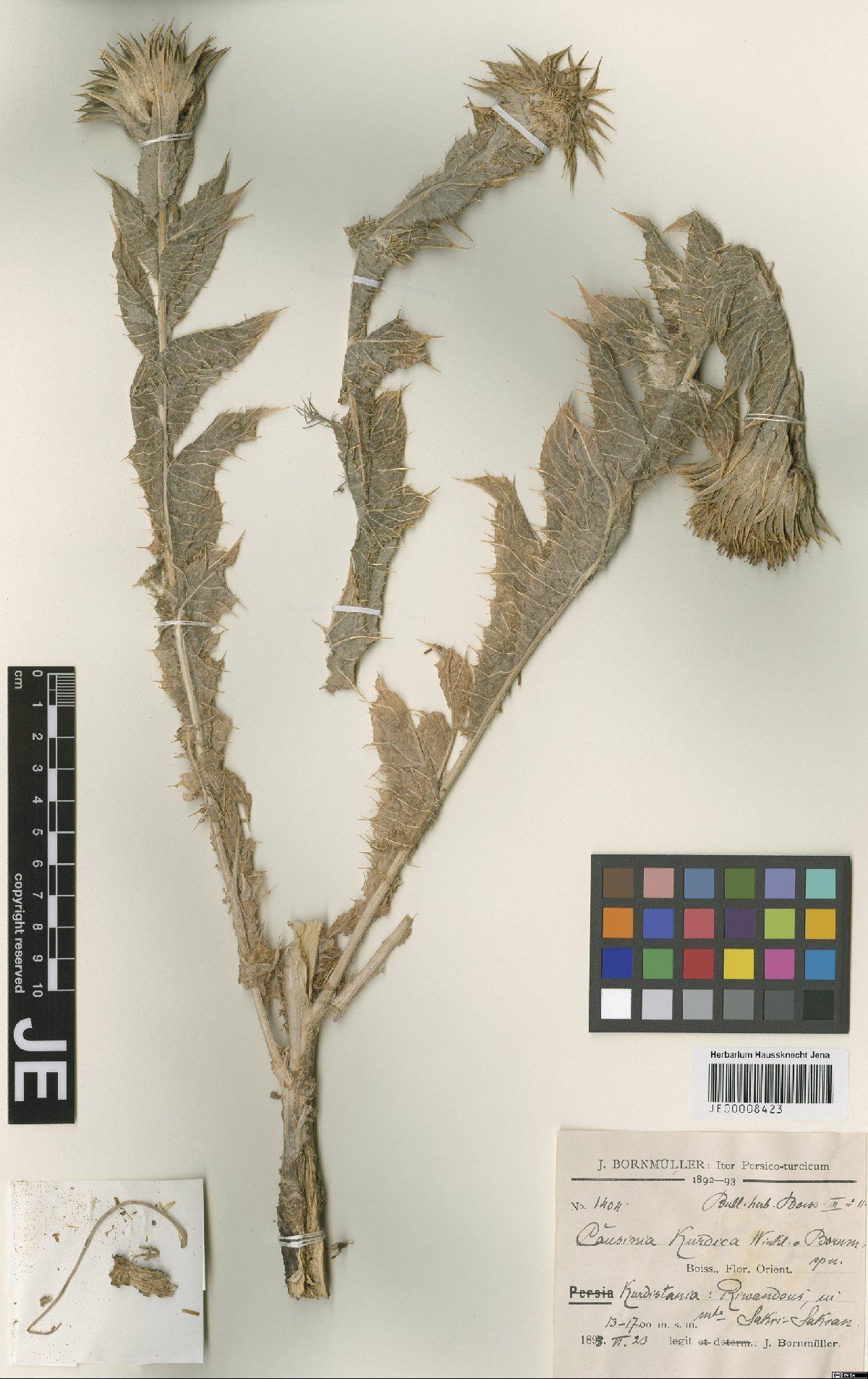
His collection number 1404 is still in herbaria today. One duplicate, in the Haussknecht Herbarium at Jena, carries his original label: "Kurdistania: Riwandous in mte. Sakri-Sakran, 13–1700 m", 23 June 1893[9].
Three new species from one trip
Bornmüller brought three new Cousinia species back from these mountains, and he and Constantin Winkler (1848–1900)[6], who had written a synopsis of the whole genus, published them together in 1895[4]:
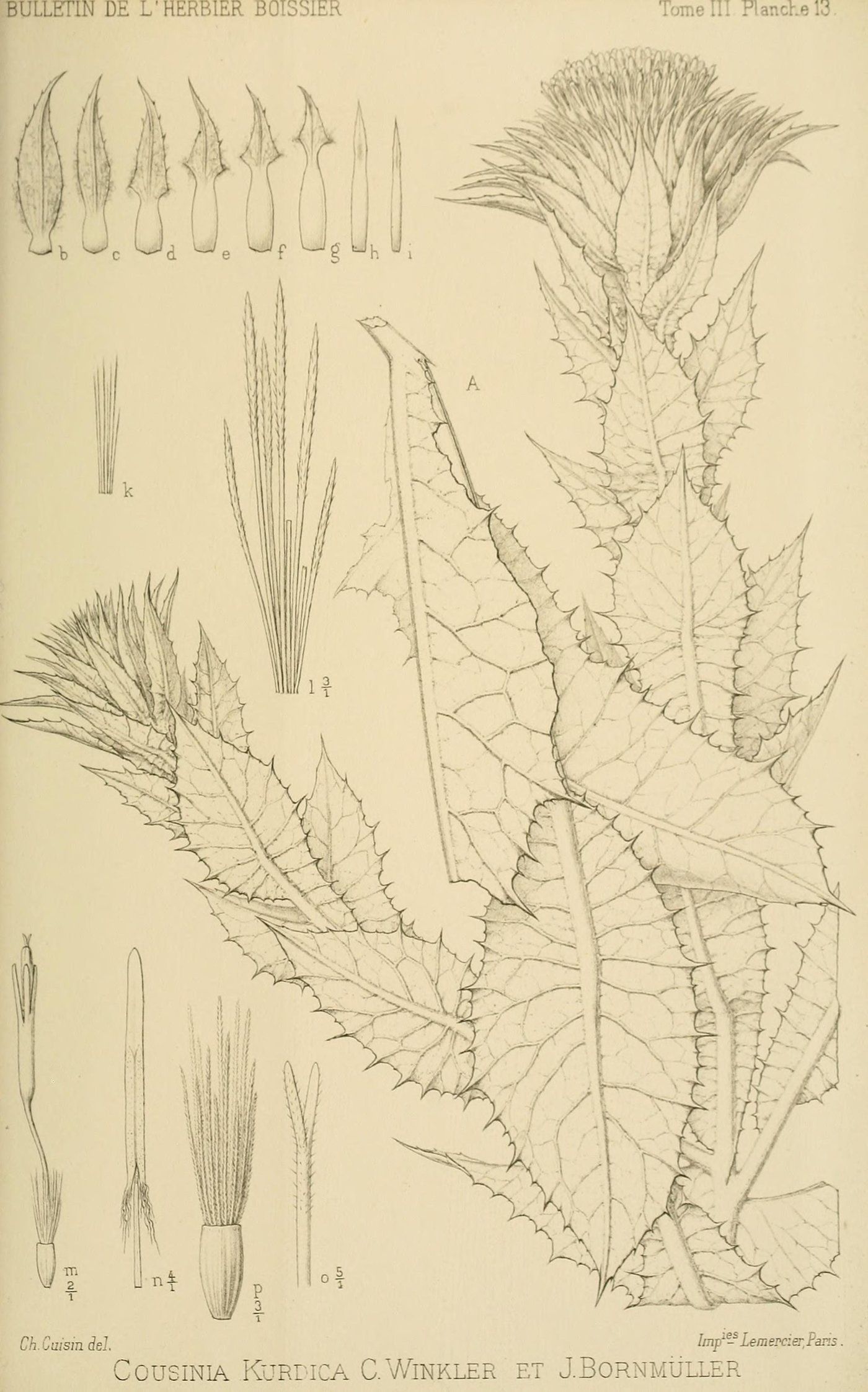
- Cousinia kurdica, the plant from Sakri-Sakran, with straw-coloured florets[4];
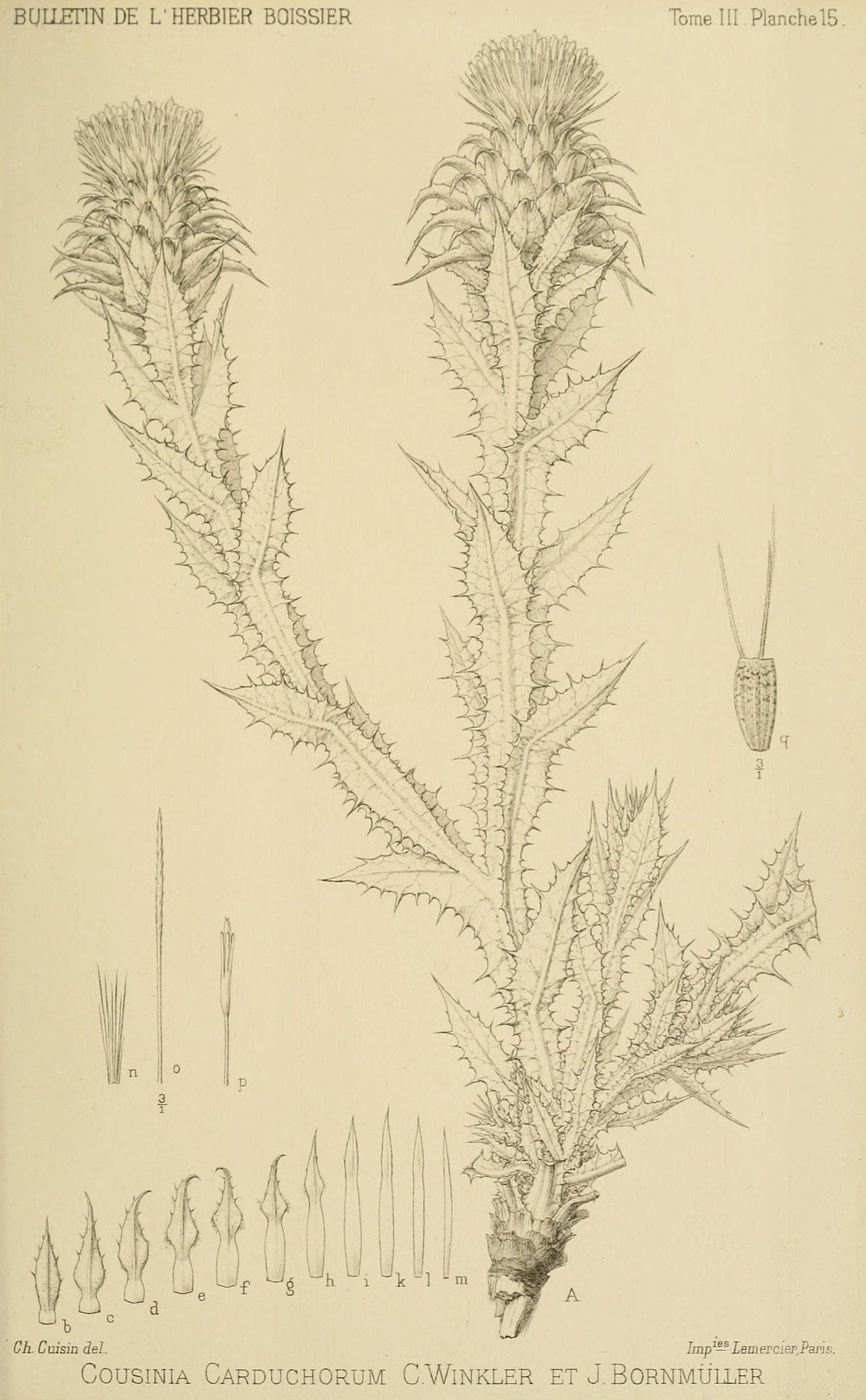
- Cousinia carduchorum, which he found "only in a few individuals" in the saddle of the mountain he called Händarin, east of Rewandiz, at 1,200–1,300 m, where oak forest rose above the slope, and also on Sakri-Sakran; its florets were yellowish[4];
- Cousinia arbelensis, "of Arbela", from the bushy eastern slopes of Sefîn near Şeqlawe (Shaqlawa)[4]; today it is counted as part of C. aintabensis, a different species[1].
Winkler had sorted the genus into groups in his synopsis, and he admitted that Bornmüller's plants "threaten to blur" his boundaries. C. kurdica, he wrote, would belong to a different group altogether "if it had only slightly broader involucral scales"[4]. Of C. carduchorum he said that it seemed "highly polymorphic", and split it into a smaller and a larger form[4].
More than a century later the sheets themselves turned out to be tangled. The smaller form came from Händarin, gathered on 28 June 1893 as number 1406; the larger was a single sheet from Sakri-Sakran, number 1405[8]. Mehregan and Kadereit found that a Berlin sheet matching the published drawing of the smaller form was wrongly labelled 1405, and that Bornmüller had cited another sheet, 1406b, under the wrong form, a slip he later seems to have corrected on the label in his own hand. They chose the Berlin sheet as the lectotype of C. carduchorum and wrote that its label "must be corrected to no. 1406"[8].
Both thistles were drawn for the paper by the artist Ch. Cuisin[4].
Too many thistles
Bornmüller saw the problem coming. In the same paper he wrote that in no other widespread genus of the region had "almost every explorer" brought back new species from the area he travelled "without meeting the species already described from neighbouring areas", so that most Cousinia species were known "from hardly more than a single locality, the find spot of the discoverer"[4].
The twentieth century added more. In the summer of 1957 the botanist Karl Heinz Rechinger collected in the oak woods of the Qendîl range between Shahidan and Pushtashan, "on the border of Persia", and in 1972 he named that plant Cousinia qandilica[1][10].
Then came the lumpers. In 2008 Iraj Mehregan and J. W. Kadereit published a revision of the whole group of Cousinia this plant belongs to, the section Cynaroideae, based on about 2,250 herbarium specimens. The section had 110 published species, spread from Lebanon to Pakistan, with its richest centres in western and north-western Iran, northern Iraq and south-eastern Turkey[8], all regions that take in parts of Kurdistan. They kept 31, plus eight subspecies[8]. In that revision Mehregan made Bornmüller's plant a subspecies, Cousinia odontolepis subsp. kurdica (C.Winkl. & Bornm.) Mehregan, with C. carduchorum and C. qandilica as synonyms[8][6]. The Flora of Iraq, in the account he revised, gives the reason: all three, from the Qendîl range and its neighbourhood, "are connected by intermediate forms", and subsp. kurdica differs from the typical subspecies mainly in its dense cobwebby wool[1].
The typical subspecies absorbed even more. Six other species names, published between 1846 and 1972 for thistles from the mountains of Başûr and from a monastery garden near Mosul, went into it, among them C. cymbolepis, gathered by Theodor Kotschy on Mount Gara in 1841, and C. acanthophysa from Mount Zawita north of Zaxo. Mehregan and Kadereit found them all "very variable but connected by intermediate forms"[8].
Not everyone agreed with so much lumping. In 2010, revising the same section for Iran, Farideh Attar and S. B. Djavadi wrote that merging so many species does "not seem logical". The bracts matter too much in telling these plants apart, they argued, and, following Rechinger, they added that the seeds of Cousinia travel badly, because the tuft of hairs on each seed is brittle, so many species really are confined to tiny areas[3]. Bornmüller, too, had noticed that most species were known from a single spot. Their revision covers Iran, but it touches this story: they keep Rechinger's C. qandilica as "a rare distinct species", and record it on the Rojhilat side of the border too[3].
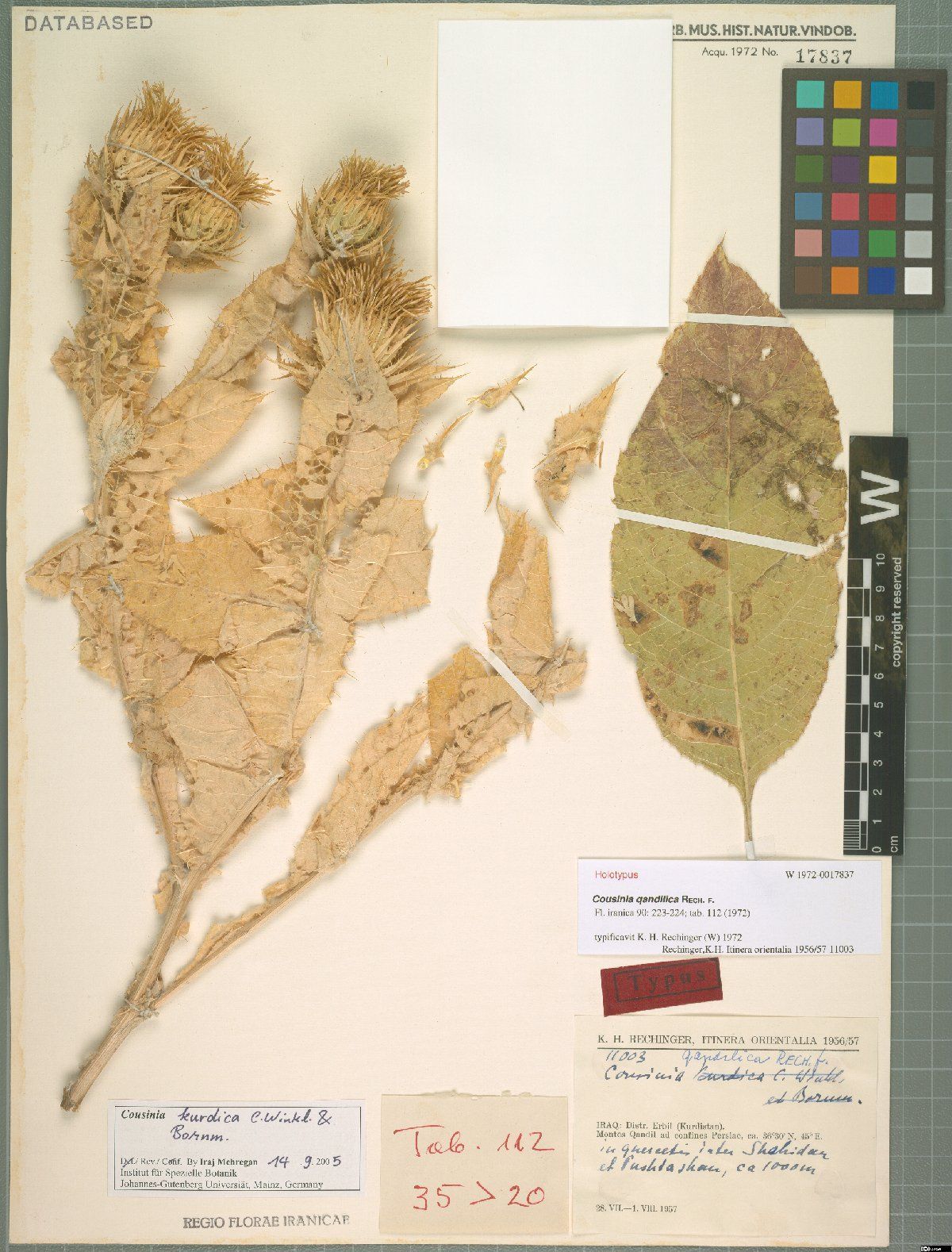
You can still see the whole story on Rechinger's own type sheet in Vienna. His 1957 label first read "Cousinia kurdica C. Winkl. et Bornm.": at first he took the plant for Bornmüller's thistle. Later he struck that through and wrote "qandilica Rech. f." above it. Next to it sits a small slip in Mehregan's hand, dated 14 September 2005, that puts it back: "Cousinia kurdica C.Winkl. & Bornm."[10].
How to recognise it
Cousinia odontolepis as a whole is a perennial[2] up to about 50 cm tall, often woolly with fine cobweb-like hairs. Its lower leaves can reach 25 × 10 cm and are usually lobed, with spiny teeth; the stem leaves run down the stem as spiny wings. The heads are 2.5–7 cm across including the bracts, and each bract ends in a broad appendage, 1–3 cm long, that narrows into a long spine with two to four smaller spines on each side. The 40 to 120 flowers in a head can be purple, reddish-pink or yellowish[1].
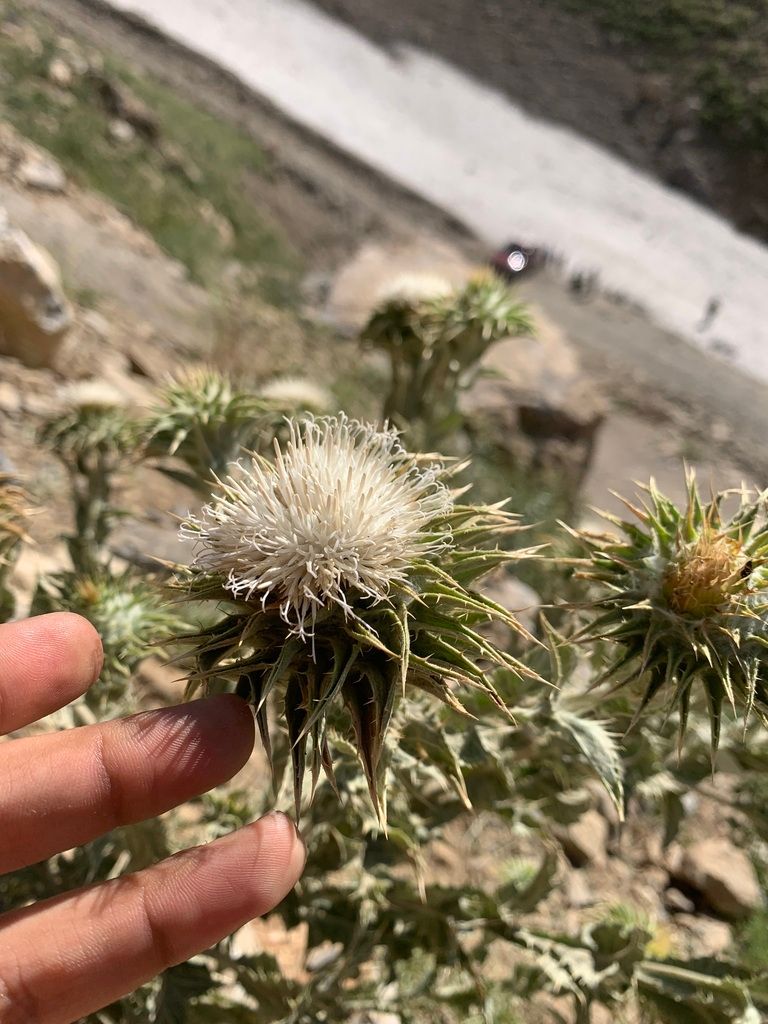
Subspecies kurdica is the woolly one. Its uppermost leaves wrap around the flower head, and its bracts are usually thickly covered in cobwebby hairs and bent backwards[1]. Mehregan describes the appendages as boat-shaped[8]. Bornmüller's plants were about 40 cm tall, with heads 5–6 cm across and florets about 23 mm long, the colour of straw[4]. The other subspecies, subsp. odontolepis, which grows elsewhere in the mountains of Başûr, around Zaxo (Zakho), Duhok, Amêdî (Amadiya) and Silêmanî (Sulaymaniyah), has barer bracts and leaves that do not enclose the head[1].
Where it grows
Kew's checklist gives the species' range as northern and north-eastern Iraq[2]: in Kurdish terms, Başûr. The Flora of Iraq calls subsp. kurdica endemic, found nowhere else[1]. It lists it from mountains on the border with Rojhilat: the Qendîl range, including Kermasur lake and the oak woods between Shahidan and Pushtashan; Mount Helgurd above Nowanda; and the mountains east of Rewandiz where Bornmüller first found it[1]. Among the sheets Mehregan and Kadereit studied are gatherings from the milk-vetch scrub on the eastern slopes above Pushtashan, at 2,000–2,200 m, and from the oak woods below the village, at about 1,000 m: the same milk-vetches and oaks that Bornmüller described on Sakri-Sakran[8][4].
There is one record from Rojhilat. Attar and Djavadi, who keep C. qandilica as a species of its own, list a single gathering of it from between Pîranşar (Piranshahr) and Serdeşt (Sardasht), at 1,300 m, at the margin of oak forest on limestone soils[3]. If C. qandilica belongs to subsp. kurdica, as Mehregan and Kadereit argue, the plant crosses the border; Kew's checklist does not include that record in its range[2].
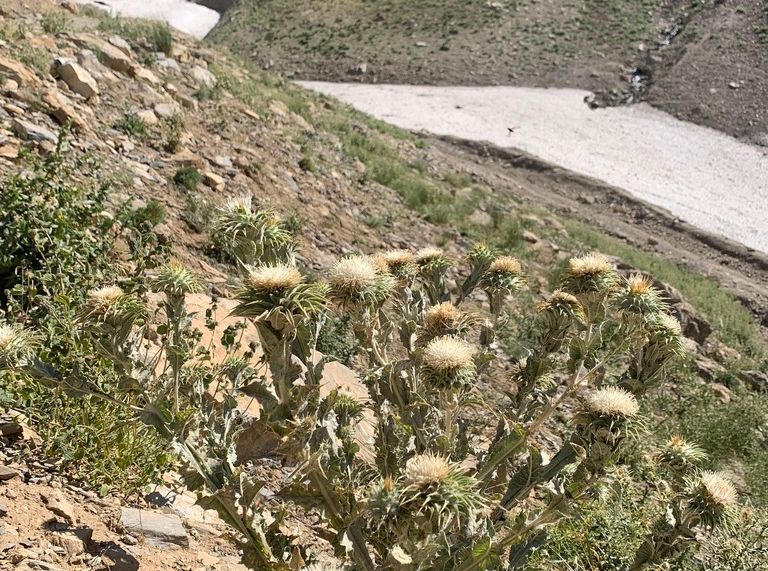
It grows on stony slopes and in oak forest, from about 1,000 to 2,600 m, and flowers from June to August[1]. That puts it in the subalpine belt and below it. On the highest summits of the same range a different thistle, Cousinia algurdina, takes over, and the two do not grow together[1]. In July 2023 a naturalist photographed subsp. kurdica in flower on a stony slope near Çoman, with snow still lying in the valley below[11].
The species has not been assessed for the IUCN Red List[12].
Its name in Kurdish
No Kurdish name has been recorded for this species or its subspecies in the sources we read. Ehmedê Dirihî's dictionary of Kurdish plant names gives şiwale dire for the genus Cousinia as a whole, with the source code KMP ("Kurdistan Medical Plant")[13]. It is a name for the genus, not for this particular thistle, and it still needs checking.
Sources
- 1.Huber-Morath, A., revised by Mehregan, I. (2019). Cousinia. In: Ghazanfar, S. A., Edmondson, J. R. & Hind, D. J. N. (eds), Flora of Iraq 6: Compositae, pp. 76–83. Royal Botanic Gardens, Kew.
- 2.Plants of the World Online. Royal Botanic Gardens, Kew.
- abcdCousinia odontolepis DC.. powo.science.kew.orghttps://powo.science.kew.org/taxon/urn:lsid:ipni.org:names:199139-1
- plant_name_id 3044097. powo.science.kew.orghttps://powo.science.kew.org/taxon/urn:lsid:ipni.org:names:199139-1accessed 14 November 2026
- 3.Attar, F. & Djavadi, S. B. (2010). A taxonomic revision of Cousinia, sect. Cynaroides (Asteraceae, Cardueae) in the flora of Iran. Iranian Journal of Botany 16(1): 130–184.
- 4.Winkler, C. & Bornmüller, J. (1895). Neue Cousinien des Orients. Bulletin de l'Herbier Boissier 3(11): 561–569, plates 13–15.
- ag archive.orghttps://archive.org/details/bulletindelherbi03herb/page/n612/mode/1up
- bp. 564. archive.orghttps://archive.org/details/bulletindelherbi03herb/page/n612/mode/1up
- cdefpp. 565. archive.orghttps://archive.org/details/bulletindelherbi03herb/page/n612/mode/1up
- hop. 567. archive.orghttps://archive.org/details/bulletindelherbi03herb/page/n612/mode/1up
- ipp. 566, 568–569. archive.orghttps://archive.org/details/bulletindelherbi03herb/page/n612/mode/1up
- jp. 566. archive.orghttps://archive.org/details/bulletindelherbi03herb/page/n612/mode/1up
- kp. 561. archive.orghttps://archive.org/details/bulletindelherbi03herb/page/n612/mode/1up
- lp. 569. archive.orghttps://archive.org/details/bulletindelherbi03herb/page/n612/mode/1up
- mplates 13 and 15. archive.orghttps://archive.org/details/bulletindelherbi03herb/page/n612/mode/1up
- np. 562. archive.orghttps://archive.org/details/bulletindelherbi03herb/page/n612/mode/1up
- 5.abcdefde Candolle, A. P. (1838). Prodromus Systematis Naturalis Regni Vegetabilis. 6: 556. biodiversitylibrary.orghttps://www.biodiversitylibrary.org/page/150487
- 6.International Plant Names Index. Royal Botanic Gardens, Kew, Harvard University Herbaria and Australian National Herbarium.
- abcdCousinia kurdica, C. odontolepis subsp. kurdica, and author records for de Candolle, Winkler, Bornmüller and Mehregan.. ipni.orghttps://www.ipni.org/n/77095475-1
- urn:lsid:ipni.org:names:199139-1. ipni.orghttps://www.ipni.org/n/199139-1accessed 14 November 2026
- 7.Boissier, E. (1875). Flora Orientalis, vol. 3. Geneva & Basel.
- ab3: 509. archive.orghttps://archive.org/details/floraorientaliss03bois/page/n516/mode/1up
- p. 509. archive.orghttps://archive.org/details/floraorientaliss03bois/page/n516/mode/1upaccessed 14 November 2026
- 8.Mehregan, I. & Kadereit, J. W. (2008). Taxonomic revision of Cousinia sect. Cynaroideae (Asteraceae, Cardueae). Willdenowia 38: 293–362. doi:10.3372/wi.38.38201https://doi.org/10.3372/wi.38.38201
- 9.abcHerbarium Haussknecht, Jena (JE), specimen records (JACQ) via GBIF. Jena, specimen JE00008423 (Bornmüller 1404), via GBIF.. gbif.orghttps://www.gbif.org/occurrence/3028983637
- 10.abNatural History Museum Vienna (W) – Herbarium. via GBIF, specimen W 1972-0017837 (Rechinger 11003), via GBIF.. gbif.orghttps://www.gbif.org/occurrence/1230525480
- 11.↩Aras, A. (2023). iNaturalist observation 172965180. inaturalist.orghttps://www.inaturalist.org/observations/172965180
- 12.↩GBIF.org GBIF Backbone Taxonomy and occurrence records. species record 3102205, IUCN Red List category.. api.gbif.orghttps://api.gbif.org/v1/species/3102205/iucnRedListCategory
- 13.↩Ahmet Kasımoğlu (Ehmedê Dirihî) (2013). Ferhenga Navên Nebatan a Kurdî (Dictionary of Kurdish Plant Names). Mardin Artuklu University, Institute of Living Languages in Turkey (ISBN 978-605-4202-12-6).
- Ghazanfar, S.A., Edmondson, J.R. & Hind, D.J.N. (eds) (2019). Flora of Iraq, Volume 6: Compositae. Royal Botanic Gardens, Kew. ISBN 978-1-84246-685-8, p. 82. kew.iro.bl.ukhttps://kew.iro.bl.uk/server/api/core/bitstreams/4f012cdf-8c78-42a4-8b06-666b032a15c1/content#page=91accessed 14 November 2026
Last updated 20 November 2026