How it got its name
- Named by
- Rech.f., 1973Published in Anz. Österr. Akad. Wiss., Math.-Naturwiss. Kl. 109: 174
A yellow flower on the roof of Qendîl
Crepis kurdica is a small yellow-flowered perennial of the daisy family that grows on rocky limestone mountain tops, between 1,800 and 3,200 m, in the Qendîl (Qandil) mountains, the range that runs along the line between South Kurdistan (Başûr) and East Kurdistan (Rojhilat)[1][2][3][4]. It flowers in July and August[1].
The Flora of Iraq calls it "rare" and lists just three gatherings of it, and Kew's checklist knows it from nowhere else: as far as botanists have recorded, it grows only in the high mountains of Başûr[1][5]. It has never been assessed for the IUCN Red List[6].
Its story is a short one with two unexpected visitors to the same high ground: a famous explorer who pressed it before it had a name, and the botanist who finally gave it one.
Pressed before it had a name
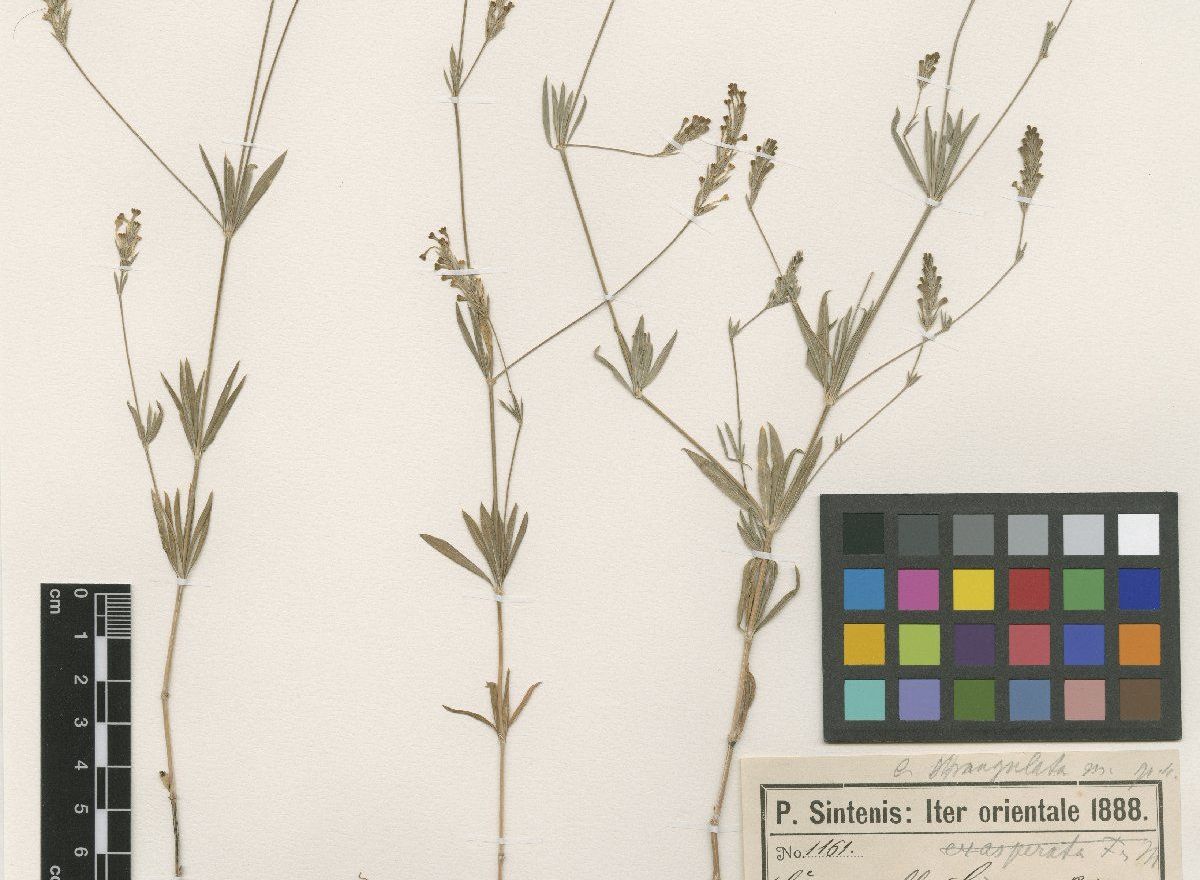
On 11 July 1951 someone was collecting plants in the Qendîl range "East of Qula Diza on Persian Frontier", that is east of Qeladizê (Qala Diza), and pressed a slender yellow-flowered plant with long, wiry flower stalks. The printed label reads "Flora of Iraqi Kurdistan", with a height range of 6,000 to 10,000 feet, and the collector is "W. Thesiger"[4].
Other specimens under the same collector's name, at Kew and elsewhere, come from the sands of the Rub' al Khali, Arabia's Empty Quarter, in 1945 and 1946, from Oman in 1948, from Nuristan in Afghanistan and from Ethiopia[7]. That is the route of the explorer and travel writer Wilfred Thesiger, almost certainly the collector, who from 1950 also travelled in Iraq and Kurdistan[8]. A notebook of his, kept at Eton College, follows his journey through Kurdistan from late July to December 1951, day by day, "commenting on the villages he passed and the mountains he climbed", with notes on local customs and words[9]. The Qendîl sheet is dated a little earlier than that notebook begins, in the same summer.
In 1951 the plant had no scientific name yet. The sheet waited until 1975, when Karl Heinz Rechinger identified it and wrote Crepis kurdica on a slip added to it[4].
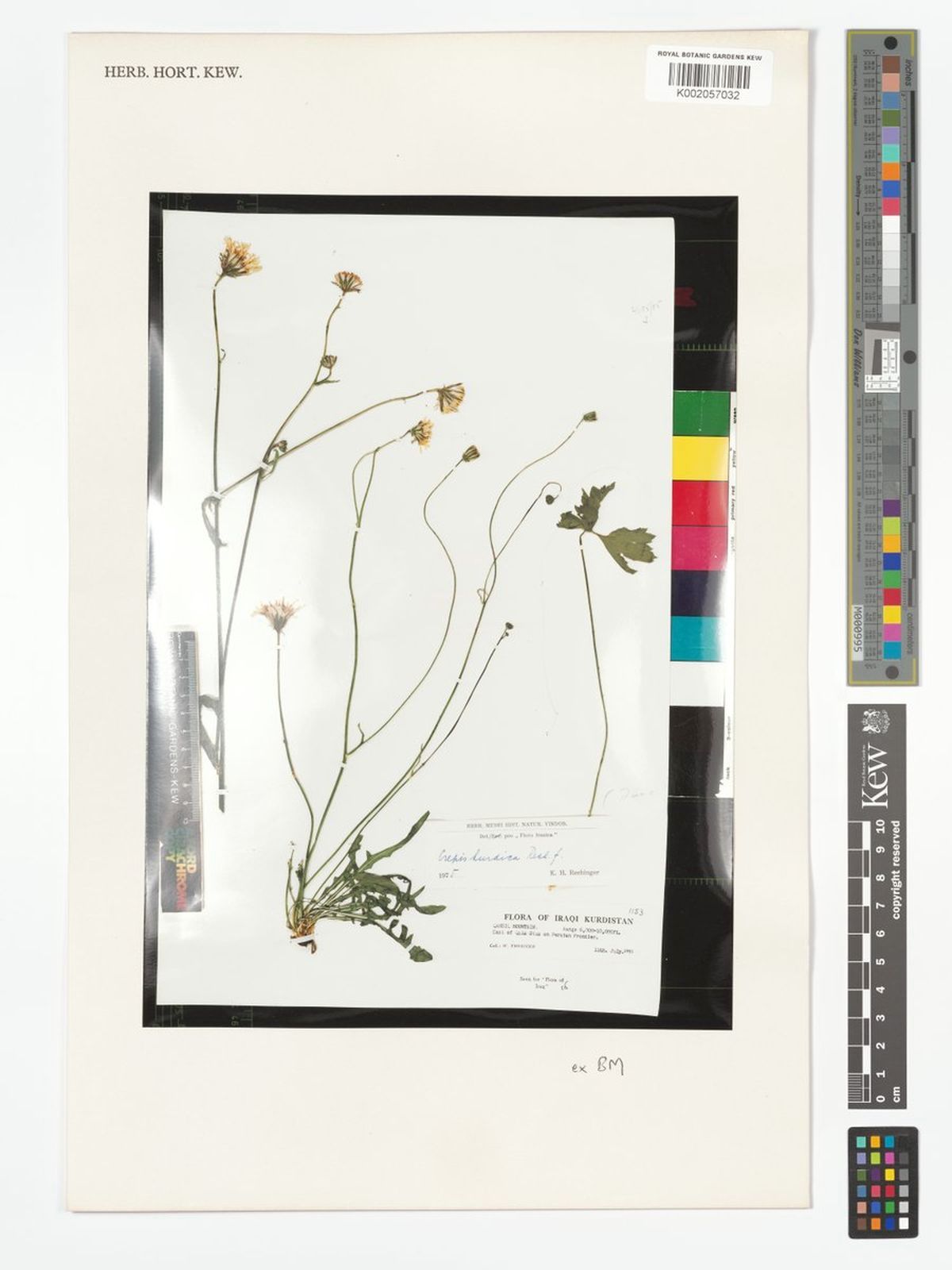
Rechinger's summer on Qendîl, 1957
Karl Heinz Rechinger (1906–1998)[10] spent the academic year 1956/57 as a visiting professor in Baghdad and used it for collecting trips, "especially into the mountains of Kurdistan"[11] (our translation). His collections laid the foundations of the herbarium of Baghdad University[11][12]. He later founded Flora Iranica, the great flora of Iran and its neighbours, which also covers northern Iraq[12], and this plant has its place in it[1].
The dates on his labels let us follow him up the mountains in the summer of 1957:
- 28 July: in rocky oak woods between Shahidan and Pushtashan, at 1,200 m, he collected a Cousinia he later named C. qandilica, after the range[2].
- 28 July to 1 August: higher up, on limestone rocks at 3,200 m above a mountain lake, he pressed the yellow Crepis that became C. kurdica[3][13].
- 10 to 14 August: in a valley above Nowanda on Mount Helgurd, at 2,600 to 3,000 m, he found another new Cousinia, C. algurdina[2].
His label for the Crepis, written in Latin, places it like this[3]:
Distr. Erbil (Kurdistan). Montes Qandil ad confines Persiae, ca. 36°30' N, 45° E. In saxosis calc., 3200 m.
District of Erbil (Kurdistan). The Qandil mountains on the borders of Persia, about 36°30' N, 45° E. On limestone rocks, 3,200 m.[3] (our translation)
He gathered enough of it to share: duplicates of his number 11128 went to herbaria in Berlin, Edinburgh, Geneva, Graz, Kew, Madrid, Munich, Stockholm and Aarhus, and two sheets stayed in Vienna[13]. One of the Vienna sheets is the holotype, the single specimen the name is tied to. Some fifteen years after the climb, Rechinger described the species and called it kurdica, "Kurdish"[3][10].
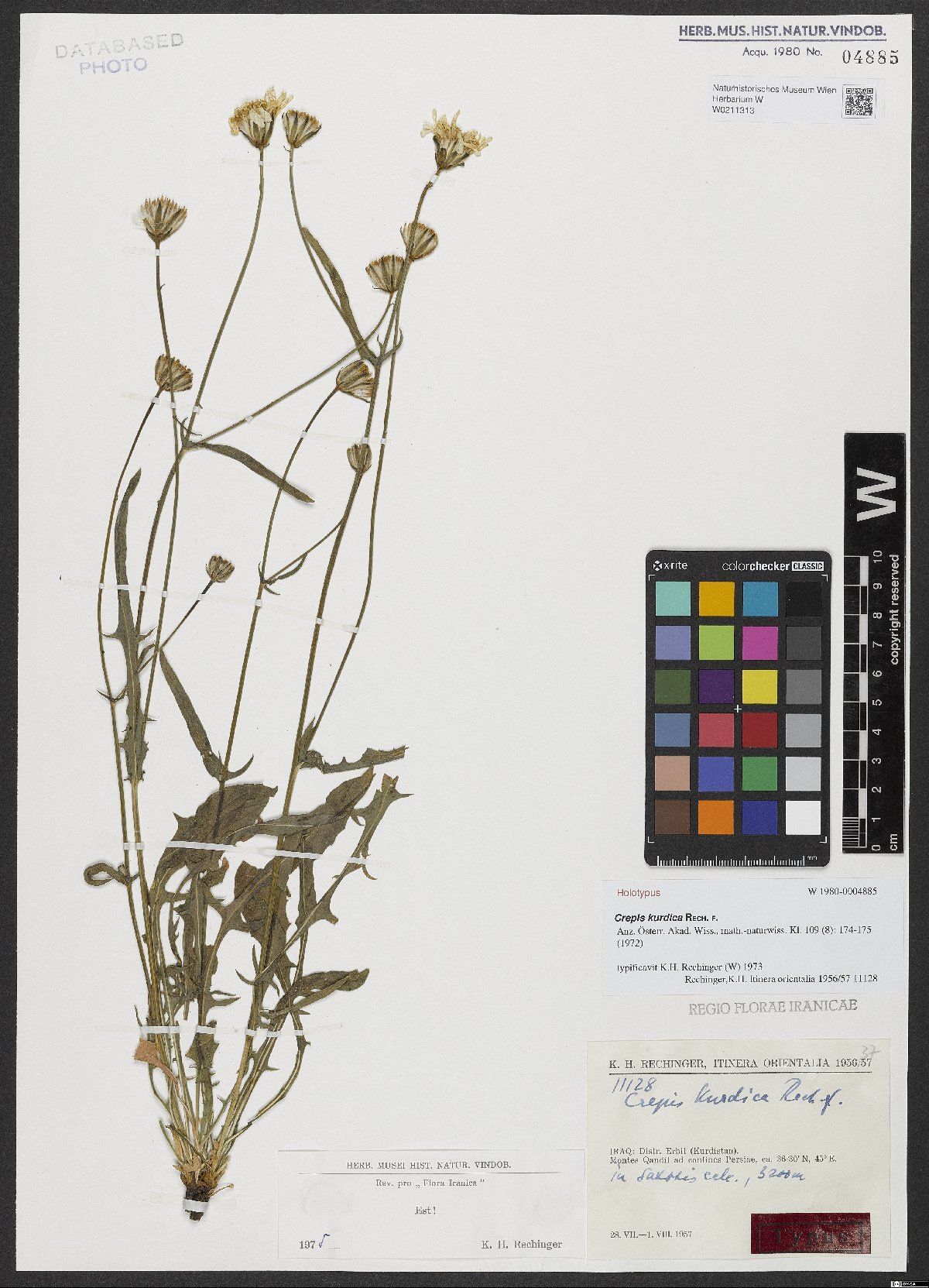
In the very same days two other collectors, A. al-Rawi and Serhang, were also on Qendîl. On 1 August 1957 they gathered the plant on a mountain slope near streams by the same lake[4]. Theirs is the third and last gathering the Flora of Iraq lists[1].
A lake with many spellings
The lake below the type locality is hard to pin down on paper. Rechinger's duplicate labels call it "Goam-e Kirmosoran"[13], the Flora of Iraq calls it "Germasur lake"[1], al-Rawi's label has "Kermasur lake"[4], and in its account of a neighbouring Crepis the Flora wonders whether "Bermasand" is the same place[1]. Four spellings, it seems, for one lake, and none of them says what the lake is called locally.
What to look for
The Flora of Iraq describes the plant like this[1]:
- a perennial, 15 to 40 cm tall, from a somewhat woody rootstock, its base clothed in a few brownish, papery remains of last year's leaves;
- a rosette of narrow leaves, 5 to 16 cm long, smooth, cut into lobes that point backwards or out to the side, and with a conspicuously white midrib;
- green, smooth stems with few, slender branches that spread out wide;
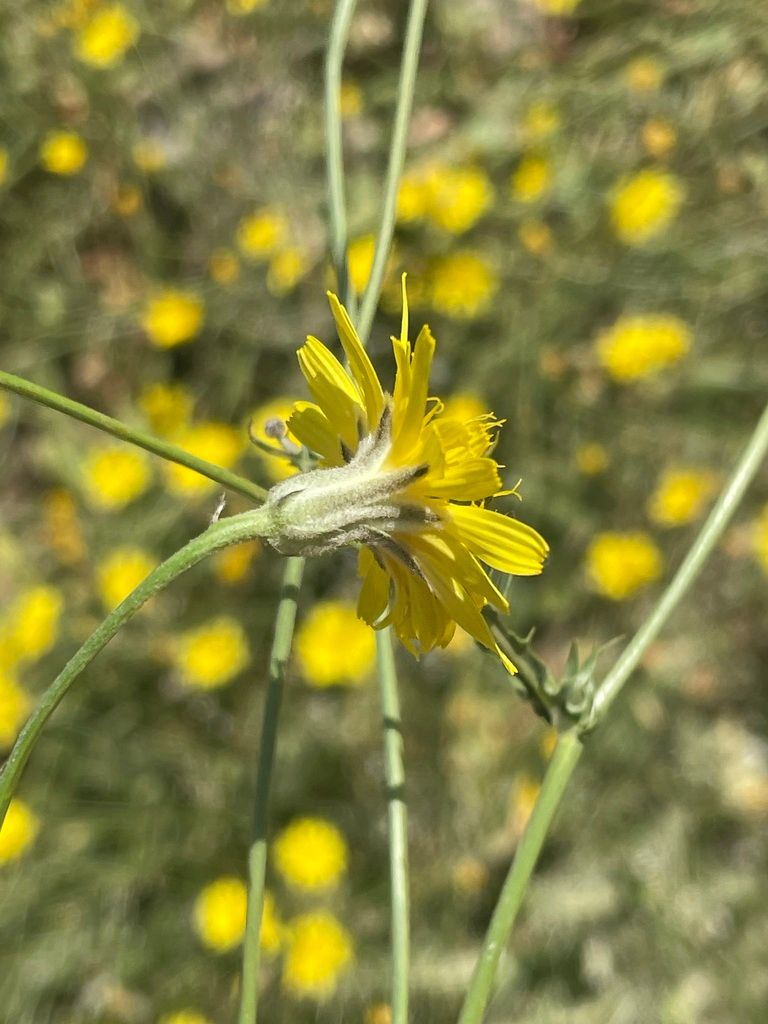
- a few flower heads, each with a bell-shaped cup of bracts 11 to 13 mm long and many yellow florets, 13 to 20 mm long, with yellow styles;
- bracts around the head covered in short-stalked glands and white woolly hairs, with tufts of white hair at their tips.
That woolly, glandular cup of bracts is the best clue: in the Flora's key, it is what separates C. kurdica from the bristly-bracted C. quercifolia[1]. Its seeds are still something of a mystery: the authors of the Flora had not seen ripe fruits[1].
Rare on paper, golden on the slope
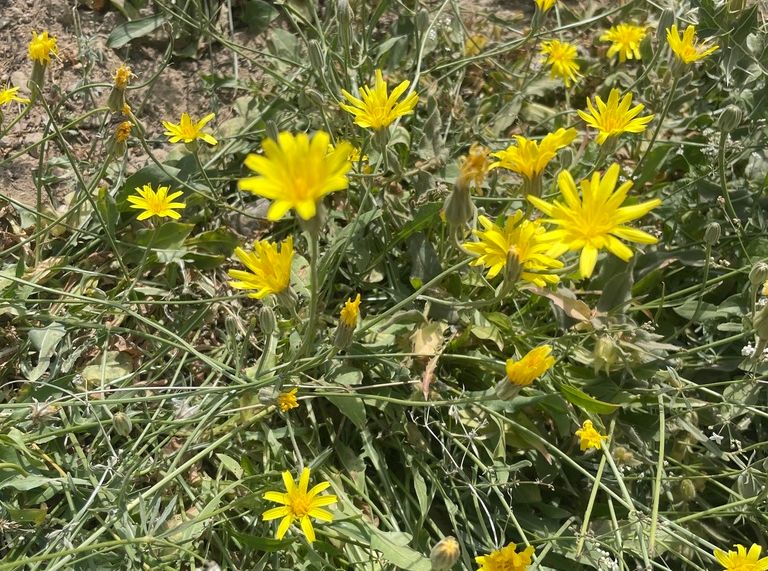
In July 2024 Arya Aras photographed Crepis kurdica in flower near Çoman (Choman). The pictures show a patch scattered with its yellow heads among grass, each head held up on a long, thin stem; one stem held in the hand branches into several slender flower stalks, just as the Flora describes the plant's few, wide-spreading branches[1]. Every new photograph like this adds to what is known about a plant that, as far as botanists have recorded, grows nowhere else on Earth[1][5].
A boot, a pedestal, a name
Crepis is a large genus of more than 200 species, eleven of them in Iraq[1]. Its name comes from the Greek krepis, "a boot, foundation or pedestal", a word Theophrastus used for a different plant altogether[1].
On the high ground of Qendîl it has a relative for company: Crepis sahendii, a plant of the stony thorn-cushion zone at 2,900 to 3,400 m, has been collected on Helgurd and near the same lake[1].
No Kurdish name has been recorded for C. kurdica in any source we checked. Some of its lowland relatives do have names. In 1932, at Şêxan (Shaikhan), a lowland Crepis, C. foetida subsp. commutata, was noted under the Kurdish name gul likah zar. A label from Duhok gives the same plant a warning: when green, it "gives sheep a fever from which they may eventually die if they continue eating it"[14].
Sources
- 1.abcdefghijklmnoDavies, F. G. & Townsend, C. C. (2019). Crepis. In: Flora of Iraq 6: 156–162. Ministry of Agriculture, Iraq & Royal Botanic Gardens, Kew.
- 2.abcFlora of Iraq 6 (2019): Cousinia, pp. 82–83. Ministry of Agriculture, Iraq & Royal Botanic Gardens, Kew.
- 3.Natural History Museum Vienna (W) – Herbarium. via GBIF.
- abcdeherbarium specimen W 0211313, holotype of Crepis kurdica (Rechinger 11128), via JACQ and GBIF.
- barcode W 0211313; GBIF occurrence 5004463276. api.gbif.orghttps://api.gbif.org/v1/occurrence/5004463276accessed 14 November 2026
- barcode W 0211313. api.gbif.orghttps://api.gbif.org/v1/occurrence/5004463276accessed 14 November 2026
- 4.Royal Botanic Gardens, Kew – Herbarium Specimens. via GBIF. gbif.orghttps://www.gbif.org/dataset/cd6e21c8-9e8a-493a-8a76-fbf7862069e5
- 5.Plants of the World Online. Royal Botanic Gardens, Kew.
- abCrepis kurdica.
- plant_name_id 3057076. powo.science.kew.orghttps://powo.science.kew.org/taxon/urn:lsid:ipni.org:names:200000-1accessed 14 November 2026
- 6.↩IUCN Red List status via GBIF: Not Evaluated.
- 7.↩GBIF.org GBIF Backbone Taxonomy and occurrence records. occurrence records of specimens collected by W. Thesiger (Royal Botanic Gardens, Kew and others). gbif.orghttps://www.gbif.org/
- 8.↩Middle East Centre Archive, St Antony's College, Oxford: Wilfred Thesiger Collection (GB165-0545), catalogue.
- 9.↩Eton College Archives (1951). MS 433/06/04/02: Wilfred P. Thesiger's Iraq, Kurdistan, Marshes notebook.
- 10.International Plant Names Index. Royal Botanic Gardens, Kew, Harvard University Herbaria and Australian National Herbarium.
- abCrepis kurdica Rech.f.; author record Rechinger, Karl Heinz (1906–1998).
- urn:lsid:ipni.org:names:200000-1. ipni.orghttps://www.ipni.org/n/200000-1accessed 14 November 2026
- 11.abRiedl, H. (1971). Hofrat Univ.-Prof. Dr. Karl-Heinz Rechinger zum 65. Geburtstag. Annalen des Naturhistorischen Museums in Wien 75: 1–16.
- 12.abLack, H. W. (1987). Karl Heinz Rechinger: a grand old man in botany. Plant Systematics and Evolution 155: 7–14.
- 13.abcIsotypes of Rechinger 11128 in the herbaria B, E, G, GZU, K, M, MA, S, W and AU, via GBIF.
- 14.↩Blakelock, R. A. (1949). The Rustam Herbarium, 'Iraq. Systematic List. Part II. Kew Bulletin 4(1): 41–42.
- Ghazanfar, S.A., Edmondson, J.R. & Hind, D.J.N. (eds) (2019). Flora of Iraq, Volume 6: Compositae. Royal Botanic Gardens, Kew. ISBN 978-1-84246-685-8, p. 157. kew.iro.bl.ukhttps://kew.iro.bl.uk/server/api/core/bitstreams/4f012cdf-8c78-42a4-8b06-666b032a15c1/content#page=166accessed 14 November 2026
Last updated 20 November 2026