A tiny crocus with shiny, deep yellow flowers only about 1.5 cm across, Crocus kurdistanicus is known for certain from only one mountainside in East Kurdistan (Rojhilat). It was found by a botanist working in Sine (Sanandaj) and named after Kurdistan, and more than twenty years later it is still known from very little material.[1][2][3]
How it got its name
- Named by
- (Maroofi & Assadi) Rukšāns, 2014Published in Int. Rock Gard. 52: 3
A yellow surprise on Panjah-Ali mountain
On 24 February 2002 the botanist Hossein Maroofi, of the Research Center of Natural Resources and Animal Science in Sine, collected crocus corms on the slopes of Panjah-Ali mountain, near the village of Kangareh, Ghorveh, at about 1800 m. He grew them on in a garden in Sine, and the specimen made from them, his number 2657, became the holotype, the one specimen the name is tied to forever. It is kept in the herbarium known as TARI.[1][4]
Later that year Maroofi published the plant in the Iranian Journal of Botany, in a short paper called "Notes on the flora of Kurdestan province, Iran". Together with Mostafa Assadi he named it Crocus danfordiae subsp. kurdistanicus, a new subspecies of a crocus until then known only from central and southern Anatolia. The Latin diagnosis that sets it apart is just four words long, "Perianthium profunde purum flavum": the flower is a deep, pure yellow.[1]
Maroofi had no specimen of Crocus danfordiae to compare it with, so he worked from Brian Mathew's descriptions and illustrations of the species. He noted that his find was "rather isolated" from the rest of its range, and he found only one real difference, the colour: pale yellow tinged with lilac, blue, grey or purple in C. danfordiae, "pure shiny deep yellow" in the plants from Panjah-Ali.[1]
Everything else about it is small. The flowers are about 1.5 cm across, with petals (strictly, perianth segments) about 1.4 cm long and 0.4 cm wide. For comparison, the paper sets them beside the much larger Crocus chrysanthus, whose flowers reach 4.5–5 cm, and beside Crocus almehensis, whose outer segments are yellow with purple veins and 2.3–3 cm long.[1]
The crocus was not the paper's only news from the province. Maroofi also recorded three plants for the first time from Iran, among them the umbellifer Laserpitium carduchorum, found at 2,500 m on Nacarouz mountain near the village of Piromran, 35 km from Seqiz (Saqqez) towards Bane (Baneh), and he reported Ranunculus lingua from the swampy margin of Zrêbar (Zarivar) lake near Merîwan (Marivan).[1]
Named after a traveller, and after Kurdistan
The name carries two stories. Kurdistanicus is Latin for "of Kurdistan". Danfordiae, the name of the species it was first attached to, honours a nineteenth-century traveller.[5]
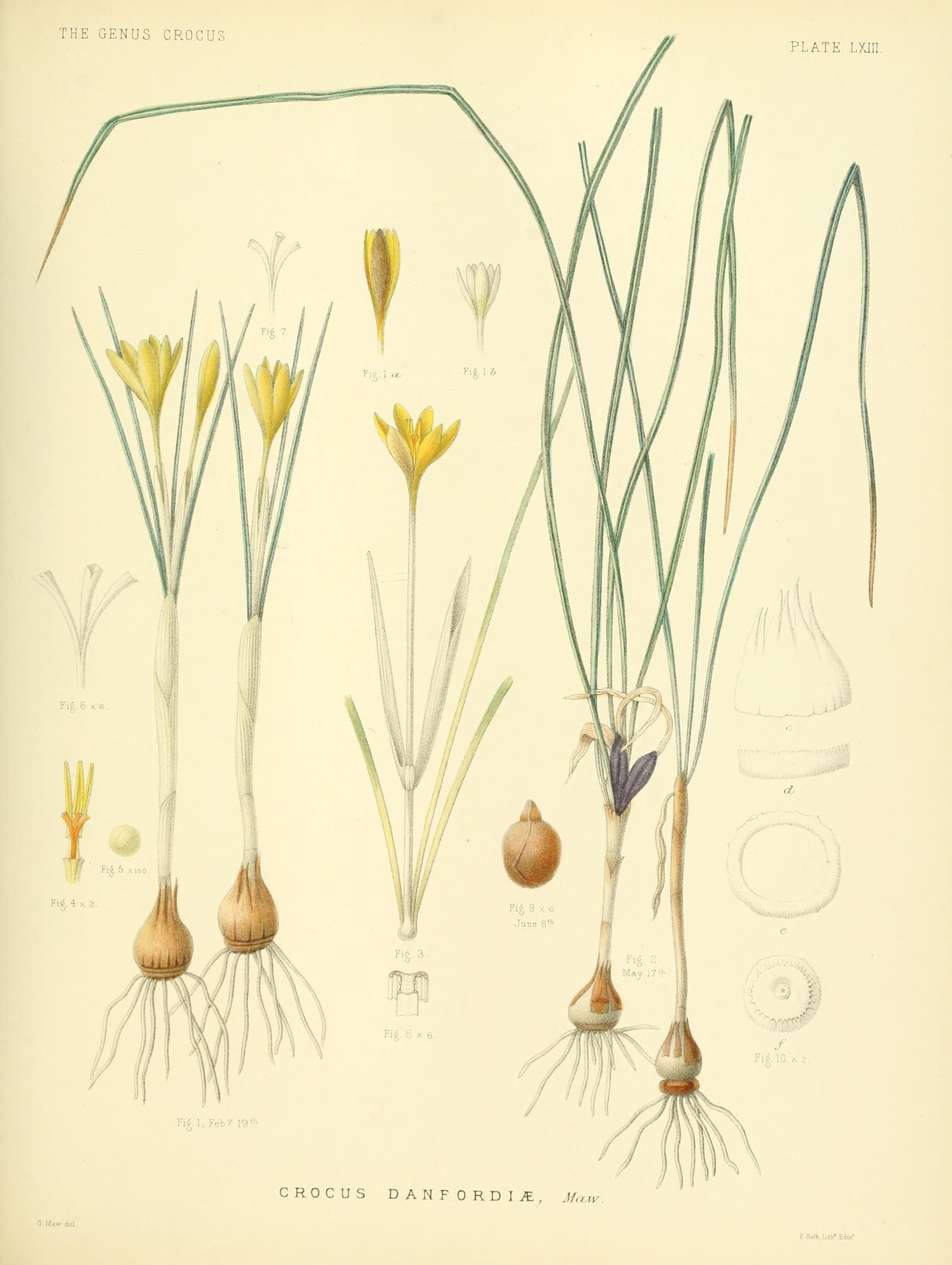
On 9 March 1879 Mrs C. G. Danford found a small yellow crocus in flower at Yar-puz in the Anti-Taurus. She gathered it again at Tapizite nearby and sent corms from there to George Maw, who named it after her: Crocus danfordiae. In his great Monograph of the Genus Crocus (1886) he went further and dedicated the whole book "to Mr. and Mrs. C. G. Danford". Their journeys through Asia Minor in 1876, 1878 and 1879 had "added much to the knowledge of the distribution of Crocuses", many of the book's small engraved vignettes were made from Mr Danford's sketches, and Mrs Danford had sent him "the roots of several new species of Crocus discovered by her".[5]
Maw's Crocus danfordiae has "very small pale yellow flowers", varying "from pale citron to orange", with white and bluish forms now and then. The plant from Panjah-Ali differs from most of these in its pure, bright yellow.[5][1]
From subspecies to species
In 2014 the crocus specialist Jānis Rukšāns raised the plant to a species of its own, Crocus kurdistanicus. His main reason was geography: the Kurdish population lies about 600 km from the easternmost known Crocus danfordiae, in Anatolia. He was frank about how little anyone knew. He had seen the plant from its type locality only in photographs taken by botanists in Iran. And he added a caution of his own: in his collection he grew a Crocus danfordiae with pure bright yellow flowers from the west of Anatolia, so the one difference Maroofi had found turns up in the typical species too. That is why, he wrote, its status "still remains unclear".[2][4]
He did have one living plant that fits it. A single bright yellow corm, like Crocus danfordiae in everything but its pure yellow colour, had turned up by chance among corms of a blue crocus of the Crocus biflorus group from the stock of the plantsman Jim Archibald, collected west of Lake Urmia. Rukšāns could not tell whether it had really come from the wild there or had slipped into the stock in cultivation.[2][6]
Rukšāns and his colleagues regard Crocus kurdistanicus as related to the Crocus danfordiae group, a group that earlier DNA work (Harpke and colleagues, cited by them) showed is not a single natural lineage.[7][8]
Still turning up
The story is not over. In 2026 Rukšāns and Vaclav Jošt described photographs of a yellow crocus that had circulated on social media, said to have been taken in mid-May somewhere on the Iran–Iraq border, where no yellow crocus was known. The photos' data showed they had in fact been taken in mid-March, and after writing to the photographer they concluded that they most likely show Crocus kurdistanicus, a species known from East Kurdistan, well away from that border.[3]
It is a reminder of how much of Kurdistan's spring flora is still being worked out. The same authors write that research on the flora of Iran, East Kurdistan included, was halted for many years after the 1979 revolution, and Rojhilat keeps producing new crocuses: Crocus iranicus, described in 2015 from the sides of a gully near Seqiz (Saqqez) at 1600 m, and Crocus oron-perii, described in 2026 from a grassy meadow on the road from Mehabad (Mahabad) to Merîwan (Marivan), near Surin, at 1966 m.[6][3]
When to look for it
We have found no published flowering time for Crocus kurdistanicus itself. The clues point to the very end of winter: the type corms were collected in late February, the social-media photographs were taken in mid-March, and its relative Crocus danfordiae is an early spring crocus that Maw flowered in February and March.[1][3][5]
Kurdish names
No Kurdish name for this particular crocus has been found. Ehmedê Dirihî's dictionary of Kurdish plant names (2013) records many names for crocuses in general, such as esparik, pîvok, gulsosin and zehferan; these belong to the whole genus and are listed on this page as genus names, to be checked.[9]
Sources
- 1.Maroofi, H. (2002). Notes on the flora of Kurdestan province, Iran. Iranian Journal of Botany 9(2): 233-237.
- 2.abcRukšāns, J. (2014). Crocus danfordiae Maw and C. chrysanthus (Herbert) Herbert (Iridaceae) and some of their allies in Turkey and Iran. International Rock Gardener 52 (25 Apr 2014). srgc.nethttps://www.srgc.net/documents/irg/2014Apr241398364476IRG52April.pdf
- 3.abcdRukšāns, J. & Jošt, V. (2026). New Crocus species (Crocoideae, Iridaceae) from Iranian Kurdistan. International Rock Gardener 196 (May 2026). srgc.nethttps://www.srgc.net/documents/irg/260528104616IRG%20196.pdf
- 4.International Plant Names Index. Royal Botanic Gardens, Kew, Harvard University Herbaria and Australian National Herbarium.
- abCrocus kurdistanicus (Maroofi & Assadi) Rukšāns, comb. et stat. nov.; basionym Crocus danfordiae subsp. kurdistanicus; author records Maroofi (Hossein, fl. 2002), Assadi (Mostafa, 1950–), Rukšāns (Jānis, 1946–).: urn:lsid:ipni.org:names:60466489-2; 20011856-1 (type data: locality, Maroofi 2657, 24 Feb 2002, holotype TARI); authors 40495-1, 13698-1, 20008688-2. ipni.orghttps://www.ipni.org/n/60466489-2
- urn:lsid:ipni.org:names:60466489-2. ipni.orghttps://www.ipni.org/n/60466489-2accessed 14 November 2026
- 5.abcdMaw, G. (1886). A Monograph of the Genus Crocus. London: Dulau. archive.orghttps://archive.org/details/monographofgenus00mawg/page/n10/mode/1up
- 6.abRukšāns, J. (2015). The genus Crocus (Iridaceae) in Iran – three new species from the so-called "Crocus biflorus" aggregate. International Rock Gardener 61 (Jan 2015, Crocus special). srgc.org.ukhttps://www.srgc.org.uk/logs/logdir/2015Feb011422783332IRG61.pdf
- 7.↩Rukšāns, J., Zubov, D. & Jošt, V. (2025). Two new species of the Crocus adamii species complex (Iridaceae) from Iran. International Rock Gardener 184 (May 2025). srgc.nethttps://www.srgc.net/documents/irg/250529174338IRG%20184.pdf
- 8.↩Advay, M. & Rukšāns, J. (2024). A new crocus species from Series Adamii from Western Iran. International Rock Gardener 172 (May 2024). srgc.nethttps://www.srgc.net/documents/irg/240530145259IRG%20172.pdf
- 9.↩Ahmet Kasımoğlu (Ehmedê Dirihî) (2013). Ferhenga Navên Nebatan a Kurdî (Dictionary of Kurdish Plant Names). Mardin Artuklu University, Institute of Living Languages in Turkey (ISBN 978-605-4202-12-6).
- Plants of the World Online. Royal Botanic Gardens, Kew, plant_name_id 493888. powo.science.kew.orghttps://powo.science.kew.org/taxon/urn:lsid:ipni.org:names:60466489-2accessed 14 November 2026
Last updated 20 November 2026