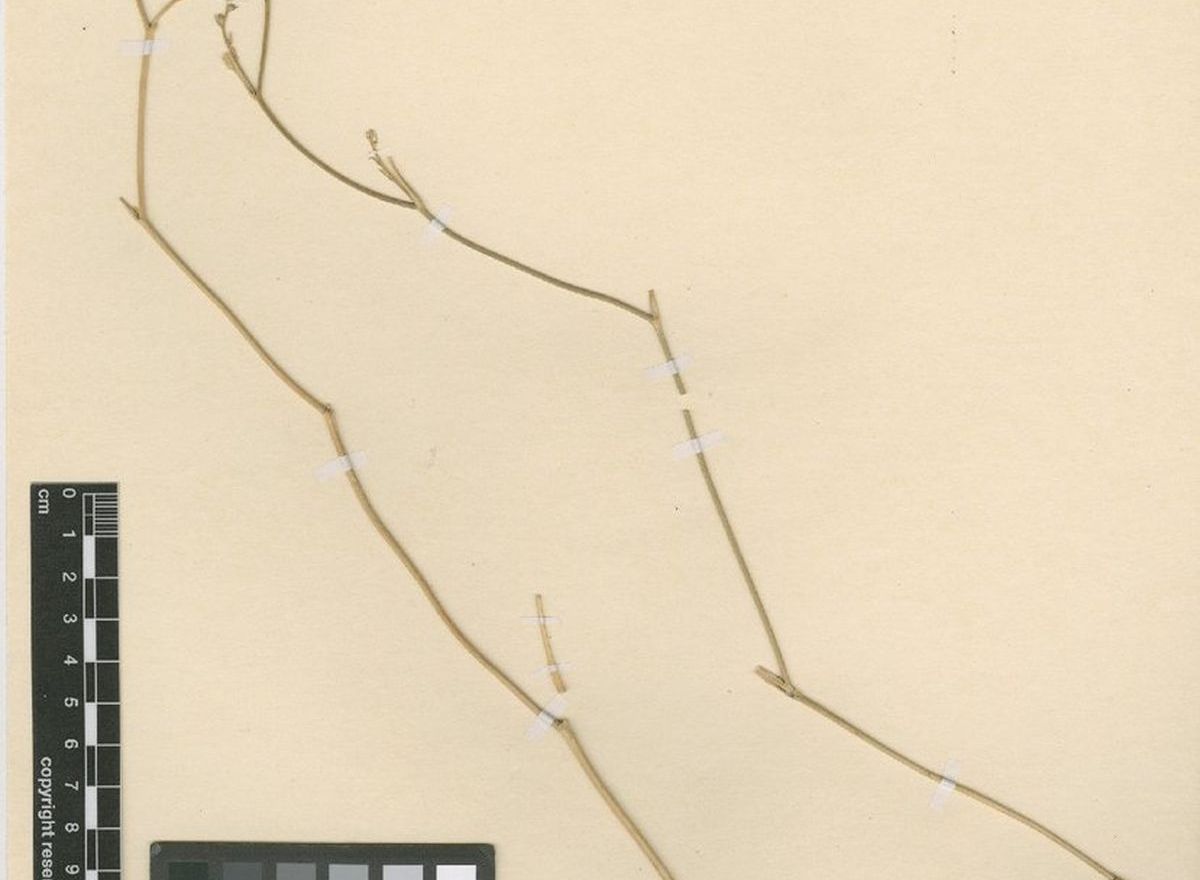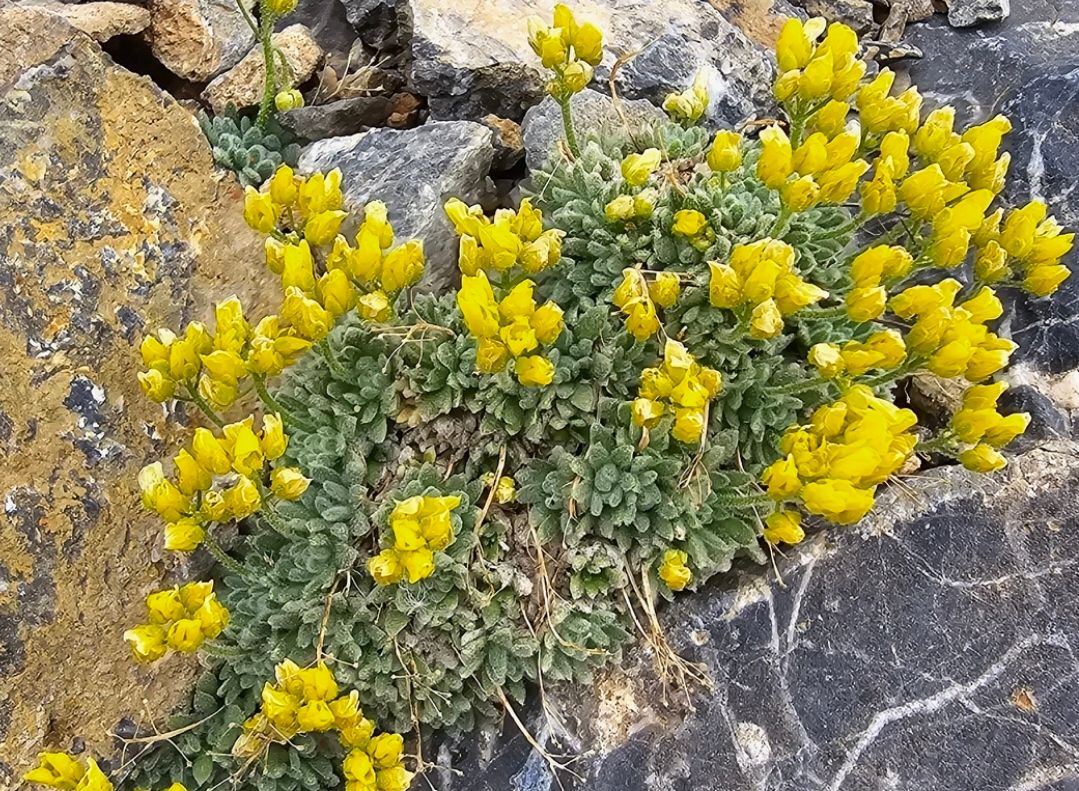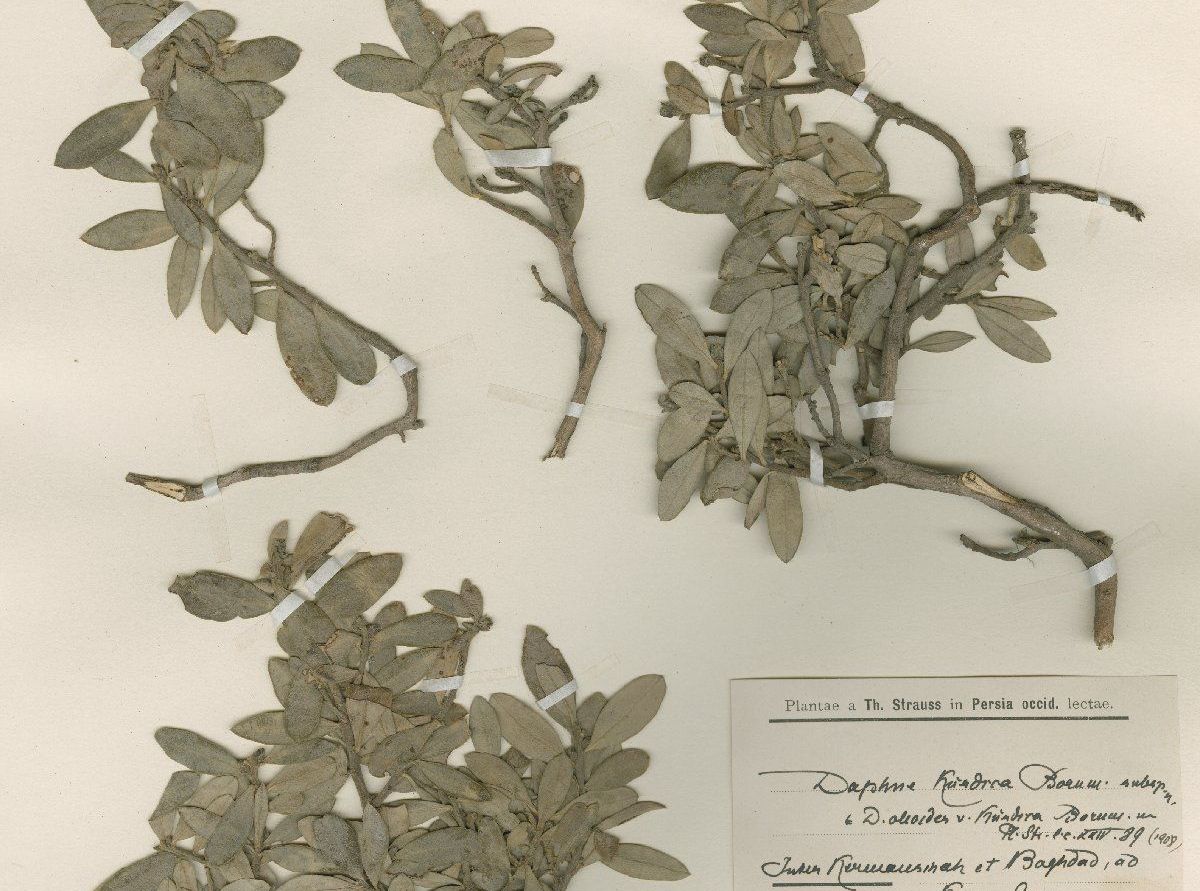
Daphne kurdica is a low shrub of the mountains of Kurdistan, with tough, lead-grey leaves and pure white flowers which, in the words of the man who first collected it, have an "intoxicating fragrance"[1]. It was found in 1894 on the old road between Kirmaşan (Kermanshah) and Baghdad, in East Kurdistan (Rojhilat), and it has since turned up on rock faces and mountain slopes from Kirmaşan to Wan (Van) and Dêrsim in North Kurdistan (Bakur)[2][1][3][4].
How it got its name
- Named by
- (Bornm.) Bornm., 1911Published in Beih. Bot. Centralbl., Abt. 2. 28: 498
A parcel from Qesrî Şîrîn
The first plant was gathered on 2 April 1894 by Theodor Strauss (1859–1911)[5], who collected plants for years in what his printed labels call "western Persia"[2][1][6]. The place was Qesrî Şîrîn (Qasr-e Shirin), on the road from Kirmaşan down to Baghdad[2]. A note on Strauss's slip, which Bornmüller printed as a footnote, places the spot east of Xaneqîn (Khanaqin), by the Elwend stream that flows into the Diyala[2][6], the river Kurds call the Sîrwan.
Strauss sent his finds to the German botanist Joseph Bornmüller (1862–1948)[5], who named them. In 1909 Bornmüller listed this daphne in his Plantae Straussianae as a new variety, Daphne oleoides var. kurdica, a "Kurdish" form of the daphne D. oleoides[2]. What set it apart were its leaves: "exceptionally larger and broader", up to 2.5 cm long and 1 cm wide[2]. In a footnote he added why the find mattered. No D. oleoides of any kind had been known before from "this whole mountain system east of the middle Tigris"[2] (our translation).
The rocks of Bîstûn
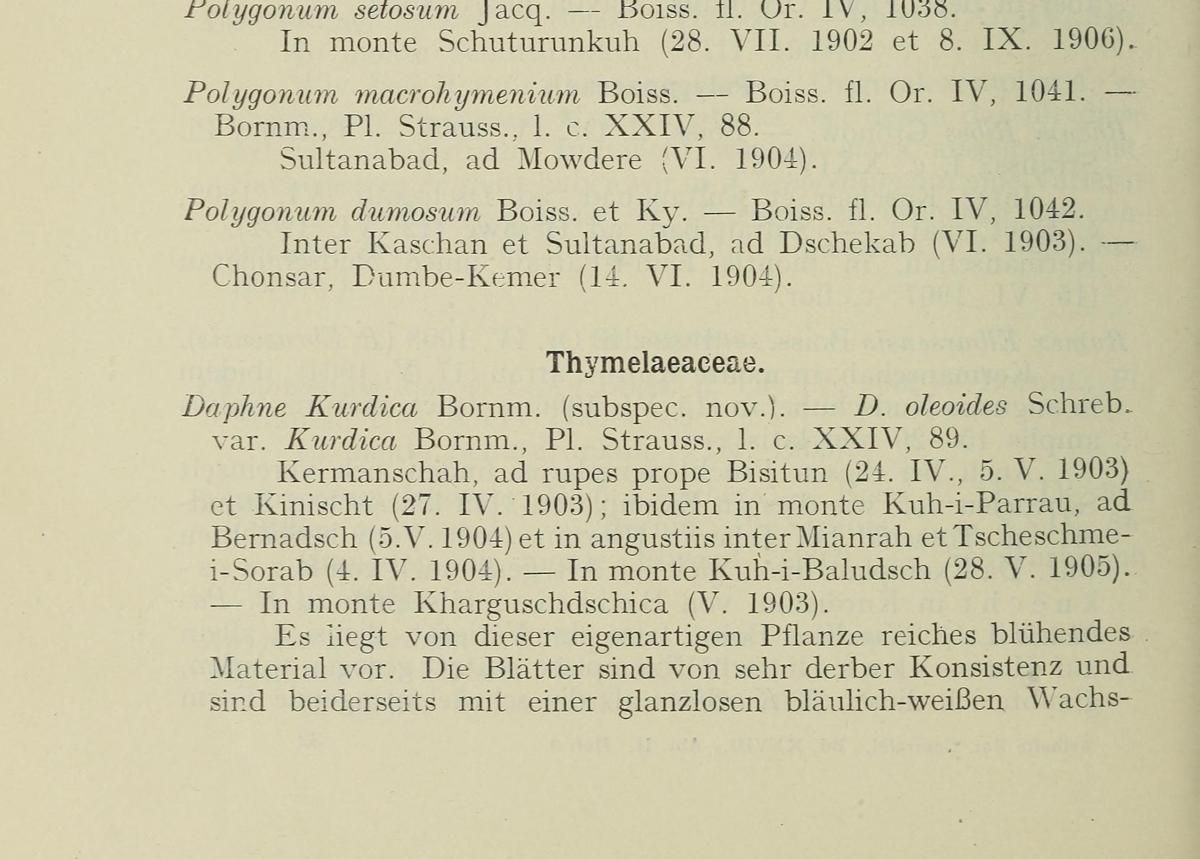
More parcels followed. Between 1903 and 1905 Strauss collected the plant again and again, most of the time around Kirmaşan[1]:
- around Kirmaşan: on the rocks near Bîstûn (Bisotun), on 24 April and 5 May 1903, and at Kinischt, on 27 April 1903;
- in the same area, on the mountain Kuh-i-Parrau, and in the gorge between Mianrah and Tscheschme-i-Sorab, in April and May 1904;
- and on two more mountains, Kuh-i-Baludsch (May 1905) and Kharguschdschica (May 1903).
(The places are given here as Bornmüller printed them.)
Bîstûn is no ordinary rock. On a cliff there, beside the ancient road from the Iranian plateau down to Mesopotamia, the Persian king Darius I had a relief and a long inscription in three languages carved in 521 BC[7]. Strauss's daphne grew on the rocks nearby[1].
In 1911, with "rich flowering material" in front of him, Bornmüller came back to the plant in his Collectiones Straussianae novae[1]. He was now sure it was more than a variety. "Evidently," he wrote, "a race of its own of D. oleoides has developed here in Persia," one that recalls D. stapfii, a daphne from further south[1][5] (our translation). And he passed on what Strauss had told him by letter about the living flowers:
„reinweiß von betäubendem Wohlgeruch“
"pure white, of intoxicating fragrance"[1] (our translation)
Species, subspecies or variety?
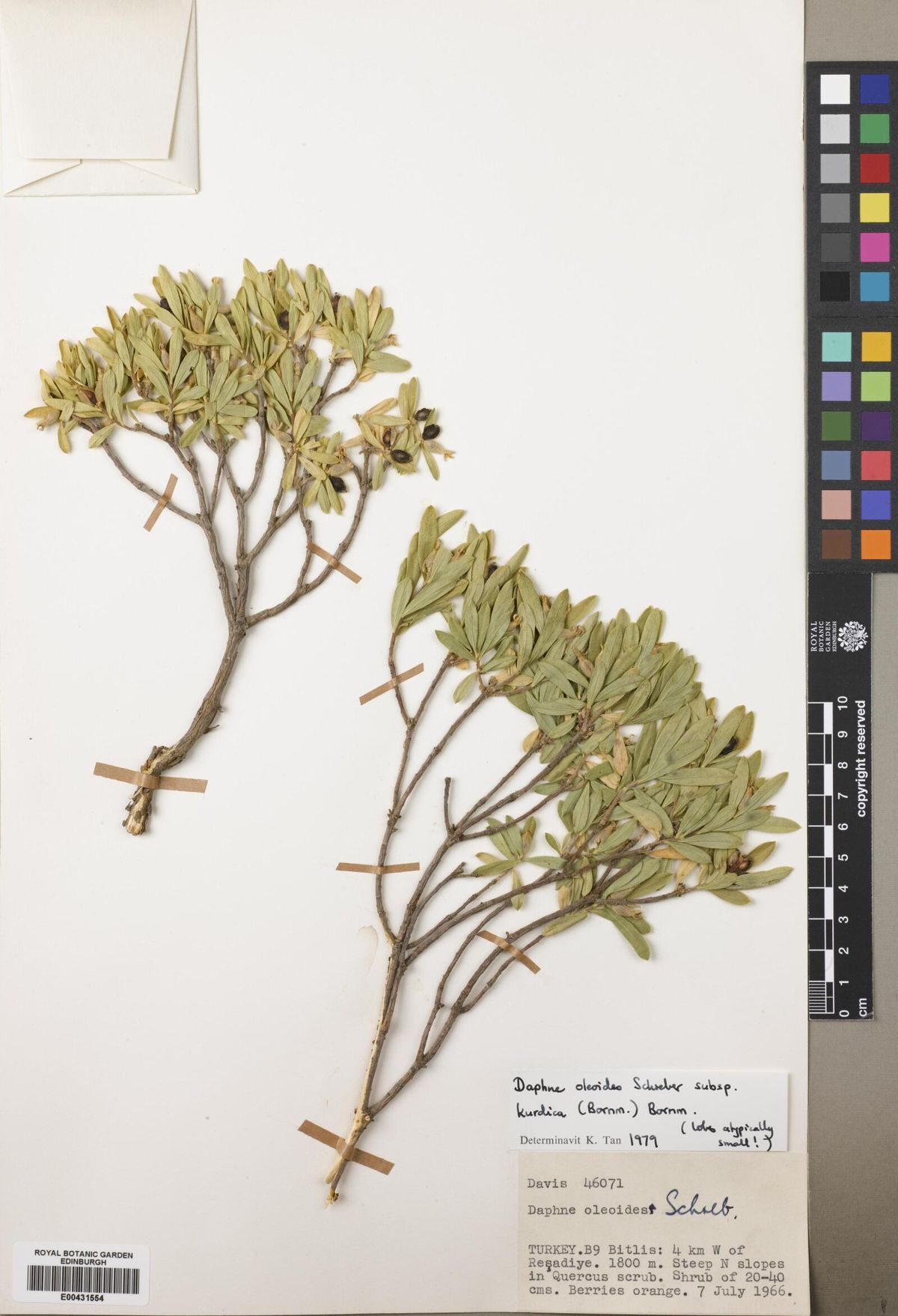
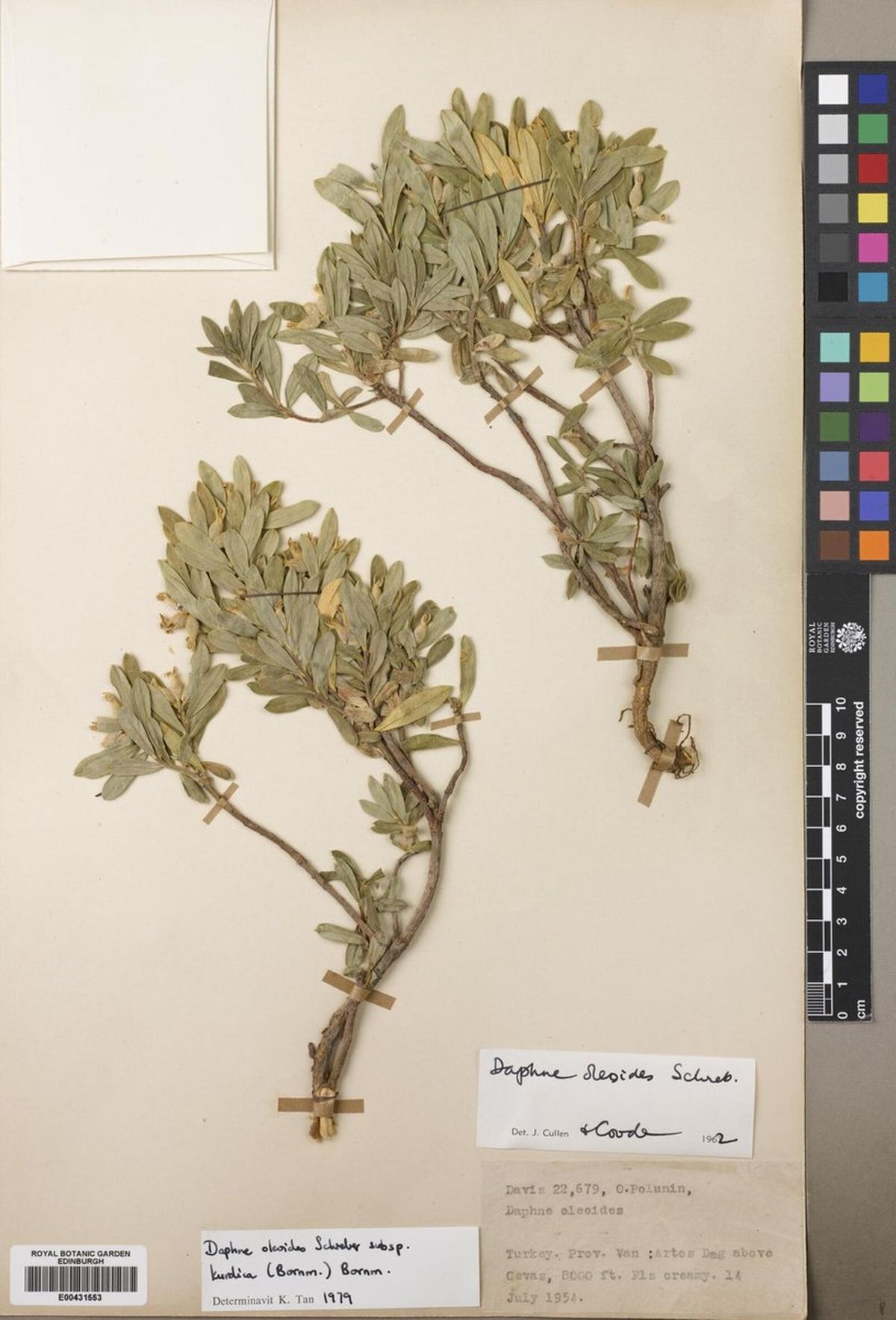
Bornmüller's 1911 heading is a small puzzle. He wrote the name as a species, Daphne Kurdica, but called it "subspec. nov.", a new subspecies[1]. Botanists have read it both ways ever since. Kew's world checklist accepts it as a species, Daphne kurdica (Bornm.) Bornm., and names the subspecies D. oleoides subsp. kurdica as an alternative treatment[5][8]. Many herbarium specimens carry the subspecies name: the Jena sheet was confirmed as D. oleoides subsp. kurdica in 1971, and the two Edinburgh sheets below were named so in 1979[6][3][3].
One more warning for anyone looking it up online. The GBIF database counts D. transcaucasica, a daphne named in 1950[5], as the same plant, so its maps show many records from Armenia and Azerbaijan[9]. Kew's checklist does not list it as a synonym: its range for D. kurdica is "E. Türkiye to NW. & W. Iran"[8].
What to look for
Bornmüller's description is short, and his exclamation marks show what struck him[1]:
- the leaves are very tough, coated on both sides with a dull, bluish-white wax, "hence lead-coloured";
- the short hairs sit on tiny knobs;
- the leaves are widest in the middle or in the upper third, and much larger than in ordinary D. oleoides: up to 2.5 cm by 1 cm on the first specimens[2], and on one sterile shoot as much as 4.5 cm long and 14 mm wide;
- otherwise it grows like D. oleoides.
Collectors' labels from Bakur add the rest. In Bedlîs (Bitlis) it was a shrub 20–40 cm tall, and by early July it was carrying orange berries[3]. High on a mountain above Gevaş, in Wan, it was still flowering in mid-July, with "creamy" flowers[3].
Where it grows
Kew gives its native range as eastern Turkey to north-western and western Iran[8]. In Kurdish terms, the records we have read come from Rojhilat and Bakur:
- Rojhilat: Qesrî Şîrîn, the type locality, close to the line between Rojhilat and South Kurdistan (Başûr)[2][6]; and the rocks and mountains around Kirmaşan, Bîstûn among them[1].
- Bakur: Artos Dağ above Gevaş, in Wan, at 8,000 feet (about 2,440 m), 1954[3]; north slopes in oak scrub west of Reşadiye, in Bedlîs, at 1,800 m, 1966[3]; and near Pülümür in Dêrsim (Tunceli), at 2,160 m, 2013[4].
Its places are rocky ones: cliffs and rocks near Bîstûn[1], steep mountain slopes and oak scrub in Bakur[3]. Strauss found it in flower in April and May[1]; high in the mountains of Bakur it was still in flower in mid-July[3].
A healing plant
In folk medicine in Turkey, the leafy shoots of this daphne are used to heal wounds, and against rheumatism and malaria[10]. Where it grows together with ordinary D. oleoides, people use the two for wounds without telling them apart[11].
In 2012 a team of pharmacologists tested that wound use in the laboratory. An extract of the shoots did help wounds heal in their tests on animals, and the main active compound turned out to be a flavonoid, luteolin-7-O-glucoside. Two coumarins, daphnetin and demethyldaphnoretin 7-O-glucoside, were found as well[10].
These are records of traditional use and laboratory studies, not medical advice.
Its Kurdish names
The name kurdica, "Kurdish", was Bornmüller's. He did not explain it, but the first plant came from Qesrî Şîrîn and most of the later ones from around Kirmaşan, both in Rojhilat[2][1].
Ehmedê Dirihî's dictionary of Kurdish plant names (2013) gives two dictionary names for Daphne oleoides ssp. kurdica, each pointing to the other: dafneya kurdan[12] and defneya kurdan[12]. A name recorded from people who know the plant where it grows has not yet turned up in the sources we have read; if you know one, Flora Kurdica would like to hear it.
Sources
- 1.Bornmüller, J. (1911). Collectiones Straussianae novae. Beihefte zum Botanischen Centralblatt 28(2).
- 2.Bornmüller, J. (1909). Plantae Straussianae. Beihefte zum Botanischen Centralblatt 24(2).
- 3.Royal Botanic Garden Edinburgh Herbarium (E), specimen catalogue (via data.rbge.org.uk and GBIF). data.rbge.org.ukhttps://data.rbge.org.uk/herb/
- 4.abNatural History Museum Vienna (W) – Herbarium. via GBIF, herbarium specimen W 2014-0009369 (Vitek et al. 13-0306, Dêrsim, 2013; via GBIF, occurrence 2598722763).
- 5.International Plant Names Index. Royal Botanic Gardens, Kew, Harvard University Herbaria and Australian National Herbarium.
- 6.abcdHerbarium Haussknecht, Jena (JE), specimen records (JACQ) via GBIF. Jena, herbarium specimen JE00011631, isotype of Daphne oleoides var. kurdica (via GBIF, occurrence 3028985199). api.gbif.orghttps://api.gbif.org/v1/occurrence/3028980654
- 7.↩ICOMOS (2006). Evaluation of the World Heritage nomination "Bisotun (Iran)", No. 1222.
- 8.Plants of the World Online. Royal Botanic Gardens, Kew.
- abcDaphne kurdica.
- plant_name_id 2757045. powo.science.kew.orghttps://powo.science.kew.org/taxon/urn:lsid:ipni.org:names:831262-1accessed 14 November 2026
- 9.↩GBIF.org GBIF Backbone Taxonomy and occurrence records. Backbone Taxonomy: Daphne kurdica, synonyms and IUCN category (accessed 15 November 2026). gbif.orghttps://www.gbif.org/
- 10.abSüntar, I., Küpeli Akkol, E., Keles, H., Yesilada, E., Sarker, S. D., Arroo, R. & Baykal, T. (2012). Efficacy of Daphne oleoides subsp. kurdica used for wound healing: identification of active compounds through bioassay guided isolation technique. Journal of Ethnopharmacology 141: 1058–1070.
- 11.↩Süntar, I., Küpeli Akkol, E., Keles, H., Yesilada, E., Sarker, S. & Baykal, T. (2014). Daphne oleoides Schreber ssp. oleoides exhibits potent wound healing effect: isolation of the active components and elucidation of the activity mechanism. Records of Natural Products 8(2): 93–109.
- 12.Ahmet Kasımoğlu (Ehmedê Dirihî) (2013). Ferhenga Navên Nebatan a Kurdî (Dictionary of Kurdish Plant Names). Mardin Artuklu University, Institute of Living Languages in Turkey (ISBN 978-605-4202-12-6).
Last updated 20 November 2026