Delphinium kurdicum is a slender, wiry delphinium of the oak hills and rocky slopes of Kurdistan, growing from a tuberous root[1] and carrying loose spikes of small flowers in high summer. It was first collected in 1841 by springs on Mount Gara above Mosul, in South Kurdistan (Başûr)[1][2], and has since been found across the mountains of North Kurdistan (Bakur) and, in a record published in 2013, of East Kurdistan (Rojhilat)[3][4][5]. Nearly two centuries on, the botanists who have handled it still do not agree on one simple thing: the colour of its flowers.
How it got its name
- Named by
- Boiss. & Hohen., 1843Published in Diagn. Pl. Orient. 1: 67
Found by the springs of Mount Gara
In August 1841 the botanist Theodor Kotschy (1813–1866)[6] was collecting on Mount Gara, the mountain Boissier placed "in Kurdistan, above Mosul"[2]. That year Kotschy was working his way south from Kurdistan into Mesopotamia, and from Mosul he went down to Baghdad on a raft supported by animal skins[7].
His dried plants were arranged and sent out to herbaria by the missionary Rudolf F. Hohenacker (1798–1874)[6][7], in printed sets labelled Pl. alepp. kurd. moss.: plants of Aleppo, Kurdistan and Mosul[8]. One of them was a delphinium nobody had described. Hohenacker and the botanist Edmond Boissier (1810–1885)[6] named it together, and Boissier published it early in 1843 in his Diagnoses Plantarum Orientalium Novarum[1][6]. Its home, in Boissier's words:
Hab. in dumosis ad fontes montis Gara Kurdistaniæ.
It grows in thickets by the springs of Mount Gara in Kurdistan.[1] (our translation)
The name kurdicum means "Kurdish": the plant carries the name of the land where its first specimen was found.
Number 627, or 427?
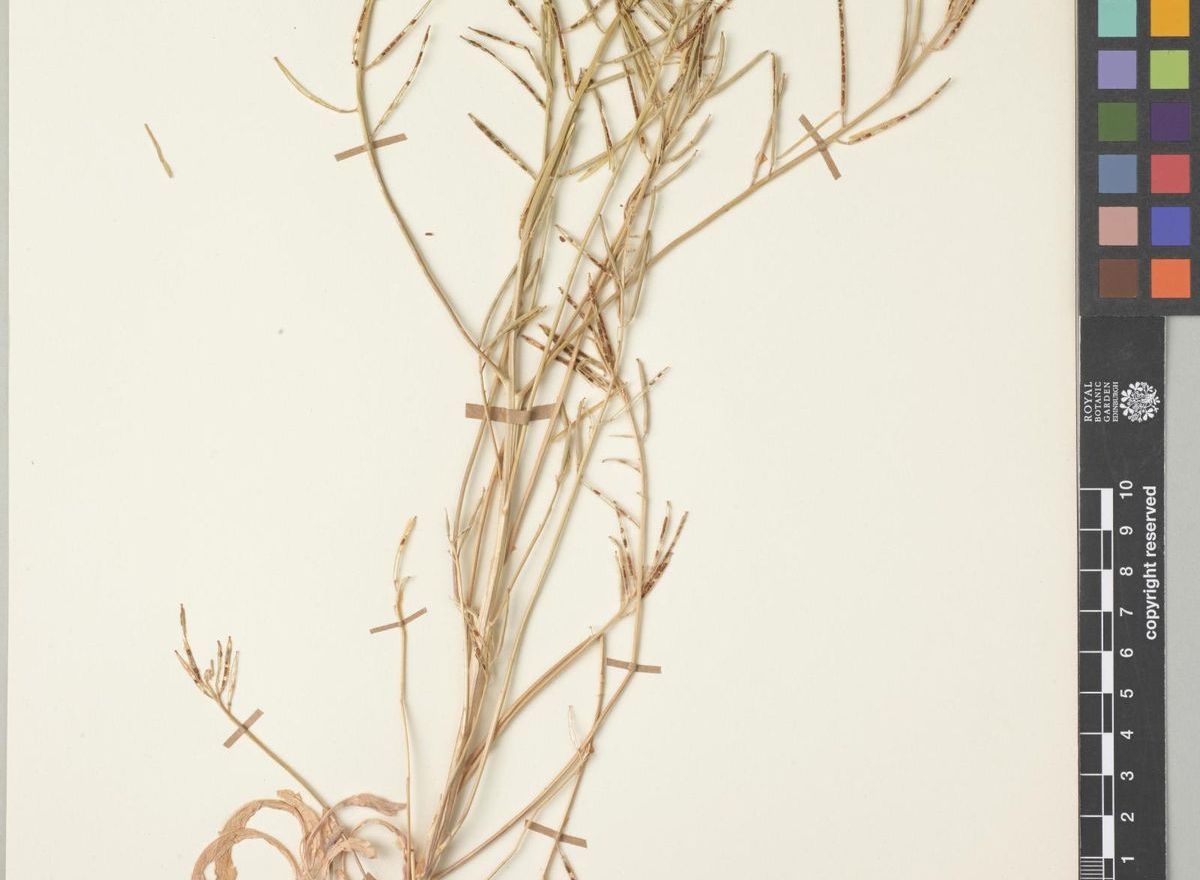
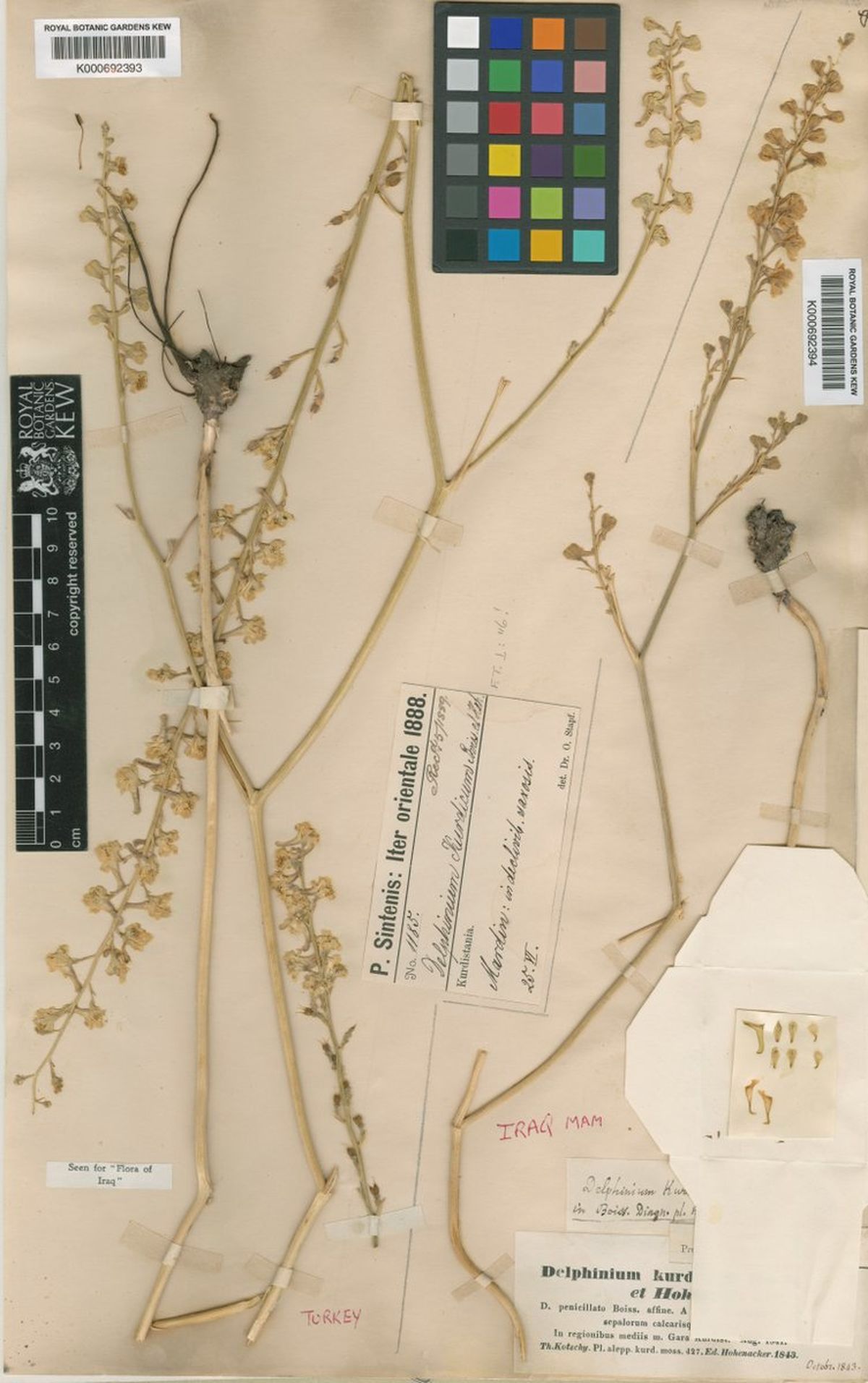
Boissier's description ends with the specimen it is based on: "Kotschy N° 627"[1]. But on the printed labels of Kotschy's set, the plant from Gara is number 427[8][9], and when Boissier came back to the species in his Flora Orientalis in 1867, he too cited "n° 427"[2]. Duplicates of number 427 are kept as type material in Halle, Paris, London, St. Louis and Kew[8][10][9].
In September 2015 B. Heuchert of the Halle herbarium added a slip to the Halle sheet, a syntype of the species: "In protolog is possible erroneously printed Nr. 627"[8]. Probably, then, a 4 became a 6 at the printer's in 1843, and the mistake has followed the name ever since.
Yellow, white, blue or pink?
Boissier's first description says nothing about colour[1]. In 1867 he gave it floribus minutis flavis, "tiny yellow flowers"[2] (our translation). Since then, almost every botanist who has described it has seen something else:
- In July 1890 the collector Paul Sintenis (1847–1907)[6] found plants near Egin (Kemaliye) on the upper Euphrates with long, loose spikes, and Josef Freyn (1845–1903)[6] described them in the Oesterreichische Botanische Zeitschrift as a new variety, elongatum, with flowers "from whitish to bluish (not yellow)"[11]. Kew's checklist no longer keeps that variety apart; it is listed as a synonym of the species[12].
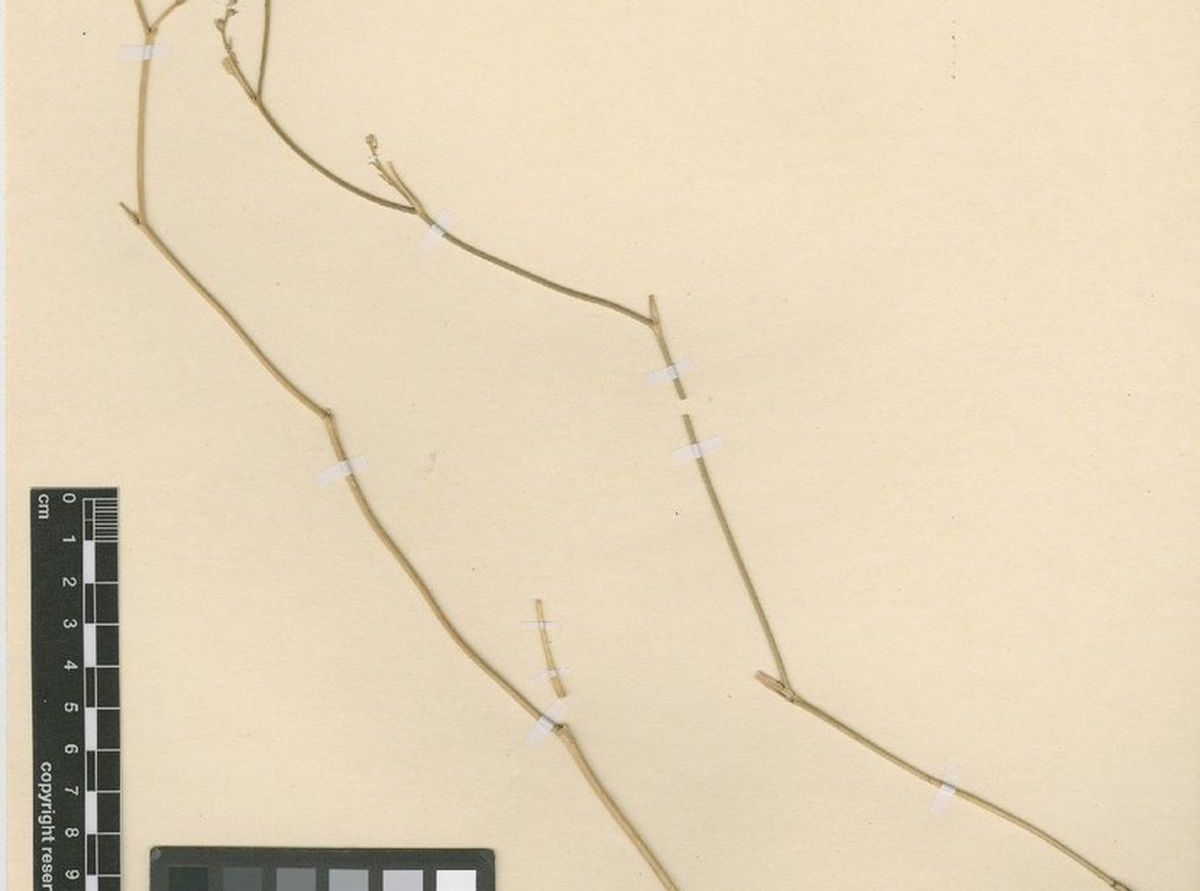
- In July 1973 John R. Edmondson collected it on the steep limestone slopes of the Munzur mountains in Dersim (Tunceli), and wrote on his label: "Flowers fawn to pink"[4].
- In 2013, botanists describing the first plant known from Rojhilat, between Ûrmiye (Urmia) and Selmas (Salmas), called its flowers "dirty white", yet still put it in their key to the yellow-flowered delphiniums of Iran[3] and compared it with "another yellow Delphinium species", D. ochroleucum[3].
Read side by side, these accounts describe a pale flower, somewhere between yellowish, dirty white, fawn and a faint pink or blue. Whether the species simply varies in colour, or whether more than one plant hides under the name, none of the sources we read says.
What to look for
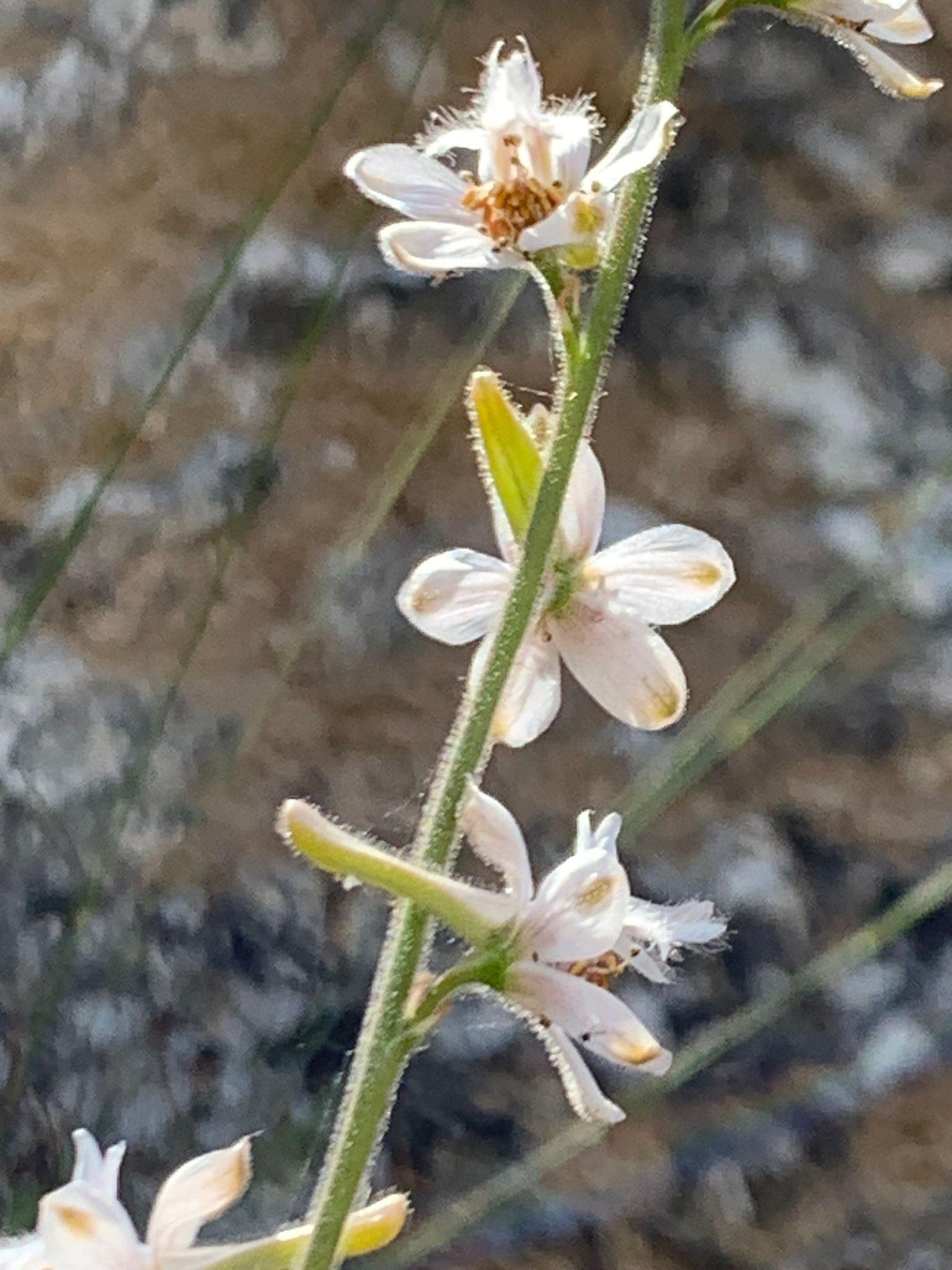
Boissier's Latin description of 1843 still works as a field guide[1] (our translation):
- a perennial from a tuberous root;
- a tall, zigzag stem, sparingly branched and almost leafless, covered in very short hairs;
- hairless, pale green leaves cut into many narrow, linear segments;
- a rather loose, spike-like flower cluster, each flower on a stalk about as long as itself, with a bract below and two small bracteoles halfway up;
- finely hairy sepals and a curved spur, longer than the flower, ending in a blunt swelling;
- upper petals hairless and leathery, the lower ones stalked, ovate, split into two lobes not quite to the middle and woolly above.
The 2013 study adds sizes: plants 30–60 cm tall, flowers 12–18 mm long, the spur 10–11 mm, and fruits (follicles) without hairs[3]. In 1867 Boissier set it beside D. penicillatum: D. kurdicum differs in its zigzag, "broken-looking" stem, its lower petals split only a little way and not almost to the base, and its hairs[2] (our translation).
Where it grows
Kew's checklist gives its native range as eastern Turkey to north-western Iran, recorded from Iran, Iraq, Syria and Lebanon, and Turkey[12]. In Kurdish terms, almost every known record lies in Kurdistan:
- Başûr: Mount Gara, the type locality[1][2]; Zawita near Duhok, July 1933[5]; Sersang, July 1955[5]; rocky oak woods above Sirsank, between Duhok and Amêdî (Amadiya), at about 1,200 m, July 1957[5]; oak woods in the Qendîl (Qandil) mountains, about 1,000 m, and Mount Koorak, about 1,000 m, both in late July 1957[5].
- Bakur: stony slopes at Mêrdîn (Mardin), where Sintenis collected it on 25 June 1888[9] (the sheet now shares a mount at Kew with Kotschy's Gara plant); in Dersim, on limestone slopes of the Munzur mountains at 1,500 m and on a dry gravel plain near Ovacık at 1,400 m[4][5]; and near Egin (Kemaliye) on the upper Euphrates, where Sintenis found it in 1890[11][5].
- Rojhilat: between Ûrmiye and Selmas, at 1,900 m, first reported in 2013[3].
- Outside Kurdistan, Boissier also listed a plant from the Taurus mountains above Gülek in Cilicia[2].
Its places are thickets by springs, scrub and oak woodland, and rocky limestone slopes, mostly between about 1,000 and 1,900 m[1][2][3][4][5]. The dated collections fall between late June and August[8][9][4][5].
Its names in Kurdish
No Kurdish name recorded from a particular place or speaker has turned up for this species in the sources we checked.
Ehmedê Dirihî's dictionary of Kurdish plant names, Ferhenga Navên Nebatan a Kurdî (2013), gives delav, with heyzeran, for Delphinium kurdicum, without saying where the name comes from[13]. On the same page delav is also printed against two quite different plants, the sedges of the genus Cyperus and the mat-grass Nardus stricta[13]. The dictionary also lists the dictionary names delavê kurdan and heyzerana kurdan, "… of the Kurds", for this species[13].
For delphiniums as a group, Edîb Polat's plant list in the Kurmanji journal Kurmancî (2006) gives hêzeran, and tûra kûrila from Kerkûk[14]; Dirihî repeats hêzeran for the genus, from the journal, with axlêwe and tûra kûrîlê[13]. These are names for the genus as a whole, not names of D. kurdicum itself. If you know this pale delphinium from the hills around Duhok, Mêrdîn or Dersim, and what it is called there, we would like to hear from you.
Sources
- 1.Boissier, E. (1843). Diagnoses Plantarum Orientalium Novarum, ser. 1, no. 1. Geneva.
- 2.Boissier, E. (1867). Flora Orientalis, vol. 1. Basel & Geneva: H. Georg. archive.orghttps://archive.org/details/floraorientaliss01bois
- 3.Sharifnia, F., Hasan Barani, M. & Assadi, M. (2013). Notes on some species of the genus Delphinium (Ranunculaceae) in Iran. Iranian Journal of Botany 19(2): 202–210. doi:10.22092/ijb.2013.4158https://doi.org/10.22092/ijb.2013.4158
- 4.abcdeRoyal Botanic Garden Edinburgh Herbarium (E), specimen catalogue (via data.rbge.org.uk and GBIF). herbarium specimen E00445488 (Edmondson 1357) (via GBIF). data.rbge.org.ukhttps://data.rbge.org.uk/herb/
- 5.abcdefghiHerbarium specimens via GBIF: K002151049, K002151050, K002151051 (Kew); BC-902833, BC-903041 (Barcelona, Rechinger 1957); E00445490 (Edinburgh); JE 00016424 (Jena).
- 6.International Plant Names Index. Royal Botanic Gardens, Kew, Harvard University Herbaria and Australian National Herbarium.
- 7.Edmondson, J. R. & Lack, H. W. (2006). Karl Georg Theodor Kotschy's itinerary in southern Iran, 1841–42. Willdenowia 36: 579–588. doi:10.3372/wi.36.36154https://doi.org/10.3372/wi.36.36154
- 8.abcdeHerbarium Universitatis Halensis, herbarium specimen HAL 0099526 (syntype, Kotschy 427) (via GBIF).
- 9.abcdRoyal Botanic Gardens, Kew – Herbarium Specimens. via GBIF, herbarium specimens K000692393 and K000692394 (via GBIF). gbif.orghttps://www.gbif.org/dataset/cd6e21c8-9e8a-493a-8a76-fbf7862069e5
- 10.↩Isotypes of Kotschy 427 at MO (1828091), BM (BM000565672) and P (P00198648) (via GBIF).
- 11.Freyn, J. (1891). Plantae novae Orientales. Oesterreichische Botanische Zeitschrift 41(11): 363.
- 12.Plants of the World Online. Royal Botanic Gardens, Kew.
- abDelphinium kurdicum Boiss. & Hohen.
- plant_name_id 2759961. powo.science.kew.orghttps://powo.science.kew.org/taxon/urn:lsid:ipni.org:names:710725-1accessed 14 November 2026
- 13.Ahmet Kasımoğlu (Ehmedê Dirihî) (2013). Ferhenga Navên Nebatan a Kurdî (Dictionary of Kurdish Plant Names). Mardin Artuklu University, Institute of Living Languages in Turkey (ISBN 978-605-4202-12-6).
- 14.↩Edîb Polat (2006). Flora Kurdistanê (I). p. 2. institutkurde.orghttps://www.institutkurde.org/publications/kurmanci/
- iNaturalist. observation 369693733 (photo only). inaturalist.orghttps://www.inaturalist.org/
Last updated 20 November 2026