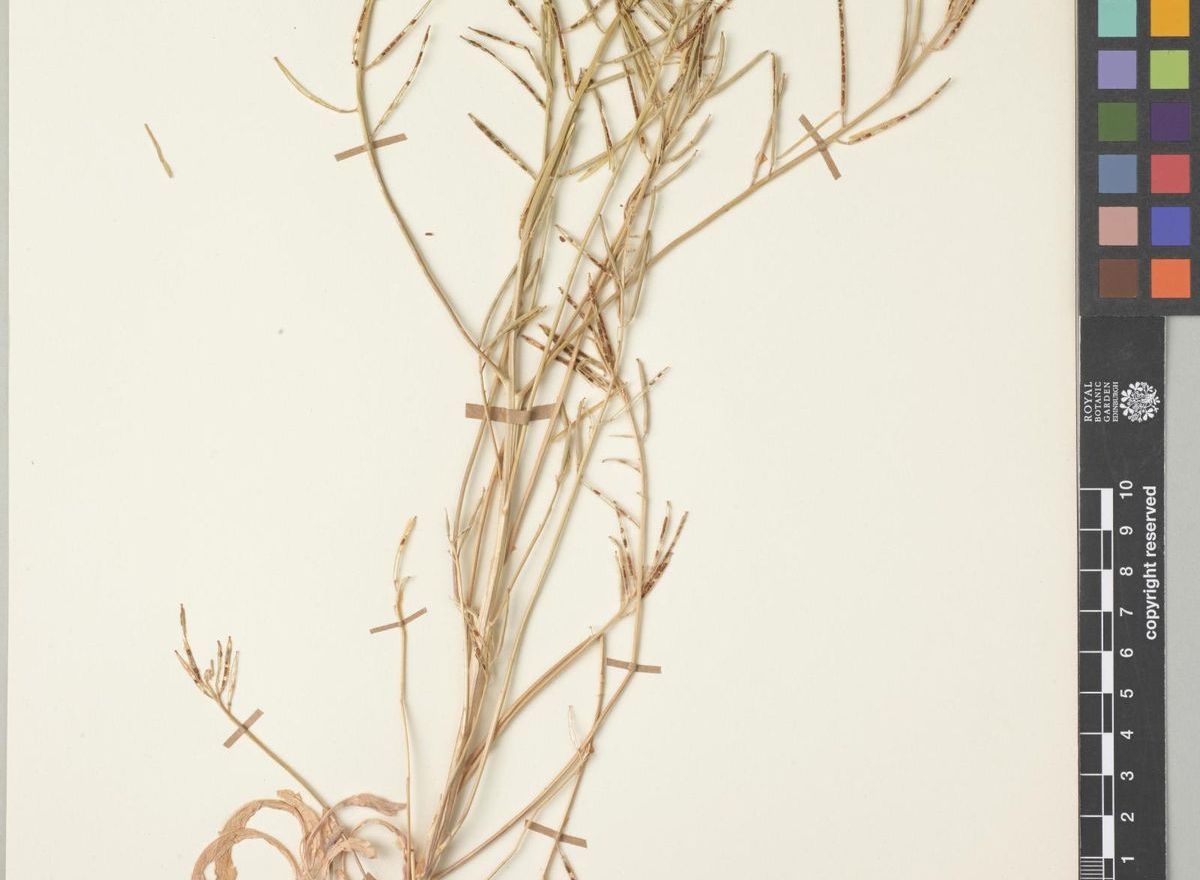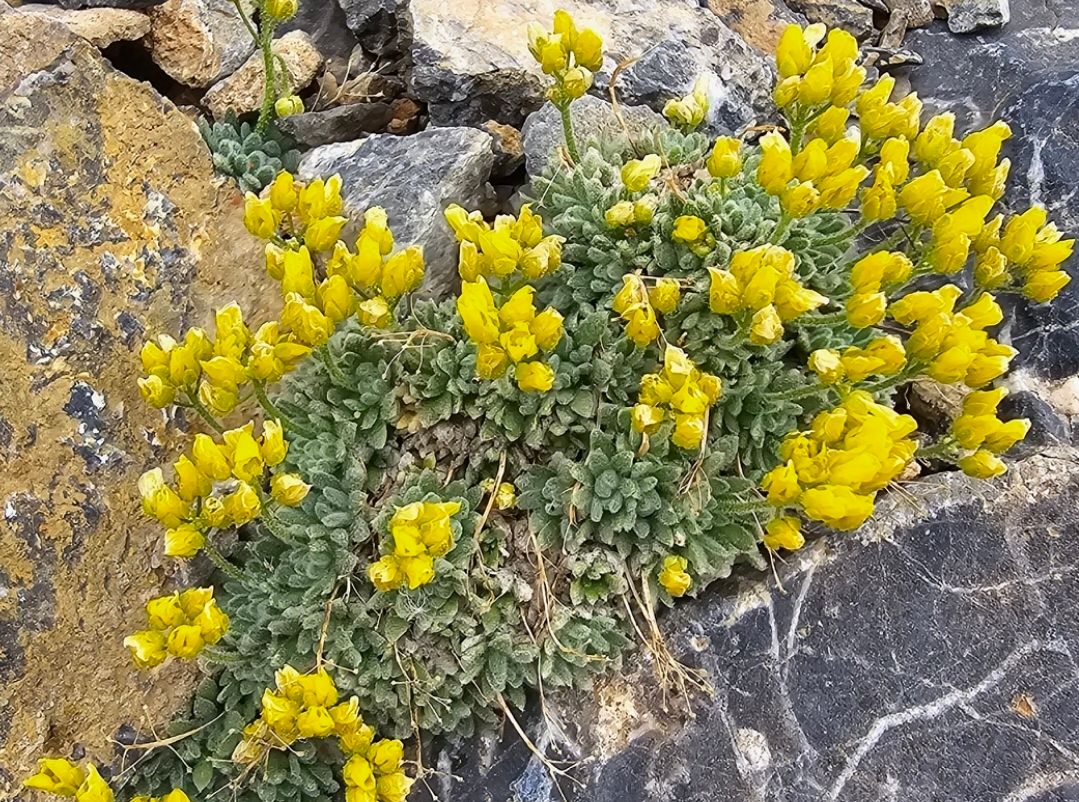
High on the bare summits of Kurdistan, Draba bruniifolia makes tight, grey-green cushions in cracks in the rock and covers them with bright yellow flowers in midsummer[1][2]. It is a small plant with a big family: Draba has more than 390 species, "mostly in extreme ecosystems at high elevations and latitudes", which makes it the most species-rich genus of the cabbage and mustard family, the Brassicaceae[3]. One of its forms was first collected on a mountain near Lake Van and carries the Kurds in its name: subspecies kurdica[4][5].
How it got its name
- Named by
- Steven, 1812Published in Mém. Soc. Imp. Naturalistes Moscou 3: 268
Found on the rocks of the eastern Caucasus
The species was named in 1812 by Christian von Steven (1781–1863)[6], in a "catalogue of rare or new plants observed during a journey around the eastern Caucasus" for the natural history society of Moscow[1]. He described two drabas growing side by side on the rocks of a high mountain he calls Schahdagh, flowering in June[1]; the botanist Pierre Edmond Boissier (1810–1885)[6] later placed Schahdagh in the eastern Caucasus[7], where Mount Shahdagh still carries the name. Steven printed the name as Draba bruniaefolia; the name databases now spell it bruniifolia[1][6].
Steven's note is short but vivid:
Utraque flores gerit speciosos luteos racemo coarctato, folia angusta rigida margine carinaque ciliata apice penicillo pilorum instructa.
Both bear showy yellow flowers in a crowded cluster, and narrow, stiff leaves fringed with hairs along the edge and the keel, each tipped with a little brush of hairs.[1] (our translation)
He told the new plant from its neighbour by its hairy flowering stalk, its slightly inflated pods, its short, stiff fruit stalks and a slightly longer style. And he compared it with a draba from much further away, which "the distinguished Adams" had brought back "from the shore of the Arctic Sea"[1] (our translation): a reminder of how far north this genus reaches[3].
A plant that keeps changing shape
Half a century later Boissier, in his Flora Orientalis, decided that Steven's plant was only a variety of a wider species, Draba olympica, which he called "polymorphic". Among the plants he folded into it was one described as a separate species, which he explained as a form whose leaves curl inwards into balls in dry ground[7]. Boissier's records run from the eastern Caucasus to Çiyayê Agirî (Mount Ararat) and Mount Savalan in the north of Iran[7].
In 1965 the botanists James Cullen (1936–2013) and Mark Coode (born 1937)[6] sorted out the genus in a series of papers preparing the Flora of Turkey[4]. Earlier work had recognised four species of this group in Turkey; they could keep only two, "the distinctions given by Schulz not being maintained consistently"[4]. Instead they made Draba bruniifolia one species with six subspecies, from the islands of the Aegean to the Caucasus, and wrote that its variation is "reticulate"[4]: roughly, the distinguishing features cross and recombine like the threads of a net, rather than lining up neatly. Kew's checklist still accepts the species and all six subspecies[8].
The Kurdish subspecies from Artos
On 15 July 1954 the botanist Peter Hadland Davis (1918–1992)[6], whose name stands on the Flora of Turkey[5], was collecting with Oleg Polunin on Artos, a mountain in the district of Westan (Gevaş) on Lake Van, in the province of Wan (Van) in North Kurdistan (Bakur). On the summit ridge, among "rocks and screes", they gathered a cushion-forming draba, and a little lower, on scree at 11,500 feet, more of it, noting "Fl lutea": flowers yellow[5][5].
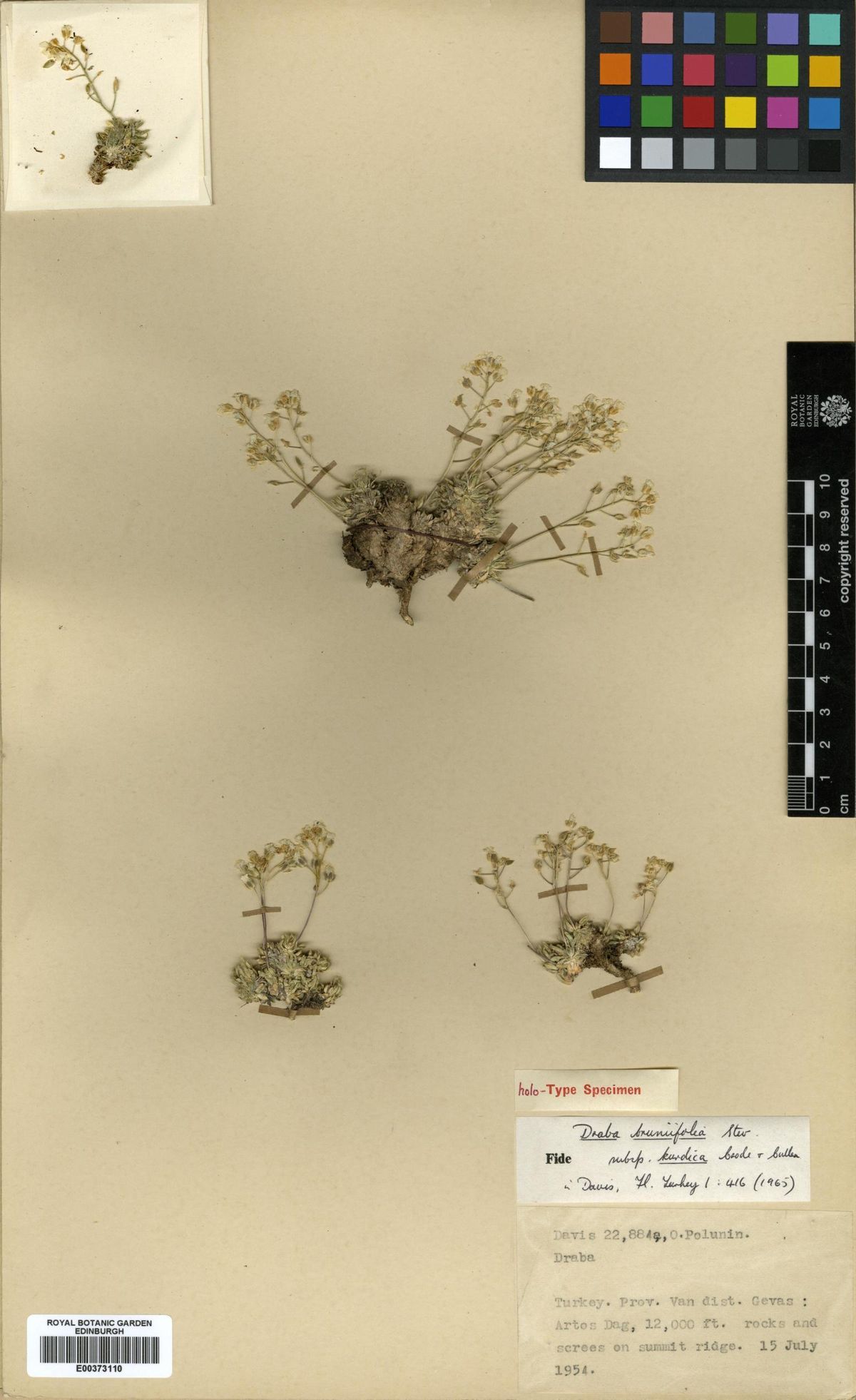
That sheet in the Royal Botanic Garden Edinburgh became the holotype, the single specimen the name is tied to, when Cullen and Coode described subsp. kurdica in 1965[4][5]. A duplicate is kept in London[9]. The typed label gives 12,000 feet, about 3,650 m; the published description prints 4,000 m[4][5].
Their Latin diagnosis is one sentence: it "differs from subsp. bruniifolia in its hairless flowering stalk, and in the hairs of the fruits, which are only short and curly"[4] (our translation). They knew of one more site, high on Çiyayê Agirî at 4,000–4,100 m[4], and they marked the subspecies "Endemic?", with a question mark[4]. They also noted that a form described from Iran, prol. buhsei, sounded "very similar" from its description, but having seen no authentic material, they left it apart[4].
The name that came first, on a Vienna sheet
The word kurdica had been written on a sheet of this plant long before. On 21 June 1939 the collector John Frödin gathered a draba at 2,750 m on Kerikas Dagh, 24 km south-west of Gevaş. On the handwritten label of his sheet in Vienna, the place begins with one word: "Kurdistan"[10].
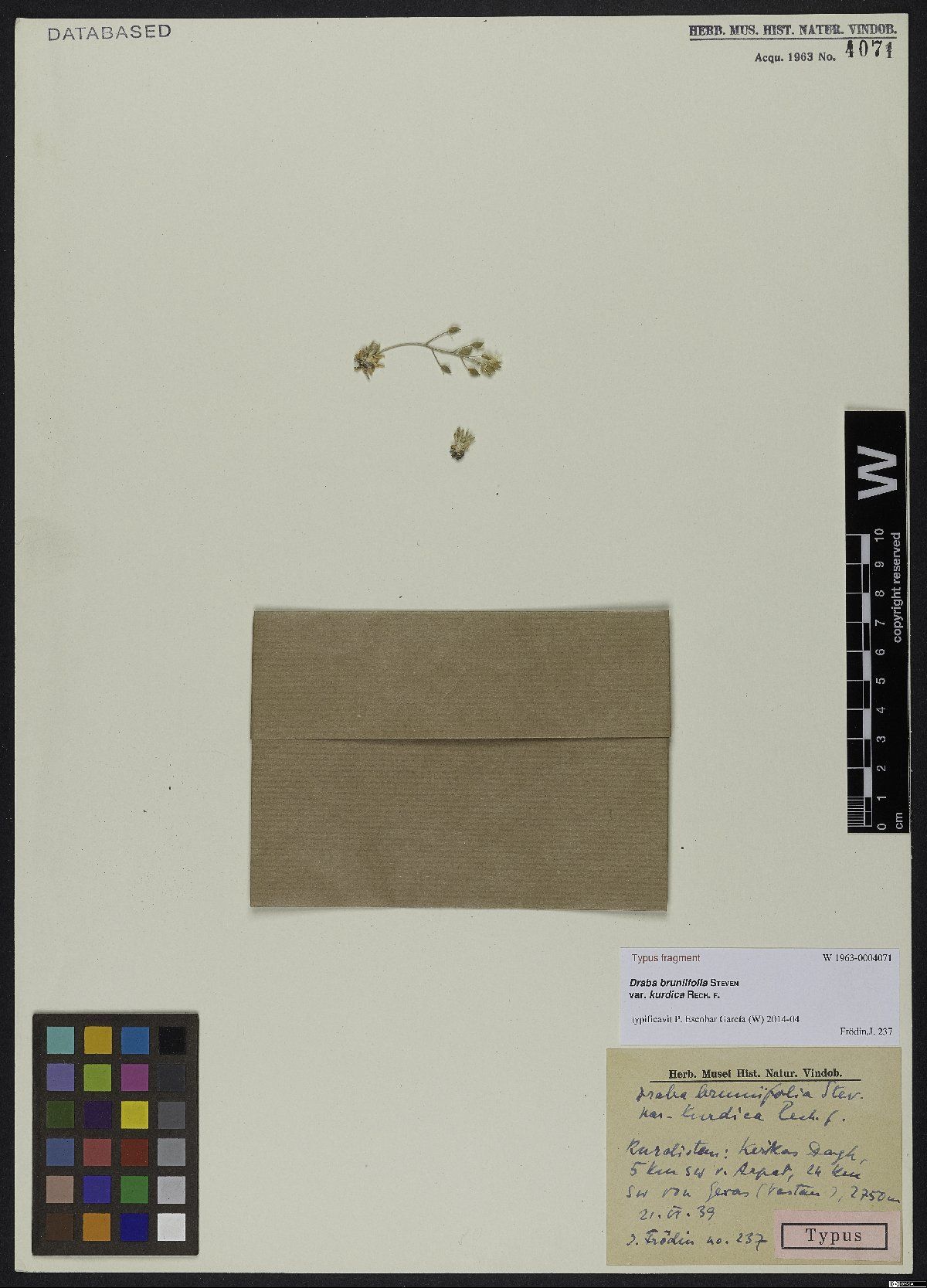
Someone wrote on it "Draba bruniifolia Stev. var. kurdica Rech. f.", a name credited to the Vienna botanist Karl Heinz Rechinger (1906–1998)[10][6], and a printed label of 2014 marks the sheet as its type[10], which suggests Rechinger may have published the variety. We could not find where: the International Plant Names Index records no such variety, only Cullen and Coode's subspecies of 1965[6]. The name kurdica in use today is theirs[6][8].
Where it grows
Kew's checklist gives the species a range from Turkey to the Caucasus and north-western Iran, with records listed for Turkey, Iraq, Iran, Syria and Lebanon, the Caucasus and the East Aegean islands[8]. Across Kurdistan, the sheets and photographs we found all come from the high mountains:
- Bakur: Artos and Kerikas Dagh in Westan (Gevaş)[5][5][10], Çiyayê Agirî[7][4], and the rocks near Gever (Yüksekova) in Colemêrg (Hakkâri), where it was photographed in full flower in July 2024[2].
- Başûr: on 29 August 1957 Ali al-Rawi of the National Herbarium of Iraq and a colleague named Serhang collected it at about 3,000 m on "black & brown stones" at the top of a border range, on what the label calls the "Iraqi-Persian border"[11].
- Rojhilat: near Ûrmiye (Urmia), on Kuhe Shahidan above the village of Darband, at 3,450 m, in 2016[10].
Every herbarium record we found from Kurdistan lies at 2,750 m or higher, on summit ridges, scree and stony ground[4][5][10][11][10].
How to recognise it
Draba bruniifolia is a low, woody-based perennial, classed as a subshrub[8]. Look for[1][4][5][2]:
- dense cushions or mats of small rosettes, grey-green with hairs;
- narrow, stiff leaves, keeled underneath, fringed with hairs and tipped with a small brush of hairs;
- leafless flowering stalks carrying a tight cluster of showy yellow flowers;
- small, oval, slightly inflated pods, covered in hairs.
In subsp. kurdica the flowering stalk is hairless, and the pods carry only short, curly hairs[4].
A Kurdish name?
We have not found a Kurdish name for Draba bruniifolia in any source we checked. The 1957 label from the National Herbarium of Iraq even has a printed line for the "Colloquial Name", but it holds only a Latin note, the subspecies name[11]. And Ehmedê Dirihî's dictionary of Kurdish plant names lists Draba bruniifolia subsp. kurdica in its Latin index, with the Kurdish column left empty and only a Turkish name beside it, artos dolaması[12]. If you know what this yellow cushion of the summits is called in your valley, Flora Kurdica would like to hear from you.
Sources
- 1.Steven, C. (1812). Catalogue des plantes rares ou nouvelles observées pendant un voyage autour du Caucase oriental. Mémoires de la Société impériale des naturalistes de Moscou 3: 244–270.
- 2.abciNaturalist. observation 392802551 (Zogador, 2024). inaturalist.orghttps://www.inaturalist.org/
- 3.abJordon-Thaden, I. E., Al-Shehbaz, I. A. & Koch, M. A. (2013). Species richness of the globally distributed, arctic–alpine genus Draba L. (Brassicaceae). Alpine Botany 123: 97–106. doi:10.1007/s00035-013-0120-9https://doi.org/10.1007/s00035-013-0120-9
- 4.Davis, P. H., Cullen, J., Coode, M. J. E. & Hedge, I. C. (1965). Materials for a Flora of Turkey: X. Notes from the Royal Botanic Garden Edinburgh 26(2): 165–201 (Draba by J. Cullen & M. J. E. Coode, pp. 185–188).
- 5.Royal Botanic Garden Edinburgh Herbarium (E), specimen catalogue (via data.rbge.org.uk and GBIF).
- 6.International Plant Names Index. Royal Botanic Gardens, Kew, Harvard University Herbaria and Australian National Herbarium.
- 7.Boissier, E. (1867). Flora Orientalis, vol. 1. Basel & Geneva: H. Georg. archive.orghttps://archive.org/details/floraorientaliss01bois
- 8.Plants of the World Online. Royal Botanic Gardens, Kew.
- abcdDraba bruniifolia.
- plant_name_id 2776369. powo.science.kew.orghttps://powo.science.kew.org/taxon/urn:lsid:ipni.org:names:282439-1accessed 14 November 2026
- 9.↩Natural History Museum, London, herbarium specimen BM000583405 (isotype, via GBIF).
- 10.Natural History Museum Vienna (W) – Herbarium. via GBIF.
- 11.abcRoyal Botanic Gardens, Kew – Herbarium Specimens. via GBIF, herbarium specimen K005866950 (National Herbarium of Iraq no. 24601, via GBIF). gbif.orghttps://www.gbif.org/dataset/cd6e21c8-9e8a-493a-8a76-fbf7862069e5
- 12.↩Ahmet Kasımoğlu (Ehmedê Dirihî) (2013). Ferhenga Navên Nebatan a Kurdî (Dictionary of Kurdish Plant Names). Mardin Artuklu University, Institute of Living Languages in Turkey (ISBN 978-605-4202-12-6), p. 1099.
Last updated 20 November 2026