Echinops kurdicus is one of the most elusive plants named after the Kurds. It belongs to Echinops, a genus of tall, spiny, thistle-like plants of the daisy family whose small flower heads are packed together into a ball[1][2]. It was named in 1863 in three lines of Latin, with no place, no collector and no specimen mentioned[1]. No photograph of the living plant has been published that we could find[3], and twelve years later a second, different Echinops from the mountains near Sine (Sanandaj) in East Kurdistan (Rojhilat) was given exactly the same name[2]. This page follows both plants.
How it got its name
- Named by
- Bunge, 1863Published in Bull. Acad. Imp. Sci. Saint-Pétersbourg , sér. 3, 6: 408
Three lines in a letter
In April 1863 the botanist Alexander von Bunge (1803–1890)[4] sat down in Dorpat (today Tartu) to write a long open letter to his friend and colleague E. Regel, director of the imperial botanical garden in St Petersburg[1]. He had come back from a journey through Persia with what he called a "comparatively large number" of new Echinops species, and this had led him to look at the whole genus again[1].
He was unusually modest about the result. He called his survey a "most deficient sketch", admitted that "errors in no small number" had probably crept in, and published it only in the hope that readers would write and tell him where he had gone wrong. Even a single, fully developed flower head of a species he did not know, he added in a footnote, could easily be sent in a letter[1] (our translation).
Echinops kurdicus appears in this letter only as the last line of the key to one section of the genus, the step-by-step choices botanists use to tell species apart[1]:
Caulis pube araneosa nulla, dense glanduloso-hispidulus, folia supra dense glandul. 37. E. kurdicus m.
Stem without cobweb-like hairs, densely covered in short glandular bristles; leaves densely glandular on the upper side. 37. E. kurdicus, mine [i.e. a new species of Bunge's own].[1] (our translation)
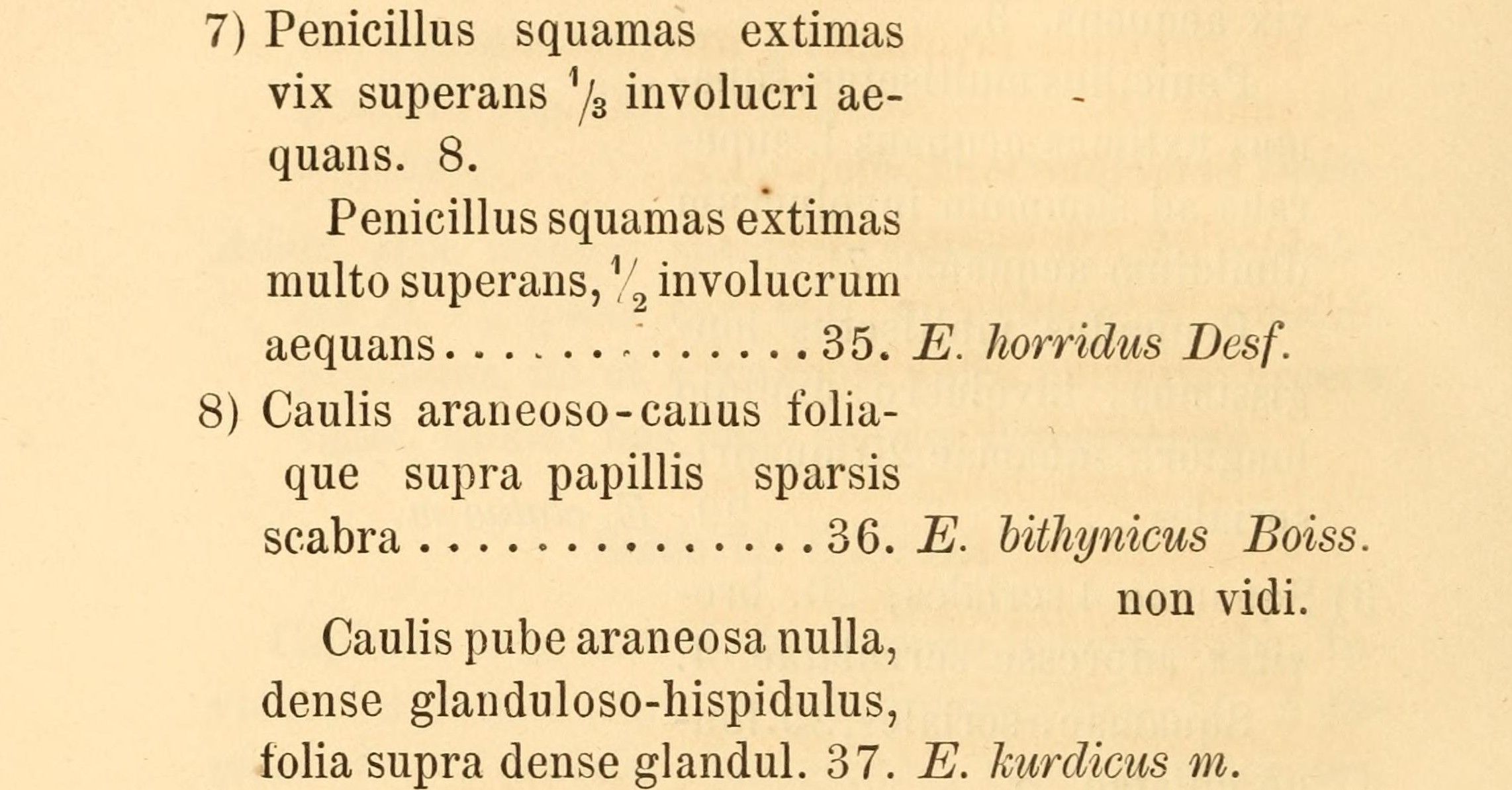
That is all. Its nearest neighbour in the key, E. bithynicus, is marked non vidi, "I have not seen it"[1], but for his own new species Bunge gave no place at all. The name database IPNI records only "Persia" for it[4].
What the three lines tell us
Read together with the rest of Bunge's key, the description still says something about the plant. Echinops kurdicus belongs to the group Bunge called Rytrodes: plants whose involucre, the cup of scales around each tiny flower head, has some 20 to 25 spiny scales, the five innermost papery and fused together. In this group, Bunge wrote, the flower balls are mostly a bright blue[1]. Within it, the Kurdish plant is the one whose tuft of bristles at the base of each head barely reaches past the outermost scales, about a third of the way up the involucre[1], and whose stem has no cobwebby wool, only a dense coat of short, sticky, glandular bristles[1].
Kew's checklist adds that it is a perennial of the temperate zone[5].
The other Echinops kurdicus
In the summer of 1867 the botanist Heinrich Haussknecht (1838–1903)[4] was travelling through Kurdistan, collecting on Pîremegrûn (Pir Omar Gudrun) in June[6]. In the mountains between a place he wrote down as "Awiheng" and Sihna, the town Kurds call Sine (Sanandaj), he collected a huge Echinops at about 8,000 feet[2][6].
The botanist Edmond Boissier (1810–1885)[4] published it in 1875 in the third volume of his Flora Orientalis as Echinops kurdicus[2]. It was a giant: stems 3 to 4 feet tall, thick and grey with wool, and basal leaves a foot long, cut into large segments with "the look of a Heracleum", the hogweeds[2].
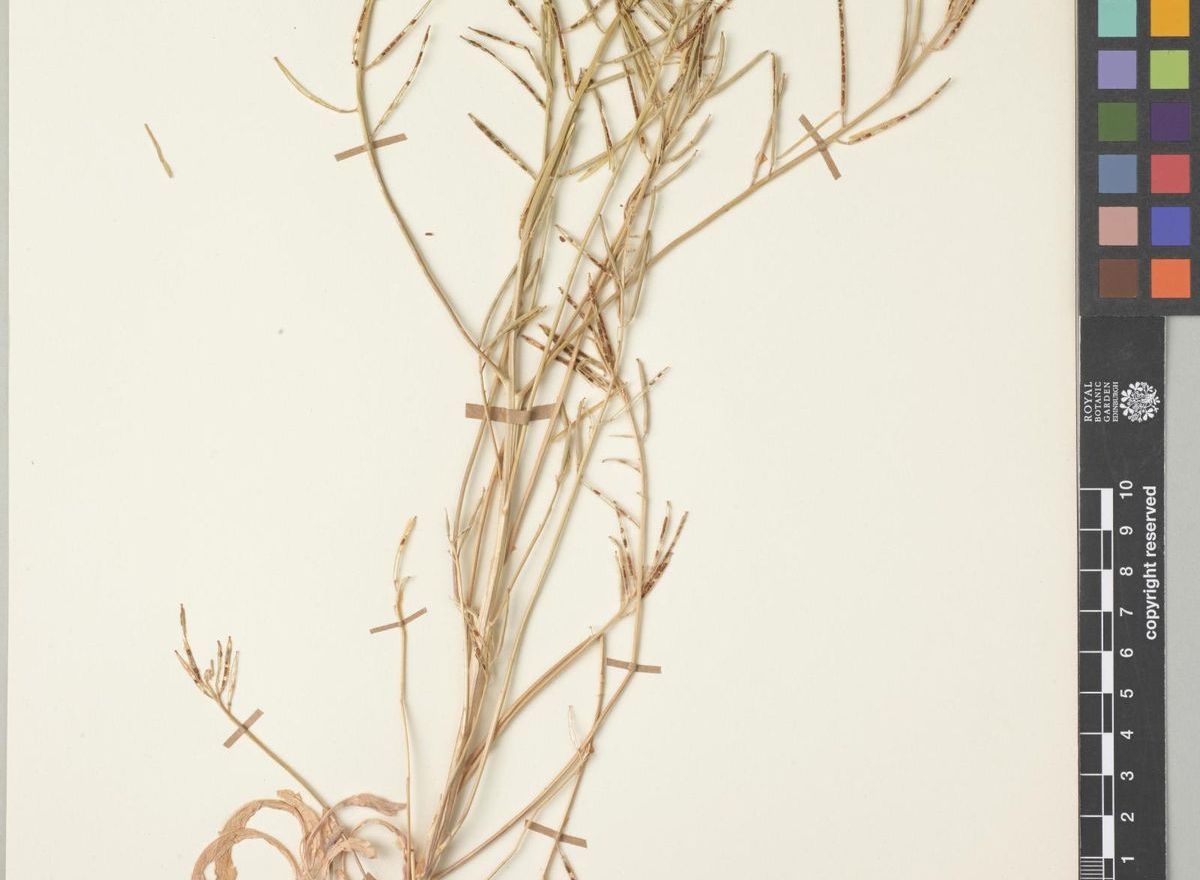
The specimens are still in Geneva and Jena[6][7]. On one of the Jena sheets, Haussknecht used a label printed for another stop on his journey, Pir Omar Gudrun, in June; the printed place and month are struck through, and the real locality is written in by hand: in montib. inter Awiheng et Sihna, "in the mountains between Awiheng and Sihna"[6]. A slip above it shows that Karl Heinz Rechinger (1906–1998)[4] looked at the sheet in 1973 while revising the genus for Flora Iranica[6].
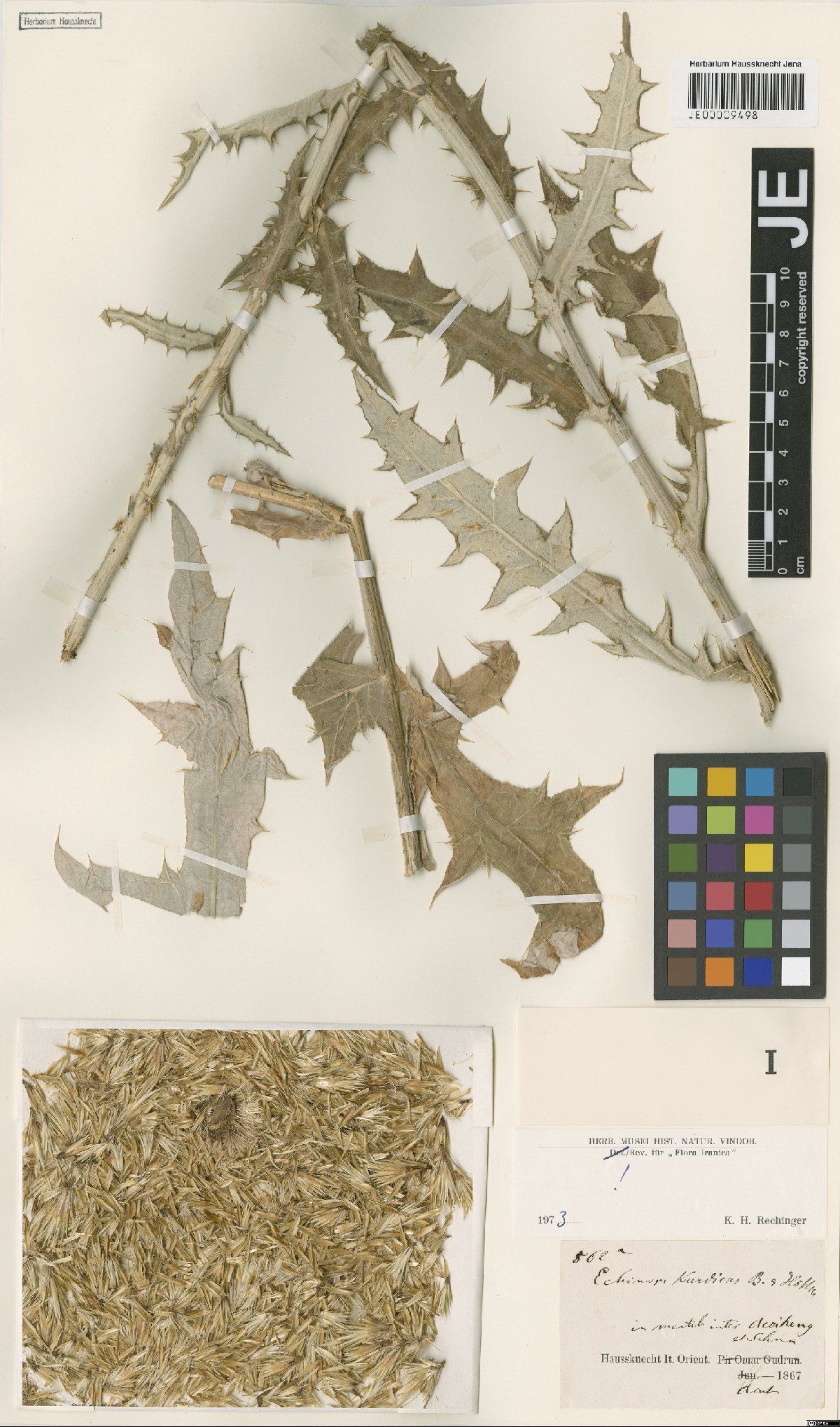
Two plants, one name
Boissier did not mention Bunge's plant anywhere in his account of the genus[2], although he cited Bunge's letter for many other species[2]. Under the rules of botanical naming, the same name cannot be used for two different species of one genus, and the first to be published wins. Bunge's E. kurdicus of 1863 came first, so Boissier's E. kurdicus of 1875 was a "later homonym" and could not stand[8].
Were they perhaps one and the same plant? The IPNI record of Boissier's name carries the query "(=kurdicus, Bunge ?)"[4]. On paper they do not match well: Bunge's key separates his plant by a stem without cobwebby wool[1], while Boissier describes his as grey-woolly[2]. Boissier even filed his plant in a different section of the genus: one whose innermost involucral scales are free from each other[2], whereas in Bunge's group the five innermost scales are fused[1]. And that was the one character, Boissier wrote, that seemed reliable to him[2].
In 2018 the botanist Kazem Negaresh settled the naming: Boissier's name was illegitimate, and he gave Haussknecht's plant a new one, Echinops rahiminejadii, in honour of the Iranian botanist Mohammad Reza Rahiminejad[8]. By renaming it, rather than sinking it under Bunge's name, he treated it as a species of its own, and Kew's checklist does the same, with Boissier's E. kurdicus as its synonym[8][5]. So the giant from the mountains near Sine is no longer called "Kurdish", and the only Echinops kurdicus left is Bunge's plant, for which no locality was ever published.
Where does it grow?
Kew's checklist gives its native range as "NW. Iran"[5], a region that takes in Rojhilat but also Iranian Azerbaijan. Beyond that, the trail is thin:
- No photographs. iNaturalist has no observations of it[3], and we found no published photograph of the living plant.
- Four herbarium sheets are filed under Bunge's name in GBIF[9][10]. Two, at Lund, were collected by Paul Sintenis (1847–1907)[4] near Mêrdîn (Mardin) in North Kurdistan (Bakur) on 25 June 1888[9]. But the Jena sheets of a Sintenis gathering from Mêrdîn on that same day, "Kurdistania, Mardin, in declivib. saxosis" (on rocky slopes), carry Boissier's name, not Bunge's[6]. The two homonyms seem to have been mixed up somewhere along the way, and no one we know of has checked which plant these are. The other two sheets, at Montpellier, have no label data online[10].
- Not in the modern survey. A 2006 survey of the genus in Iran, with keys to some 70 species, does not mention E. kurdicus under either author, as far as we could read it[11].
Part of the reason may be the plants themselves. Boissier called Echinops "a genus very difficult in distinguishing its species, and a torment for botanists"[2] (our translation), and the 2006 survey still calls it "one of the most problematic genera of the Iranian flora", adding that "usually most botanists avoid to collect such very spiny and tall-growing plants"[11]. A plant named from three lines, in a genus that collectors avoid, may be hiding in plain sight in herbaria under another name, or under its own.
The species has not been assessed for the IUCN Red List[12].
Names in Kurdish
No Kurdish name for Echinops kurdicus has been recorded from people who know the plant. Ehmedê Dirihî's dictionary of Kurdish plant names lists four dictionary names for it: gagozê kurdan, gotelê kurdan, hergotê kurdan and şekirokê kurdan[13]. The dictionary gives no author for the Latin name, so it does not say which of the two Echinops kurdicus it means. For the genus as a whole, the plant list Flora Kurdistanê, drawn up by the Kurmancî working group of the Kurdish Institute of Paris, gives three Kurmanji names against "Echinops spp": serteşîk, şekirok and teşîlok[14]. These are names for the genus, not specifically for this species. In the Lilakh region of Rojhilat, a 2025 survey recorded a related species, E. orientalis, under the name /kærtæʃi/ (as the authors transcribe it); students there named its seeds and spines as a remedy for colds[15].
Sources
- 1.Bunge, A. (1863). Über die Gattung Echinops. Bulletin de l'Académie Impériale des Sciences de Saint-Pétersbourg, sér. 3, 6: 390–412; reprinted in Mélanges biologiques 4: 361–392 (cited pages 361–362, 384, 386).
- aimp. 384. archive.orghttps://archive.org/details/mlangesbiologi4186165impe/page/n421/mode/1up
- bfghjklp. 386. archive.orghttps://archive.org/details/mlangesbiologi4186165impe/page/n421/mode/1up
- cepp. 361–362. archive.orghttps://archive.org/details/mlangesbiologi4186165impe/page/n421/mode/1up
- dp. 362. archive.orghttps://archive.org/details/mlangesbiologi4186165impe/page/n421/mode/1up
- 2.Boissier, E. (1875). Flora Orientalis, vol. 3. Geneva & Basel.
- ajk3: 424–438; p. 424. archive.orghttps://archive.org/details/floraorientaliss03bois
- bcdh3: 424–438; p. 437. archive.orghttps://archive.org/details/floraorientaliss03bois
- e3: 424–438; pp. 437–438. archive.orghttps://archive.org/details/floraorientaliss03bois
- fg3: 424–438. archive.orghttps://archive.org/details/floraorientaliss03bois
- i3: 424–438; p. 425. archive.orghttps://archive.org/details/floraorientaliss03bois
- 3.abiNaturalist. Echinops kurdicus (taxon 926385), accessed 15 November 2026.. inaturalist.orghttps://www.inaturalist.org/taxa/926385
- 4.International Plant Names Index. Royal Botanic Gardens, Kew, Harvard University Herbaria and Australian National Herbarium.
- acdegauthor records for Bunge, Boissier, Haussknecht, Sintenis and K. H. Rechinger.. ipni.orghttps://www.ipni.org
- bEchinops kurdicus Bunge.. ipni.orghttps://www.ipni.org/n/202555-1
- fEchinops kurdicus Boiss. & Hausskn. ex Boiss.. ipni.orghttps://www.ipni.org/n/202556-1
- urn:lsid:ipni.org:names:202555-1. ipni.orghttps://www.ipni.org/n/202555-1accessed 14 November 2026
- 5.Plants of the World Online. Royal Botanic Gardens, Kew.
- acEchinops kurdicus Bunge.. powo.science.kew.orghttps://powo.science.kew.org/taxon/urn:lsid:ipni.org:names:202555-1
- bWorld Checklist of Vascular Plants (Royal Botanic Gardens, Kew): Echinops rahiminejadii Negaresh, via GBIF.. gbif.orghttps://www.gbif.org/species/231083306
- plant_name_id 3040448. powo.science.kew.orghttps://powo.science.kew.org/taxon/urn:lsid:ipni.org:names:202555-1accessed 14 November 2026
- 6.Herbarium Haussknecht, Jena (JE), specimen records (JACQ) via GBIF.
- aJena: JE 00015909 (Haussknecht 413, Pir Omar Gudrun, 1867), via GBIF.. gbif.orghttps://www.gbif.org/occurrence/3028979894
- bcdeJena: JE 00009498 and JE 00009497 (Haussknecht 562 a, 1867), via GBIF.. gbif.orghttps://www.gbif.org/occurrence/3029003910
- fJena: JE 00030703 and JE 00030704 (Sintenis 1150, Mardin, 1888), via GBIF.. gbif.orghttps://www.gbif.org/occurrence/6177631955
- 7.↩Conservatoire et Jardin botaniques de Genève (G) – Herbarium. via GBIF, Haussknecht 562a), via GBIF.. gbif.orghttps://www.gbif.org/occurrence/5295106435
- 8.abcNegaresh, K. (2018). A new name in Echinops (Asteraceae) from Flora of Iran. Taxonomy and Biosystematics 10(34): 1–6. tbj.ui.ac.irhttps://tbj.ui.ac.ir/article_23491.html?lang=en
- 9.abBiological Museum, Lund University: LD 2060655 and LD 2051647 (Sintenis, Mardin, 1888), via GBIF. gbif.orghttps://www.gbif.org/occurrence/5839424476
- 10.abHerbarium of the University of Montpellier: MPU105949 and MPU105950, via GBIF. gbif.orghttps://www.gbif.org/occurrence/1424862119
- 11.Mozaffarian, V. (2006). A taxonomic survey of Echinops L. tribe Echinopeae (Asteraceae) in Iran: 14 new species and diagnostic keys. Iranian Journal of Botany 11(2): 197–239.
- 12.↩GBIF.org GBIF Backbone Taxonomy and occurrence records. IUCN Red List category for Echinops kurdicus (Not Evaluated).. api.gbif.orghttps://api.gbif.org/v1/species/7787009/iucnRedListCategory
- 13.↩Ahmet Kasımoğlu (Ehmedê Dirihî) (2013). Ferhenga Navên Nebatan a Kurdî (Dictionary of Kurdish Plant Names). Mardin Artuklu University, Institute of Living Languages in Turkey (ISBN 978-605-4202-12-6), pp. 239, 305, 385, 736.
- 14.↩Ehmedê Dirihî (2007). Flora Kurdistanê (II). institutkurde.orghttps://www.institutkurde.org/publications/kurmanci/
- 15.↩Adel Mohammadi, Zhina Bagheri (2025). Ethnobotanical study focused on students' awareness of medicinal plants in the Lilakh region, Kurdistan (in Persian). p. 9. doi:10.22091/ethc.2025.12812.1056https://doi.org/10.22091/ethc.2025.12812.1056
Last updated 20 November 2026