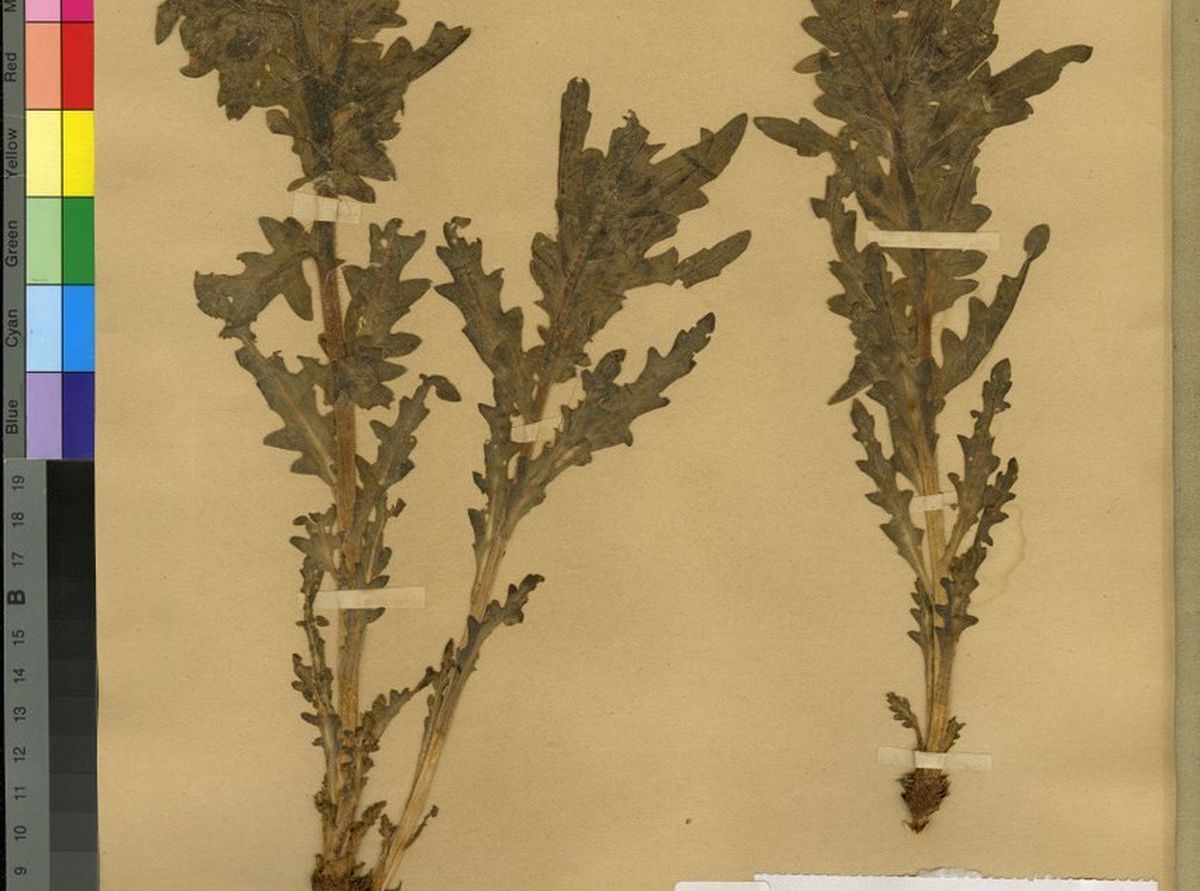
Hyoscyamus kurdicus is a small mountain henbane, first found high on Helgurd above Rewandiz (Rawanduz) in South Kurdistan (Başûr), between 2,700 and 3,100 metres[1]. It is a perennial that grows from a firm, woody rootstock, and its stems barely reach a foot in height[1]. The name kurdicus means "Kurdish": the plant is named after the land where it was discovered.
How it got its name
- Named by
- Bornm., 1898Published in Verh. K. K. Zool.-Bot. Ges. Wien 48: 611
Where it grows in Kurdistan
At 2700–3100 m above sea level.
A Kurdish henbane in a book about Palestine
The botanist Joseph Bornmüller (1862–1948)[2] spent the spring and early summer of 1893 in the mountains of Kurdistan, from early May to early July[3]. On 26 June he was on Helgurd, close to the Persian frontier, and among the plants he pressed that day was a henbane he could not match with any known species[1][4].
He did not publish it for five years, and when he did, it was in an unexpected place. In 1898 he wrote up the plants of a trip through Palestine and Syria[1]. In the middle of that list, in the section on the nightshade family, he slipped in a note in square brackets about a plant from somewhere else entirely[1]:
Eine von mir in den östlich von Mossul gelegenen Grenzgebirgen entdeckte, noch unbeschriebene perennirende Art dieser Gattung, der hochalpine H. Kurdicus Bornm. …, dürfte auch in den Bergen von Mardin oder Nord-Syrien zu Hause sein.
A still undescribed perennial species of this genus, which I discovered in the border mountains east of Mosul, the high-alpine H. kurdicus Bornm. …, may well also be at home in the mountains of Mardin or northern Syria.[1] (our translation)
The note gives a short list of how the plant differs from its relatives and promises that "a detailed diagnosis will be published elsewhere"[1]. Those few lines were enough: the international index of plant names treats this note as the place where Hyoscyamus kurdicus was published[2]. That index still carries the remark "Syria" for the name[2], probably because the note sits in a paper on Syria and Palestine, although the plant came from Helgurd.
Up the mountain from Rewandiz
Years later Bornmüller told the story of that journey[3]. From Baghdad he travelled north through Kerkûk (Kirkuk) to Hewlêr (Erbil). At the beginning of May he turned east "into the Kurdish mountains" and made his base in the village of Şeqlawe (Shaqlawa), on the slopes of Mount Sefîn. Later in the season he moved on to "the little Kurdish town of Riwandus", from where he climbed Helgurd and Sakri-Sakran, the ranges of the Zagros right on the Persian border, and found "a great variety of high-mountain flora"[3] (our translation). By early July he had to leave again, back to Hewlêr and on to Mosul[3].
It was a rich day. On the same 26 June, at the same height, beside the melting snow of Helgurd, Bornmüller also collected the plant he later named Merendera kurdica, known today as Colchicum kurdicum[5]. Two plants named after the Kurds came down the mountain in one botanist's press.
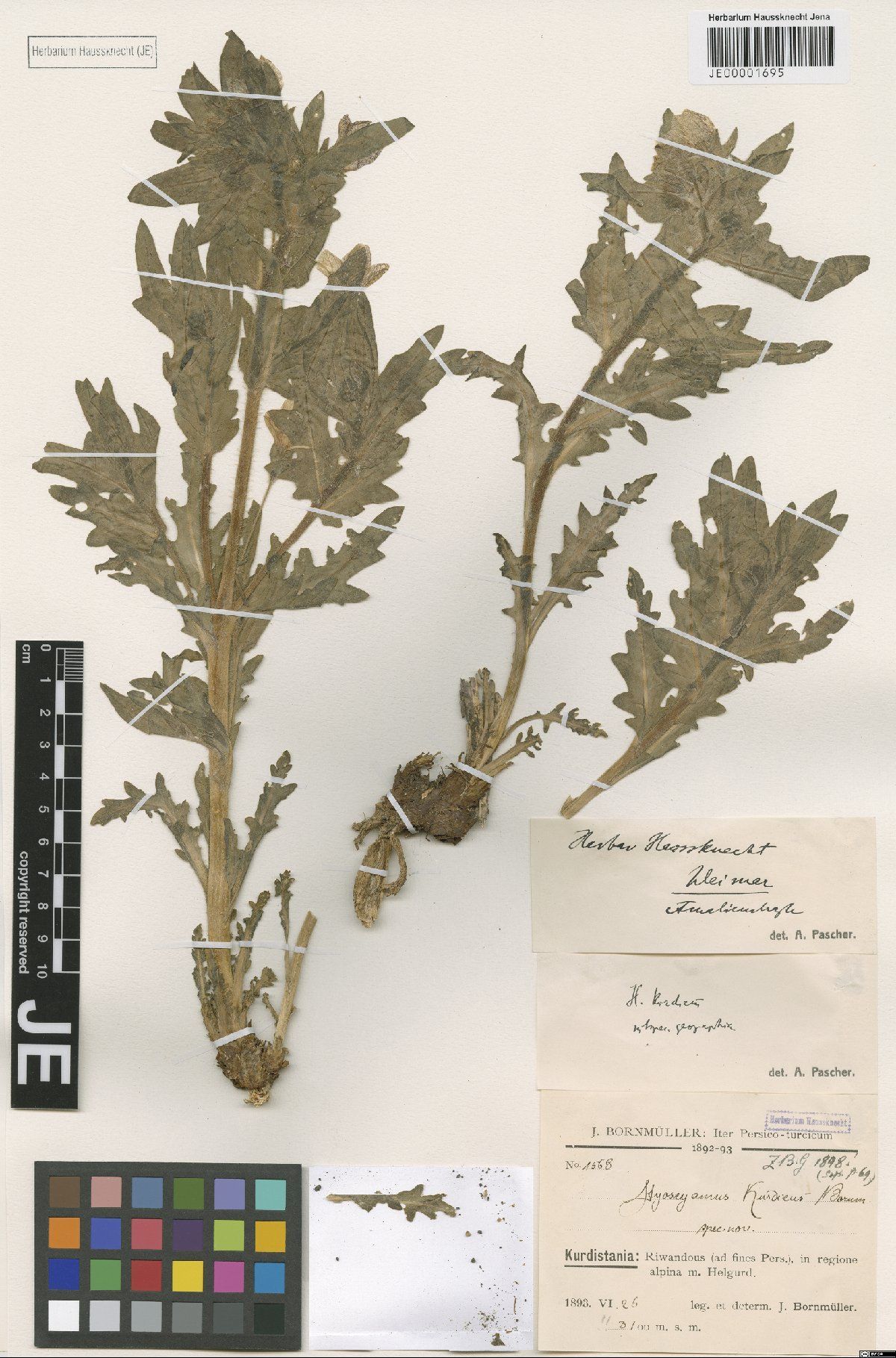
Duplicates of his henbane went to herbaria in Jena and Paris; the Paris sheet is stamped as received on 30 January 1895[4][6]. The Jena sheet carries two slips by the botanist Adolf Pascher of Prague, who, Bornmüller wrote in 1911, was preparing a monograph of the henbanes[4][7].
What to look for
Bornmüller set his plant beside Hyoscyamus reticulatus, a henbane named by Linnaeus that grows from the eastern Mediterranean to Central Asia and Iran and lives only one or two years[1][2][8]. H. kurdicus, he wrote, differs in[1]:
- Root: a firm, woody rootstock; it is a perennial.
- Stems: low, "hardly a foot high", densely scaled at the base with the brown remains of last year's leaves.
- Leaves: more deeply cut and more hairy.
- Flower stalks: slender, twice as long as the calyx.
- Calyx: smaller, its lobes not ending in a spiny point.
- Flowers: smaller corollas, without the coloured network of veins that gives H. reticulatus its name.
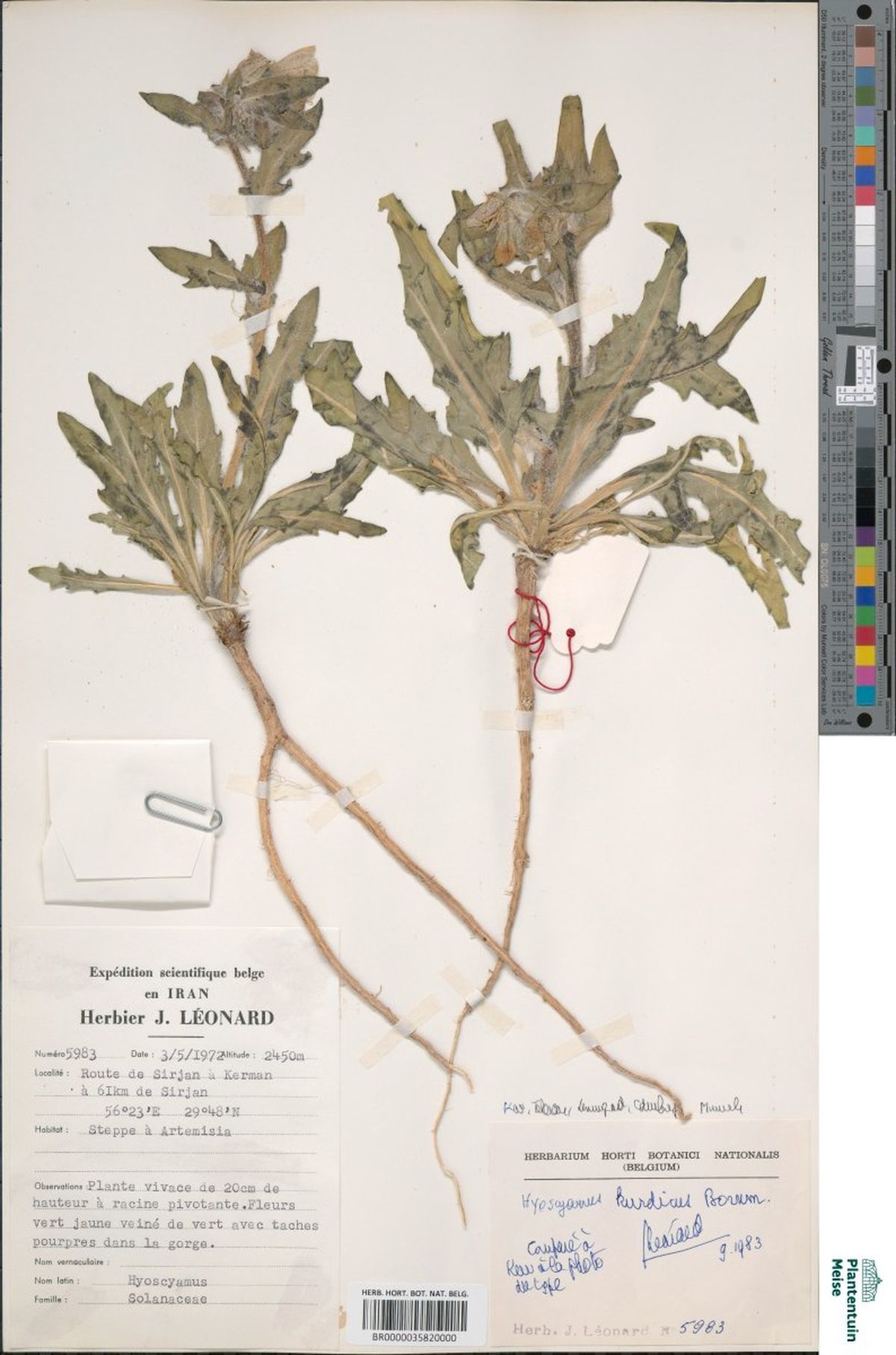
The pressed plants show the woody crowns and the toothed, grey-green leaves well[4][6]. A collector in southern Iran in May 1972 described a plant of 20 cm with a taproot, and flowers "greenish yellow, veined with green, with purple spots in the throat"[9] (our translation). In a key to the henbanes of Iran, H. kurdicus is the one with a single stem and oblong-ovate or lance-shaped leaves[10].
One henbane, or several?
Henbanes are hard to sort, and this one has been questioned more than once. In 1995 the botanist An-ming Lu[2], who also worked on the classification of the henbanes[2], looked at the Paris sheet and wrote on it: "Hyoscyamus kurdicus Bornm. ? = H. reticulatus L."[6]. With a question mark, he wondered whether Bornmüller's plant was simply a form of the very species it had been set apart from.
Others have gone the other way and made the species larger. In 1972, for the Flora Iranica, Eva Schönbeck-Temesy[2] described H. pojarkovae[2], and in 1996 the botanists Ahmad Ghahreman and Mahboubeh Khatamsaz treated it as the same plant as H. kurdicus[10]. Kew's checklist of the world's plants still keeps the two apart and accepts both[8]. For now Hyoscyamus kurdicus stands as an accepted species, with no synonyms in that checklist[8].
The henbanes of Kurdistan have one more surprise. A tiny relative that the collector Paul Sintenis (1847–1907)[2] found in 1888 "in Kurdistan, or rather in northern Mesopotamia", forms small, dense cushions hanging from rock faces, "showered with golden-yellow flowers"[7] (our translation). It was first named Hyoscyamus leptocalyx[2]. In 1997 An-ming Lu thought it different enough to give it a genus of its own, Archihyoscyamus[2].
Where it grows
Kew's checklist gives its range as northern Iraq to Iran[8]. In Kurdish terms that means Başûr, where it was discovered, and Rojhilat, where a population from Kurdistan province was used for a study of henbane chromosomes[11]. Further east and south, plants identified as H. kurdicus have been gathered:
- on the Alamut road between Tehran and Qazvin, at 2,300 m (May 2006)[12];
- in the Haraz valley in Mazandaran, at about 1,800 m (May 1959), named as H. kurdicus by Schönbeck-Temesy in 1970 for the Flora Iranica[13];
- on Artemisia steppe between Sirjan and Kerman, at 2,450 m (May 1972)[9].
Helgurd itself rises to about 3,613 metres[14], and Bornmüller's plant grew in its alpine zone, at 2,700 to 3,100 metres[1]. His guess that it would also turn up in the mountains of Mêrdîn (Mardin) in North Kurdistan (Bakur) is still only a guess: none of the sources we read records it there. On his way home that August, his own route ran through Cizîr (Cizre), Nisêbîn (Nusaybin) and Riha (Urfa)[3], but it was high summer by then, and the list of his journey has hardly anything from that stretch[3].
Strong chemistry
Henbanes are rich in the alkaloids hyoscyamine and scopolamine, substances that medicine uses to relax cramped muscles, widen the pupil, ease pain and calm[12]. A study of four Iranian henbanes found scopolamine to be the main alkaloid in H. kurdicus, with the most of it in the leaves[12].
These are laboratory findings, not medical advice. Do not use wild henbanes yourself.
Kurdish names
No Kurdish name for this henbane with a place or a speaker attached has been found yet. Ehmedê Dirihî's dictionary of Kurdish plant names lists two dictionary names whose wording mirrors the Latin kurdicus: bengê kurdan and xerbengî kurdan[15]. It credits xerbengî kurdan to a source it abbreviates KMP, "Kurdistan Medical Plant"[15].
The same dictionary gives benc, beng, kelbeşik and xerbeng for the henbanes as a whole[15], and herebeng and kerkuj for H. reticulatus, the relative Bornmüller compared it with[15]. For the black henbane, H. niger, it lists xerebeng, benc, beng, giyabeng and others[15], and Edîb Polat's plant list of 2006 gives giyabeng and xirebenk[16]. These are names for other henbanes, and they still need checking; they are not names for this species.
Sources
- 1.Bornmüller, J. (1898). Ein Beitrag zur Kenntniss der Flora von Syrien und Palästina. Verhandlungen der k. k. zoologisch-botanischen Gesellschaft in Wien 48: 544–653.
- 2.International Plant Names Index. Royal Botanic Gardens, Kew, Harvard University Herbaria and Australian National Herbarium.
- 3.Bornmüller, J. (1911). Iter Persico-turcicum 1892–1893. Beihefte zum Botanischen Centralblatt 28(2): 148–149.
- 4.abcdHerbarium Haussknecht, Jena (JE), specimen records (JACQ) via GBIF. Jena, specimen JE 00001695 (isotype; via GBIF). api.gbif.orghttps://api.gbif.org/v1/occurrence/3028980654
- 5.↩Bornmüller, J. (1899). Eine neue Colchicacee Assyriens. Merendera Kurdica Bornm. (sp. nov.). Bulletin de l'Herbier Boissier 7: 79-80. archive.orghttps://archive.org/details/bulletindelherbi07herb
- 6.abcMuséum national d'Histoire naturelle, Paris, specimen P00058233 (isotype; via GBIF).
- 7.abBornmüller, J. (1911). Collectiones Straussianae novae. Beihefte zum Botanischen Centralblatt 28(2), p. 474. archive.orghttps://archive.org/details/beiheftezumbotan2821unse
- 8.Plants of the World Online. Royal Botanic Gardens, Kew.
- abcdHyoscyamus kurdicus, H. reticulatus, H. pojarkovae.
- plant_name_id 2857427. powo.science.kew.orghttps://powo.science.kew.org/taxon/urn:lsid:ipni.org:names:815918-1accessed 14 November 2026
- 9.abMeise Botanic Garden, specimen BR0000035820000 (J. Léonard 5983; via GBIF).
- 10.Ghahreman, A. & Khatamsaz, M. (1996). The genus Hyoscyamus L. (Solanaceae) in Iran. Iranian Journal of Botany 7(1): 31–37.
- 11.↩Sheidai, M., Mosallanejad, M. & Khatamsaz, M. (1999). Karyological studies in Hyoscyamus species of Iran. Nordic Journal of Botany 19(3): 369–373 (via the Iranian Flora Chromosome Index).
- 12.abcBahmanzadegan, A., Sefidkon, F. & Sonboli, A. (2009). Determination of hyoscyamine and scopolamine in four Hyoscyamus species from Iran. Iranian Journal of Pharmaceutical Research 8(1): 65–70.
- 13.↩University Museum of Bergen, specimen BG 2093031 (P. Wendelbo 714; via GBIF).
- 14.↩Nature Iraq (2009). Halgurd Mountain (IQ017). In: Key Biodiversity Areas of Iraq..
- 15.Ahmet Kasımoğlu (Ehmedê Dirihî) (2013). Ferhenga Navên Nebatan a Kurdî (Dictionary of Kurdish Plant Names). Mardin Artuklu University, Institute of Living Languages in Turkey (ISBN 978-605-4202-12-6).
- 16.↩Edîb Polat (2006). Flora Kurdistanê (I). institutkurde.orghttps://www.institutkurde.org/publications/kurmanci/
- Bornmüller, J. (1898). [Contribution on the flora of Syria and Palestine.]. Verhandlungen der k.k. Zoologisch-Botanischen Gesellschaft in Wien 48 (Hyoscyamus kurdicus on p. 611), vol. 48, p. 611. archive.orghttps://archive.org/details/verhandlungender48zool/page/n632/mode/1upaccessed 14 November 2026
- GBIF.org GBIF Backbone Taxonomy and occurrence records.
- occurrence 3028977989 (JE 00001695, Isotype). api.gbif.orghttps://api.gbif.org/v1/occurrence/3028977989accessed 14 November 2026
- occurrence 438530798 (P00058233, Isotype). api.gbif.orghttps://api.gbif.org/v1/occurrence/438530798accessed 14 November 2026
Last updated 20 November 2026