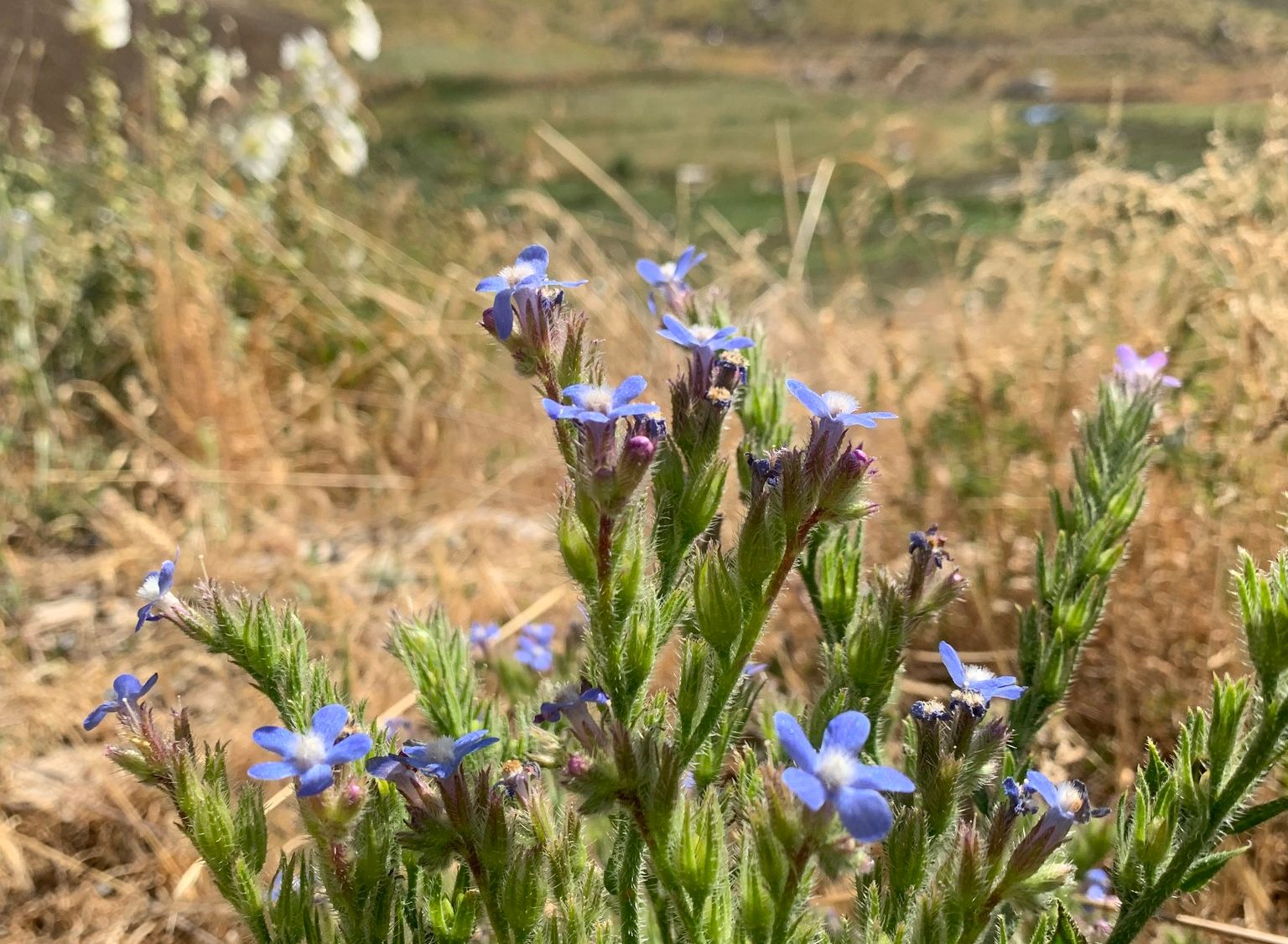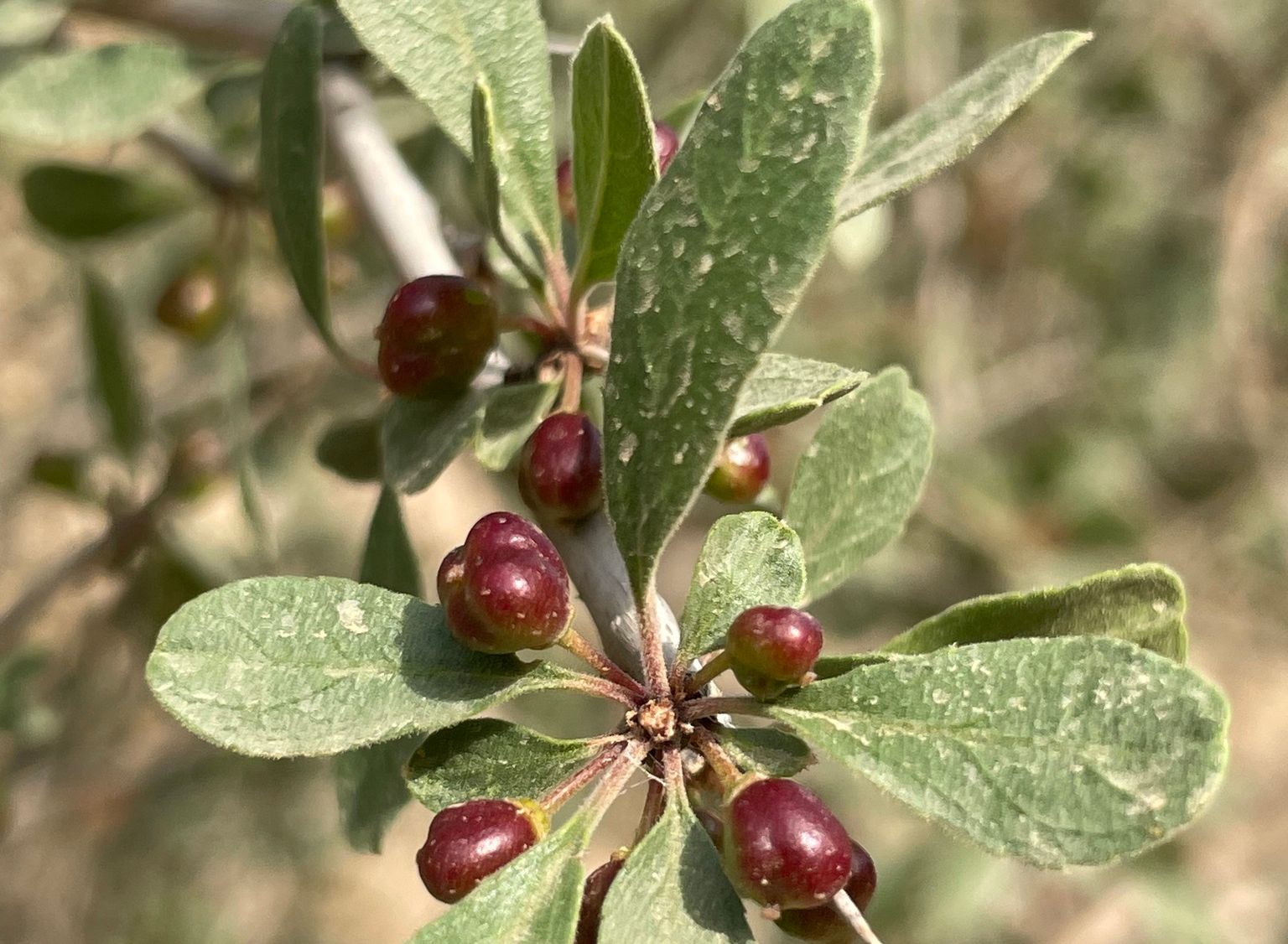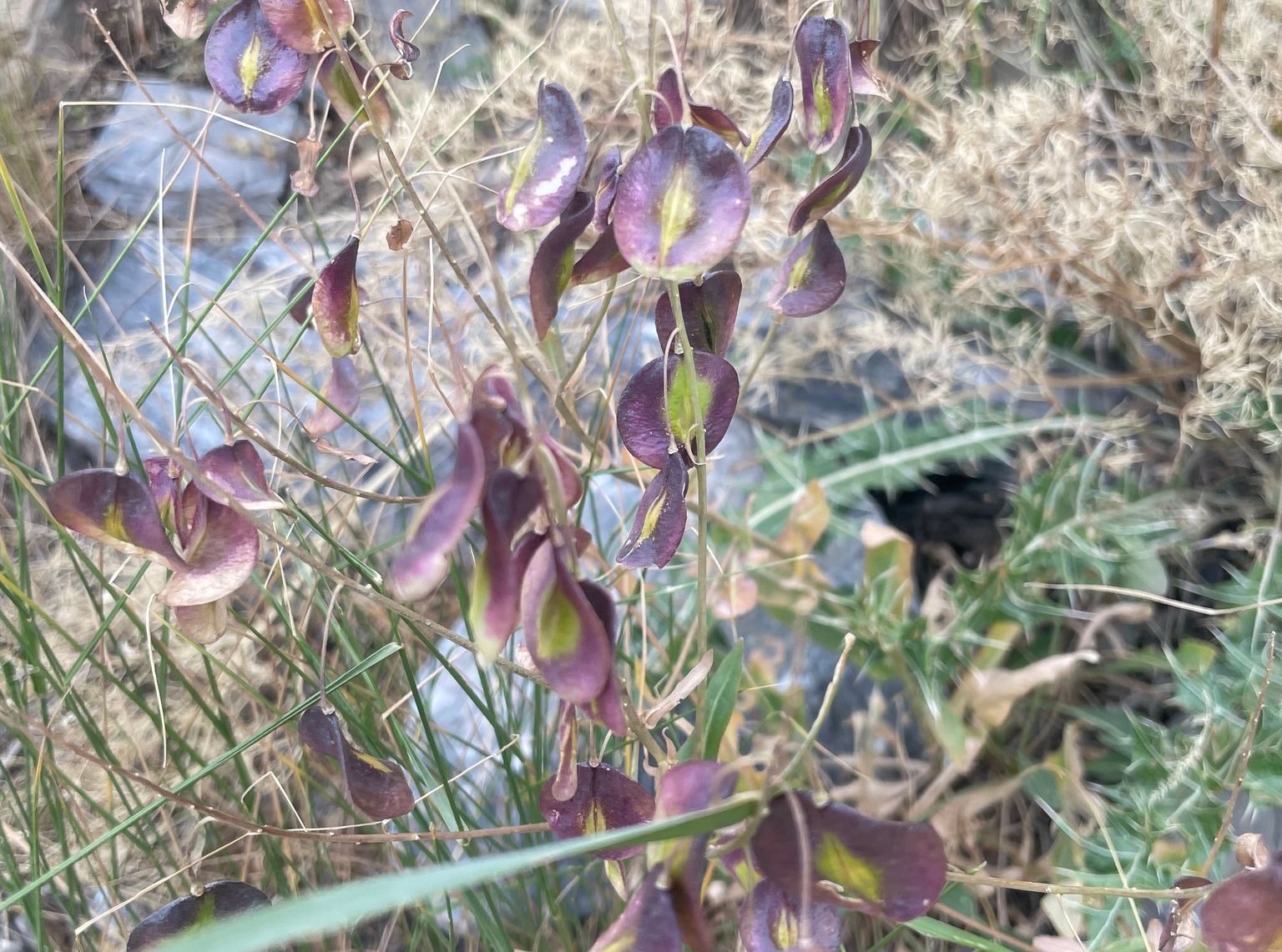
Isatis cappadocica is a yellow-flowered cousin of woad, for centuries a source of blue dye in Europe[1]. Its range runs from Turkey to western Iran[2], and it grows on rocky mountain slopes across much of Kurdistan[3][4]. Botanists count it among the most variable species of its genus[5]. In 2005 a team in Tehran described a form from the mountains near Bîcar (Bijar) in East Kurdistan (Rojhilat): Isatis cappadocica subsp. kurdica, the Kurdish subspecies[6][7].
How it got its name
- Named by
- Desv., 1815Published in J. Bot. Agric. 3: 174
A woad from Cappadocia
The genus Isatis has about 80 species, spread from the Mediterranean through the Middle East to Central Asia[1]. One of them is woad, Isatis tinctoria, grown across Europe from the 12th to the 17th century for its "indigo blue colour" until imported indigo and then synthetic dyes put the woad fields out of business[1].
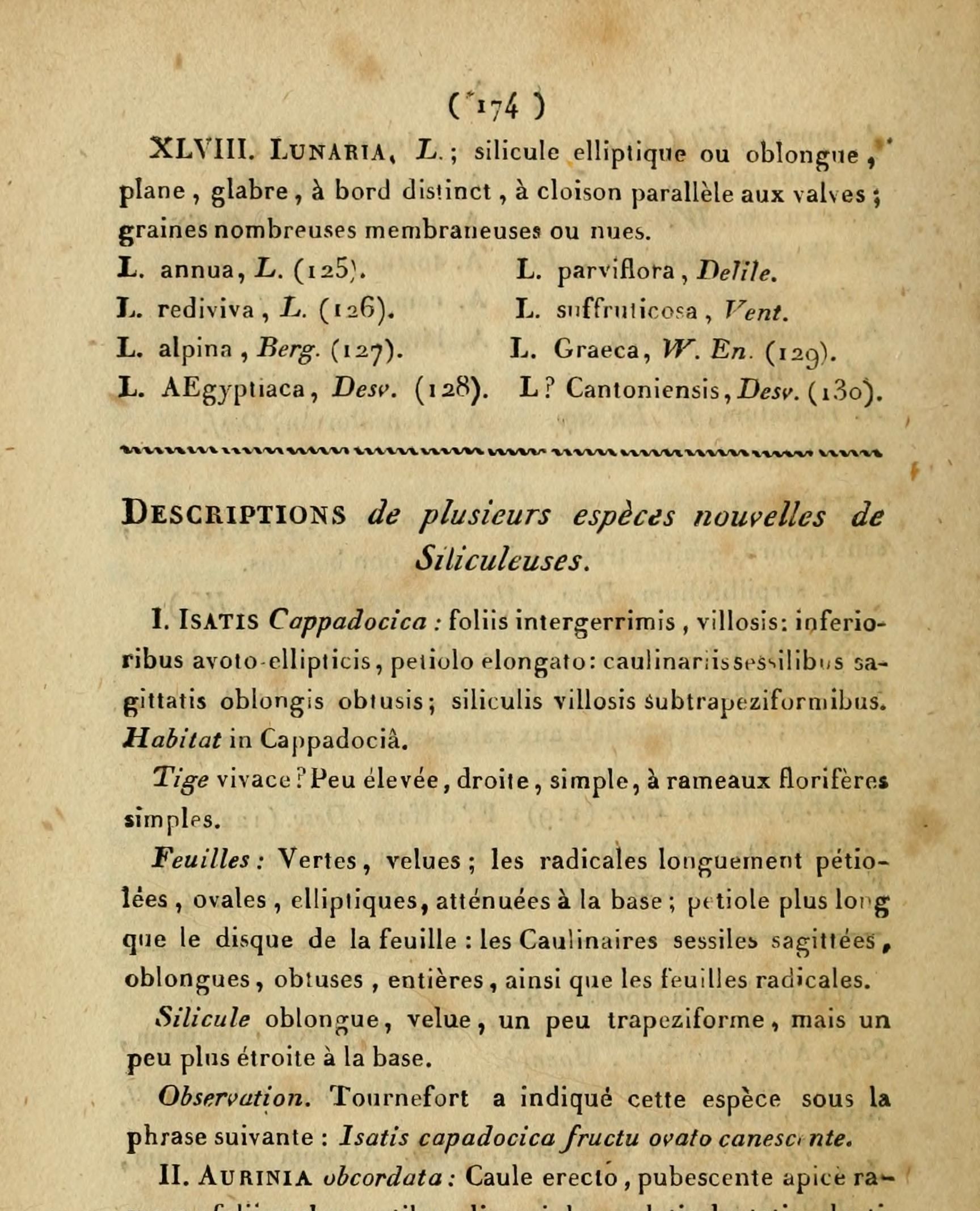
In the Journal de Botanique edited by the botanist Nicaise Auguste Desvaux (1784–1856)[6], a survey of the cress family listed the species of Isatis in a row: woad first, and near the end a new name, I. cappadocica[8]. A few pages later came its description[8]:
Isatis Cappadocica: foliis intergerrimis [sic], villosis … siliculis villosis subtrapeziformibus. Habitat in Cappadociâ.
Cappadocian Isatis: leaves entire and hairy … fruits hairy and somewhat trapezium-shaped. It grows in Cappadocia.[8] (our translation)
The plant came from Cappadocia in central Anatolia, and it was not entirely new: Desvaux noted that Joseph Pitton de Tournefort had already recorded it as Isatis capadocica fructu ovato canescente, "Cappadocian Isatis with an oval, greyish fruit"[8] (our translation). The issue that carried the description is dated April 1814 but came out early in 1815, which is why name databases give the year as 1815[6].
What to look for
Desvaux's description, together with what later botanists added, gives a clear picture[8][9][10]:
- a perennial, sometimes woody at the base, with upright stems[2][8][3];
- leaves green or greyish and hairy, with untoothed edges; the lower leaves oval to elliptic on long stalks, the stalk longer than the blade; the stem leaves stalkless, oblong and blunt, arrow-shaped at the base[8][3];
- yellow flowers, as in the whole genus[9];
- fruits that hang down on stalks bent back and thickened at the tip[9][10]. Each fruit is a flat, winged pod with a single seed in the middle, and it does not split open[8][9][10].
The fruits are what botanists look at first, and they are also what makes this plant so hard to pin down.
A plant that will not sit still
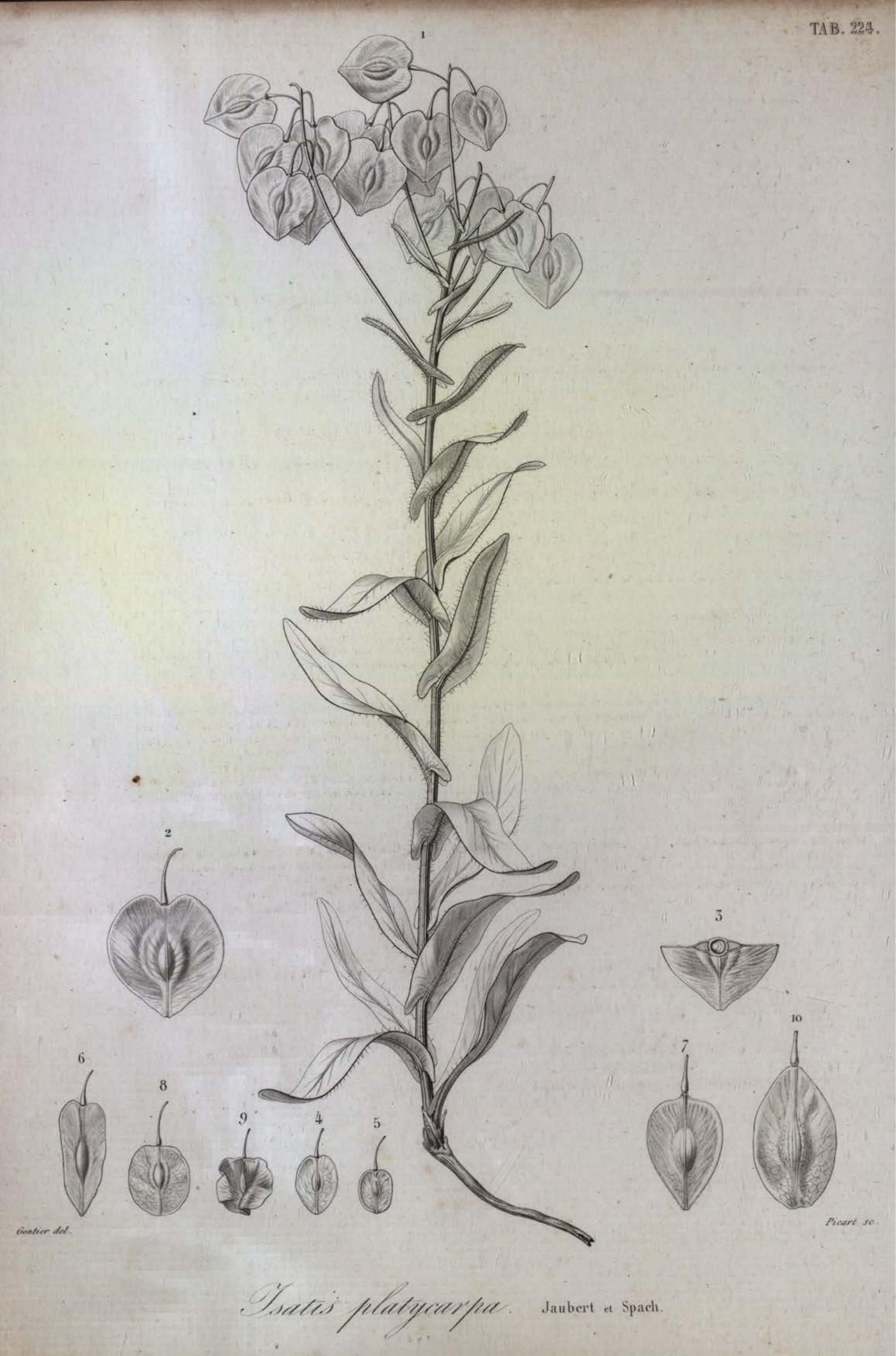
In 1847 the botanists Hippolyte François Jaubert and Édouard Spach published an illustrated plate of an Isatis from the Caucasus and Iran that they called I. platycarpa, a plant that botanists now divide between two species[2][5][2]. In habit and leaves, they wrote, it was "entirely" like woad, but its fruits were "strikingly variable" (egregie ludens)[10] (our translation). Their Latin is almost a colour chart:
junior saepe violacea, matura straminea v. stramineo et violaceo variegata, modo plana, modo crispato- v. undulato-plicata.
When young [the fruit is] often violet; when ripe, straw-coloured, or mottled straw and violet; sometimes flat, sometimes crinkled or folded in waves.[10] (our translation)
They drew fruits of six forms side by side, and added that their plant might "perhaps not unjustly" be joined to another species, I. latisiliqua[10] (our translation).
Twenty years later Pierre Edmond Boissier did exactly that. The Flora Orientalis of 1867 put Desvaux's I. cappadocica and Jaubert and Spach's I. platycarpa together under a single species, called I. latisiliqua, noting that it "varies much in the shape and size of its fruit, which is hairless or hairy"[9] (our translation). The supplement of 1888 went further: its fruits were "very polymorphic in hairiness, size and shape"[3] (our translation).
The 20th century did not settle it. In 1964 Peter Hadland Davis, who was preparing the Flora of Turkey, called it "an extremely polymorphic species whose limits and subdivision remain somewhat uncertain"[5]. Steven's name I. latisiliqua (1812) is older than Desvaux's[9], but it turned out to belong to a distinct plant of the Caucasus. Once that was recognised, the rest of Boissier's broad species took Desvaux's name, I. cappadocica[5][2], and Jaubert and Spach's I. platycarpa went with Steven's plant, apart from its large-fruited form[2]. Kew's checklist splits the species into eight subspecies[2]. Two of them carry names from Kurdistan.
Named after a Kurdish mountain
In 1867 the botanist Heinrich Carl Haussknecht travelled through the mountains of Kurdistan, and on the limestone crags of Pîremegrûn (Pira Magrun), a mountain of limestone ridges west of Silêmanî (Sulaymaniyah)[11] that the labels call Pir Omar Gudrun, at 3,000 to 7,000 feet, collected a low, velvety, grey-green Isatis with branching stems and fruits covered in fine felt[3][12]. Boissier named it after the mountain: gudrunensis, "from Gudrun"[3]. The same mountain appears on later herbarium labels from the Silêmanî country[4]. Haussknecht also brought the species back from the limestone mountains of Hewraman (Avroman) and Şaho (Schahu), noting it at 9,000 feet on Şaho[3][4].
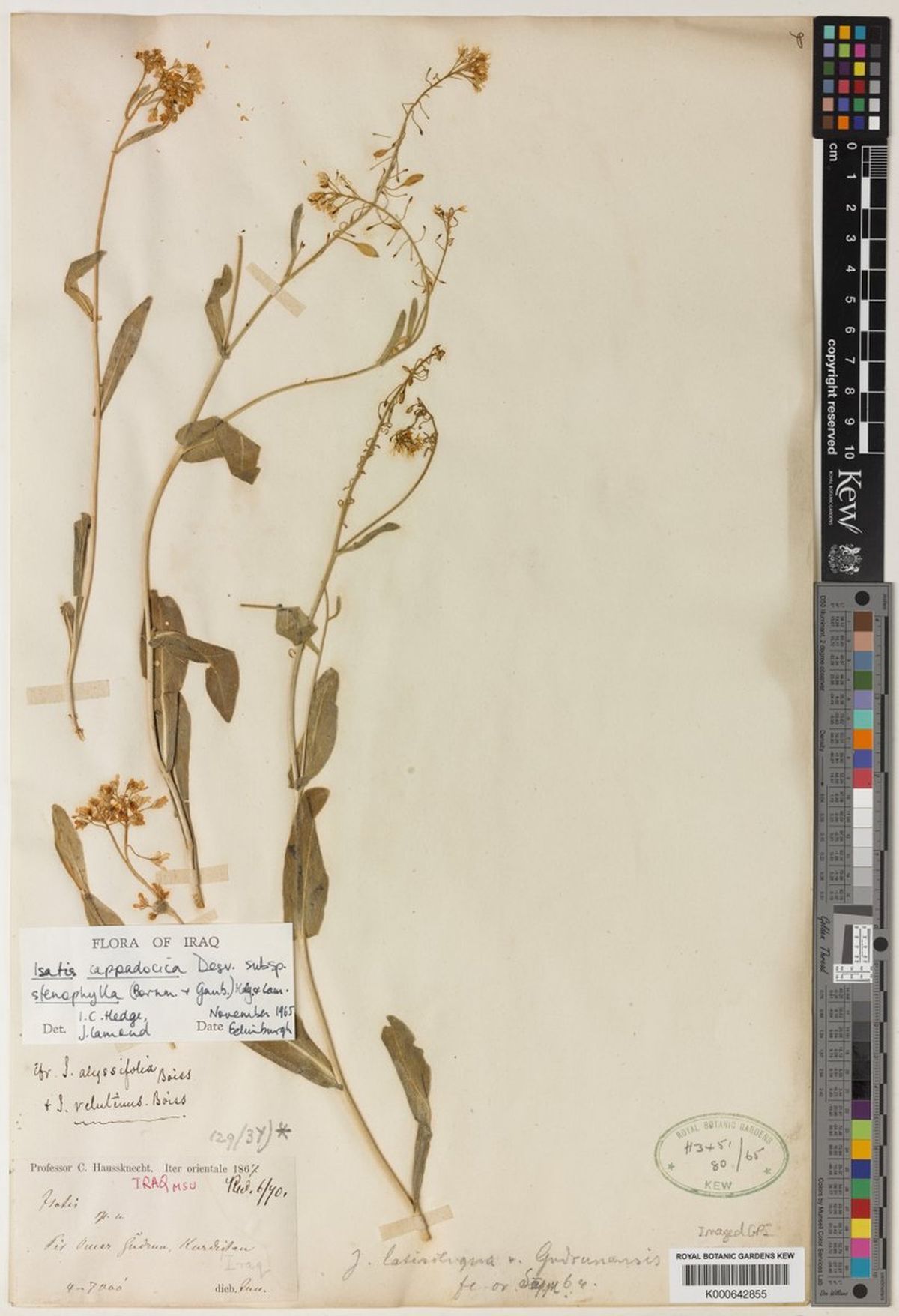
The story of that sheet shows how slippery the species is. In 1964 Davis moved gudrunensis into I. cappadocica, as a variety found in southern Anatolia, northern Iraq (that is, Başûr), western Iran and Lebanon[5]. A year later, botanists at Edinburgh working on the Flora of Iraq looked at Haussknecht's sheet at Kew and filed it under a different subspecies, stenophylla[12]. Today Kew accepts gudrunensis as a subspecies of its own[2][6][2].
The Kurdish subspecies
The newest form comes from Rojhilat. Sepideh Sajedi, Fariba Sharifnia and Mostafa Assadi, botanists in Tehran, set out to sort the Isatis of Iran. They studied the sheets in Iranian herbaria, images of type specimens from Vienna, Munich, Montpellier and Kew, and fresh plants they collected in nine provinces. They compared 69 characters and published their results in 2005 in the Iranian journal Rostaniha, in Persian with an English abstract[7]. Among them was a subspecies they presented as new to science: Isatis cappadocica subsp. kurdica[6][7].
Its type, the specimen the name is tied to, was gathered by Sajedi, Aghabeigi and Eskandari in the province of Kurdistan, on Kuh-e Hamzeharab near Bîcar (Bijar), between 2,000 and 2,500 m. It is kept as the holotype, number 39110, in the herbarium coded IRAN[6].
That is nearly all that can be said about it from what is openly available. The online abstract of the paper does not say how the Kurdish subspecies differs from its relatives; that is in the full text, with photographs, fruit drawings and a key to the subspecies[7]. No specimen filed under the name has been shared through GBIF, the global biodiversity database[4], and as of November 2026 nobody has posted a photograph of it to iNaturalist[13]. A photo of an Isatis in fruit from the hills around Bîcar would be a first.
Where it grows
Kew's checklist gives the species a native range from Turkey to north-western and western Iran, including the Transcaucasus, Iraq, and Lebanon and Syria[2]. In Kurdish terms that is a plant of Bakur, Başûr and Rojhilat. Herbarium sheets show how widely it has been collected across Kurdistan[12][4]:
- South Kurdistan (Başûr): on Helgurd at 2,300 m (Karl Heinz Rechinger, 1957); on Mantelian Dagh east of Rewandiz (Rawanduz) at 1,150 m and on Hawara Bhinda Mountain north-east of Hacî Omeran (Haji Omaran) at 1,800 m (1959); at Pêncwên (Penjwin) at 1,600 m; at Kemarspa on the road from Helebce (Halabja) to Tewêle (Tawela) at 1,920 m; and on Pîremegrûn (Pir Omar Gudrun on the label) above Qarachitan at 1,400 m.
- North Kurdistan (Bakur): on dry rocky slopes on the first ridge between Gever (Yüksekova) and Varegoz in Colemêrg (Hakkâri) (Davis, 1966); on Siyahkir Dag south-east of Elbak (Başkale) at 1,950 m (1967); just north of the citadel of Wan (Van) at 1,700 m (1987); and on Mount Munzur above Pulur (Ovacık) in Dêrsim (Tunceli) at 2,400 m (Davis and Hedge, 1957).
- East Kurdistan (Rojhilat): between Sine (Sanandaj) and Arez (1971); the Ûrmiye (Urmia) district (1926); and the type locality of subsp. kurdica near Bîcar[6].
Put together, the records describe a plant of dry, rocky and limestone mountain slopes. Most sheets with a height come from between about 1,100 and 2,500 m, and Haussknecht noted it as high as 9,000 feet on Şaho[6][3][4]. The dated records run from May to August[4].
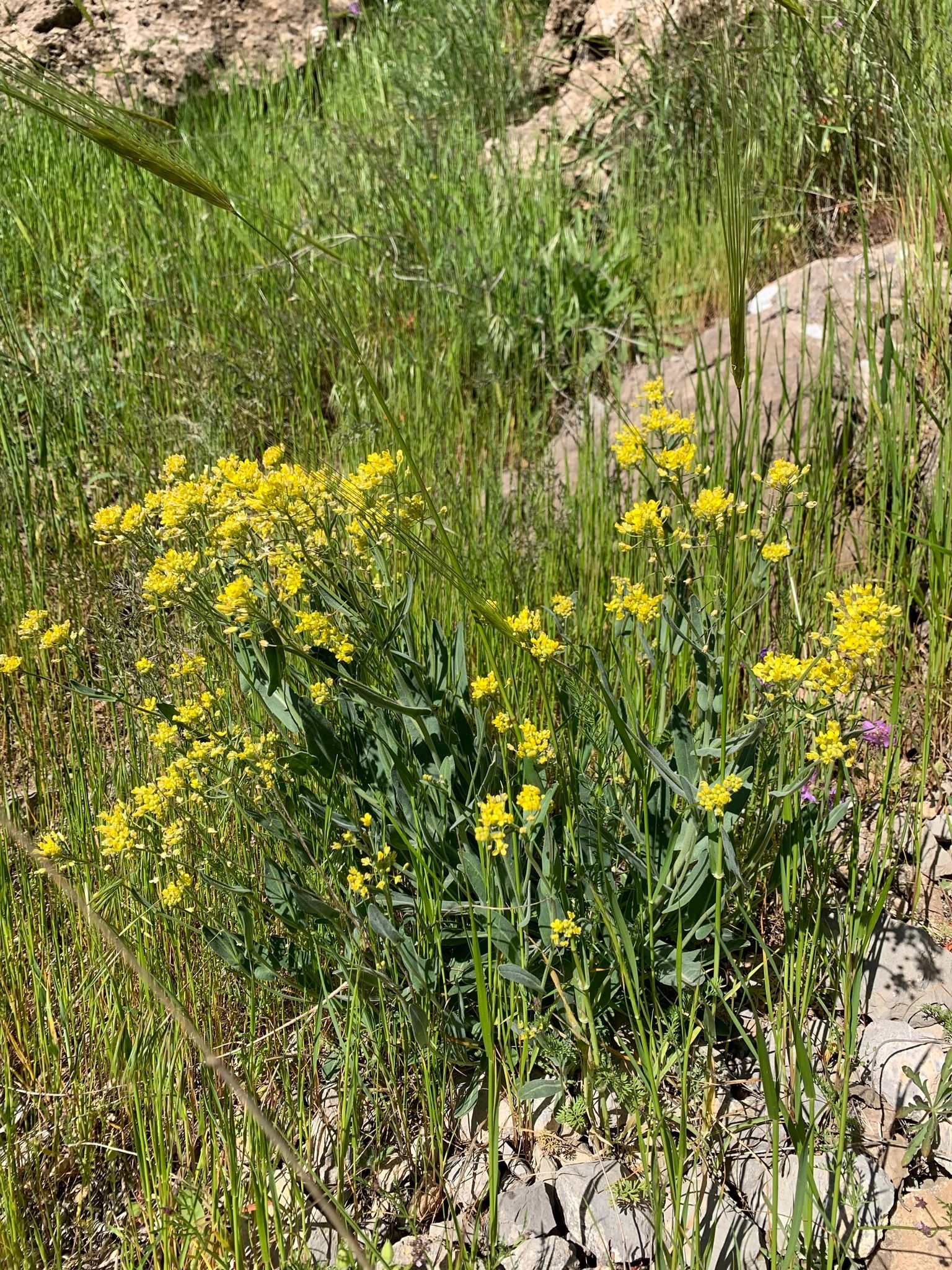
It is still found there. In early May 2023 Arya Aras photographed it in full yellow flower in the Silêmanî area, and in mid-July 2024 photographed its hanging fruits, flushed deep purple, near Çoman (Choman) in Hewlêr (Erbil) province[13]. Violet young fruits are just what Jaubert and Spach described in 1847, even if their own plant is now counted partly under another species[10][2].
A plant that drinks arsenic
Isatis cappadocica has a surprising talent. In 2009 researchers reported that it grows on arsenic-contaminated mine spoil in Iran and carries arsenic up into its shoots, at more than 100 mg per kilogram of dry weight and at higher levels than in its roots[14]. Plants from populations away from the mine were also highly tolerant, and the authors concluded that the tolerance is built into the species rather than an adaptation of one mine population. More than half of the arsenic in the plant was bound to phytochelatins[14]. Later work by the same first author used seeds from the gold and arsenic mine at Zarshuran, 40 km north of Takab, raised shoot levels above 700 mg per kilogram in the laboratory, and counts the plant among the arsenic hyperaccumulators[15]. Which subspecies these plants belong to, the studies do not say.
Kurdish names
Ehmedê Dirihî's dictionary of Kurdish plant names has two dictionary names for Isatis cappadocica[16]:
- teteran, which the dictionary credits to a source it calls "Kurdistan Medical Plant"[16]. Another entry on the same page gives teteran for a second Isatis, I. gaubae[16].
- gamêşka, listed with teteran[16].
For the genus as a whole, the dictionary gives wisme and ximeherde, credited to Emîr Emînî[16]. Woad has a longer list: darê heşî, çiwît, helikê pisîngan, kewegiya, nîl and wesme[16].
Sources
- 1.abcSperanza, J., Miceli, N., Taviano, M. F., Ragusa, S., Kwiecień, I., Szopa, A. & Ekiert, H. (2020). Isatis tinctoria L. (Woad): A Review of its Botany, Ethnobotanical Uses, Phytochemistry, Biological Activities, and Biotechnological Studies. Plants 9(3): 298. doi:10.3390/plants9030298https://doi.org/10.3390/plants9030298
- 2.Plants of the World Online. Royal Botanic Gardens, Kew.
- abcghjIsatis cappadocica Desv. and its subspecies.
- defikWorld Checklist of Vascular Plants (WCVP), via GBIF: Isatis latisiliqua Steven, Isatis platycarpa Jaub. & Spach, Isatis cappadocica subsp. gudrunensis.
- plant_name_id 2866916. powo.science.kew.orghttps://powo.science.kew.org/taxon/urn:lsid:ipni.org:names:285755-1accessed 14 November 2026
- 3.Boissier, E. (1888). Flora Orientalis, Supplementum (ed. R. Buser). Geneva & Basel. archive.orghttps://archive.org/details/PierreEdmondBoissierFloraOrientalisSiveEnumeratioPlantarumInOrienteAGraeciaEtAeg
- 4.abcdefgHerbarium specimens of Isatis cappadocica at Kew, Edinburgh and the Smithsonian, via GBIF (occurrences 5072817387, 5072824371, 5072798429, 5072823515, 5072818533, 2452272897, 574888836, 5072818529, 5072799564, 5072818531, 575304173, 5072818534, 912509458).
- 5.Davis, P. H. (1964). Materials for a Flora of Turkey: VIII. Cruciferae I: Isatis. Notes from the Royal Botanic Garden Edinburgh 26.
- 6.International Plant Names Index. Royal Botanic Gardens, Kew, Harvard University Herbaria and Australian National Herbarium.
- 7.abcdSajedi, S., Sharifnia, F. & Assadi, M. (2005). A study of the genus Isatis in Iran (in Persian). Rostaniha 6(1).
- 8.Desvaux, N. A. (1814 [1815]). Journal de Botanique, appliquée à l'Agriculture, à la Pharmacie, à la Médecine et aux Arts 3: 161, 174.
- 9.Boissier, E. (1867). Flora Orientalis, vol. 1. Basel & Geneva: H. Georg. archive.orghttps://archive.org/details/floraorientaliss01bois
- 10.abcdefgJaubert, H. F. & Spach, É. (1847). Illustrationes Plantarum Orientalium. 3: tab. 224.
- 11.↩Ahmad, K. H. K., Bety, A. & Khanaqa, P. A. (2015). Geomorphology of the Piramagroon–Kanikhan valley, Sulaimani Governorate, Kurdistan Region, North Iraq. International Journal of Geography and Geology 4(12): 183–195.
- 12.abcRoyal Botanic Gardens, Kew – Herbarium Specimens. via GBIF, herbarium specimen K000642855 (Haussknecht, 1867), via GBIF. gbif.orghttps://www.gbif.org/dataset/cd6e21c8-9e8a-493a-8a76-fbf7862069e5
- 13.abiNaturalist. observations 160022903 and 229845862 (Arya Aras). inaturalist.orghttps://www.inaturalist.org/
- 14.abKarimi, N., Ghaderian, S. M., Raab, A., Feldmann, J. & Meharg, A. A. (2009). An arsenic-accumulating, hypertolerant brassica, Isatis capadocica. New Phytologist 184(1): 41–47. doi:10.1111/j.1469-8137.2009.02982.xhttps://doi.org/10.1111/j.1469-8137.2009.02982.x
- 15.↩Karimi, N. & Souri, Z. (2013). Metabolic adaptations to arsenic-induced oxidative stress in Isatis cappadocica. Iranian Journal of Plant Physiology 3(4): 785–792.
- 16.Ahmet Kasımoğlu (Ehmedê Dirihî) (2013). Ferhenga Navên Nebatan a Kurdî (Dictionary of Kurdish Plant Names). Mardin Artuklu University, Institute of Living Languages in Turkey (ISBN 978-605-4202-12-6).
Last updated 20 November 2026