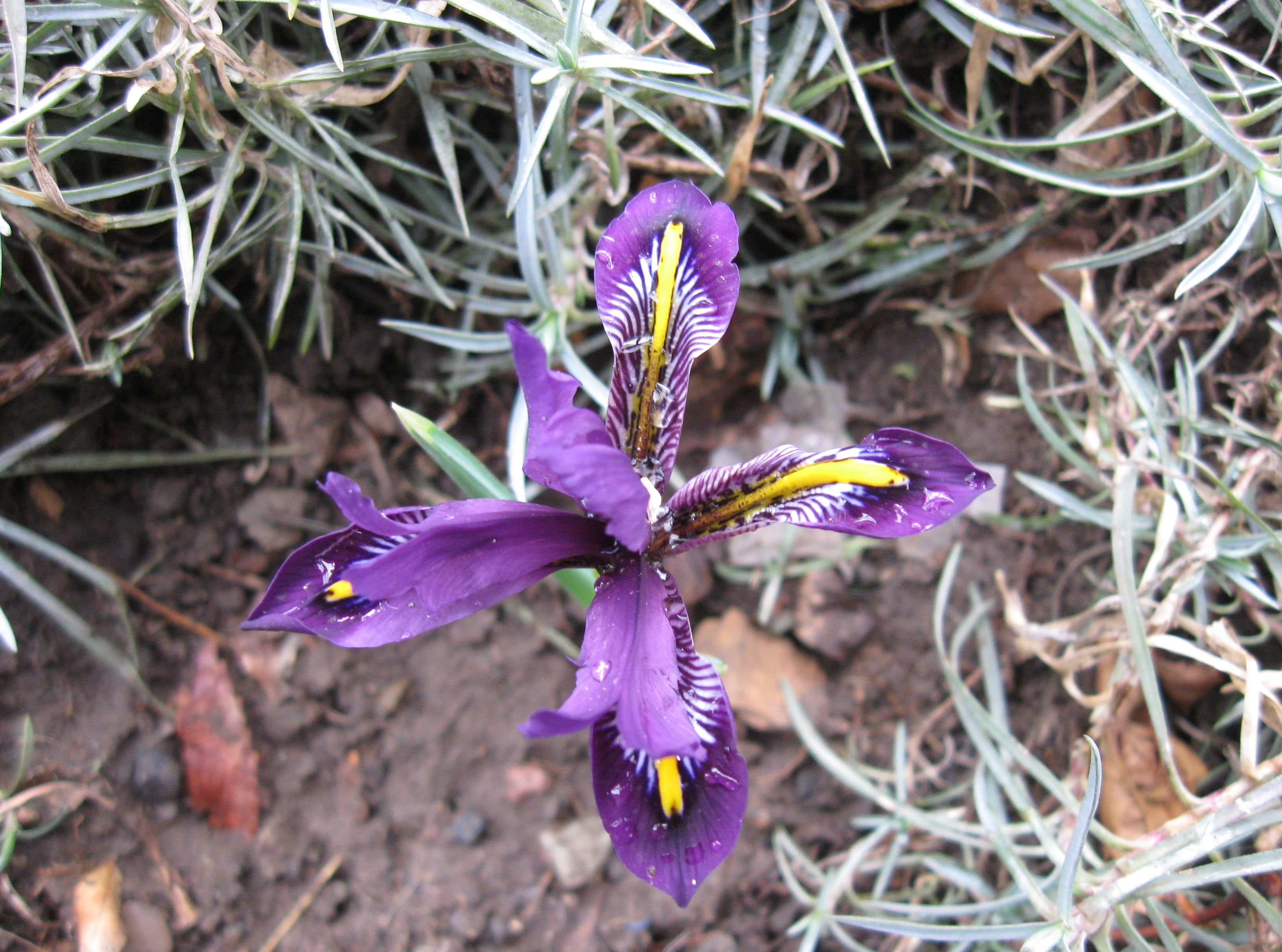
Iris reticulata is a small bulbous iris that grows wild from the Caucasus to Turkmenistan[1]. In Kurdistan it has been collected in the mountains of North Kurdistan (Bakur)[2], South Kurdistan (Başûr)[3] and East Kurdistan (Rojhilat)[4]. It flowers early in the year, often right after the snow melts[5]. One of its subspecies, subsp. kurdica, is named after Kurdistan[6] and is known only from a small area south of Elbak (Başkale, Turkey)[7].
The name
Friedrich August Marschall von Bieberstein described the species in 1808, in his Flora Taurico-Caucasica[8]. The type was collected by Adam in “Iberia”, which Adil Güner places at Tbilisi in Georgia[9]. Reticulata means “netted”: the bulb is wrapped in a coarse net of fibres[10]. In English it is called netted iris or winter iris[11]. Botanists have also placed it in other genera, as Neubeckia reticulata (1863) and Xiphion reticulatum (1866)[12] and as Iridodictyum reticulatum[1].
Description
A plant 7–17 cm tall in flower. Each bulb has one to three narrow leaves, four-angled in section, which are no longer than the flower at first and later grow to 30 cm. The single flower varies from pale blue to violet or purple, with a perianth tube 4–7 cm long[10]. In the typical subspecies the flower is dark purple or claret all over, apart from a few markings and a yellow crest[13]. The capsule ripens more or less at ground level[10].
Where it grows
Iris reticulata grows at 600–2700 m in mountain grassland, on limestone rocks and stony slopes, and in oak forest and scrub[10].
In North Kurdistan, Güner lists collections from Amed (Diyarbakır), Çewlîg (Bingöl), Bedlîs (Bitlis), Mûş (Muş) and Colemêrg (Hakkâri). For the typical subspecies he gives open pine and oak woods, meadows, fields, steppe and rocky slopes, at 680–2600 m[2].
In South Kurdistan, herbarium specimens at Kew come from the Sefîn mountain near Şeqlawe (Shaqlawa), collected in 1958[3], from Silêmanî (Sulaymaniyah), in 1920[14], and from oak forest on Qeredax (Qaradagh), in 1964[15]. A 2023 study by botanists of the University of Silêmanî maps it in the Kurdistan Region[16].
In East Kurdistan, it was collected in 1964 on limestone 50 miles east of Sine (Sanandaj)[4], and in 1890 at Kangavar[17].
The bulb specialist Jānis Rukšāns thinks that, in the wide sense, the name still hides several unrecognised species, and that many of their localities are little explored[5].
Flowering
February to May[10]. Like the other netted irises, it blooms right after the snow melts, when few people are in the mountains to see it[5].
Kurdish names
The dictionary of Kurdish plant names by Ehmedê Dirihî (Ahmet Kasımoğlu, 2013) gives two names for Iris reticulata together with their source: gulale newroze, from Emîr Emînî[18], and gulenewroze, from the source it calls “Kurdistan Medical Plant”[19]. Its Latin index also lists bilbizêk, gulbizaya mazêran, newroz and sosina bêj for the species, without a source; it gives bilbizêk and newroz for other irises as well[20].
Subspecies
Kew's World Checklist accepts four subspecies: subsp. reticulata, subsp. isikgunerae, subsp. selahattinii and subsp. kurdica[1].
Iris reticulata subsp. kurdica
Rukšāns described it in 2007 as Iris reticulata var. kurdica, in his book Buried Treasures[21]. The type was collected on 27 May 2004 by Rukšāns, Arnis Seisums and Henrik Zetterlund on steep serpentine slopes 27 km south of Elbak, on the road to Colemêrg, at about 1800 m. The holotype is kept at the herbarium in Gothenburg[6]. Seisums had taken a few bulbs that were not in flower; when they first bloomed in Rukšāns's garden, the plants were very small and of a different colour[7]. Rukšāns explained the name in his own words: it is “named after Turkish Kurdistan where it is growing, to recall the former independent Kurdish state”[6].
Its rank has changed three times. In 2015 Crespo and colleagues moved it to another genus as Iridodictyum kurdicum, and in 2019 Rukšāns made it a species, Iris kurdica[6]; in 2021 Güner made it a subspecies of I. reticulata[22]. Kew follows Güner[1].
It is smaller than typical I. reticulata: 10–12 cm tall, with two leaves. The falls are very dark, almost blackish purple, with a narrow deep-yellow ridge[6]. The standards are purplish pink, and its black anthers and pollen set it apart from the other netted irises growing nearby[7].
In Kurdistan, it is known only from three gatherings within about 30 km of each other, along the road from Elbak to Gever (Yüksekova)[7]. Güner gives steep serpentine slopes at 1880–2600 m, flowering in April[22]. Mehmet Fırat collected it again at the type locality on 7 April 2011, at 2600 m[23].
Sources
- 1.abcdPlants of the World Online. Royal Botanic Gardens, Kew, Iris reticulata M.Bieb.: distribution, synonyms, accepted subspecies. powo.science.kew.orghttps://powo.science.kew.org/taxon/urn:lsid:ipni.org:names:439030-1archivedhttps://web.archive.org/web/20250119142619/https://powo.science.kew.org/taxon/urn:lsid:ipni.org:names:439030-1accessed 30 October 2026
- 2.abAdil Güner (2021). Resimli Türkiye Florası (Illustrated Flora of Turkey). ANG Vakfı Nezahat Gökyiğit Botanik Bahçesi, pp. 27–29 (subsp. reticulata: habitat and specimens). turkiyeflorasi.org.trhttps://turkiyeflorasi.org.tr/pdf/10.30796/ANGV.2021.9.pdfdoi:10.30796/ANGV.2021.9https://doi.org/10.30796/ANGV.2021.9archivedhttps://web.archive.org/web/20261030080244/https://s3.turkiyeflorasi.org.tr/web-version/10.30796/ANGV.2021.9.pdfaccessed 30 October 2026
- 3.abRoyal Botanic Gardens, Kew – Herbarium Specimens. via GBIF, K002214814: Sefin Dagh, Shaqlawa, 9 Apr 1958, O. Polunin 5042. gbif.orghttps://www.gbif.org/occurrence/4602153103archivedhttps://web.archive.org/web/20261030034921/https://api.gbif.org/v1/occurrence/4602153103accessed 30 October 2026
- 4.abRoyal Botanic Gardens, Kew – Herbarium Specimens. via GBIF, K002214857: 50 miles E of Sanandaj, limestone, 7 Mar 1964, P. Furse 5015. gbif.orghttps://www.gbif.org/occurrence/4601947105archivedhttps://web.archive.org/web/20261030035139/https://api.gbif.org/v1/occurrence/4601947105accessed 30 October 2026
- 5.abcJānis Rukšāns (2019). Bulbous irises of subgen. Hermodactyloides Spach (Iridaceae). International Rock Gardener 112, Scottish Rock Garden Club, p. 46. srgc.nethttp://srgc.net/documents/irg/2019Apr261556270768IRG_112_April_2019.pdfarchivedhttps://web.archive.org/web/20261030025547/http://srgc.net/documents/irg/2019Apr261556270768IRG_112_April_2019.pdfaccessed 30 October 2026
- 6.abcdeJānis Rukšāns (2019). Bulbous irises of subgen. Hermodactyloides Spach (Iridaceae). International Rock Gardener 112, Scottish Rock Garden Club, p. 44. srgc.nethttp://srgc.net/documents/irg/2019Apr261556270768IRG_112_April_2019.pdfarchivedhttps://web.archive.org/web/20261030025547/http://srgc.net/documents/irg/2019Apr261556270768IRG_112_April_2019.pdfaccessed 30 October 2026
- 7.abcdJānis Rukšāns (2019). Bulbous irises of subgen. Hermodactyloides Spach (Iridaceae). International Rock Gardener 112, Scottish Rock Garden Club, p. 45. srgc.nethttp://srgc.net/documents/irg/2019Apr261556270768IRG_112_April_2019.pdfarchivedhttps://web.archive.org/web/20261030025547/http://srgc.net/documents/irg/2019Apr261556270768IRG_112_April_2019.pdfaccessed 30 October 2026
- 8.↩International Plant Names Index. Royal Botanic Gardens, Kew, Harvard University Herbaria and Australian National Herbarium, Iris reticulata M.Bieb., Fl. Taur.-Caucas. 1: 34 (1808). ipni.orghttps://www.ipni.org/n/439030-1archivedhttps://web.archive.org/web/20261030025654/https://www.ipni.org/n/439030-1accessed 30 October 2026
- 9.↩Adil Güner (2021). Resimli Türkiye Florası (Illustrated Flora of Turkey). ANG Vakfı Nezahat Gökyiğit Botanik Bahçesi, p. 26 (type). turkiyeflorasi.org.trhttps://turkiyeflorasi.org.tr/pdf/10.30796/ANGV.2021.9.pdfdoi:10.30796/ANGV.2021.9https://doi.org/10.30796/ANGV.2021.9archivedhttps://web.archive.org/web/20261030080244/https://s3.turkiyeflorasi.org.tr/web-version/10.30796/ANGV.2021.9.pdfaccessed 30 October 2026
- 10.abcdeFlora of Pakistan. University of Karachi and Missouri Botanical Garden, via eFloras, Iridaceae (S.I. Ali & B. Mathew): Iris reticulata. efloras.orghttp://www.efloras.org/florataxon.aspx?flora_id=5&taxon_id=240010004archivedhttps://web.archive.org/web/20261030025527/http://www.efloras.org/florataxon.aspx?flora_id=5&taxon_id=240010004accessed 30 October 2026
- 11.↩GRIN-Global Taxonomy. USDA Agricultural Research Service, National Plant Germplasm System, Iris reticulata M.Bieb. (taxon 20387): common names, citing Erhardt et al. 2008, Der große Zander, p. 1483. npgsweb.ars-grin.govhttps://npgsweb.ars-grin.gov/gringlobal/taxon/taxonomydetail?id=20387archivedhttps://web.archive.org/web/20261030030224/https://npgsweb.ars-grin.gov/gringlobal/taxon/taxonomydetail?id=20387accessed 30 October 2026
- 12.↩Adil Güner (2021). Resimli Türkiye Florası (Illustrated Flora of Turkey). ANG Vakfı Nezahat Gökyiğit Botanik Bahçesi, p. 27 (synonyms). turkiyeflorasi.org.trhttps://turkiyeflorasi.org.tr/pdf/10.30796/ANGV.2021.9.pdfdoi:10.30796/ANGV.2021.9https://doi.org/10.30796/ANGV.2021.9archivedhttps://web.archive.org/web/20261030080244/https://s3.turkiyeflorasi.org.tr/web-version/10.30796/ANGV.2021.9.pdfaccessed 30 October 2026
- 13.↩Adil Güner (2021). Resimli Türkiye Florası (Illustrated Flora of Turkey). ANG Vakfı Nezahat Gökyiğit Botanik Bahçesi, p. 30 (diagnosis of subsp. isikguneri). turkiyeflorasi.org.trhttps://turkiyeflorasi.org.tr/pdf/10.30796/ANGV.2021.9.pdfdoi:10.30796/ANGV.2021.9https://doi.org/10.30796/ANGV.2021.9archivedhttps://web.archive.org/web/20261030080244/https://s3.turkiyeflorasi.org.tr/web-version/10.30796/ANGV.2021.9.pdfaccessed 30 October 2026
- 14.↩Royal Botanic Gardens, Kew – Herbarium Specimens. via GBIF, K002214817: Sulaimaniya, 1 Apr 1920, R.J.D. Graham 649. gbif.orghttps://www.gbif.org/occurrence/4601949138archivedhttps://web.archive.org/web/20261030035030/https://api.gbif.org/v1/occurrence/4601949138accessed 30 October 2026
- 15.↩Royal Botanic Gardens, Kew – Herbarium Specimens. via GBIF, K002214815: oak forest, Kopa Qara Dagh, Sulaimaniya, 29 Apr 1964, F.A. Barkley 8520. gbif.orghttps://www.gbif.org/occurrence/4601954119archivedhttps://web.archive.org/web/20261030075452/https://api.gbif.org/v1/occurrence/4601954119accessed 30 October 2026
- 16.↩Hoshman Omar Majeed, Rubar Hussein Muhammed Salih (2023). Iris zagrica subsp. penjwenica; Iris zagrica subsp. warteica; two new subspecies from the Iraqi Kurdistan region belonging to Iris section Zagrica. Passer Journal 5(2): 404–409, University of Garmian, p. 405, fig. 1 (distribution map). doi:10.24271/PSR.2023.409295.1357https://doi.org/10.24271/PSR.2023.409295.1357
- 17.↩Royal Botanic Gardens, Kew – Herbarium Specimens. via GBIF, K002214827: Kangawar, Kurdistan, 18 Nov 1890, F.D. Godman 16. gbif.orghttps://www.gbif.org/occurrence/4601950084archivedhttps://web.archive.org/web/20261030075553/https://api.gbif.org/v1/occurrence/4601950084accessed 30 October 2026
- 18.↩Ahmet Kasımoğlu (Ehmedê Dirihî) (2013). Ferhenga Navên Nebatan a Kurdî (Dictionary of Kurdish Plant Names). Mardin Artuklu University, Institute of Living Languages in Turkey (ISBN 978-605-4202-12-6), p. 316 (gulale newroze, source AA = Emîr Emînî, see p. 65).
- 19.↩Ahmet Kasımoğlu (Ehmedê Dirihî) (2013). Ferhenga Navên Nebatan a Kurdî (Dictionary of Kurdish Plant Names). Mardin Artuklu University, Institute of Living Languages in Turkey (ISBN 978-605-4202-12-6), p. 332 (gulenewroze, source KMP = Kurdistan Medical Plant, see p. 65).
- 20.↩Ahmet Kasımoğlu (Ehmedê Dirihî) (2013). Ferhenga Navên Nebatan a Kurdî (Dictionary of Kurdish Plant Names). Mardin Artuklu University, Institute of Living Languages in Turkey (ISBN 978-605-4202-12-6), p. 1115 (Latin index: Iris).
- 21.↩International Plant Names Index. Royal Botanic Gardens, Kew, Harvard University Herbaria and Australian National Herbarium, Iris reticulata var. kurdica Rukšāns, Buried Treasures 363 (2007). ipni.orghttps://www.ipni.org/n/60446532-2archivedhttps://web.archive.org/web/20261030025824/https://www.ipni.org/n/60446532-2accessed 30 October 2026
- 22.abAdil Güner (2021). Resimli Türkiye Florası (Illustrated Flora of Turkey). ANG Vakfı Nezahat Gökyiğit Botanik Bahçesi, p. 31 (subsp. kurdica). turkiyeflorasi.org.trhttps://turkiyeflorasi.org.tr/pdf/10.30796/ANGV.2021.9.pdfdoi:10.30796/ANGV.2021.9https://doi.org/10.30796/ANGV.2021.9archivedhttps://web.archive.org/web/20261030080244/https://s3.turkiyeflorasi.org.tr/web-version/10.30796/ANGV.2021.9.pdfaccessed 30 October 2026
- 23.↩Mehmet Fırat (2022). Iris zagrica subsp. zagrica (Iridaceae): a new record locality for the flora of North Iraq. Doğu Fen Bilimleri Dergisi 5(2): 12–18, p. 16 (M. Fırat 27323, topotype of var. kurdica). dergipark.org.trhttps://dergipark.org.tr/tr/download/article-file/2791531archivedhttps://web.archive.org/web/20261030031129/https://dergipark.org.tr/tr/download/article-file/2791531accessed 30 October 2026
- Photo: Valen1988, CC BY-SA 4.0, via Wikimedia Commons. commons.wikimedia.orghttps://commons.wikimedia.org/wiki/File:Iris_reticulata,_Armenia.jpg
Last updated 30 October 2026