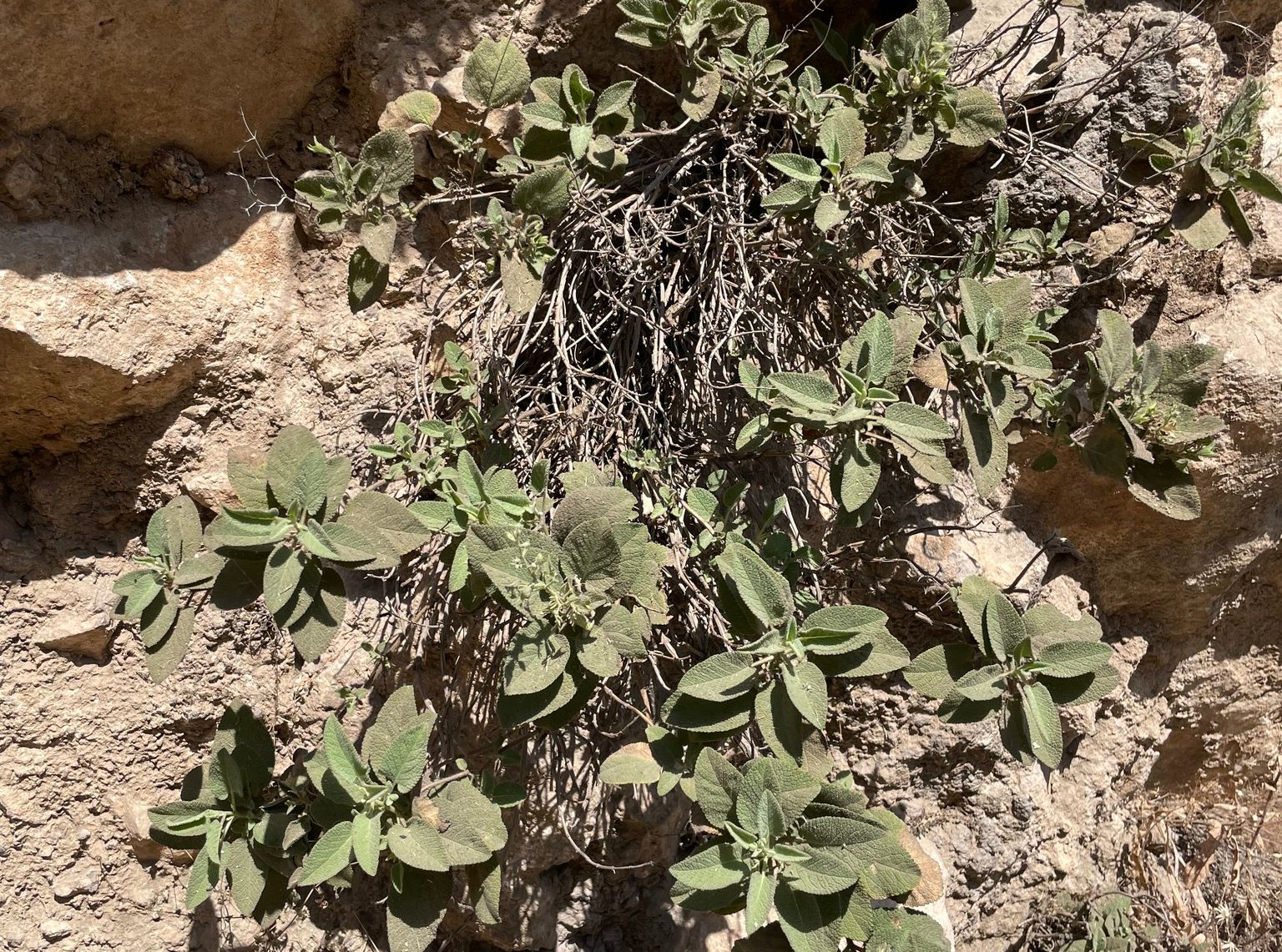
Salvia kurdica is a sage of the limestone rocks of the Kurdish mountains: a low, brittle, very aromatic shrub about half a metre tall, with soft, wrinkled, sticky-haired leaves and carmine to bright pink two-lipped flowers whose lower lip is marked with white[1][1]. It was first gathered on rocks near the walls of Amêdî (Amadiya) in South Kurdistan (Başûr) in 1841, and nearly every record since comes from a short stretch of mountains on either side of today's border: Amêdî and Akrê in Başûr, and the foot of Mount Cûdî in North Kurdistan (Bakur)[2][3][4][4][1][5]. Its epithet, kurdica, means simply "Kurdish".
How it got its name
- Named by
- Boiss. & Hohen. ex Benth., 1848Published in Prodr. 12: 268
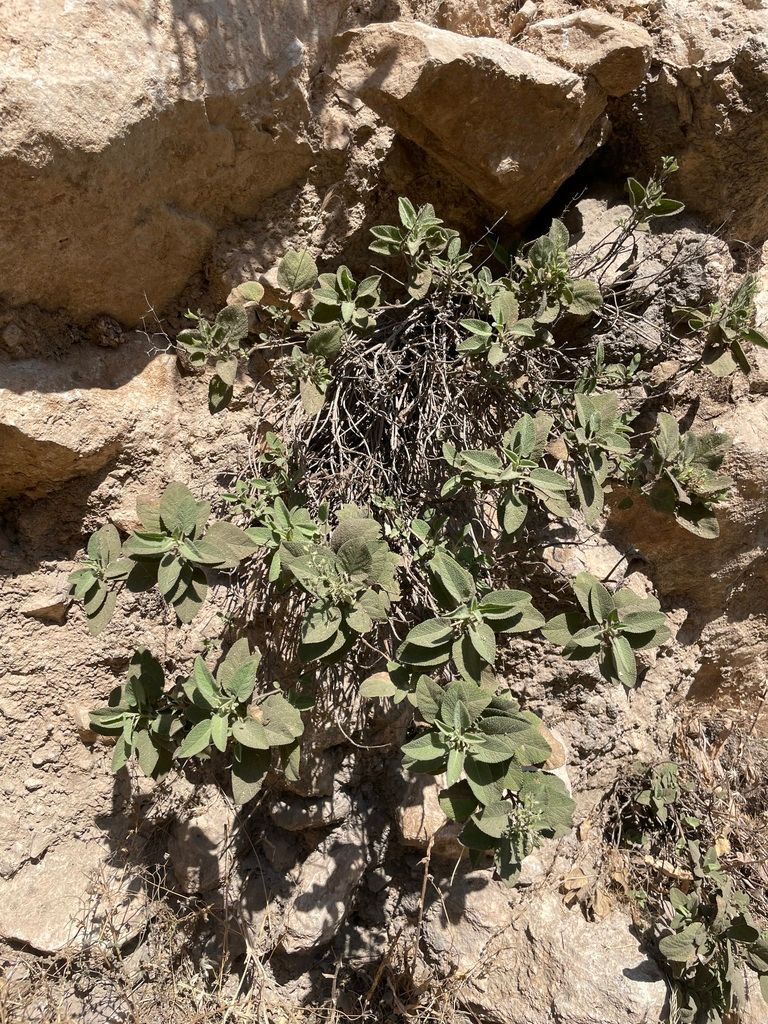
Pink flowers on the rocks of Amêdî
On 31 July 1841, the plant collector Theodor Kotschy (1813–1866)[6] was among the rocks around Amêdî, the old town on its flat-topped rock. He pressed a sage growing there, and its printed label records exactly where: "Ad rupes prope Amadia Kurdist.", "on rocks near Amadia, Kurdistan", with a note on its colour, "Flos roseus": "the flower pink"[1]. Kotschy's own handwritten field label, which survives on a sheet in Washington, is more precise still. As we read his German, it says "Kurdistan. Stadt Amadie … An Felsblöcken unmittelbar neben der Stadtmauer … Den 31ten Juli 1841": "Kurdistan, the town of Amadie … on rock blocks right next to the town wall … 31 July 1841"[7] (our reading and translation). Three days later, on 3 August, he was collecting the Kurdish hollyhock (Alcea kurdica, in Kurdish hêro) on nearby Mount Gara[8].
Kotschy's collections were arranged and distributed by the missionary Rudolph Friedrich Hohenacker (1798–1874)[9][6], and his Kurdish gatherings went out under the title printed at the foot of the label: "Th. Kotschy. Pl. alepp. kurd. moss. 347. Ed. Hohenacker. 1843.", "plants of Aleppo, Kurdistan and Mosul, no. 347, edited by Hohenacker, 1843"[1] (our expansion of the abbreviations). Above it, in larger type, the label already gives the plant a name: Salvia (Hymenosphace) Kurdica Boiss. et Hohenack. n. sp., a new species named by Edmond Boissier (1810–1885) and Hohenacker himself[1][6].
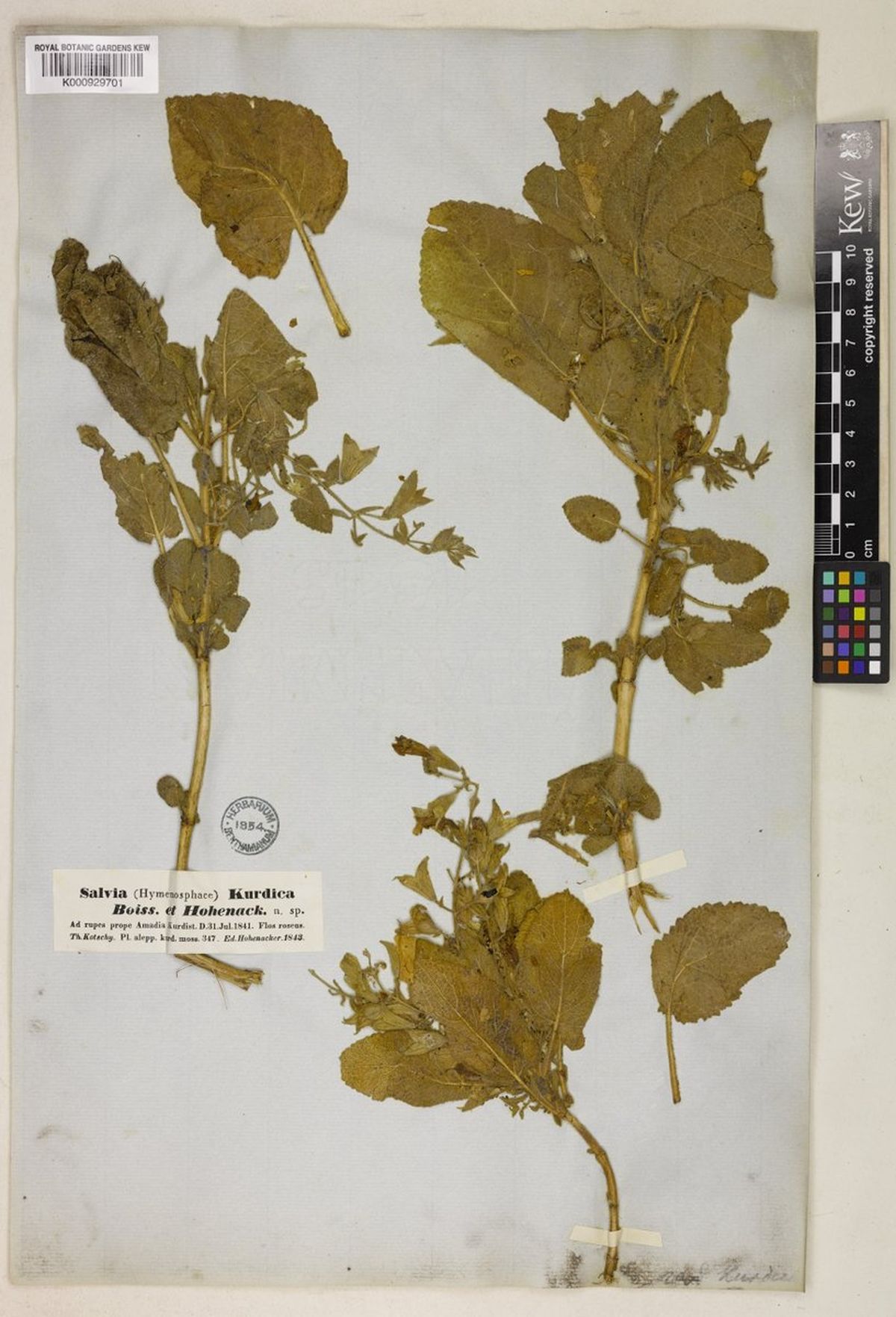
A name printed before it was published
A name on a label, without a description, is not yet a validly published name. It became one in 1848, when the botanist George Bentham (1800–1884)[6] wrote up the sage family for volume 12 of de Candolle's Prodromus, a survey of all known plants. Under number 20 in the genus Salvia, he described S. kurdica from Kotschy's specimen, crediting the name to Boissier and Hohenacker's manuscript and marking that he had seen a dried specimen himself ("v. s.")[2]. That is why the full name is written Salvia kurdica Boiss. & Hohen. ex Benth.: Boissier and Hohenacker chose the name, Bentham published it[2][6].
His Latin portrait is of a plant "undique viscoso-villosa", sticky-hairy all over, with long-stalked, broadly ovate, round-toothed, heart-based and wrinkled leaves, flowers about two to a whorl, a bell-shaped calyx "softly sticky-hairy", and a corolla twice as long as the calyx. The biggest leaves were about three inches long and two wide (roughly 7.5 × 5 cm), "but most much smaller"[2].
The sheet above carries the round stamp of Bentham's own herbarium, "Herbarium Benthamianum 1854"[1]. Hohenacker's sets travelled much further: duplicates of the same gathering are now kept in at least a dozen herbaria, from Paris, Geneva, London and Kew to Munich, Göttingen, Halle, Stockholm, Wageningen, St. Louis, Washington and Harvard[7].
"Described from imperfect fragments"
Boissier finally treated the species himself in the fourth volume of Flora Orientalis (1879), his flora of the East. His locality line is a small piece of nineteenth-century geography:
Hab. ad rupes prope mœnia urbis Amadieh Kurdistaniæ Assyriacæ.
It grows on rocks near the walls of the town of Amadieh, in Assyrian Kurdistan.[3] (our translation)
He was frank about how little material anyone had: "Ex frustulis imperfectis descripta", "described from imperfect fragments". From what there was, he noted leaves like those of Salvia macrochlamys with a blade about three inches by two, short loose side-branches of flowers, a fruiting calyx 9–10 lines long (about 2 cm) and a corolla about 10 lines long (a little over 2 cm), with a ring of hairs inside[3]. He placed it in the first section of the genus, among the sages with undivided leaves, next to S. macrochlamys[3].
Back to the walls, a century later
The rocks of Amêdî kept their sage. On 10–12 July 1957, the botanist Karl Heinz Rechinger (1906–1998)[6] collected it again "on sandy, stony ground below the town, about 900 m", and typed two words on his label: "ditio classica", the classic ground, the place where the species was first found[4].
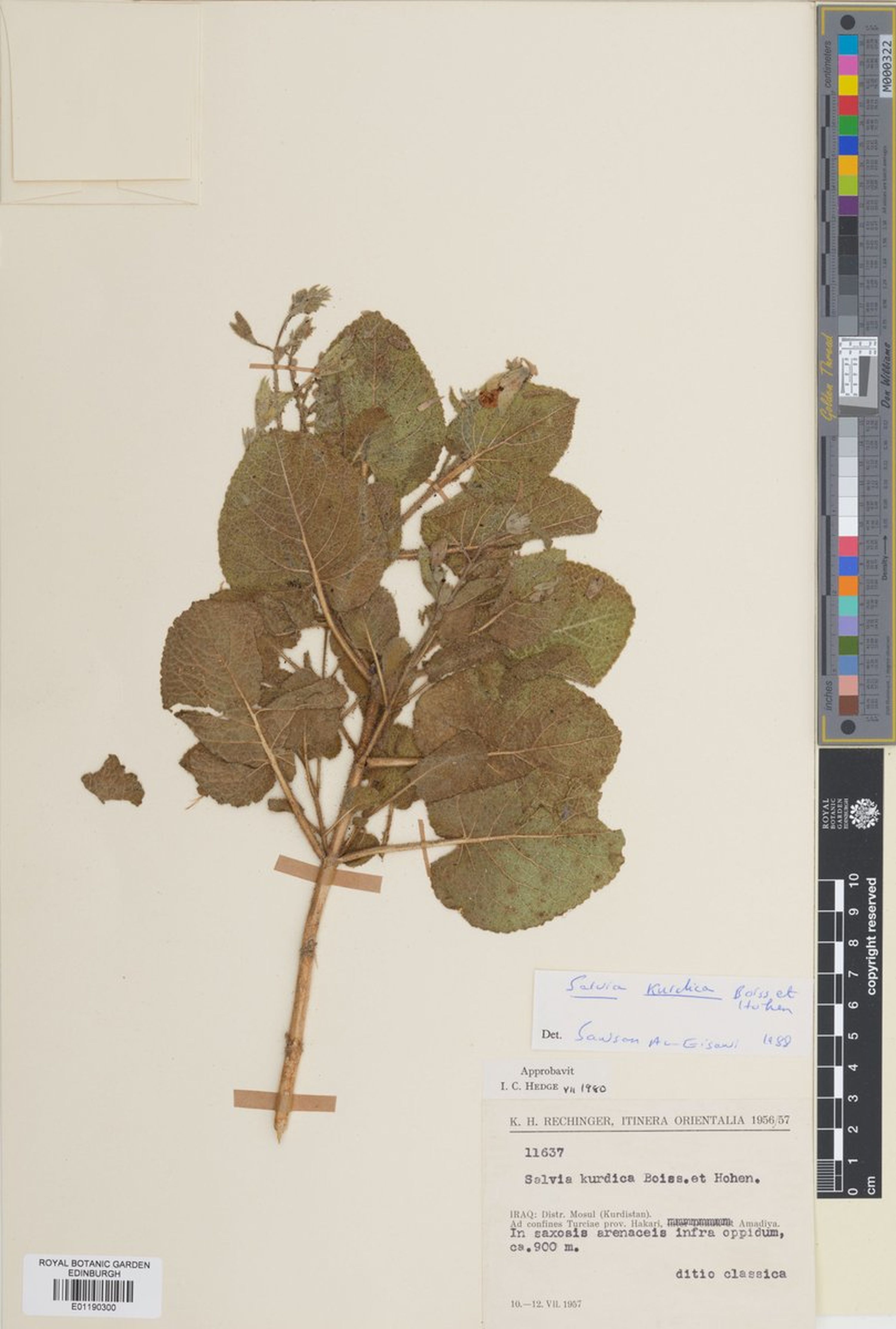
A leaf of Rechinger's gathering has since gone further than any pressed plant could. The duplicate kept in Munich was sampled for DNA, and its sequences are now public in GenBank as Salvia kurdica, voucher "Rechinger 11637 (M)"[10].
Four years later, on 12 July 1961, the botanist A. D. Q. Agnew collected it at Amêdî for the University Herbarium in Baghdad. His habitat note could hardly be shorter: "Town walls"[4]. One hundred and twenty years after Kotschy noted it "right next to the town wall", the sage was still growing there.
Across the border: Mount Cûdî
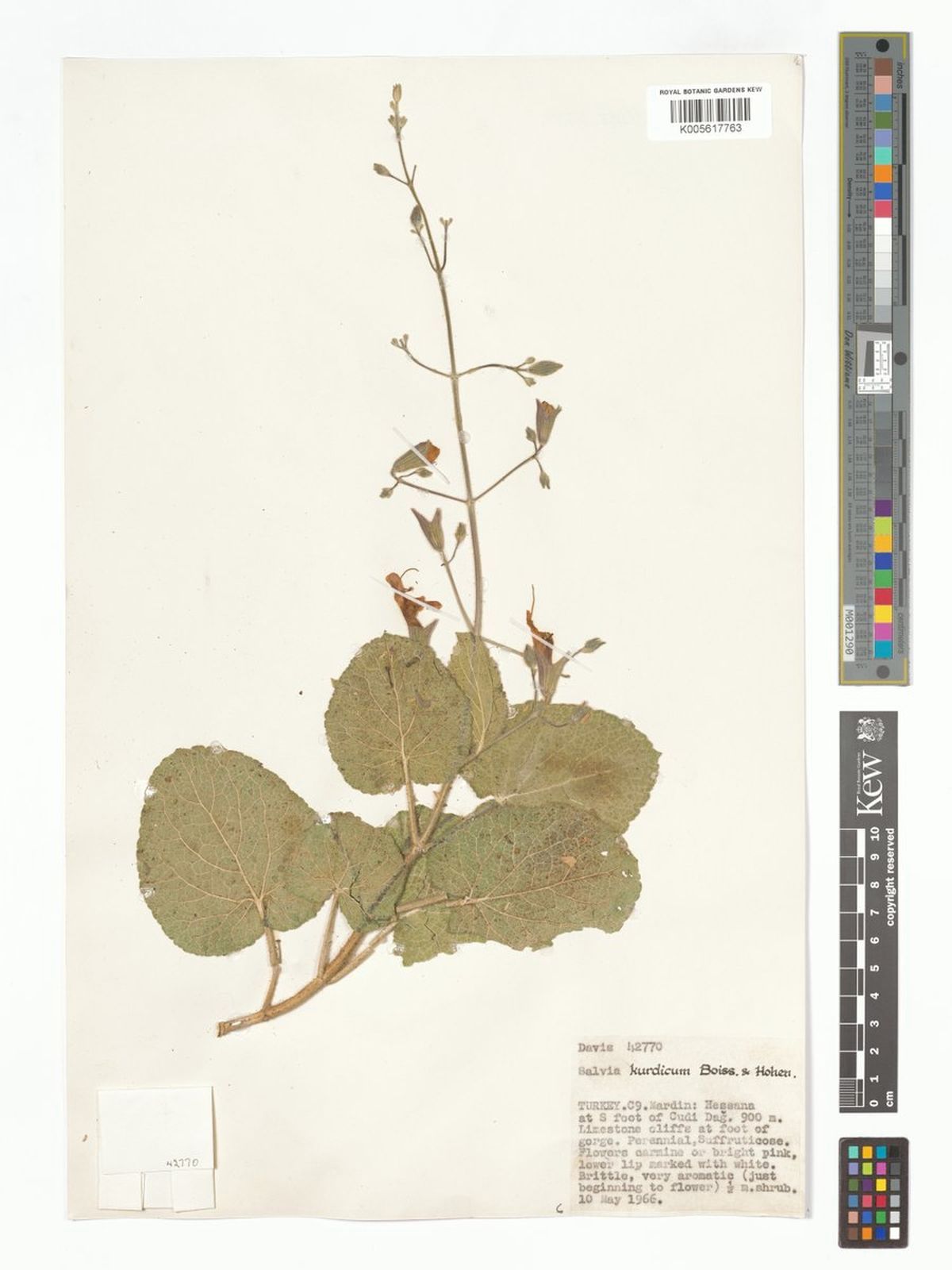
In May 1966, the botanist Peter Hadland Davis (1918–1992)[6], editor of the Flora of Turkey, found the same sage at Hessana, at the southern foot of Mount Cûdî (Cudi Dağı), in North Kurdistan (Bakur), at 900 m[1]. Cûdî is the mountain that Syriac and Islamic tradition name as the resting place of Noah's Ark. His label is the fullest field note on the plant we found:
TURKEY. C9. Mardin: Hessana at S foot of Cudi Dağ. 900 m. Limestone cliffs at foot of gorge. Perennial, Suffruticose. Flowers carmine or bright pink, lower lip marked with white. Brittle, very aromatic (just beginning to flower) ½ m. shrub. 10 May 1966.[1]
The label's "Mardin" is the province of the time; Cûdî lies today in the province of Şirnex (Şırnak).
How to recognise it
No modern flora we could read describes the species in full. Putting together the protologue, Flora Orientalis and the field labels, Salvia kurdica is:
- a low shrub, woody at the base, about half a metre tall, brittle and very aromatic[2][3][1];
- sticky-hairy all over ("viscoso-villosa"), pale green[2][3];
- with long-stalked, broadly ovate, heart-based leaves, round-toothed and wrinkled, the largest about 7.5 × 5 cm[2][3];
- with few flowers to each whorl, usually two, in short, loose side-spikes[2][3];
- a bell-shaped calyx, two-lipped, the upper lip with three tiny teeth and the lower one split into two sharp lobes[2][3];
- and a corolla about twice as long as the calyx, pink ("flos roseus"), carmine or bright pink with white marks on the lower lip[2][1][1].
Where it grows
Every record we found comes from rocks and stony slopes in a narrow band of the Kurdish mountains; where the labels give an altitude, it is 900–940 m:
- Amêdî (Amadiya), Başûr: the type locality: rocks near the town walls (Kotschy 1841), sandy stony ground below the town at about 900 m (Rechinger 1957), "town walls" and stony hillsides (Agnew 1961)[2][3][4][4];
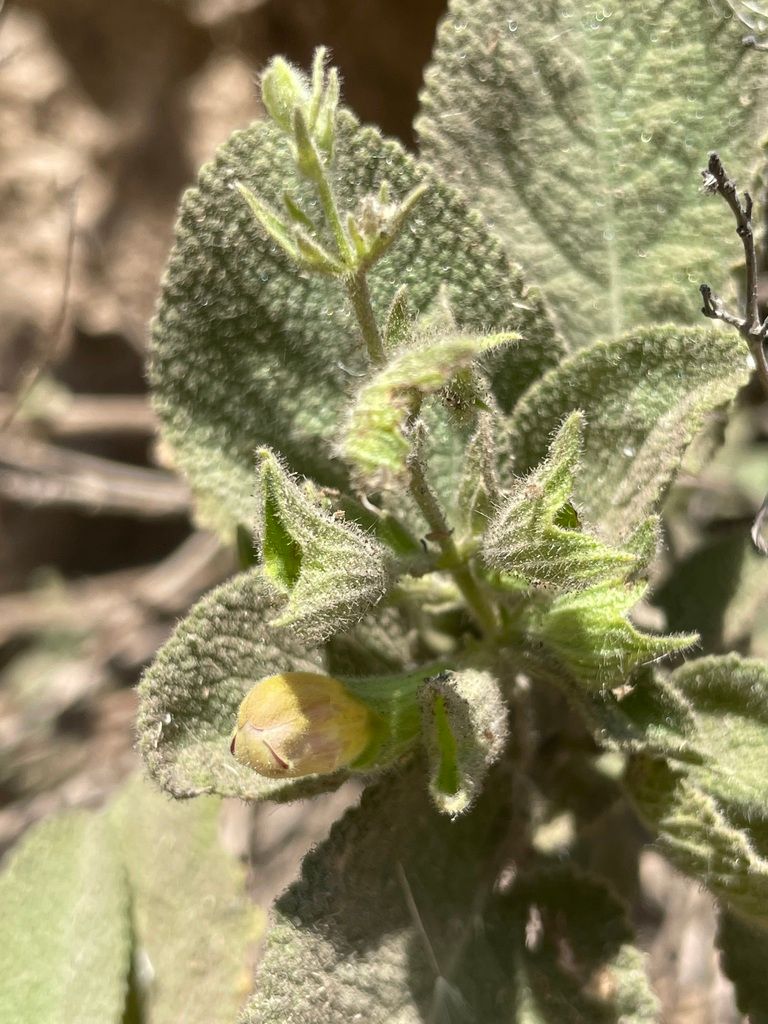
- Akrê (Aqrah), Başûr: limestone at 940 m near a waterfall the label calls "Al-Sieba fall in Aqra" (6 June 1983)[5], and an observation with photographs from July 2024[11];
- Mount Cûdî, Bakur: limestone cliffs at the foot of a gorge at Hessana, 900 m (Davis 1966)[1].
The labels date it in flower from early May, when Davis found it "just beginning to flower", to the end of July, when Kotschy noted its pink flowers[1][1].
According to Sakar Hama and Saman Ahmad of the University of Silêmanî (Sulaimani), Ian Hedge's account of Salvia for Flora Iranica (1982) reported 23 sage species from Başûr, "including the endemic S. kurdica"; with Salvia ali-askaryi, described in 2016, and their own new record S. sclareopsis, they count 25 species there, two of them endemic[12]. Davis's sheet from Cûdî shows that the border does not stop it: Kew's world checklist gives its range as south-eastern Turkey to northern Iraq[13]. Put in Kurdish terms, it is a sage found so far only in the mountains of Başûr and Bakur, on either side of the border.
Kurdish names
No Kurdish name has been recorded from people for Salvia kurdica itself. Ehmedê Dirihî's dictionary of Kurdish plant names lists three dictionary names for it, all built on the pattern "… of the Kurds", like the Latin name[14]:
- çeqleta kurdan, from the Istanbul Kurdish Institute[14];
- çuxletê kurdan, with the place code Çewlîg (Bingöl)[14];
- guhbelê kurdan[14].
The first parts are names Dirihî records for other plants: çeqlet and çuxlet for other sages, Salvia multicaulis and S. nemorosa (çuxlet again from Çewlîg), and guhbel for Phlomis pungens[14]. In the same row, the dictionary's Turkish column reads kürt adaçayı, "Kurdish sage"[14].
For the sages in general, the Kurmancî working group of the Kurdish Institute of Paris lists rihana bejî and rîhana kovî (çiyayî), with the Zazaki form rihana koyî[15]. These are names for the genus, not for this species.
Sources
- 1.Royal Botanic Gardens, Kew – Herbarium Specimens. via GBIF. gbif.orghttps://www.gbif.org/dataset/cd6e21c8-9e8a-493a-8a76-fbf7862069e5
- 2.Bentham, G. (1848). Labiatae. In: de Candolle, A.P., Prodromus Systematis Naturalis Regni Vegetabilis 12. Paris.
- 3.Edmond Boissier (1879). Flora Orientalis, vol. 4. H. Georg, Geneva and Basel (Internet Archive).
- 4.Royal Botanic Garden Edinburgh Herbarium (E), specimen catalogue (via data.rbge.org.uk and GBIF). data.rbge.org.ukhttps://data.rbge.org.uk/herb/
- 5.abUniversity of Basel herbaria, specimen BASBG-00068438 (Baghdad University Herbarium 39810, 1983), via GBIF.
- 6.International Plant Names Index. Royal Botanic Gardens, Kew, Harvard University Herbaria and Australian National Herbarium.
- 7.abDuplicate specimens of Kotschy 347 (1841) in P, G, BM, K, M, GOET, HAL, S, WAG, MO, US and GH, via GBIF.
- 8.↩Alefeld, F. (1862). Ueber die Malveen. Oesterreichische Botanische Zeitschrift 12: 246–261.
- 9.↩Edmondson, J. R. & Lack, H. W. (2006). Karl Georg Theodor Kotschy's itinerary in southern Iran, 1841–42. Willdenowia 36: 579–588, p. 583. doi:10.3372/wi.36.36154https://doi.org/10.3372/wi.36.36154
- 10.↩GenBank sequences KU563821 and KU578212 (voucher Rechinger 11637, M), via GBIF.
- 11.↩iNaturalist. observation 230276635 (Arya Aras, 2024). inaturalist.orghttps://www.inaturalist.org/
- 12.↩Hama, S. Y. & Ahmad, S. A. (2019). Salvia sclareopsis (Lamiaceae), a new record for Iraq. Iranian Journal of Botany 25(2): 120–122. doi:10.22092/ijb.2019.128707.1269https://doi.org/10.22092/ijb.2019.128707.1269
- 13.Plants of the World Online. Royal Botanic Gardens, Kew.
- ↩Salvia kurdica.
- plant_name_id 182960. powo.science.kew.orghttps://powo.science.kew.org/taxon/urn:lsid:ipni.org:names:456491-1accessed 14 November 2026
- 14.Ahmet Kasımoğlu (Ehmedê Dirihî) (2013). Ferhenga Navên Nebatan a Kurdî (Dictionary of Kurdish Plant Names). Mardin Artuklu University, Institute of Living Languages in Turkey (ISBN 978-605-4202-12-6).
- 15.↩Kurmancî 40 (2007). Flora Kurdistanê (II). Institut kurde de Paris. p. 2.
- 16.Ehmedê Dirihî (2007). Flora Kurdistanê (II). institutkurde.orghttps://www.institutkurde.org/publications/kurmanci/
- 17.Edîb Polat (2006). Flora Kurdistanê (I). institutkurde.orghttps://www.institutkurde.org/publications/kurmanci/
- 18.Catalogue of Life, vernacular names via the GBIF Backbone Taxonomy. api.gbif.orghttps://api.gbif.org/v1/species/3898623/vernacularNamesaccessed 14 November 2026
- GBIF occurrence records of herbarium type specimens (per-record URL in each fact). occurrence 1259578553 (MO 2280467); cf. 1322633120 (US 2492377, no. 547). api.gbif.orghttps://api.gbif.org/v1/occurrence/1259578553accessed 14 November 2026
Last updated 20 November 2026