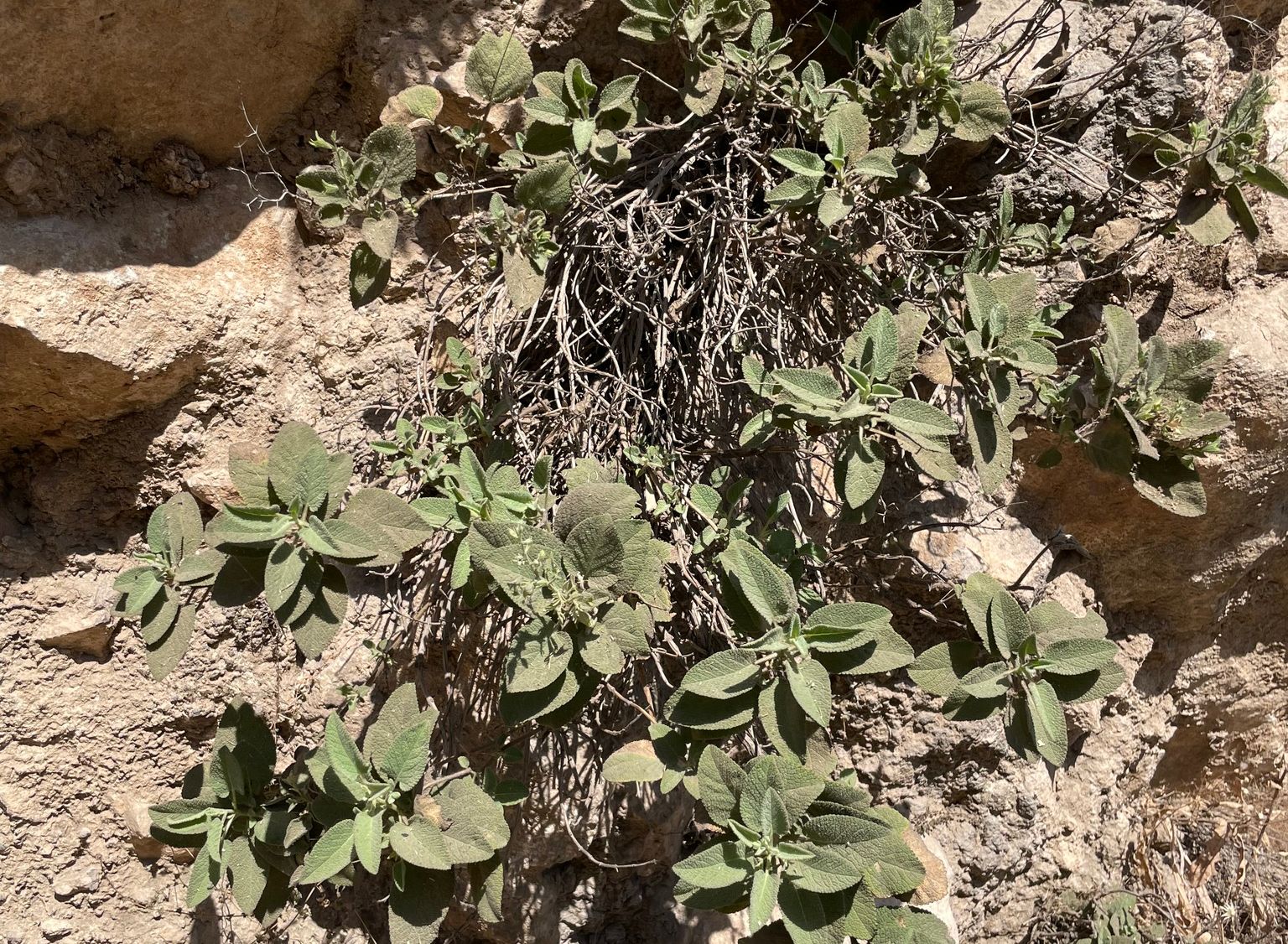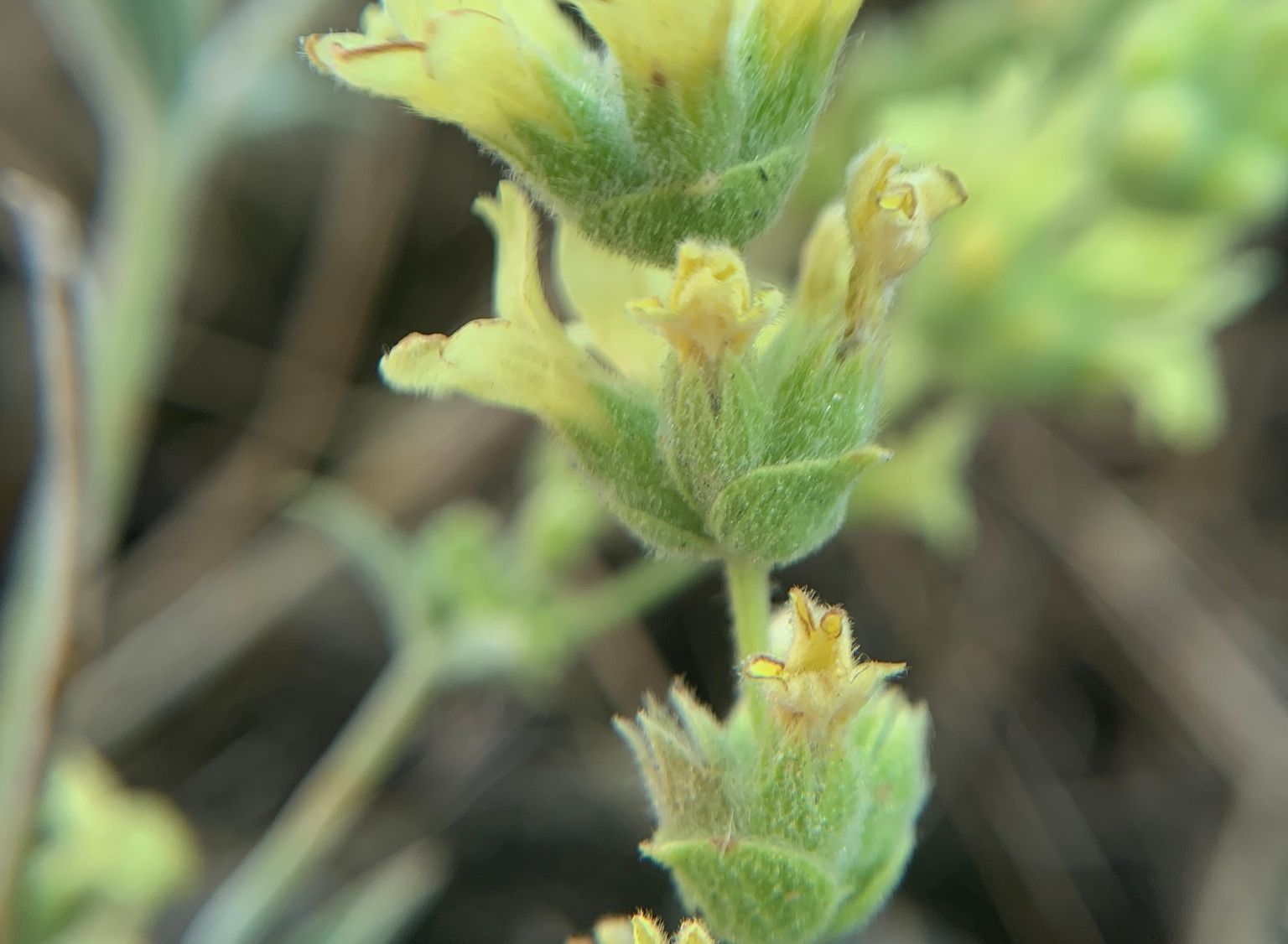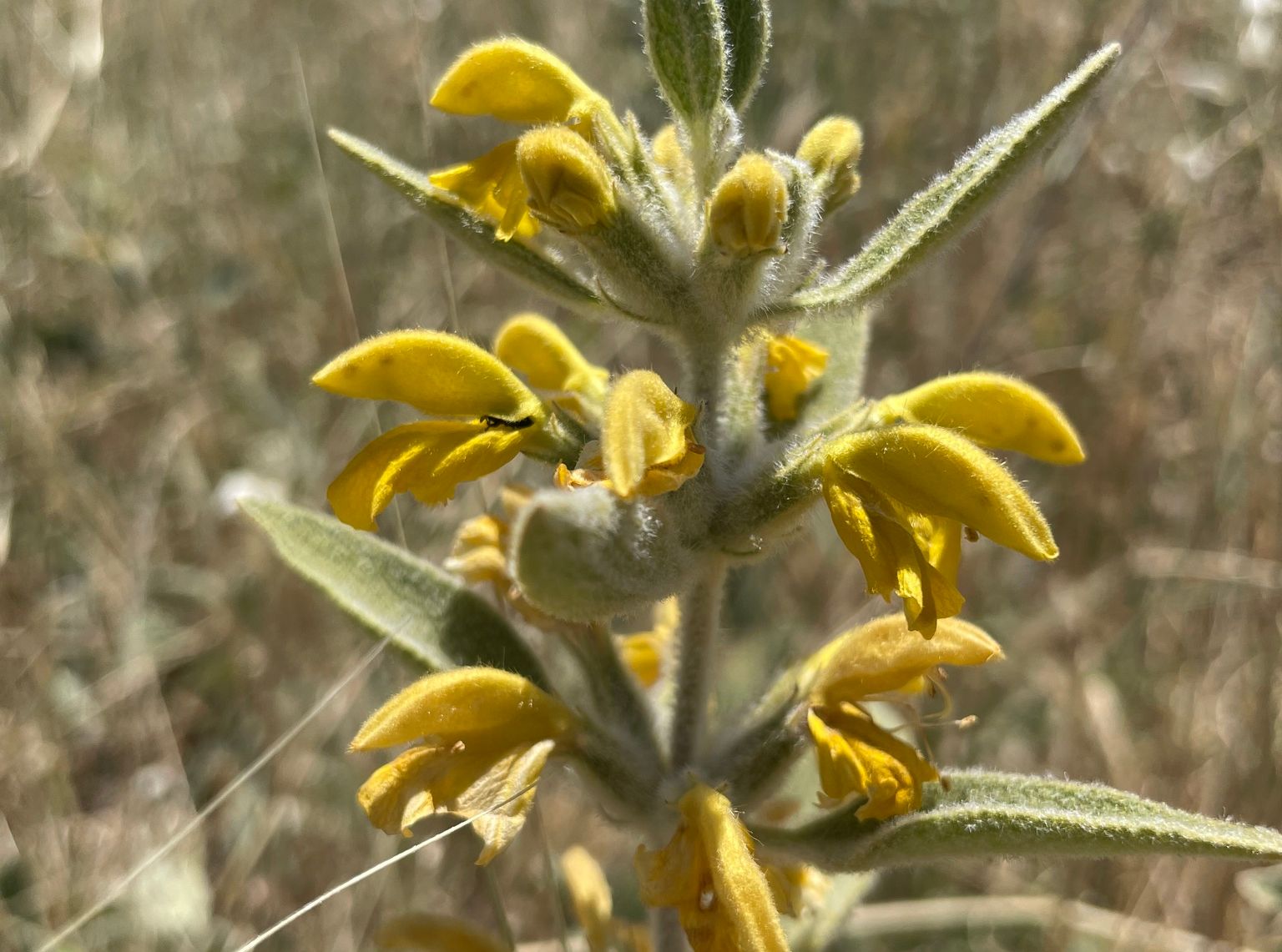
Phlomis kurdica is a grey, woolly perennial of the mint and sage family (Lamiaceae) that carries whorls of large yellow, hooded flowers in late spring[1][2]. It grows on dry hills, field edges and stony ground across much of Kurdistan, from Xarpêt (Harput) and Mêrdîn (Mardin) in the north to Silêmanî (Sulaymaniyah), Sine (Sanandaj) and Kirmaşan (Kermanshah) in the east[3][4][4][5], and in Kurmanji it has a name of its own, sîvanok[6][7].
How it got its name
- Named by
- Rech.f., 1940Published in Oesterr. Bot. Z. 89: 274
"Common at the village of Gumgum"
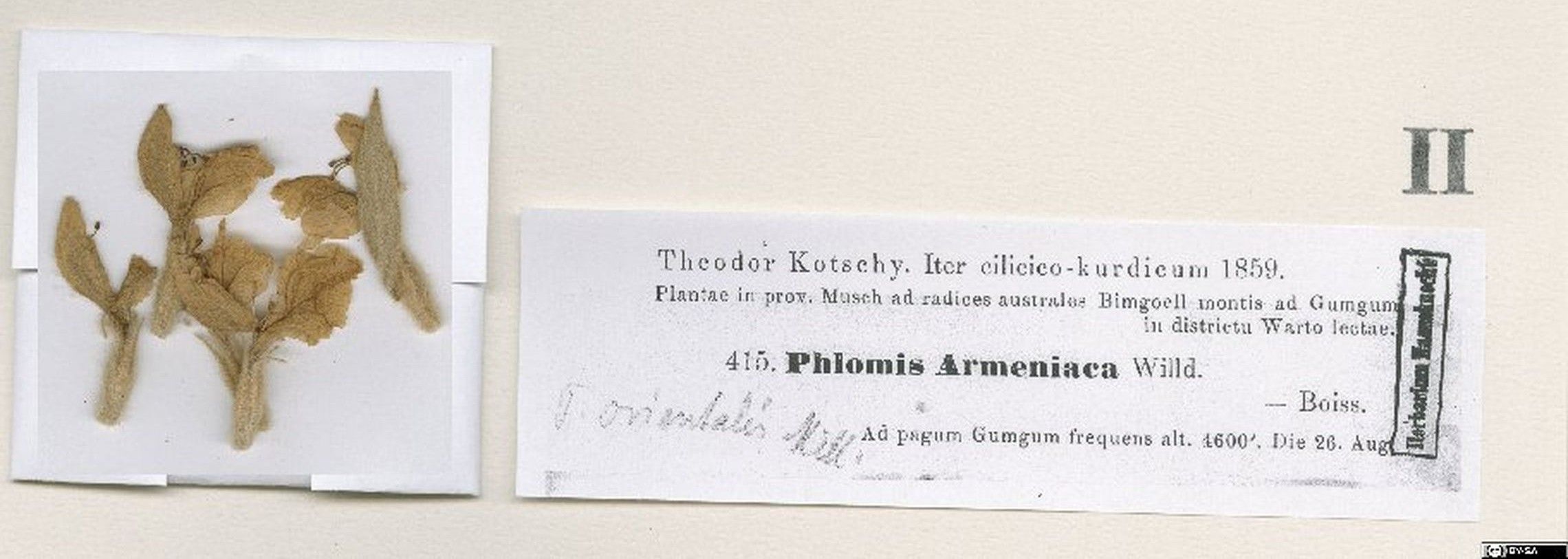
On 26 August 1859 the botanist Theodor Kotschy (1813–1866)[8] was collecting at the southern foot of the Bingöl mountains, at the village he wrote down as Gumgum: Gimgim, today Varto, in the province of Mûş in North Kurdistan (Bakur)[9][10]. He found a Phlomis there and noted that it was common: frequens, at 4,600 feet, about 1,400 m[10].
Kotschy did not take it for a new species. He sent his plants out under the title Iter cilicico-kurdicum, "the journey through Cilicia and Kurdistan", and the printed label of this one, number 415, calls it Phlomis armeniaca, a species that was already known[10]. A later hand pencilled another known name beside it, "P. orientalis"[10].
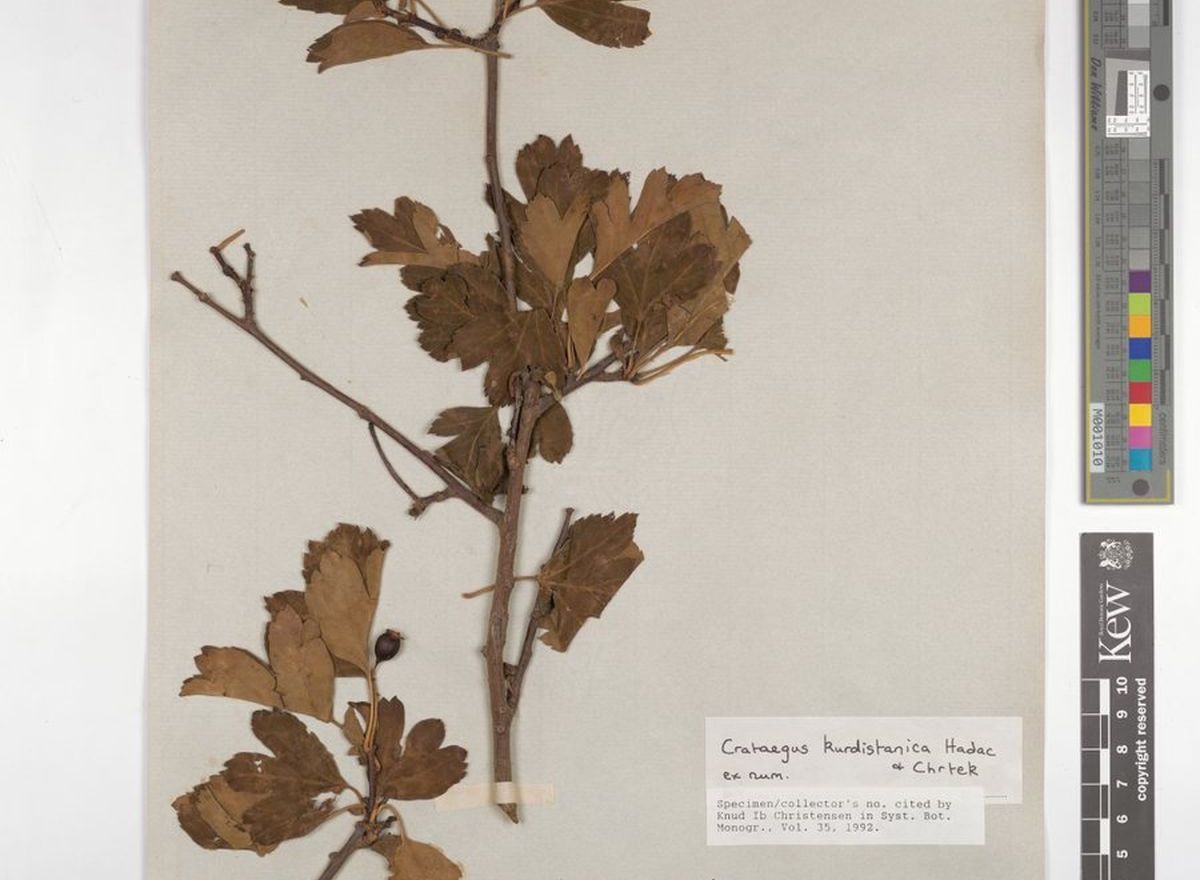
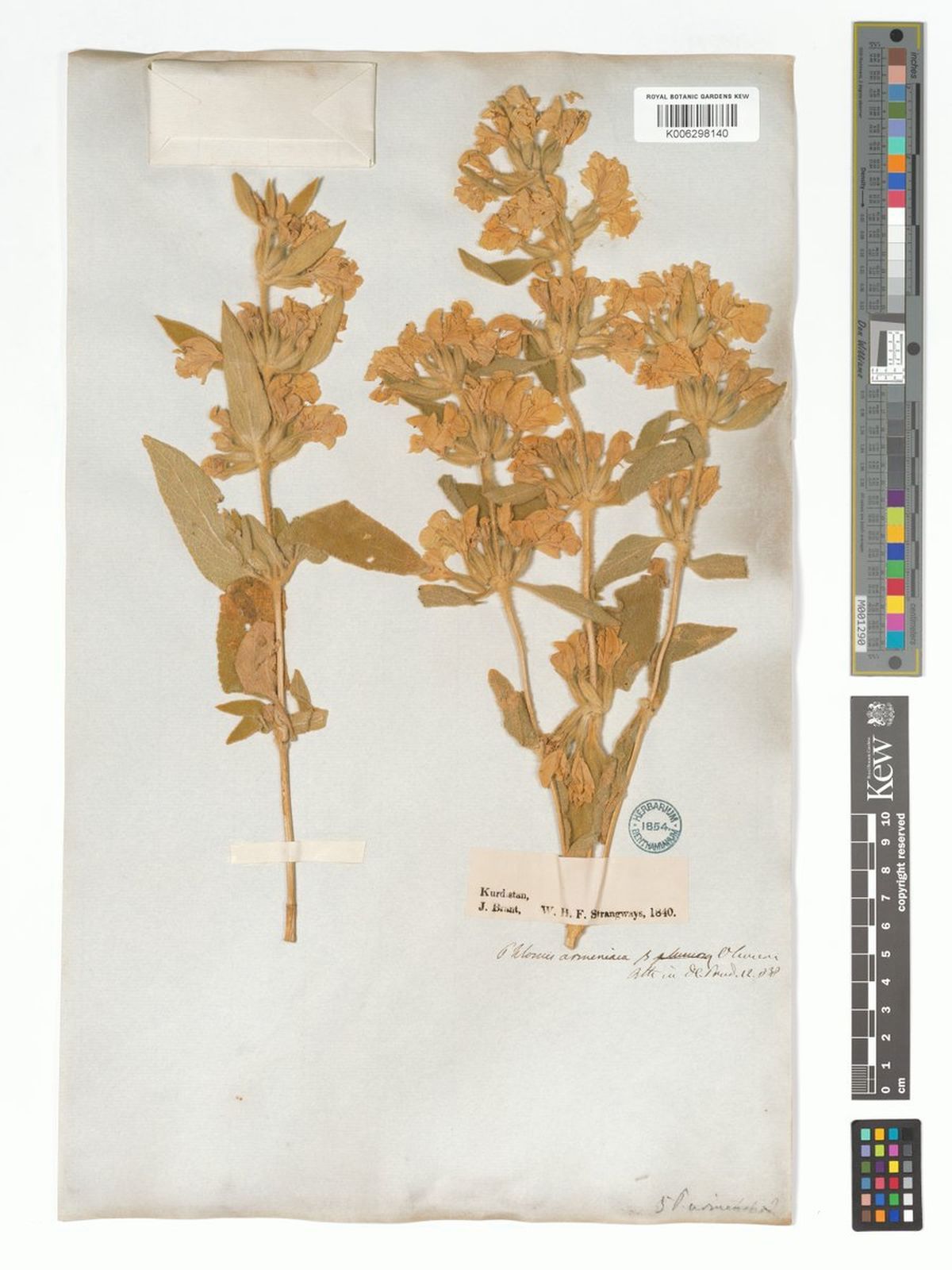
A sheet at Kew now filed as P. kurdica is older still. It carries a small printed label, "Kurdistan, J. Brant, W. H. F. Strangways, 1840", and the stamp of George Bentham's herbarium from 1854; the only name written on it is again Phlomis armeniaca[4].
A name, eighty years later
The plant waited until 1940 for its own name. That year the Vienna botanist Karl Heinz Rechinger (1906–1998)[8] published a critical revision of one group of Phlomis, section Gymnophlomis, and in it he described Phlomis kurdica, "the Kurdish Phlomis"[11][8]. Kotschy's Gimgim gathering became the type, the specimen that fixes the name: the sheet in Geneva is catalogued as the holotype, and duplicates are kept in Jena, Vienna and London[9][3].
The index of plant names summarises where Rechinger's material came from in three words: "Kurdistan", "Mesopotamia", "Syria"[8]. The sheets now kept as type material in Jena and Vienna show what that meant on the ground[3]:
- Heinrich Haussknecht (1838–1903)[8] collected it in May 1867 between Hewlêr (Erbil) and Pirdê (Altun Köprü), and in June 1867 at about 3,000 feet in the Bazyan pass, which his label calls Derbent-i-Basian; in 1865 he had found it on hills near Dîlok (Aintab) and in the desert between Sirûc (Suruç) and Riha (Urfa)[3].
- Paul Sintenis (1847–1907)[8] gathered it in 1888 and 1889 around Mêrdîn, on a sheet labelled "Kurdistania", and on the mountains of Xarpêt[3].
- Joseph Bornmüller (1862–1948)[8] found it in June 1893 in the fields at Enkawa (Ankawa) near Hewlêr, at about 500 m[3].
- In 1910 the Vienna expedition to Mesopotamia collected it near Mosul[3], and an older gathering came from between Homs and Hama in Syria[3].
In the same paper Rechinger described a hybrid between P. kurdica and P. bruguieri, and called it P. × praetervisa, from the Latin for "overlooked"[11][8][5]. In South Kurdistan (Başûr), R. A. Blakelock of Kew later recorded the hybrid as "very common on the lower slopes" of a mountain near Walza, and noted from Kerkûk (Kirkuk) province that it was a "useful grazing plant"[5].
What to look for
A 2025 study by botanists from the University of Garmian in Kelar (Kalar) gives a close description of plants from near Derbendîxan (Darbandikhan) in Başûr[2]:
- branched, upright, square stems 45 to 50 cm tall[2];
- leaves heart-shaped at the base with scalloped edges, the lower ones oblong, about 9–10.5 cm long and 3–5.5 cm wide, covered with white or yellowish hairs[2];
- flowers in whorls of 3 to 9, with five to eight whorls spaced out along each flowering stem[2];
- a hairy, tubular calyx of 14–18 mm, and a yellow, two-lipped corolla 32–35 mm long and densely hairy[2].
Under the lens its felt turns out to be made of several kinds of hairs: simple ones, star-shaped ones and small branched "trees", some of them tipped with glands. The authors note that the glandular, tree-like hairs are unusual for the genus[2].
Where it grows
Kew's checklist gives its range as eastern Turkey to western Iran and on to Israel, with records from Iran, Iraq, Syria and Lebanon, Palestine and Turkey[1]. Most of the herbarium record, though, comes from Kurdistan:
- Bakur: besides Gimgim[9] and the old gatherings at Xarpêt, Mêrdîn and Riha[3], it was collected in the 1950s and 1960s on the road from Mûş to Gimgim, at Pêrtag (Pertek) in Dêrsim, between Amed and Farqîn (Silvan), on Qerejdax (Karacadağ), between Mêrdîn and Nisêbîn (Nusaybin), in wheat fields by the Euphrates near Meletî (Malatya), and on rocky slopes near Albistan (Elbistan)[4].
- Başûr: in the 1930s in a cornfield and on stony red loam at Hewlêr, on a stony hillock between Mosul and Êsfinê (Ain Sifni) and in a field nearby[5]; in a 2016 survey at Mashe village in the district of Amêdî, in meadows and forest at 983 m[12]; in 1867 in the Bazyan pass at about 3,000 feet[3]; and in 2024 along roads near Derbendîxan in Silêmanî governorate, at 545 and 682 m[2].
- East Kurdistan (Rojhilat): Rechinger himself collected it again in 1971 and 1974, on roadsides and dry hills 64 km west of Sine towards Merîwan (Marivan), north of Seqiz (Saqqez), and in abandoned fields and on stony slopes near Mehabad (Mahabad)[4]. Another sheet comes from near Kirmaşan[4].
Its places are dry and open: hills "between rocky slopes and steppe vegetation"[2], stony hillsides, field margins, fallow land and roadsides[4][4][5]. The 2025 study describes its sites as having hot, dry summers and freezing winters[2].
Flowering
Near Derbendîxan it flowers from late April to early June[2]. Elsewhere it can be found in flower much later: the plants Kotschy gathered at Gimgim at the end of August still carry flowers[10]. Rechinger's gatherings in Rojhilat were made in June and July[4].
Uses
In the district of Amêdî, a survey of plant knowledge in 2016 recorded that its stems and leaves are boiled and the liquid drunk; the use is given as "fever recover after giving birth"[12].
The plant yields an essential oil. Studies of plants from Kordestan province in Rojhilat and from Turkey found germacrene D as a main component, and the oil showed moderate activity against the yeast Candida albicans in the lab[13][14].
These are records of traditional use and laboratory studies, not medical advice.
Kurdish names
Sîvanok is the Kurmanji name given to Phlomis kurdica in Edîb Polat's list "Flora Kurdistanê", published by the Kurdish Institute of Paris in 2006, which glosses it in English as "Kurdish sage"[6]. The next instalment of the list, in 2007, shows sîvanok again, next to a drawing of the plant[7]. In the same list the large-flowered P. grandiflora is guhbelok[6].
Ehmedê Dirihî's dictionary of Kurdish plant names (2013) chose this plant as one of its two examples of a scientific name that refers to the Kurds; the other is Orobanche kurdica. In its introduction he writes that Phlomis kurdica is called "kurdish sage" in English, "Phlomis du kurdistan" in French and "munzur çalbası" in Turkish, and that Kurds, too, can call it "guhbeloka kurdan" or "sîvanoka kurdîstanê"[15]. His word list gives these dictionary names, "… of the Kurds", in several spellings: guhbelokê kurdan, sîvanokê kurdan, sîlvanokê kurdan, sêvanokê kurdan and sîvenokê kurdan[15]. He also lists gubel, a name he gives in his Turkish column too[15].
For the genus Phlomis as a whole, Dirihî gives heşelûre and kaşesor[15].
In the 2016 Amêdî survey, the local-name column gives only "phloms", the Latin genus name[12].
Not used, for the record: the protologue[11] (paywalled, unread); the English name "Kurdish Lampwick" (only in the Catalogue of Life list, no flora or paper).
Sources
- 1.Plants of the World Online. Royal Botanic Gardens, Kew.
- abPhlomis kurdica Rech.f.
- plant_name_id 152281. powo.science.kew.orghttps://powo.science.kew.org/taxon/urn:lsid:ipni.org:names:453933-1accessed 14 November 2026
- 2.Ahmed, I. H., Darwish, K. F. & Wahid, C. F. (2025). Morphological and anatomical study of Phlomis kurdica (Lamiaceae) in Kurdistan Region of Iraq. ZANCO Journal of Pure and Applied Sciences 37(2): 22–32. doi:10.21271/ZJPAS.37.2.3https://doi.org/10.21271/ZJPAS.37.2.3
- 3.abcdefghijType material of Phlomis kurdica in the herbaria of Jena (JE), Vienna (W), Geneva (G) and London (BM), via GBIF.
- 4.Royal Botanic Gardens, Kew – Herbarium Specimens. via GBIF. gbif.orghttps://www.gbif.org/dataset/cd6e21c8-9e8a-493a-8a76-fbf7862069e5
- 5.abcdeBlakelock, R. A. (1949). The Rustam Herbarium, 'Iraq. Systematic List. Part III. Kew Bulletin 4(4): 528.
- 6.abcEdîb Polat (2006). Flora Kurdistanê (I). institutkurde.orghttps://www.institutkurde.org/publications/kurmanci/
- 7.abEhmedê Dirihî (2007). Flora Kurdistanê (II). institutkurde.orghttps://www.institutkurde.org/publications/kurmanci/
- 8.International Plant Names Index. Royal Botanic Gardens, Kew, Harvard University Herbaria and Australian National Herbarium.
- 9.Conservatoire et Jardin botaniques de Genève (G) – Herbarium. via GBIF.
- abcherbarium specimen G00330341 (holotype, Kotschy 415), via GBIF.
- G00330341 (GBIF occurrence 1144563685), Holotype. api.gbif.orghttps://api.gbif.org/v1/occurrence/1144563685accessed 14 November 2026
- G00330341. api.gbif.orghttps://api.gbif.org/v1/occurrence/1144563685accessed 14 November 2026
- 10.abcdeHerbarium Haussknecht, Jena (JE), specimen records (JACQ) via GBIF. Jena, herbarium specimen JE00018344 (isotype, Kotschy 415), via GBIF. api.gbif.orghttps://api.gbif.org/v1/occurrence/3028980654
- 11.abcRechinger, K. H. (1940). Kritische Revision von Phlomis Sect. Gymnophlomis Benth. Österreichische Botanische Zeitschrift 89: 257–298. doi:10.1007/BF01514017https://doi.org/10.1007/BF01514017
- 12.Shimal Ahmed Tahir (2017). Plant biodiversity and ethnobotanical properties of various plants in Amedi (Duhok, N. Iraq). tez.yok.gov.trhttps://tez.yok.gov.tr/UlusalTezMerkezi/
- 13.↩Nikan, M., Saeidnia, S., Manayi, A. & Saadatmand, S. (2017). Essential oils of four Phlomis species growing in Iran: chemical composition, antimicrobial and antifungal activity. Progress in Nutrition 19(1-S): 75–79. doi:10.23751/pn.v19i1-S.5406https://doi.org/10.23751/pn.v19i1-S.5406
- 14.↩Karadağ, A. E., Demirci, B., Kültür, Ş., Demirci, F. & Başer, K. H. C. (2020). Antimicrobial, anticholinesterase evaluation and chemical characterization of essential oil Phlomis kurdica Rech. fil. growing in Turkey. Journal of Essential Oil Research 32(3): 242–246. doi:10.1080/10412905.2020.1743786https://doi.org/10.1080/10412905.2020.1743786
- 15.Ahmet Kasımoğlu (Ehmedê Dirihî) (2013). Ferhenga Navên Nebatan a Kurdî (Dictionary of Kurdish Plant Names). Mardin Artuklu University, Institute of Living Languages in Turkey (ISBN 978-605-4202-12-6).
- 16.Catalogue of Life, vernacular names via the GBIF Backbone Taxonomy. api.gbif.orghttps://api.gbif.org/v1/species/3887557/vernacularNamesaccessed 14 November 2026
- iNaturalist. observation 238277516 (Arya Aras, 2024), photo only. inaturalist.orghttps://www.inaturalist.org/
Last updated 20 November 2026