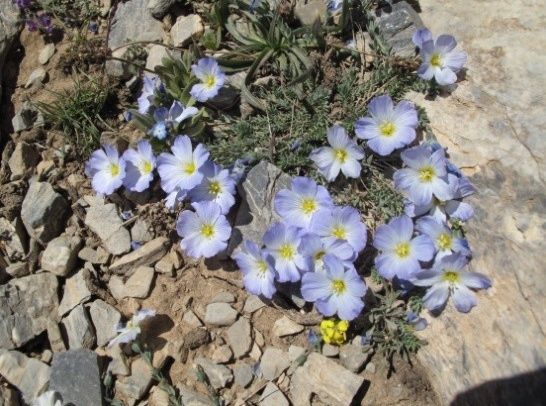
Linum kurdicum is a small wild flax of the high mountains of Kurdistan. It hugs the rock above 3,000 metres, a woody stock sending out short, grey-green stems that lie flat on the ground, and in July it opens flowers of a clear sky blue, paler towards the centre[1][2]. It is known from a handful of summits around Wan (Van) and Colemêrg (Hakkâri) in North Kurdistan (Bakur), and since 2014 also from the mountains west of Lake Urmia in East Kurdistan (Rojhilat)[1][3][4].
How it got its name
- Named by
- (P.H.Davis) Naum.-Svetl., 2016Published in Novosti Sist. Vyssh. Rast. 47: 56
Summer 1954: a blue flax on four mountains
In the summer of 1954 the botanist Peter Hadland Davis (1918–1992)[5] was collecting for what would become the Flora of Turkey, together with O. Polunin[1]. Their route through the mountains of Bakur took them up four peaks, and on every one they found the same low blue flax[1]:
- on Artos Dağ above Westan (Gevaş), on 15 July, at 3,500 m on exposed slopes, and lower down, at 3,000–3,300 m, growing up through the cushions of the thorny sainfoin Onobrychis cornuta;
- on Kavussahap Dağ in the district of Çatak, on 23 July, at 3,400 m on the summit ridge;
- on Ispiriz Dağ near Elbak (Başkale), at the end of July (30 July in Davis's paper, 31 July on the labels), at 3,400 m on a rocky slope of the north ridge;
- and on Cîlo (Cilo Dağ), 10 km west of its highest peak, on 9 August, at 3,500 m on a rocky limestone ridge.
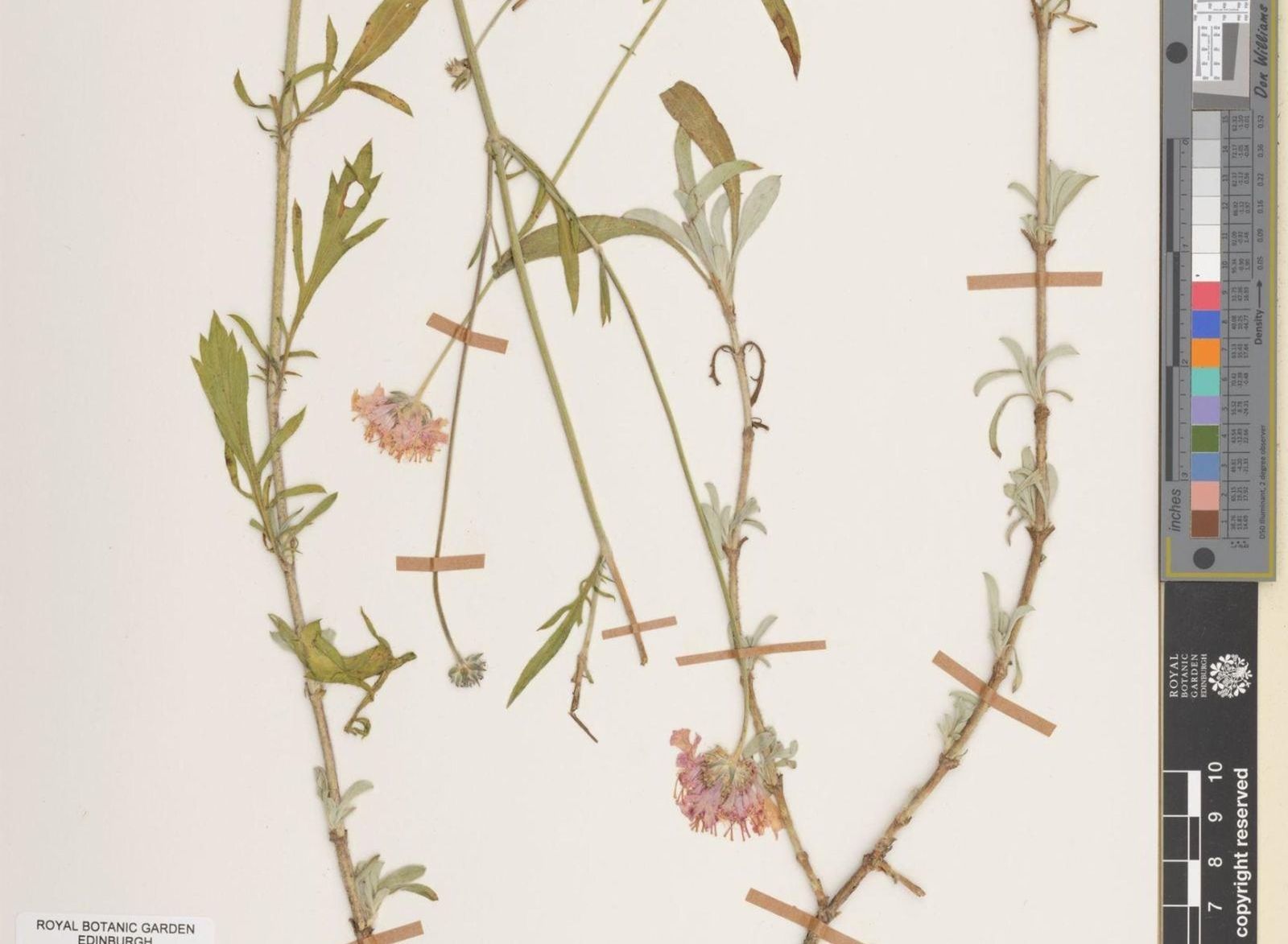
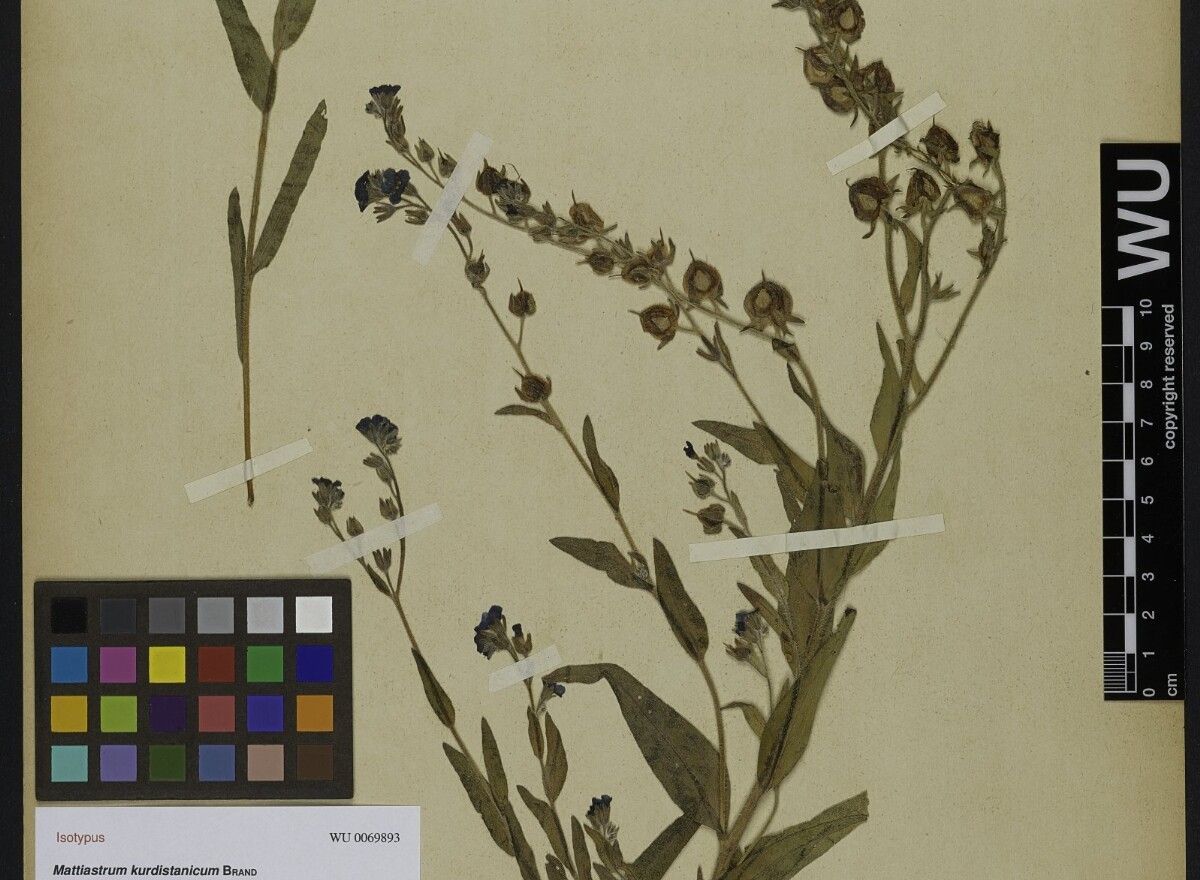
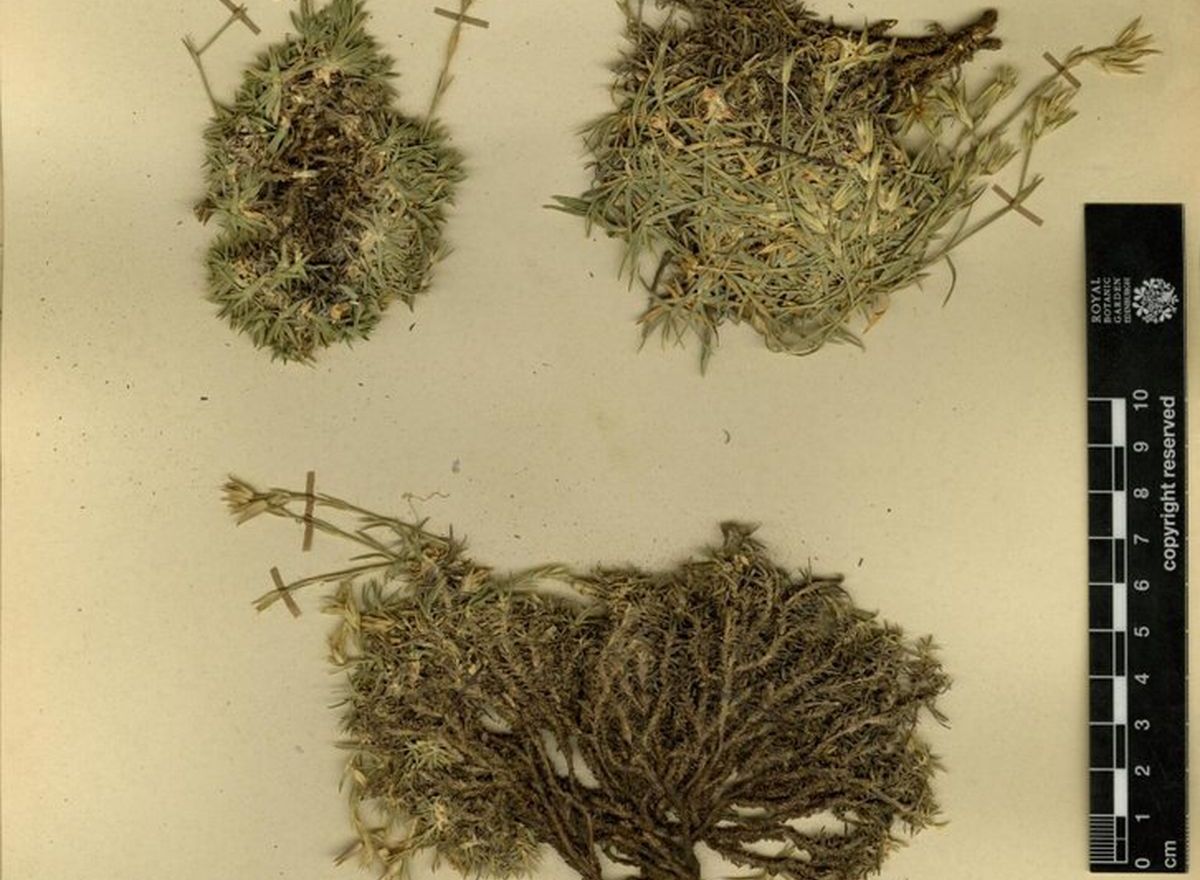
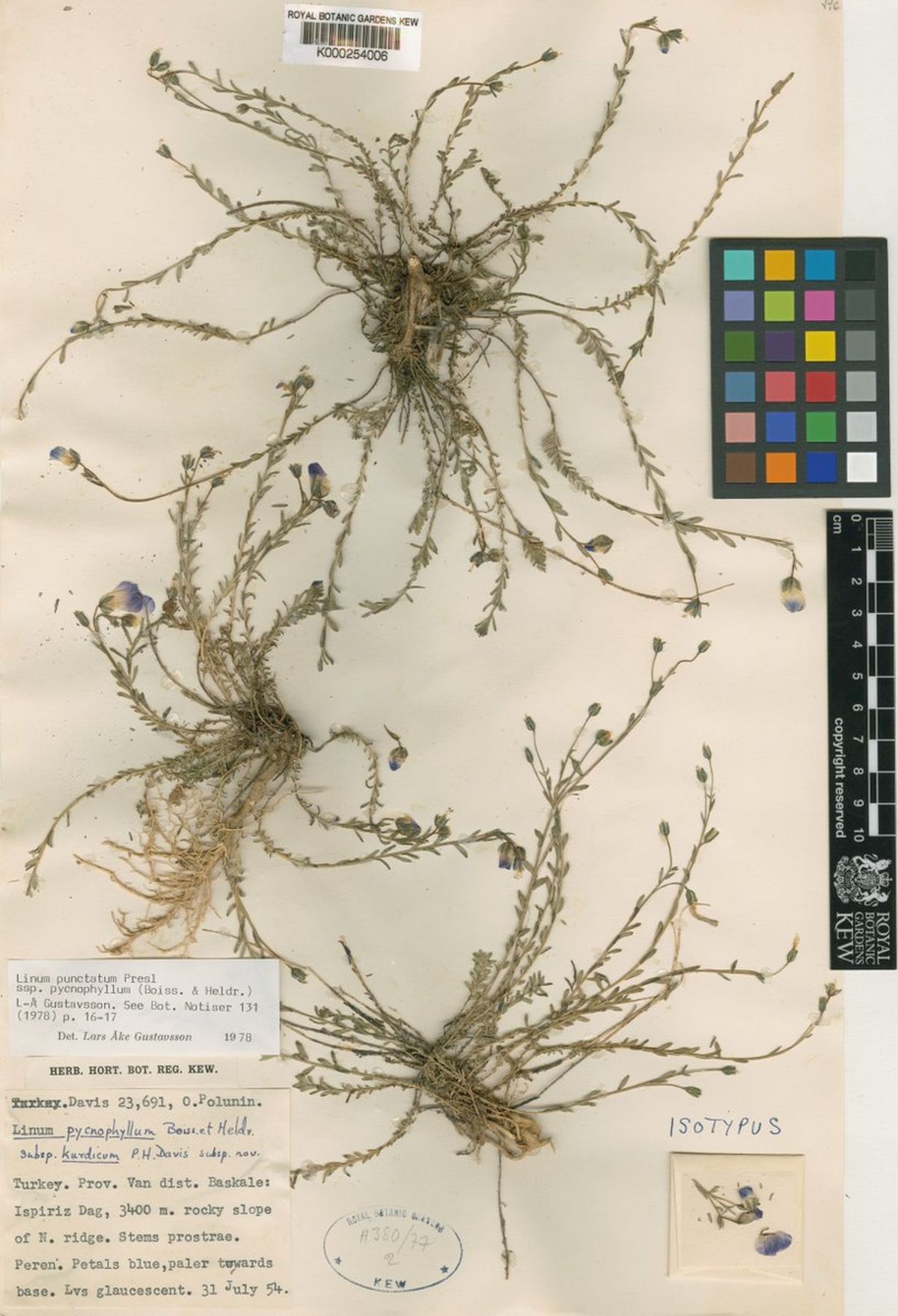
The Ispiriz gathering, Davis & Polunin no. 23691, became the type, the specimen the name is tied to. Davis's field notes are typed on its labels: "stems prostrate. Perennial. Petals blue, paler towards base; leaves glaucescent", that is, with a bluish-grey bloom[2][6]. Sheets of it went to Edinburgh, Kew, London, Geneva and Yerevan[7][2][6][8].
"The Kurdish plant"
Davis published the flax in 1957, in his Materials for a Flora of Turkey[1]. He headed the type citation "TURKEY (Kurdistan)", and in his discussion he simply calls it "the Kurdish plant"[1]. The name he gave it, kurdicum, means "Kurdish".
What puzzled him was its closest relative. The plant looked almost exactly like Linum pycnophyllum, which Davis described as "a rare alpine plant confined to Greece"[1]. Finding "a closely related Irano-Turanian race in S.E. Turkey, 1800 km. away" was, he wrote, "rather surprising"[1]. The differences were slight: in the Kurdish plant the stems mostly lie pressed flat on the ground rather than trailing, are less wavy, and carry fewer, less crowded leaves[1]. He had never seen the fruit of the Greek plant, but in all other characters, he wrote, the Kurdish plant "so closely resembles the Greek that I have no hesitation in including it within that species"; indeed, he admitted, "subspecific rank might not have been assigned to it if the geographical disjunction had not been so marked"[1]. So he described it as a subspecies, Linum pycnophyllum subsp. kurdicum[1][5].
In his key to the Turkish flaxes of its section, Davis set it beside a neighbour from the same mountains, Linum meletonis, which Handel-Mazzetti had found in 1910 on Meleto Dağ in Sasûn (Sason) and which Davis thought "apparently endemic to Turkish Kurdistan"; he and Polunin gathered that one too in 1954, in the mountains of Bedlîs (Bitlis) and Colemêrg[1]. The Kurdish flax keys out by its "plants typically prostrate", its capsule only 5–6 mm long and its blunt, crowded leaves[1].
Subspecies, species, subspecies, species
The name has moved three times since.
In 1978 the botanist Lars Åke Gustavsson joined the Greek flax to a Sicilian one, Linum punctatum. He judged Davis's differences too slight to keep the Kurdish plant apart[9], and his determination slip, dated 1978, is still glued to the Kew sheet of the type, renaming it Linum punctatum subsp. pycnophyllum[6]. (Davis himself had already noted how close the Greek plant was to "the Sicilian L. punctatum", a species, he added, with more pointed leaves and sepals and larger capsules than the Kurdish plant[1].) Taken in this broad sense, Maroofi and Gholipour write, L. punctatum is restricted to a few mountains in Sicily, in Greece (Mt Smolika) and in Turkey[3].
In 1982 the botanists Greuter and Burdet gave the Kurdish flax its own place again, as Linum punctatum subsp. kurdicum[5]. And in 2016 A. A. Naumenko-Svetlova raised it to a species of its own, Linum kurdicum, in her review of the flaxes of section Adenolinum[7]. That is the name Kew's checklist accepts today[10]. In the same paper she counted a flax from the Gomara region of northern Morocco, described in 1931, as the same species, so that her L. kurdicum grows in Turkey and Morocco[7]. Kew's checklist does not follow her there: it gives the species' range as eastern Turkey to north-western Iran only[10].
Not everyone has followed the change. A 2020 study by Semiz and Yılmaz still lists Davis's Kurdish gatherings under the Greek-Sicilian subspecies pycnophyllum[9].
How to recognise it
From Davis's Latin description and the later accounts[1][7][3]:
- a perennial with a stout, woody stock, from which grow many short stems, mostly lying flat on the ground, 6–12 cm long (8–13 cm in the plants from Rojhilat[3]), densely leafy;
- leaves narrowly oblong, blunt, thick, glaucous (grey-green with a bluish bloom), 5–9 mm long and 1–2 mm wide, with one faint vein;
- 1 to 5 flowers on each stem, mostly three in the plants from Rojhilat[3];
- sepals 3–5 mm long, hardly veined, the outer ones oblong, the inner ones broadly elliptic and blunt;
- petals blue, 11–15 mm long, their edges overlapping[1]; in the plants from Rojhilat obovate, with a short claw of about 2 mm at the base[3];
- a small, egg-shaped capsule 5–6 mm long, on a stalk that stays upright in fruit[1][3].
Maroofi and Gholipour describe it as heterostylous: some plants have flowers with long styles, others with short ones[3].
Not every plant keeps flat. On Artos Dağ, where it grew up through thorny cushions, Davis found plants with ascending or upright stems, an "erect habitat form up to 30 cm. tall"[1].
In an English garden
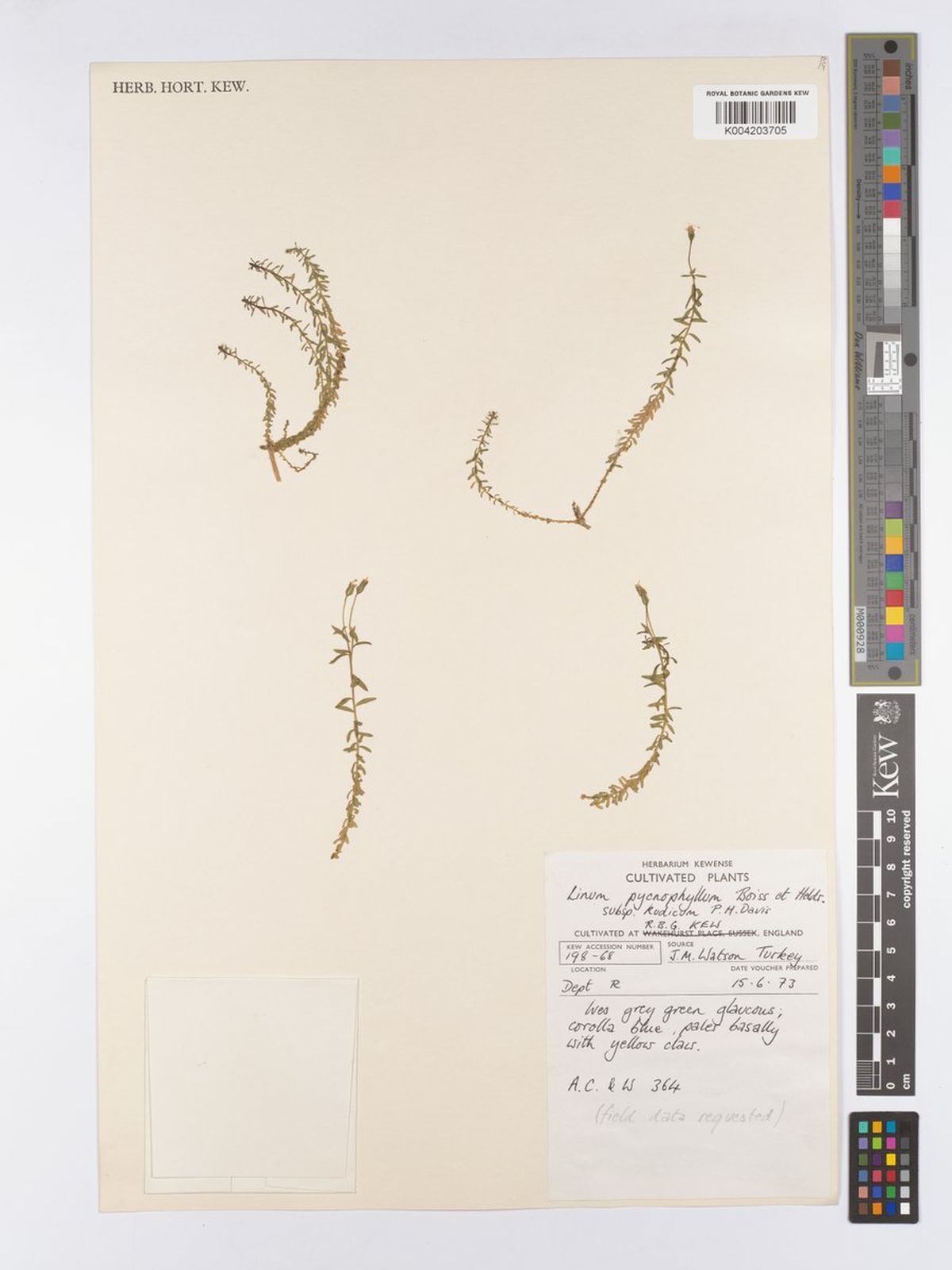
The Kurdish flax has also been grown far from its mountains. A sheet at Kew, labelled "Cultivated Plants", was pressed on 15 June 1973 from a plant grown in the gardens at Kew, raised from J. M. Watson's collection from Turkey[6]. Its notes describe the leaves as "grey green glaucous" and the corolla as "blue, paler basally with yellow claw": the yellow is at the narrow base of each petal[6].
Where it grows
Kew's checklist gives its range as eastern Turkey to north-western Iran[10]. In Kurdish terms, that is a plant of the high mountains of Bakur and Rojhilat:
- Bakur: Davis's four mountains of 1954 around Wan and Colemêrg[1]; and Başet Dağ near Gürpınar in the Wan region, where M. Ünal collected it at 3,500 m on 24 July 2002[9].
- Rojhilat: in 2012 and 2013 A. Gholipour and Amini Rad collected it on Chighidarreh Mountain near Silveh, in the district of Pîranşar (Piranshahr), at 3,370 m, and on Avrin Mountain near Xoy (Khoy), at 3,143 m; Maroofi and Gholipour identified it among the specimens in the herbarium of the agricultural and natural-resources research centre of Kurdistan province in Sine (Sanandaj), and reported it as new to Iran in 2014[3]. Their paper also carries a photograph of the plant in its natural habitat, the one at the top of this page[3]. In 2016 J. Noroozi gathered it on Kuhe Shahidan near the village of Darband in the Ûrmiye (Urmia) area, at 3,450 m[4].
It is a plant of the alpine zone: rocky and stony slopes, ridges and summits, from about 3,000 to 3,500 m in the records we read[1][3][9][4]. Naumenko-Svetlova gives a wider band, 1,900–3,500 m, for her broader species, including the Moroccan plant[7]. It flowers in June and July[7], and the Kurdish gatherings were made between early July and early August[1][3][4].
In July 2024 an iNaturalist user photographed a mat of blue flaxes with yellow centres near Gever (Yüksekova) in Colemêrg and posted it under the older name L. punctatum subsp. pycnophyllum[11]. No one else has confirmed the identification yet, so it is a lead, not a record; it would fit the known range.
Its names in Kurdish
No Kurdish name was recorded with any of the specimens. Ehmedê Dirihî's dictionary of Kurdish plant names gives several dictionary names for it, each ending in kurdan, "of the Kurds", and each glossed in Turkish kürt keteni, "Kurdish flax"[12]:
- bezerekê kurdan[12];
- ketenê kurdan, also ketanê kurdan[12];
- kitana kurdan[12];
- şadanika kurdan, also zegereka kurdan[12];
- zerereka kurdan[12].
These are dictionary names rather than names collected from people who know this mountain flax.
Sources
- 1.Davis, P. H. (1957). Materials for a Flora of Turkey II: Linum Linn. Notes from the Royal Botanic Garden Edinburgh 22(3): 135 ff. (L. pycnophyllum subsp. kurdicum, pp. 138–139).
- 2.abcInstitute of Botany, National Academy of Sciences of Armenia, herbarium specimen ERE 0004425 (isotype; via GBIF).
- 3.Maroofi, H. & Gholipour, A. (2014). Two new records from the genera Linum and Ranunculus for the flora of Iran. Iranian Journal of Botany 20(1): 25–28.
- 4.abcdNatural History Museum Vienna (W) – Herbarium. via GBIF, herbarium specimen W 2017-0006007 (via GBIF).
- 5.International Plant Names Index. Royal Botanic Gardens, Kew, Harvard University Herbaria and Australian National Herbarium.
- abcLinum pycnophyllum subsp. kurdicum P.H.Davis; Linum punctatum subsp. kurdicum (P.H.Davis) Greuter & Burdet; author record P. H. Davis.
- urn:lsid:ipni.org:names:77161431-1. ipni.orghttps://www.ipni.org/n/77161431-1accessed 14 November 2026
- 6.Royal Botanic Gardens, Kew – Herbarium Specimens. via GBIF. gbif.orghttps://www.gbif.org/dataset/cd6e21c8-9e8a-493a-8a76-fbf7862069e5
- 7.Naumenko-Svetlova, A. A. (2016). Taxonomic review of the genus Linum L. section Adenolinum (Rchb.) Juz. (Linaceae). Novosti Sistematiki Vysshikh Rastenii 47: 40 ff. (L. kurdicum, p. 56).
- 8.↩Natural History Museum, London, BM000795275, and Conservatoire et Jardin botaniques de Genève, G00368617 (isotypes; via GBIF).
- 9.Semiz, G. & Yılmaz, Ö. (2020). A new distribution area of Linum punctatum Presl subsp. pycnophyllum (Boiss. & Heldr.) Gustavsson (in Turkish). Bağbahçe Bilim Dergisi 7(2): 29–33.
- 10.Plants of the World Online. Royal Botanic Gardens, Kew.
- abcLinum kurdicum (P.H.Davis) Naum.-Svetl.
- plant_name_id 3015070. powo.science.kew.orghttps://powo.science.kew.org/taxon/urn:lsid:ipni.org:names:77161431-1accessed 14 November 2026
- 11.↩iNaturalist. observation 394940796 (Gever, July 2024; identification unconfirmed). inaturalist.orghttps://www.inaturalist.org/
- 12.Ahmet Kasımoğlu (Ehmedê Dirihî) (2013). Ferhenga Navên Nebatan a Kurdî (Dictionary of Kurdish Plant Names). Mardin Artuklu University, Institute of Living Languages in Turkey (ISBN 978-605-4202-12-6).
- 13.Edîb Polat (2006). Flora Kurdistanê (I). institutkurde.orghttps://www.institutkurde.org/publications/kurmanci/
- 14.Ehmedê Dirihî (2007). Flora Kurdistanê (II). institutkurde.orghttps://www.institutkurde.org/publications/kurmanci/
- Herbarium ERE, sheet 0004425 (Linum pycnophyllum subsp. kurdicum, isotype; Davis 23691), via GBIF.
- ERE 0004425 (isotype). api.gbif.orghttps://api.gbif.org/v1/occurrence/2876013839accessed 14 November 2026
- ERE 0004425 (isotype); K000254006 habitat "Rocky slope of N. ridge.". api.gbif.orghttps://api.gbif.org/v1/occurrence/2876013839accessed 14 November 2026
Last updated 20 November 2026