How it got its name
- Named by
- (Post) Greuter & Burdet, 1985Published in Willdenowia 15: 74
A scabious from the Kurd Mountain
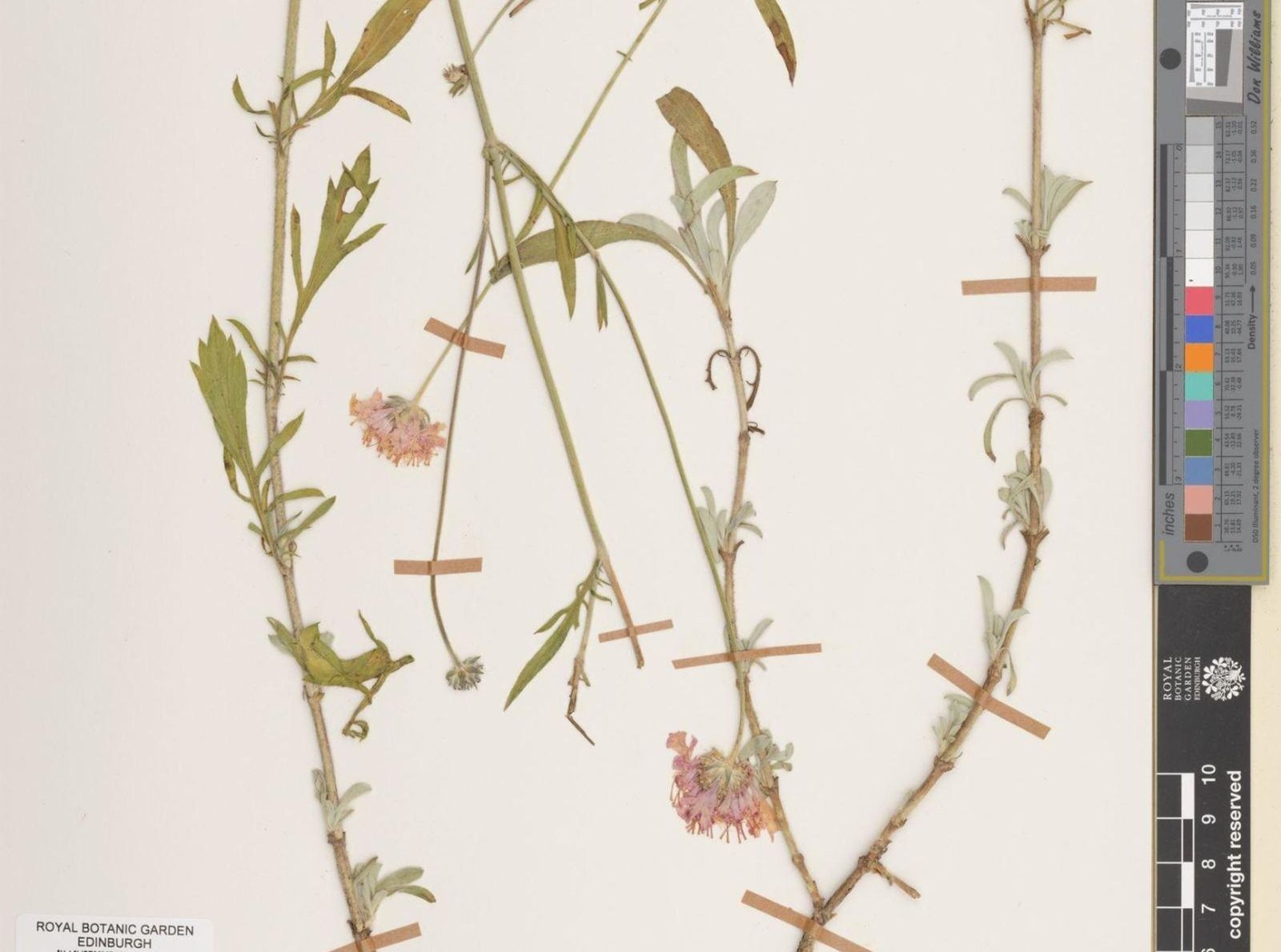
Lomelosia kurdica is a perennial scabious: a plant of silvery, softly hairy leaves and long bare stalks, each topped by a flat, pincushion-like head of pink flowers[1][2]. It was described from a plant gathered in September 1891 on the Kurd Mountain, the Kurd Dagh, called Çiyayê Kurmênc in Kurdish: the highland around Efrîn (Afrin) in the far west of Rojava, which reaches north across the Turkish border[1]. That is where its name comes from.
Kew's checklist gives its native range as southern Turkey, with records in the Syria–Lebanon region and in Turkey[3]. The specimens we could find tell a more precise story: the Kurd Mountain, centred on Efrîn, where it was discovered, and the Nur (Amanus) Mountains just to the west, where botanists found it again in the twentieth century[4][5][5][5][5].
Post's September on the Kurd Dagh
The botanist who named it was George Edward Post (1838–1909)[6], a clergyman and doctor at the Syrian Protestant College in Beirut and the author of a Flora of Syria, Palestine and Sinai[2]. In 1891 he made an excursion to the Kurd Dagh[1][4]. In the fourth part of his Plantae Postianae, printed in Lausanne in May 1892, he described the mountains for his readers:
Le Kurd Dagh est une chaîne de montagnes situées entre le mont Amanus et le plateau d'Aintab en Asie Mineure ; sa hauteur moyenne est d'un millier de mètres au-dessus du niveau de la mer.
The Kurd Dagh is a chain of mountains lying between Mount Amanus and the plateau of Aintab in Asia Minor; its average height is about a thousand metres above sea level.[1] (our translation)
Its flora, he wrote, had "a fairly large number of species that are peculiar to it", and "we were astonished that so small a collection yielded so many new forms". Compared with the Amanus, closer to the sea, the Kurd Dagh had "a more desert-like character"[1] (our translation). Among those new forms was a scabious. Post called it Scabiosa kurdica, from the Latin for "Kurdish", and gave its home in one line:
Habitat Kurd Dagh Syriæ borealis ; floret Septembro 1891. N° 18.
It grows on the Kurd Dagh in northern Syria; in flower in September 1891. No. 18.[1]
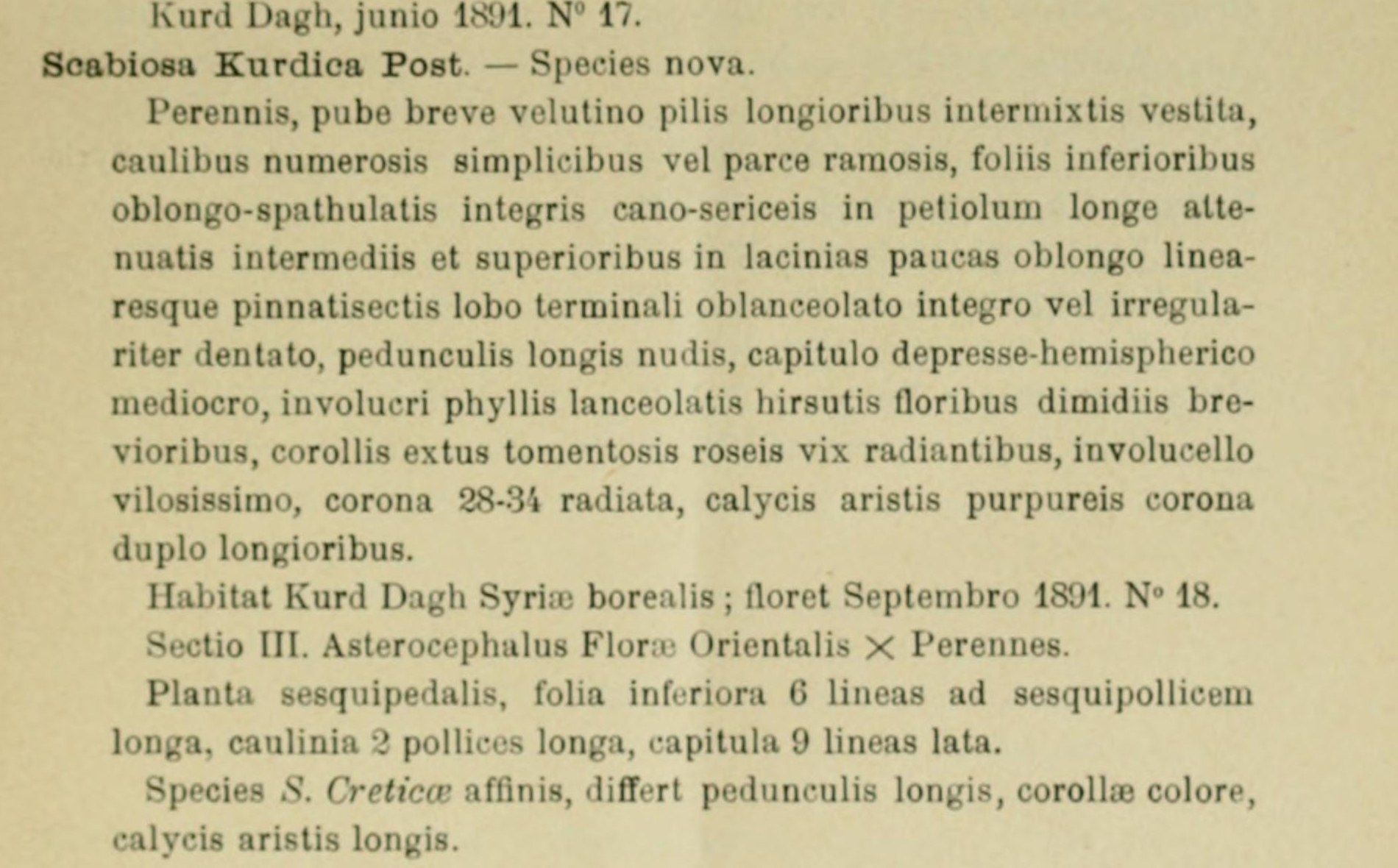
Post's specimen number 18 from the Kurd Dagh is kept today in the herbarium of the Conservatoire et Jardin botaniques in Geneva, marked as the holotype, the single sheet the name is tied to[4]. Geneva also holds a second sheet of Post's, number 89, gathered in August 1891 in the Amanus and filed as a type of the same name[4].
What to look for
Post compared his plant with S. cretica and said it differed in its long flower stalks, its flower colour and its long calyx bristles[1]. In his Flora of Syria, Palestine and Sinai of 1896 he described it in English[2]:
- a perennial, 45–50 cm tall, velvety with short down and longer hairs mixed in;
- many stems, unbranched or with a few branches;
- lower leaves oblong and spoon-shaped, untoothed, silky, tapering into a stalk; the leaves higher up cut into a few narrow, oblong to linear lobes, the end lobe untoothed or irregularly toothed;
- long, naked flower stalks, each with a single head, flattened-hemispherical and about 2 cm across;
- pink flowers, woolly outside, the outer ones hardly larger than the rest;
- around each flower, a very hairy little cup that ends in a crown of 28 to 34 rays, and purple calyx bristles twice as long as that crown[1][2].
That last detail, the crown, turns out to be the key to the plant's modern name.
A crown of rays, and a forgotten genus
In 1838 the eccentric naturalist Constantine Samuel Rafinesque turned to the scabiouses in his Flora Telluriana. The genus Scabiosa, he complained, "offered a crowd of anomalies", and the followers of Linnaeus were still "blending to this day 16 fine Genera into Scabiosa"[7]. He then split them up. One of his new genera was Lomelosia, set apart by its fruits, which carry a crown that is membranous, flat, wheel-shaped and round[7]. Beside the name he wrote, in brackets, just "edge membr", for the membranous edge[7].
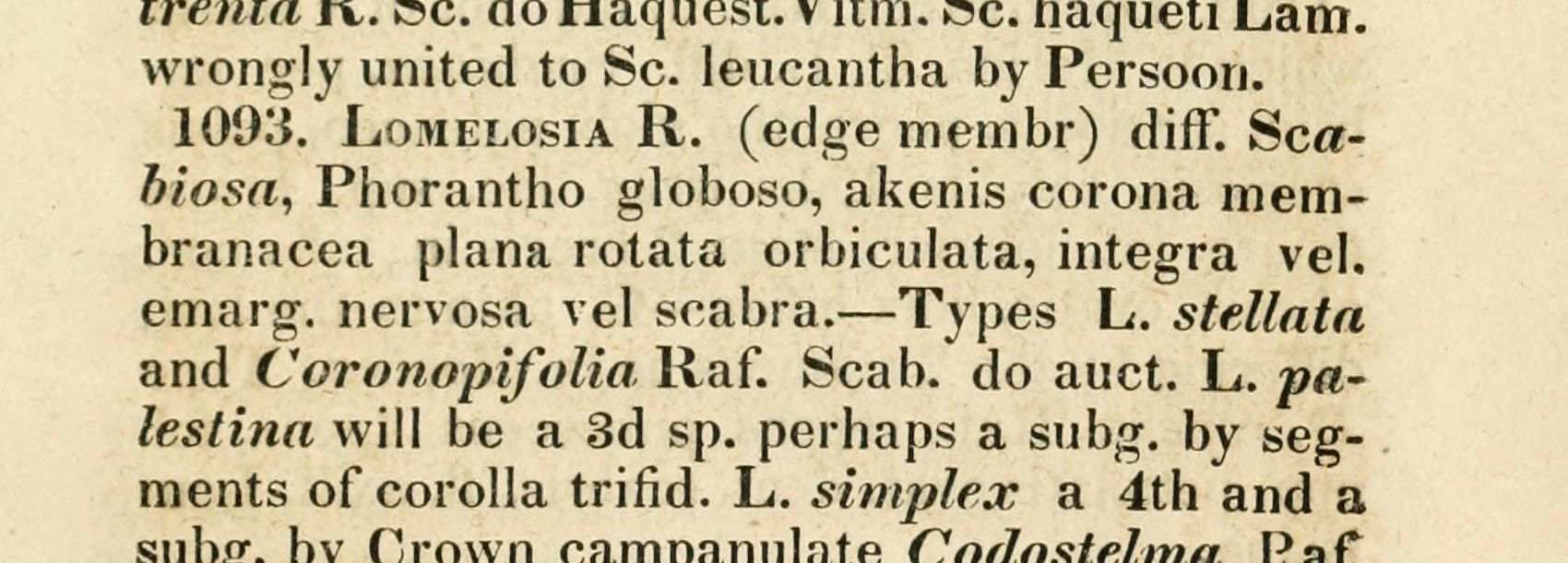
Post still kept his plant in Scabiosa[1], and so did R. A. Blakelock of Kew for its relatives in 1948[8]. Post placed his new species in the group the Flora Orientalis called Asterocephalus[1]; Blakelock gave the same group its other name, section Trochocephalus[8]. In 1985 the botanists Werner Greuter and Hervé Burdet moved Post's plant into Rafinesque's genus as Lomelosia kurdica (Post) Greuter & Burdet[6]. Today Lomelosia is the name for the species once grouped as section Trochocephalus, and a molecular study of the family describes how, in Lomelosia and Scabiosa, the end of the little cup around each fruit has developed into a membranous crown[9]. The "(Post)" in the name records who described it first. The genus now ranges from the Mediterranean to Korea and the western Himalaya[3].
Where it grows
Since Post, the plant has been gathered at least four more times that we know of, all in the Nur (Amanus) Mountains of Hatay, west of the Kurd Mountain, and all in late summer or autumn[5][5][5][5]:
- East of Erzin, in an oak wood of Quercus cerris at about 1,200 m, on 14 October 1957, by G. Wagenitz and H.-J. Beug. Wagenitz added a note to the label: "vidi typum!", "I have seen the type!"[5]
- In the Amanus near Dörtyol, at about 900 m, on 21 September 1967[5].
- Above Yeşilkent, at 305 m, on 10 and 11 August 1969, by J. Darrah: on a grassy bank in pine wood, "uncommon", and on a steep bank of soil below pines. His labels give the colours as "pale pink" and "cream with pink tips"[5][5].
Put together, the records describe a plant of hills and mountain woods, of oak and pine, from about 300 to 1,200 m, flowering from August into October[1][5][5][5][5]. Post's own "about a thousand metres" for the Kurd Dagh fits the same band[1].
One sheet does not fit. In New York there is a specimen labelled Scabiosa kurdica, gathered by Fred and Elizabeth Barkley on 7 May 1963 "on the conglomerate of a bluff near the Greater Zab", east of a place the label spells Askeykalik, in the Hewlêr (Erbil) province of Başûr[10]. If the name is right, it would put the plant far to the east, on the Great Zab. But the label does not say who named it, Kew's checklist does not include Iraq in the range[3], and every other gathering was made in late summer or autumn rather than in May[1][5][5][5][5]. For now it is a puzzle for a specialist to look at.
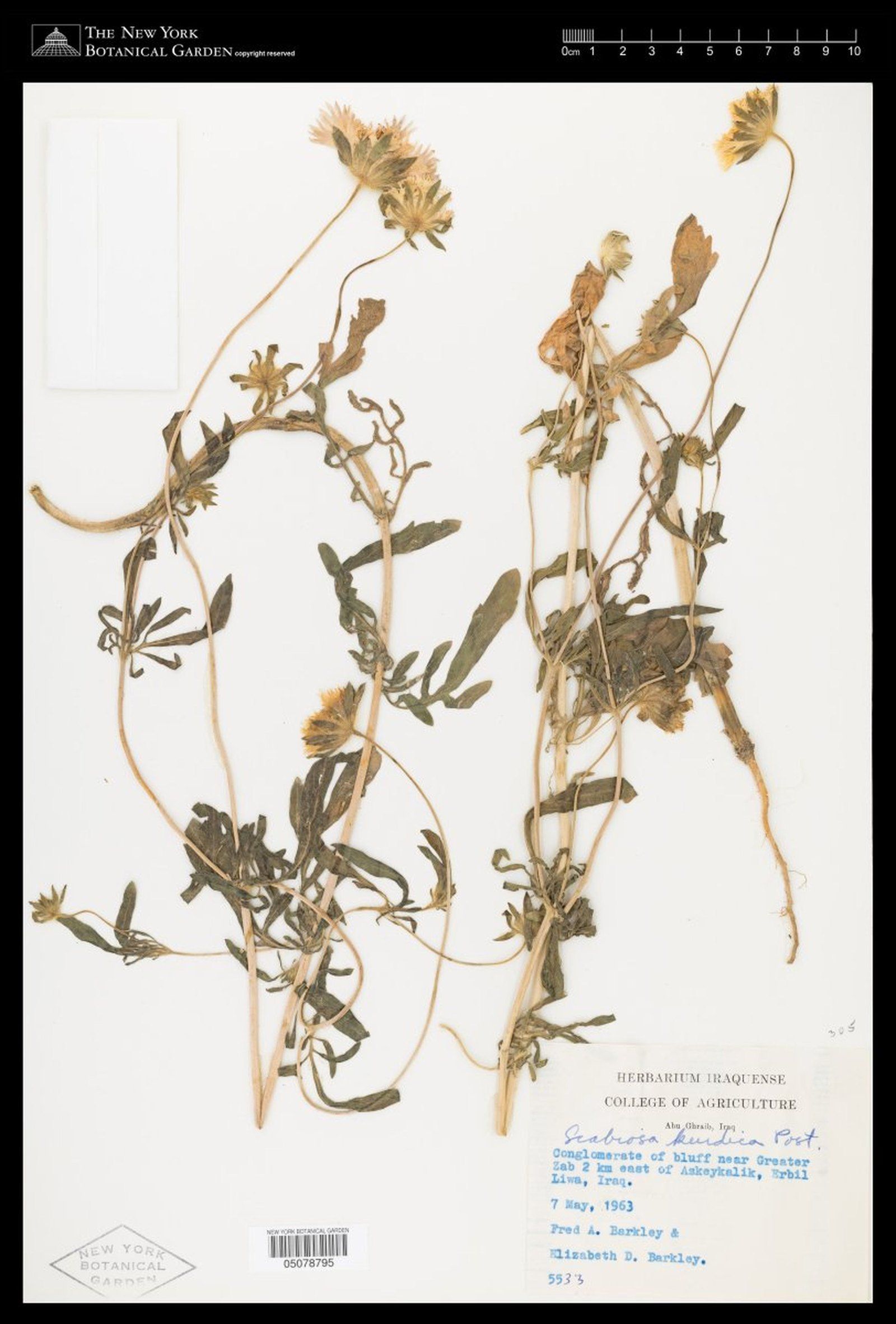
The plant has not been assessed for the IUCN Red List[11], and as far as we could find, no one has yet published a photograph of it alive: all nine records on GBIF are pressed specimens, and iNaturalist has no observations[11]. One of Darrah's sheets carries a slip saying that in 2006 a small piece was taken from it for DNA extraction[5], so the plant has at least been sampled for the laboratory, if not yet for the camera.
Names in Kurdish
Ehmedê Dirihî's dictionary of Kurdish plant names, published in 2013 by Mardin Artuklu University, lists Scabiosa kurdica under five headwords, each a dictionary name[12]:
- giyaxurîya kurdan (p. 290)
- gulbaxa kurdan (p. 321)
- gulgurrrîyê kurdan (p. 337)
- sîrka maranê kurdan (p. 707)
- zîwan (p. 911)
Most entries also list the others as alternatives, sometimes in slightly different forms: giyaxurîyê kurdan, sîrika maranê kurdan and zîwanê kurdan[12]. Four of the five headwords end in kurdan, "of the Kurds", and so mirror the Latin kurdica, as do the Turkish names printed beside them, such as kürt uyuz otu[12].
On the same pages the dictionary gives shorter names for scabiouses in general and for related plants[12]:
- gulgurrî for the genus Scabiosa as a whole, credited to the Paris Kurdish Institute's dictionary (p. 337);
- sîrka maran for the field scabious, Scabiosa arvensis, credited, like sîrka maranê kurdan, to Derwîş Îzolî's Kurdish–Turkish dictionary (p. 707);
- giyaxurî for Cephalaria syriaca, a relative from the same family, with zîwan among its other names (p. 290).
The plain name zîwan is the only one of the five without kurdan. The dictionary marks it with a source code, TBL, that does not appear in its own list of sources, and the Turkish column next to it reads zivan[12]. On the same page, zîwan is also the headword for two Cephalaria species, C. setosa and C. syriaca, each marked with a place (Riha and Dîyar), and for two ryegrasses, Lolium perenne and L. temulentum[12]. In the dictionary the plain name belongs to several plants, and this scabious is only one of them.
A spoken Kurdish name for a close relative was written down much earlier. In June 1932, at Ba'adhara near Şêxan (Shaikhan) in Başûr, Salim Effendi, collecting for the Rustam Herbarium, whose plants Blakelock listed in the Kew Bulletin, found a cousin, Scabiosa palaestina, on hilly ground, noted that it was "a good fodder plant", and recorded its "native name" as kia killor, marked as Kurdish[8]. Rafinesque, a century before, had already counted that species among his Lomelosia[7].
Sources
- 1.Post, G.E. (1892). Plantae Postianae, fasc. 4. Lausanne.
- 2.abcdPost, G.E. (1896). Flora of Syria, Palestine and Sinai. Beirut: Syrian Protestant College. biodiversitylibrary.orghttps://www.biodiversitylibrary.org/page/18086455
- 3.Plants of the World Online. Royal Botanic Gardens, Kew.
- abcLomelosia kurdica; Lomelosia.
- plant_name_id 2339533. powo.science.kew.orghttps://powo.science.kew.org/taxon/urn:lsid:ipni.org:names:915223-1accessed 14 November 2026
- 4.abcdConservatoire et Jardin botaniques de Genève (G) – Herbarium. via GBIF, herbarium specimens G00360140 (holotype) and G00360139 (via GBIF).
- 5.Royal Botanic Garden Edinburgh Herbarium (E), specimen catalogue (via data.rbge.org.uk and GBIF). data.rbge.org.ukhttps://data.rbge.org.uk/herb/
- 6.International Plant Names Index. Royal Botanic Gardens, Kew, Harvard University Herbaria and Australian National Herbarium.
- abLomelosia kurdica (Post) Greuter & Burdet, Willdenowia 15(1): 74 (1985); Scabiosa kurdica Post, Pl. Post. 4: 7 (1892); Lomelosia Raf., Fl. Tellur. 4: 95 (1838); author record for G. E. Post.
- urn:lsid:ipni.org:names:915223-1. ipni.orghttps://www.ipni.org/n/915223-1accessed 14 November 2026
- 7.Rafinesque, C. S. (1838). Flora Telluriana. 4: 94–95. Philadelphia.
- 8.abcBlakelock, R. A. (1948). The Rustam Herbarium, 'Iraq. Systematic List. Part I. Kew Bulletin 3(3): 404–405.
- 9.↩Caputo, P., Cozzolino, S. & Moretti, A. (2004). Molecular phylogenetics of Dipsacaceae reveals parallel trends in seed dispersal syndromes. Plant Systematics and Evolution 246: 163–175. doi:10.1007/s00606-004-0154-yhttps://doi.org/10.1007/s00606-004-0154-y
- 10.↩New York Botanical Garden, herbarium specimen 05078795 (Barkley & Barkley 5533, 1963).
- 11.abGBIF.org GBIF Backbone Taxonomy and occurrence records. occurrence records and IUCN status for Lomelosia kurdica (taxon 4103171); iNaturalist taxon 777641. gbif.orghttps://www.gbif.org/
- 12.Ahmet Kasımoğlu (Ehmedê Dirihî) (2013). Ferhenga Navên Nebatan a Kurdî (Dictionary of Kurdish Plant Names). Mardin Artuklu University, Institute of Living Languages in Turkey (ISBN 978-605-4202-12-6).
Last updated 20 November 2026