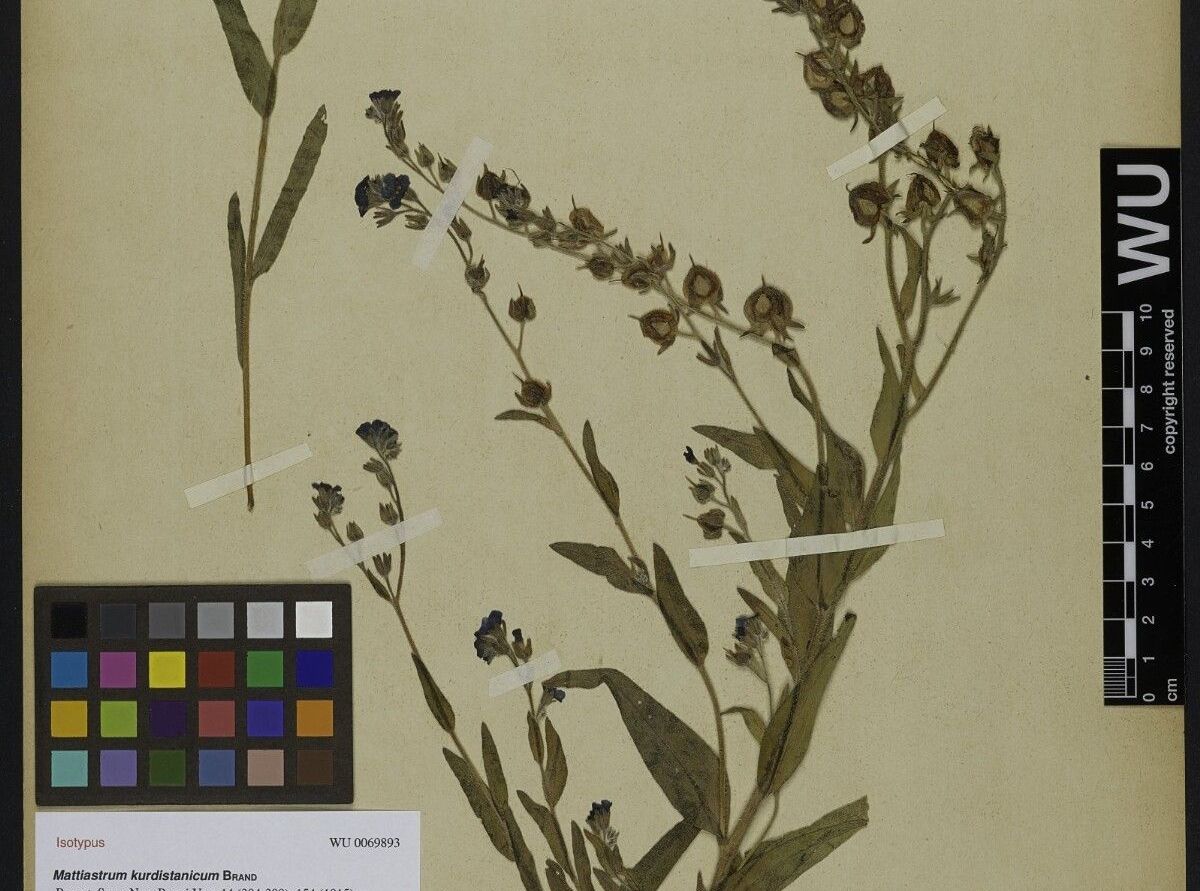
Mattiastrum kurdistanicum is a rough-haired member of the borage family with bell-shaped flowers that the botanist who described it called "most beautifully blue"[1]. Every known record of it comes from one mountain in North Kurdistan (Bakur): Qerejdax (Karacadağ), the old volcano between Amed (Diyarbakır) and Riha (Şanlıurfa)[2][3]. Its fruits are its most striking feature: four flat nutlets, each about a centimetre across, ringed by a broad wing[1][4]. The name kurdistanicum, "of Kurdistan", comes straight from the locality on its first label, which Brand printed as "Kurdistan: Diarbekir: Karadjadagh"[1].
How it got its name
- Named by
- Brand, 1915Published in Repert. Spec. Nov. Regni Veg. 14: 154
Number 710
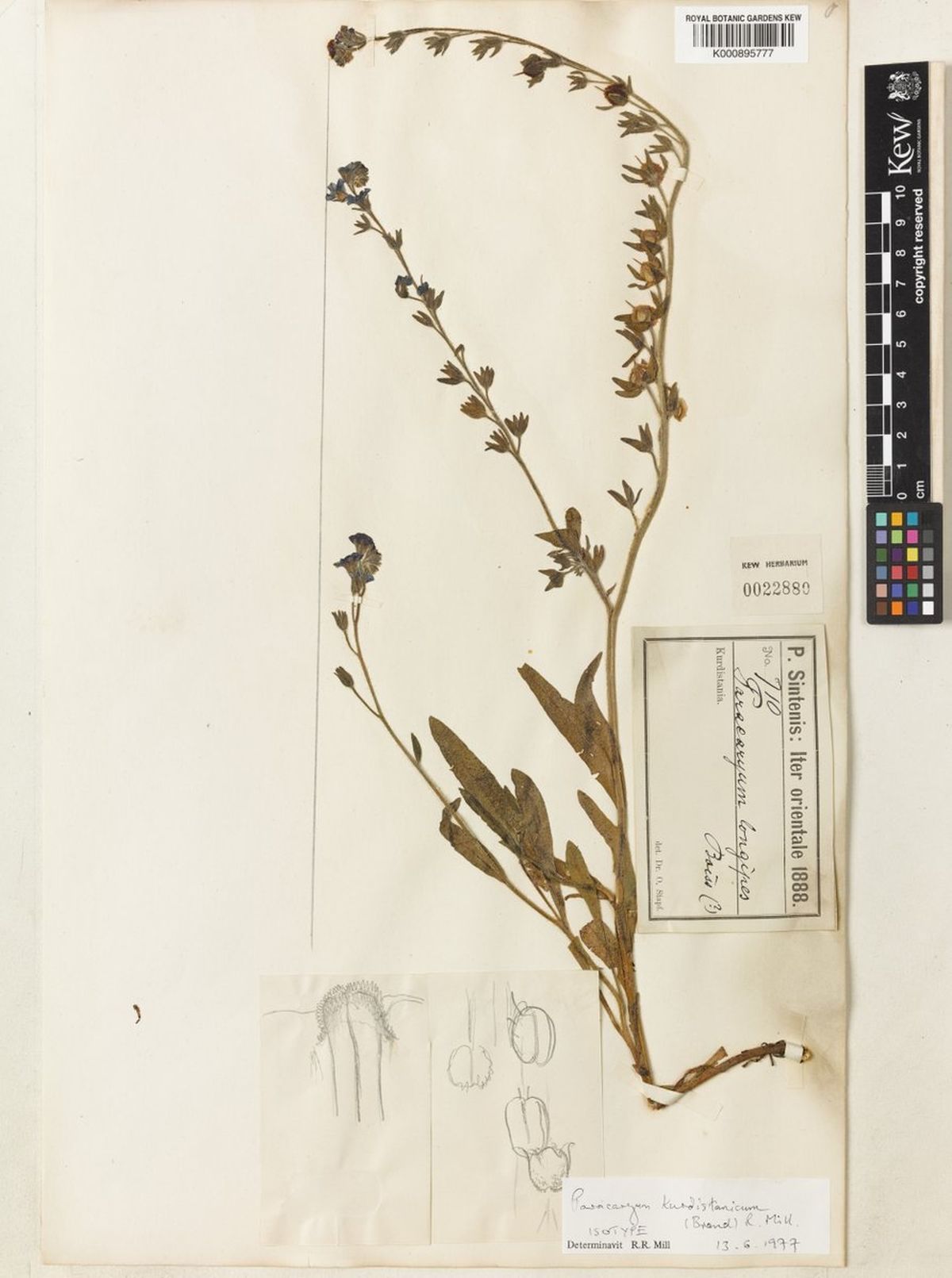
In the spring of 1888 the plant collector Paul Sintenis (1847–1907)[5] was in Bakur on the collecting journey his labels call Iter orientale 1888, the "Eastern journey of 1888"[2][6]. On 26 May he was on Qerejdax, collecting among the shrubs on its slopes, and among his plants that day was a slender, bristly herb with blue flowers[2][6][7]. It became number 710 of his collection.
Duplicates of the plant went to several herbaria, each sheet with the same printed label, "P. Sintenis: Iter orientale 1888", the number and "Kurdistania", completed by hand: "Diarbekir: Karadjadagh, in fruticetis", "in thickets"[2][6][7]. Today duplicates of no. 710 are kept in Vienna, Jena, Meise, Geneva, Lund and at Kew[2][3][6][7].
The name on those labels was a guess. They read "Paracarium longipes Boiss.?", question mark included, and name who made the guess: "det. Dr. O. Stapf", the botanist Otto Stapf (1857–1933)[5][3][6]. Paracaryum longipes was a species already described by Boissier. The question stayed open until 1915.
A new species, and a new genus
That year the botanist August Brand (1863–1930)[5] took up no. 710 while sorting out a group of borage-family plants with flat, winged fruits. He concluded that it was a species new to science, and named it Mattiastrum kurdistanicum[1]. A small slip on the Jena sheet reads "Mattiastrum kurdistanicum n. sp. ! Br."[6]. His description ends with the locality from the label, in his own printing:
Kurdistan: Diarbekir: Karadjadagh, in Gebüschen. Blühend im Mai.
Kurdistan: Diarbekir: Karadjadagh, among shrubs. Flowering in May.[1] (our translation from the German)
The genus name was new too. Boissier had kept these plants as a section of Paracaryum called Mattiastrum. In the same paper Brand raised the section to a genus of its own[1]. His reason was the fruit: Paracaryum, he wrote, has cup- or boat-shaped nutlets, while those of Mattiastrum are flat and broadly winged, like those of the related genus Rindera[1]. He could not use the older name Mattia, he explained, because it had often been used for Rindera before[1]. Six years later he repeated the description, word for word, in his monograph of the tribe Cynoglosseae for Das Pflanzenreich[8].
Three genera in 66 years
Brand's genus did not settle the matter. The botanist Robert Mill (b. 1950)[5] still called it Mattiastrum kurdistanicum when he identified a specimen in January 1975[3]. Two years later, in the "Materials for a Flora of Turkey" published in Edinburgh, he moved it back into Paracaryum as P. kurdistanicum[9]. Mill, then a research assistant on the Flora of Turkey in Edinburgh[9], had studied both genera and concluded that Mattiastrum "should be re-united with Paracaryum". The name Mattiastrum lived on one rank lower, as Paracaryum subgenus Mattiastrum, based on Boissier's old section[9]. His studies of the two genera were to be reported in "a forthcoming paper"; here he published only the new names that Turkish plants needed[9]. The Kew duplicate of Sintenis 710 carries the traces of that work: small pencil drawings of a nutlet and of the scales in the throat of the flower, and his label "ISOTYPE", dated 13 June 1977[3]. In 1981 Werner Greuter and Hervé Burdet moved it again, into Cynoglossum, as C. kurdistanicum[5].
Today Kew's World Checklist accepts Brand's original name, Mattiastrum kurdistanicum[10]. Botanists in the region have kept using Paracaryum: a 2015 paper by Lütfi Behçet of Çewlîg (Bingöl) University and Ahmet İlçim calls it P. kurdistanicum[4]. They count it in Paracaryum subgenus Modestomattiastrum, the group in which the anthers sit below the scales in the flower's throat[4]. That name goes back to Brand himself, who had put the plant in a section Modestomattiastrum of his new genus, for species with squarish throat scales and a style shorter than the calyx[1].
What to look for
Brand's description and the 2015 comparison give a clear picture[1][4]:
- Habit: an upright, rough-haired herb, the stem simple or branched only near the top. Brand measured 30–60 cm; the plants compared in 2015 had stems of 23–30 cm, not woody at the base and without sterile shoots. Brand asked whether it lives two years ("Bienne?"); Kew's checklist lists it as a perennial[1][4][10].
- Leaves: narrow to fairly broad (6–16 mm), oblong to linear-lanceolate, with a single vein and a blunt tip. The lower leaves taper gradually into a long stalk and reach 10–12 cm with the stalk; the upper ones are tiny, stalkless and pointed.
- Flowers: in paired, lengthening coils at the tips of the shoots. The sepals are about 7 mm long; the corolla is bell-shaped, 6.5–11 mm long, with broad lobes longer than its 4 mm tube; small squarish scales sit in its throat, and the style is short, 2.3–4.3 mm. The 2015 comparison finds the coils in the leaf axils as well as at the tips. Brand saw them "most beautifully blue"; the botanists who found it in 1957 noted "Flowers dark violet"[1][4][3].
- Fruit: the flower stalks, 3.5–6 mm long in flower, lengthen as the fruit ripens, to 7–12.5 mm. The four nutlets are flat and roughly round, about 10–11 mm across, with a broad wing 2.5–3 mm wide whose edge is only faintly toothed. Brand saw hooked bristles on the central disc and on the edge of the wing; the 2015 comparison describes the disc as only sparsely warty and the wing as always hairless[1][4].
A mountain of basalt
Qerejdax is not an ordinary mountain. It is an extinct volcanic massif, most of it in the provinces of Amed and Riha, with a smaller part in Mêrdîn (Mardin)[2]. Its slopes have a place in the history of farming: in 1997 a genetic study found that wild einkorn wheat from these mountains is the likely ancestor of cultivated einkorn, and that einkorn was probably first domesticated near them[11].
Every record of Mattiastrum kurdistanicum we could find comes from this one massif[10][2][3][12][4]:
- Sintenis's type, on 26 May 1888, "in thickets"[2];
- on 19 May 1957, on the north slope between Sêwreg (Siverek) and Amed, at 1,250 m, in a "Rocky basalt gulley", by the botanists Peter Davis and Ian Hedge[3];
- on 2 May 1966, 30 km east of Sêwreg, at 1,260 m[12];
- on 28 May 2005, on Kollubaba hill, at 1,950 m, on rocky slopes[4].
Kew's checklist gives its range simply as southeastern Turkey[10]. All the dated records fall in May, which is when Brand's description says it flowers[1]. No photograph of a living plant has been published on iNaturalist so far; the pictures on this page are of herbarium sheets.
Its relatives in Bakur
Robert Mill counted Paracaryum cristatum, a plant of the same group with densely crested nutlets, as a close relative[1][9]. In 1977 he described a new subspecies of it, P. cristatum subsp. carduchorum, from the Nehil stream on the road between Colemêrg (Hakkâri) and Gever (Yüksekova), and wrote that it "approaches P. kurdistanicum": both have long fruiting stalks, but the Colemêrg plant has smaller flowers and tiny warts on its nutlet wings[9].
Unlike P. kurdistanicum, the new subspecies is spread across the mountains of Bakur. Mill cited it from Nemrut Dağı in Bedlîs (Bitlis), from between Hamur and Tutak in Agirî (Ağrı), from near Wan (Van), from the Zab gorge on the road from Colemêrg to Wan and from between Gever and Şemzînan (Şemdinli). In a narrow zone near Gola Wanê (Lake Van), where its range overlaps with the typical subspecies, intermediate plants occur[9]. He also read Riedl's Flora Iranica description of P. cristatum "as it occurs in N Iran and N Iraq" as this same subspecies, while the typical one is, in his words, "apparently endemic to Turkey"[9].
In 2015 a third relative turned up in Çewlîg: Behçet and İlçim described Paracaryum bingoelianum from rocky slopes of Şamdağı, south-east of Genç, where Behçet had collected it in July 2012[4]. At first glance it resembled both P. cristatum and P. kurdistanicum. It differs in its woody, shrub-like base, its many stems with sterile shoots, its longer flowers (11–15 mm, against 6.5–11 mm in P. kurdistanicum) and its much larger nutlets, 15–18 mm across, with hooked bristles on the disc and on the wing[4]. It is known from only two places in the district of Genç, in subalpine steppe at 1,750–2,000 m, and its authors proposed classing it as Critically Endangered, because grazing and erosion threaten its tiny range[4].
Its name in Kurdish
No Kurdish name for this plant has been recorded in the sources we searched. Ehmedê Dirihî's Ferhenga Navên Nebatan a Kurdî (2013), the large dictionary of Kurdish plant names, lists it in its Latin index under its old name, Paracaryum kurdistanicum. Where a Kurdish name would stand, the entry gives no plant name, only the place it comes from, Qerejdax[13]. The dictionary does the same for Mill's Colemêrg subspecies, with Colemêrg[13].
If you know a name for this plant from Qerejdax or the villages around it, Flora Kurdica would like to hear it.
Conservation
The species has not been assessed for the IUCN Red List[14].
Sources
- 1.Brand, A. (1915). Neue Borraginaceen-Studien. Repertorium Specierum Novarum Regni Vegetabilis 14: 146–156.
- 2.abcdefghUniversität Wien herbarium, specimen WU 0069893 (isotype, Sintenis 710) (via GBIF).
- 3.Royal Botanic Gardens, Kew – Herbarium Specimens. via GBIF. gbif.orghttps://www.gbif.org/dataset/cd6e21c8-9e8a-493a-8a76-fbf7862069e5
- 4.Behçet, L. & İlçim, A. (2015). Paracaryum bingoelianum (Boraginaceae), a new species from Turkey. Turkish Journal of Botany 39: 334–340. doi:10.3906/bot-1309-58https://doi.org/10.3906/bot-1309-58
- 5.International Plant Names Index. Royal Botanic Gardens, Kew, Harvard University Herbaria and Australian National Herbarium.
- abcdauthor records for Brand, Sintenis, Stapf, Mill, Greuter and Burdet.
- eMattiastrum kurdistanicum Brand; Paracaryum kurdistanicum (Brand) R.R.Mill; Cynoglossum kurdistanicum (Brand) Greuter & Burdet, Willdenowia 11(1): 35 (1981).
- urn:lsid:ipni.org:names:118516-1. ipni.orghttps://www.ipni.org/n/118516-1accessed 14 November 2026
- 6.abcdefHerbarium Haussknecht, Jena (JE), specimen records (JACQ) via GBIF. Jena, specimen JE 00011691 (Sintenis 710) (via GBIF). api.gbif.orghttps://api.gbif.org/v1/occurrence/3028980654
- 7.abcMeise Botanic Garden, specimen BR0000006967963 (Sintenis 710) (via GBIF).
- 8.↩Brand, A. (1921). Borraginaceae-Borraginoideae-Cynoglosseae. In: Engler, A. (ed.), Das Pflanzenreich IV. 252 (Heft 78). Leipzig, pp. 61–62.
- 9.Mill, R. R. (1977). Paracaryum. In: Davis, P. H. (comp.), Materials for a Flora of Turkey XXXIV: Boraginaceae, Gentianaceae, Solanaceae. Notes from the Royal Botanic Garden Edinburgh 35(3): 297–314.
- 10.Plants of the World Online. Royal Botanic Gardens, Kew.
- abcdMattiastrum kurdistanicum.
- plant_name_id 2364107. powo.science.kew.orghttps://powo.science.kew.org/taxon/urn:lsid:ipni.org:names:118516-1accessed 14 November 2026
- 11.↩Heun, M., Schäfer-Pregl, R., Klawan, D., Castagna, R., Accerbi, M., Borghi, B. & Salamini, F. (1997). Site of einkorn wheat domestication identified by DNA fingerprinting. Science 278(5341): 1312–1314. doi:10.1126/science.278.5341.1312https://doi.org/10.1126/science.278.5341.1312
- 12.abNatural History Museum Vienna (W) – Herbarium. via GBIF, specimen W 1966-0021291 (Eiselt, 1966) (via GBIF).
- 13.Ahmet Kasımoğlu (Ehmedê Dirihî) (2013). Ferhenga Navên Nebatan a Kurdî (Dictionary of Kurdish Plant Names). Mardin Artuklu University, Institute of Living Languages in Turkey (ISBN 978-605-4202-12-6).
- 14.↩IUCN Red List status via GBIF: Not Evaluated.
- Brand, A. (1915). [Mattiastrum, in his treatment of Borraginaceae.]. Repertorium Specierum Novarum Regni Vegetabilis 14: 154, p. 154. archive.orghttps://archive.org/details/mobot21753000023977/page/n159/mode/1upaccessed 14 November 2026
Last updated 20 November 2026