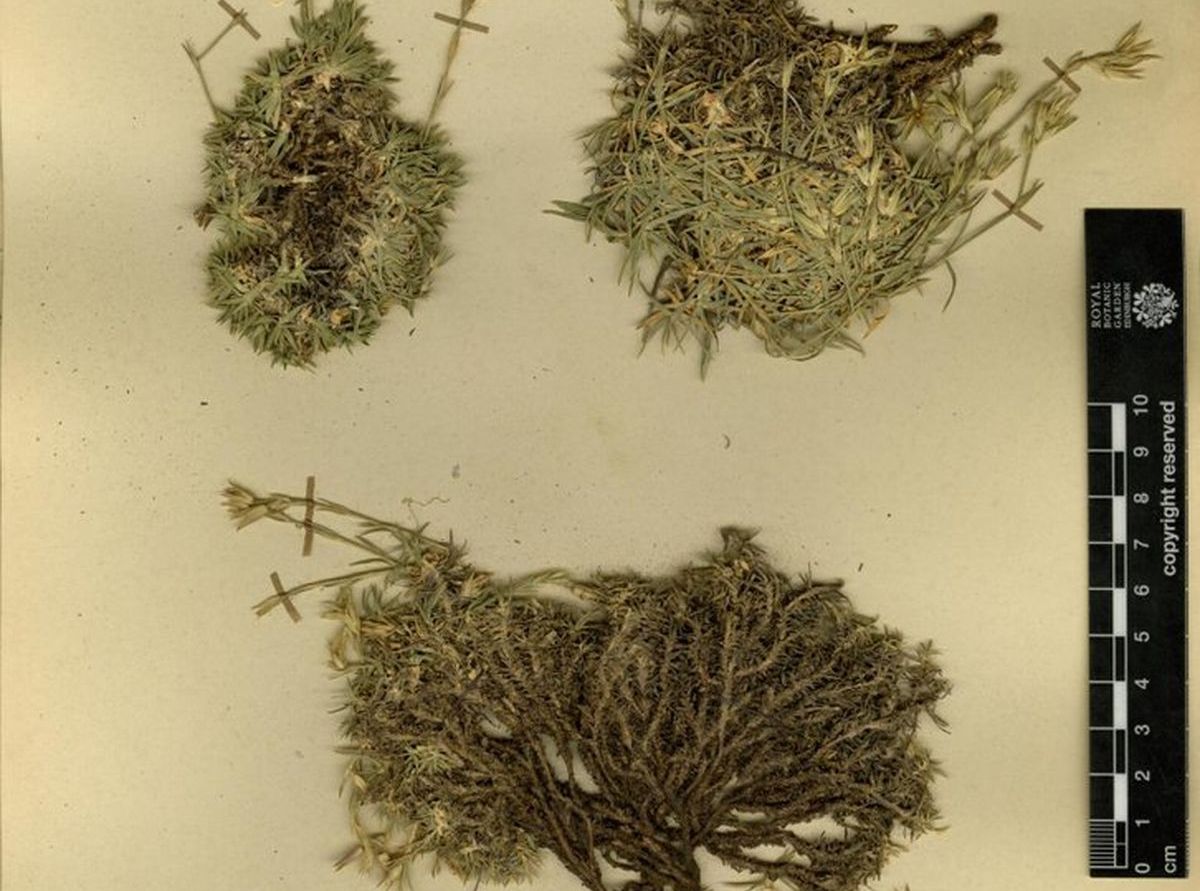
Minuartiella dianthifolia is a small, cushion-forming perennial of the pink family (Caryophyllaceae), the family of carnations and sandworts[1][2]. Most of it lives on a few mountains in the south of Anatolia[1]. But one form of it, subspecies kurdica, has been found in only one place in Kurdistan: the stony slopes of Mount Artos, above Westan (Gevaş) near Lake Van (Gola Wanê) in Bakur[1][3][3].
The botanist who named it thought it might even deserve to be a species of its own[1]. As of 2022, nobody had tested that with DNA[4]. No photograph of the living plant is known to us, and all we know of it comes from a handful of pressed specimens. This is their story.
How it got its name
- Named by
- (Boiss.) Dillenb. & Kadereit, 2014Published in Taxon 63: 84
A plant related to none, from Lycia
The species was first found far to the west. In 1846 a collector whom Boissier calls "Dr. Pestalozza" gathered it on the Akdagh, a mountain in Lycia in the south-west of Anatolia[1][5]. The specimen reached the botanist Pierre Edmond Boissier (1810–1885)[6], and it is still kept in Geneva[1]. Boissier named it Alsine dianthifolia in 1849, "the Alsine with leaves like a pink (Dianthus)" (our reading of the name), and he was impressed:
Species distinctissima nulli propiùs affinis.
A most distinct species, closely related to none.[5] (our translation)
He added that in its general look it somewhat recalled the sandworts of Arenaria section Eremogone, but that its many-nerved sepals and leaves placed it elsewhere[5]. Right after it he described Alsine pestalozzae, a plant McNeill later counted among its closest relatives[1], whose flowering specimens had also come from Pestalozza. Boissier called that one Omnium Alsinearum pulcherrima et princeps, "the most beautiful of all the Alsine species, and their prince"[5] (our translation). Keep that relative in mind: it comes back in the Kurdish story.
Fourteenth of July 1954, Mount Artos
A century later, the plant turned up more than 1,000 km further east. On 14 July 1954 the botanists Peter Hadland Davis (1918–1992) and Oleg Polunin were collecting on Mount Artos above Westan, in the province of Wan (Van), at 8,500 feet (about 2,590 m)[1][3][6]. Among Davis's plants that day was a tight tuft of narrow leaves with white flowers, his number 22,716. The typed label calls it simply "Arenaria"[3].
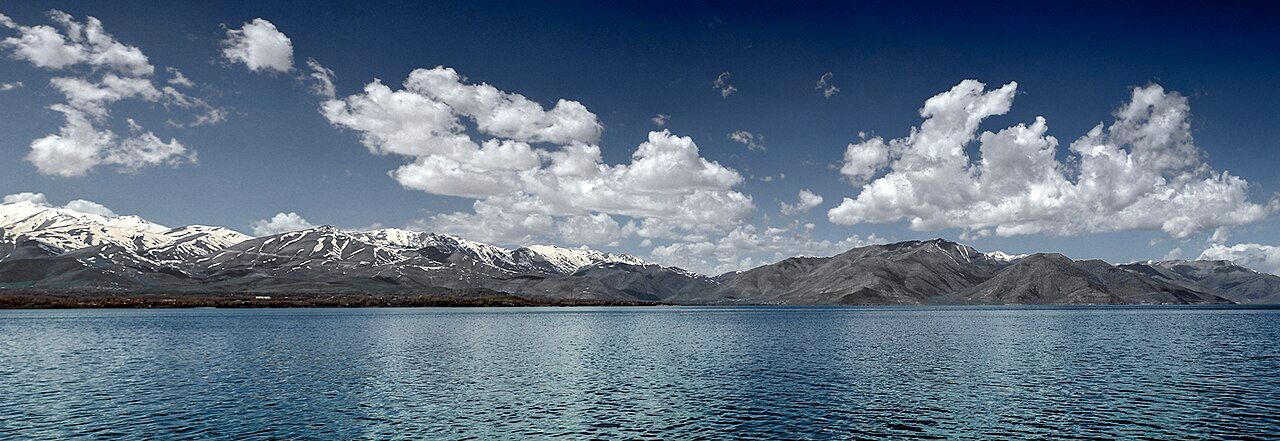
Two years later, on 2 September 1956, the young botanist John McNeill (born 1933)[6] collected the same plant on the northern slopes of Artos above Westan, at 3,000 m. His label notes simply: "Perennial"[3].
McNeill was then working on a revision of all the sandworts and their relatives of the Near East, published in Edinburgh in 1963[1]. When he came to Davis's sheet and his own, he saw a plant unlike the Lycian one, and he gave it a name of its own: Minuartia dianthifolia subsp. kurdica, "the Kurdish subspecies"[1]. In the formal record he filed its home under the heading "Turkey: Kurdistan: Prov. Van"[1]. The original specimen, the holotype, is kept at the Royal Botanic Garden Edinburgh, with duplicates at Kew and the Natural History Museum in London[1][3][7].
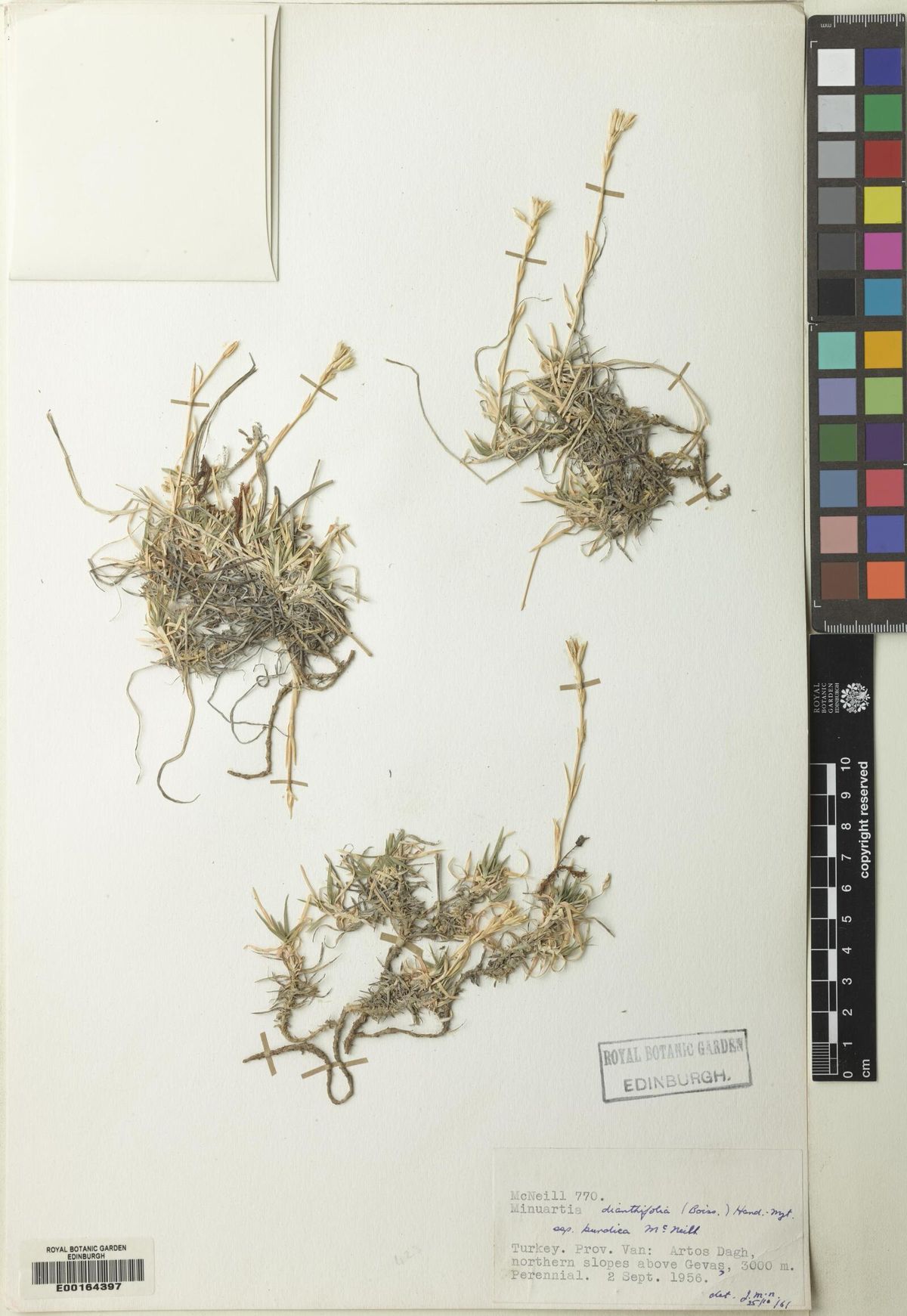
A subspecies with "some claim" to be a species
Why only a subspecies? McNeill explained his doubts in a few frank lines:
A more distinctive plant occurs still further east in Turkish Kurdistan; this has only been collected twice—by Davis in 1954 and by the writer in 1956, in both cases on the same mountain near Lake Van.[1]
What set it apart most was its petals: short, egg-shaped and narrowed at the base into a little stalk, a "claw", just like those of Boissier's "prince", Alsine pestalozzae (today Minuartiella pestalozzae)[1]. McNeill thought that prince "probably the largest and most striking species of the genus": its spiny leaves and dense growth give it "the appearance of an Acanthophyllum or an Acantholimon", two other genera of prickly cushion plants. Yet it is closely related to M. dianthifolia, "especially to subsp. kurdica", and like M. dianthifolia it is, in his words, "a relict mountain endemic"[1]. In its tufted habit, leaf shape and hairy sepals the Kurdish plant also came close to Minuartia acuminata, a plant then known only from a single specimen from Mishou Dagh near Tabriz[1]. McNeill concluded:
It has indeed some claim to specific recognition but in the absence of specimens from other Kurdish mountains it has been thought best to place it within M. dianthifolia.[1]
So the plant's rank still hangs on a question McNeill asked in 1963: does it grow on other Kurdish mountains too?
What to look for
McNeill's description[1] is all there is, so here it is in plain words. The Kurdish subspecies is:
- a dense cushion, with many short, woody stems up to 2 mm thick, thickly clothed in the dead leaves of earlier years;
- leaved with very narrow, triangular, long-pointed leaves 6–18 mm long and 1.5–2 mm wide at the base, covered in short glandular (sticky-tipped) hairs;
- flowering on stems 4–9 cm tall, with three or four (rarely five) pairs of leaves and a tight head of two or three (rarely four) flowers on short, densely glandular stalks of 5–7 mm;
- recognisable by its glandular sepals, 6–8.5 mm long (rarely 9 mm), and its white petals[3], which are egg-shaped, clearly clawed and much shorter than the sepals;
- a capsule only about two-thirds as long as the calyx.
It grows in stony places and flowers from July to August[1].
Its two relatives in Anatolia differ in small but telling ways[1]. The Lycian plant, subsp. dianthifolia, has hairless leaves and petals nearly as long as the sepals, and grows in looser tufts. Subsp. cataonica, from the Anti-Taurus mountains around Binboğa dağ, has glandular leaves like the Kurdish plant but hairless, longer sepals (8.5–12 mm) and narrower petals with hardly any claw.
Both are known from only a few collections. McNeill knew the Lycian plant from the type and six other gatherings, and the Anti-Taurus plant from five; two of those five, collected by Balansa and by Haussknecht, Boissier had already seen and counted as his Alsine dianthifolia[1].
One mountain, or more?
When McNeill wrote, the species was known only from four mountain areas in Turkey, among them the Lycian peaks in the south-west, the Anti-Taurus and Mount Artos, and from one record from a mountain in Nakhchivan, in the Caucasus, whose plants he had not seen[1]. Of that Nakhchivan plant he wrote: "It may well represent a fourth subspecies"[1]. He saw more at stake than one plant. Should the Nakhchivan plants, "or new collections in Eastern Turkey and Azerbaijan", show further steps between M. dianthifolia and M. acuminata of Mishou Dagh, "as is not improbable", then the rank of M. acuminata itself might have to be reconsidered[1].
Five years later he may have found a piece of the answer in his own herbarium work. A sheet in Edinburgh, collected on 16 July 1958 on a mountain steppe at 2,000–2,400 m in the Meghri district of what was then Soviet Armenia, close to Nakhchivan, had come in under another name, Minuartia lineata. In March 1968 McNeill relabelled it as Minuartia dianthifolia subsp. kurdica[3]. We have not found that identification in print, so for now it is one expert's note on one sheet. But it hints that the Kurdish subspecies, so far known only from Artos, may have relatives (or outposts) on other mountains of the region.
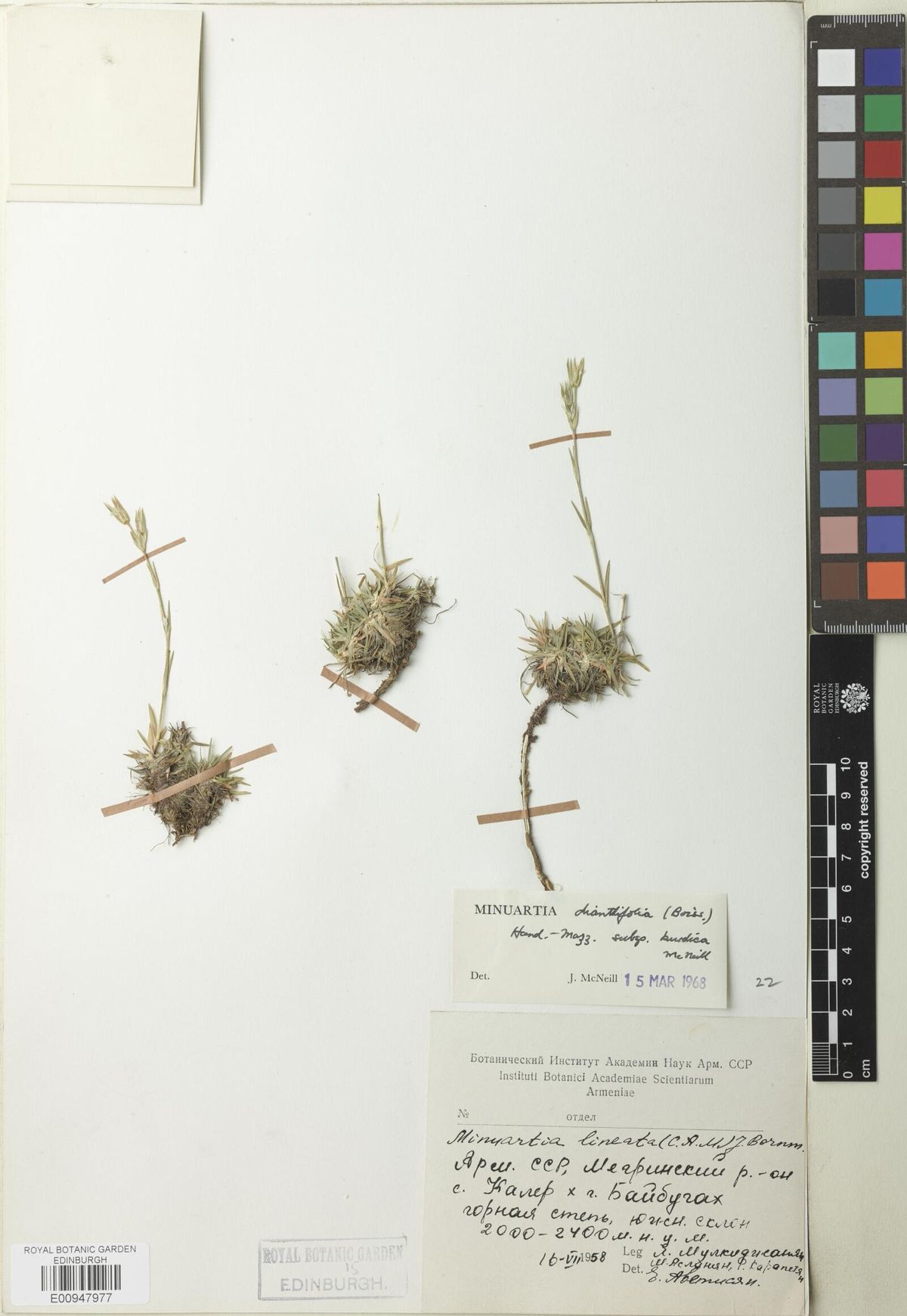
Kew's world checklist gives the species' range as south-western Türkiye only[2], which leaves out the Kurdish subspecies on Mount Artos.
From Alsine to Minuartiella
The plant has changed genus several times. Boissier put it in Alsine (1849); later botanists moved it to Minuartia (Handel-Mazzetti, 1912), to Arenaria (Fernald, 1919)[1][2] and to Somerauera (Á. Löve and D. Löve, 1974)[2].
The latest move came from DNA. In 2014 Markus Dillenberger and Joachim Kadereit studied the relationships within the large genus Minuartia and found what later authors call "rampant polyphyly": the plants grouped under that one name came from several separate branches of the family tree[6][4]. They split it into smaller genera, aiming for groups that each descend from one ancestor[4]. One of the new genera was Minuartiella, "the little Minuartia" (our reading of the name). The Kurdish plant became Minuartiella dianthifolia subsp. kurdica[6].
Minuartiella is a small genus, which a 2022 study calls "a genus otherwise limited to South-West Asia" (that study added a species from Greece)[4]. That study's DNA analysis included two subspecies of M. dianthifolia, but not the Kurdish one, which has been "not investigated yet by molecular techniques"[4]. Whether it is a subspecies, a species of its own or something else is still an open question.
A name in Kurdish?
We know of no Kurdish name for this plant. Ehmedê Dirihî's dictionary of Kurdish plant names lists Minuartia dianthifolia subsp. kurdica in both its Turkish and its Latin index, but the column for the Kurdish name is empty[8]. If you know a name for the small white-flowered cushions of Mount Artos, Flora Kurdica would like to hear it.
Sources
- 1.McNeill, J. (1963). Taxonomic studies in the Alsinoideae: II. A revision of the species in the Orient. Notes from the Royal Botanic Garden Edinburgh 24(3): 241-404.
- ai
- bpp. 342–344.
- cdhklmnqsuvwp. 344.
- efp. 343.
- goxp. 345.
- jrpp. 343–344.
- ppp. 344–345.
- typp. 342–343.
- p. 343. archive.orghttps://archive.org/details/notes-from-royal-botanic-garden-edinburgh-24-003-241-404/page/n102/mode/1upaccessed 14 November 2026
- p. 344. archive.orghttps://archive.org/details/notes-from-royal-botanic-garden-edinburgh-24-003-241-404/page/n103/mode/1upaccessed 14 November 2026
- 2.Plants of the World Online. Royal Botanic Gardens, Kew.
- abcdWorld Checklist of Vascular Plants (Royal Botanic Gardens, Kew): Minuartiella dianthifolia.
- plant_name_id 2996815. powo.science.kew.orghttps://powo.science.kew.org/taxon/urn:lsid:ipni.org:names:77137471-1accessed 14 November 2026
- 3.Royal Botanic Garden Edinburgh Herbarium (E), specimen catalogue (via data.rbge.org.uk and GBIF). data.rbge.org.ukhttps://data.rbge.org.uk/herb/
- 4.abcdeDe Luca, D., Del Guacchio, E., Conti, F., Iamonico, D. & Caputo, P. (2022). Relationships within Mcneillia indicate a complex evolutionary history and reveal a new species of Minuartiella (Caryophyllaceae, Alsinoideae). Plants 11(16): 2118. doi:10.3390/plants11162118https://doi.org/10.3390/plants11162118
- 5.Boissier, E. (1849). Diagnoses Plantarum Orientalium Novarum, ser. 1, no. 9. Genève. archive.orghttps://archive.org/details/e.-boissier-diagnoses-plantarum-orientalium-novarum-series-secunda.-n.o-8-13-1842-1854
- 6.International Plant Names Index. Royal Botanic Gardens, Kew, Harvard University Herbaria and Australian National Herbarium.
- 7.↩Natural History Museum, London, herbarium specimen BM000552446 (isotype), via GBIF.
- 8.↩Ahmet Kasımoğlu (Ehmedê Dirihî) (2013). Ferhenga Navên Nebatan a Kurdî (Dictionary of Kurdish Plant Names). Mardin Artuklu University, Institute of Living Languages in Turkey (ISBN 978-605-4202-12-6), pp. 999, 1125.
Last updated 20 November 2026