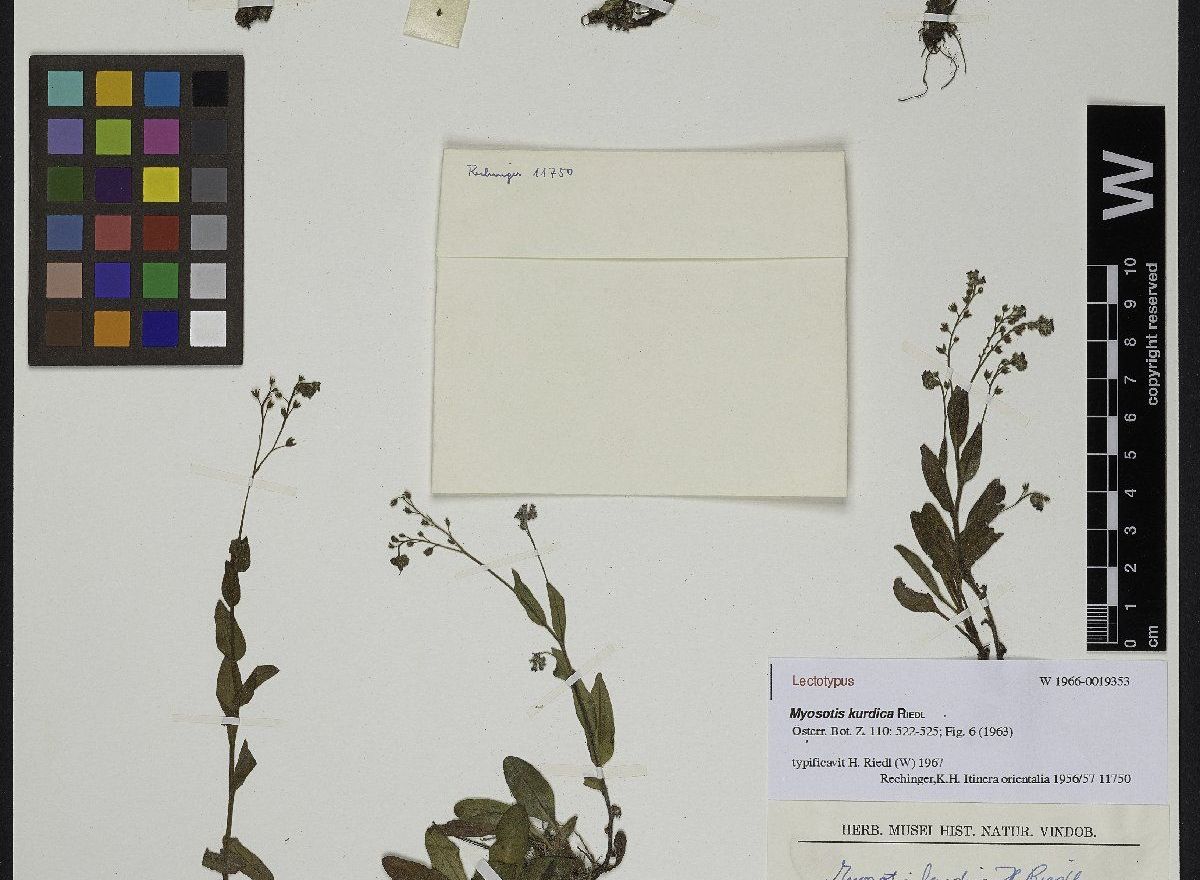
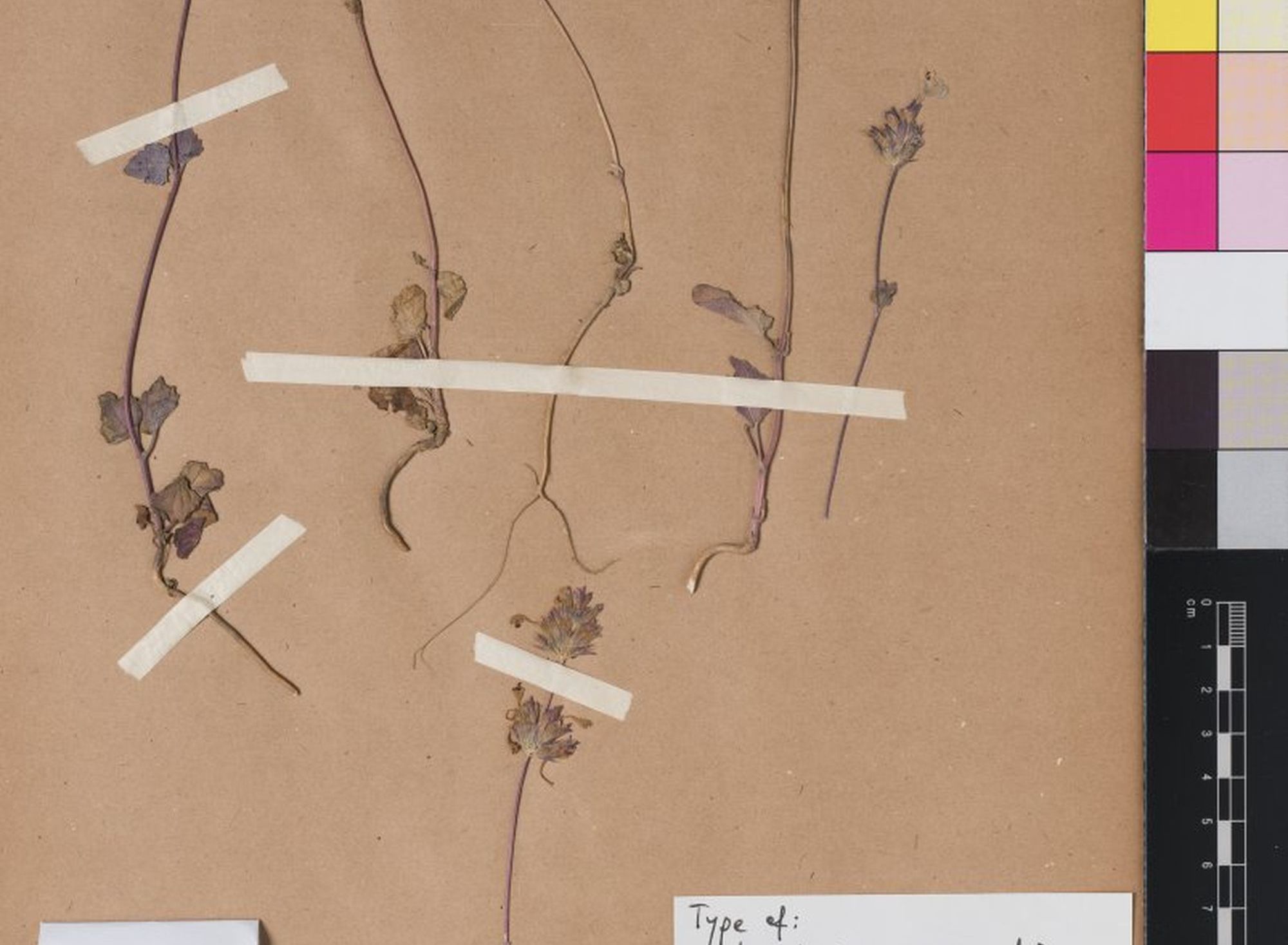
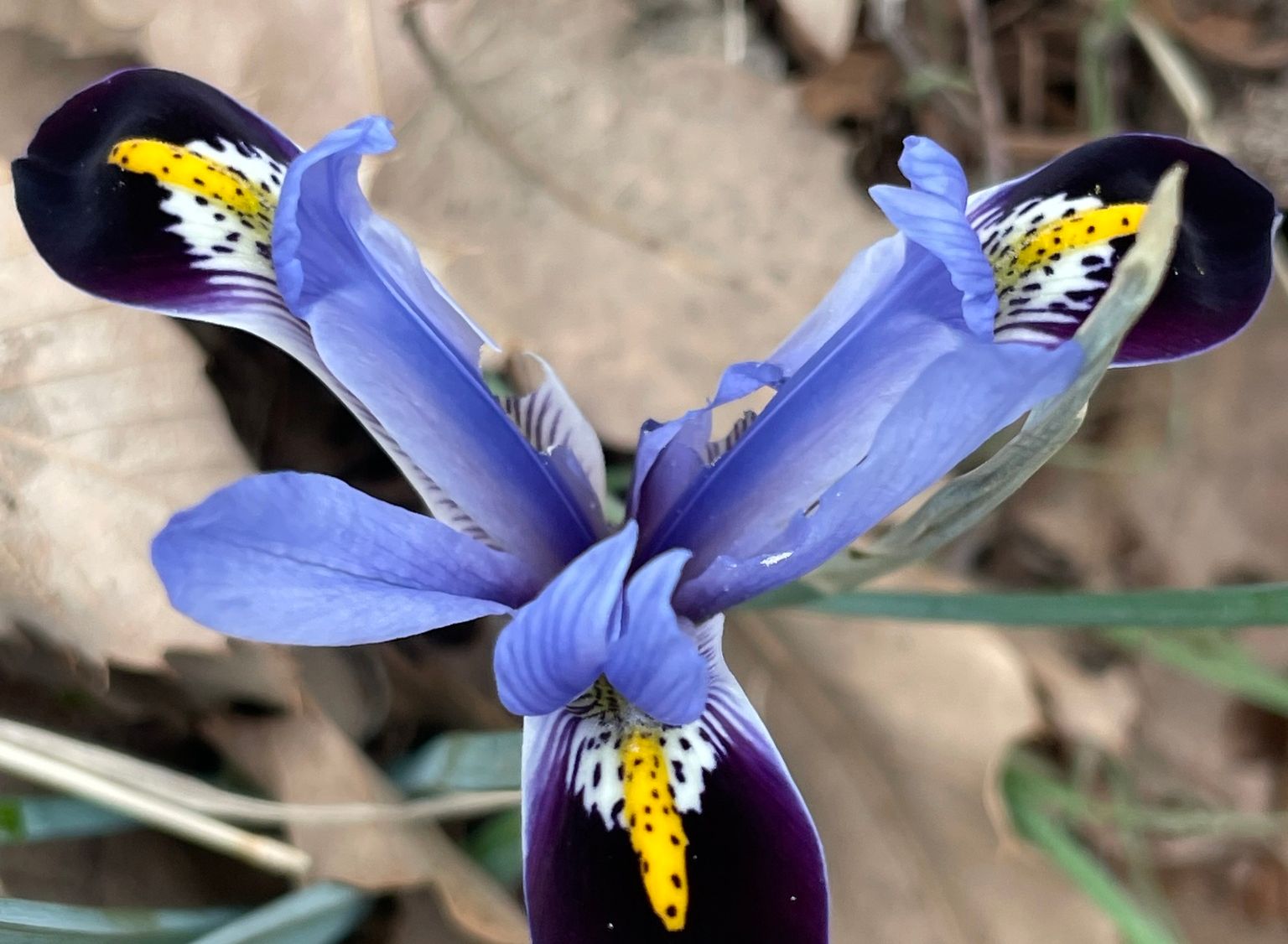
Muscari kurdicum is a small spring bulb of Rojhilat, East Kurdistan, with nodding bells of blue to violet[1][2]. It belongs to the grape-hyacinth genus, Muscari[3][4], and as far as the published record goes, it is known from a single place on the road from Dîwandere to Seqiz, at 2,100 m[1][3].
How it got its name
- Named by
- Maroofi, 2007Published in Iran. J. Bot. 13: 75
- Type collected by
- Maroofi3 March 2004
A March day above 2,000 metres
On 3 March 2004 the botanist Hossein Maroofi, of the Research Center of Agriculture and Natural Resources of Kurdistan, was collecting on the road between Dîwandere (Divandarreh) and Seqiz (Saqqez), 3 km from the village of Zarrieneh, at 2,100 m[1][3]. Among the plants he gathered was a little bulb. The paper lists two more gatherings from the same place, numbers 7802 and 7791[1].
In his own words: "In the new gathering of plants in Kurdistan (West of Iran), there was an interesting Muscari species which was identified as a new species of the genus"[1]. In 2007 he published it in the Iranian Journal of Botany as Muscari kurdicum, "a new species from Kurdistan (Iran)"[1].
The specimen from that March day, Maroofi's number 7109, is the holotype, the one specimen to which the name is tied for good. It is kept in the Kurdistan herbarium, with a duplicate at the herbarium TARI[1][3]. The epithet kurdicum means "Kurdish". The paper does not explain the choice, but the plant, its type and its describer's institute all come from Kurdistan[1].
A botanist who named the flora after Kurdistan
Muscari kurdicum is one of a whole family of names. Between 2002 and 2023 Maroofi published, alone or with colleagues, a run of plants whose names carry Kurdistan or the Kurds[3]:
- Crocus danfordiae subsp. kurdistanicus (2002), raised in 2014 to Crocus kurdistanicus;
- Muscari kurdicum (2007);
- Amygdalus kurdistanica (2009);
- Allium kurdistanicum (2011);
- Tragopogon kurdicus (2014);
- Campanula kurdistanica (2015);
- Pentanema kurdistanicum (2016);
- Cephalaria kurdistanica (2020);
- Heracleum kurdistanicum (2021);
- Tanacetum kurdistanicum (2022);
- Silene kurdistanica (2023).
Several of these have pages of their own on Flora Kurdica.
What it looks like
Maroofi's description paints a compact, sturdy little plant[1]:
- Bulb: one, egg-shaped to oblong, 1.2–2.7 cm long, in a coat Maroofi calls "brown ivory"; it does not multiply into offsets.
- Leaves: usually two or three, rarely up to six, upright and channelled, sheathing the stem at the base, 3.5–8 cm long and 0.7–1.3 (rarely 2.2) cm wide when the plant flowers, lengthening to about 14 cm by fruiting time, dark green.
- Flowering stems: one or two, 7–14 cm, standing above the leaves. The whole plant is up to 14 cm tall in flower and 21 cm in fruit.
- Flowers: a dense, oval spike of 7 to 36 bells, rarely as many as 62. Each fertile flower is 4–6 mm long, bell-shaped and hangs downwards on a short stalk. They are "blue to bright or dark violet, rarely white", and the small lobes at the rim, slightly bent inwards and alternately smaller and larger, are the same colour as the bell. The anthers inside are violet.
- Sterile flowers: up to four at the top of the spike, held upright or outwards, blue to bright violet, with a narrow dark violet stripe down the back of the lobes and tube.
- Fruit: a capsule about 5.5 mm across, with black seeds whose surface is rather pitted.
Not quite a grape hyacinth
In the garden grape hyacinths, such as the common grape-hyacinth Muscari botryoides[4], each little flower is pinched in at the mouth, like a tiny urn. The flowers of M. kurdicum are not: they are open bells, "without distinct constriction at throat", with lobes coloured like the tube[1].
That detail matters. Botanists have long set apart a small group of Muscari with exactly these flowers, first as a section, Pseudomuscari, in 1935, then as a subgenus by 1965, and since 1970 also as a genus of its own under the same name[3]. One key to Iran's grape hyacinths puts the difference in a single line: in Pseudomuscari the flowers are "violet, blue or whitish, unconstricted at throat, with concolourous lobes"; in Muscari proper they are "dark violet, constricted at throat, with whitish lobes"[5].
Maroofi placed his plant in that group, subgenus Pseudomuscari[1]. He compared it with three relatives: M. pseudomuscari from northern Iran, and M. azureum and M. coeleste, which he gives as Turkish[1]. Its closest relative, he wrote, is M. azureum. The Kurdish plant differs from it in the size and shape of its leaves, the length of its flowering stem, the size of its spike, the colour of its flowers and its stamens[1]. In his comparison table M. azureum has bright sky-blue flowers and stamens set almost in one row, where M. kurdicum has blue to violet flowers and stamens in two rows[1]. M. pseudomuscari differs in another way: it carries 7–12 sterile flowers at the top of its spike, against a few, at most four, in the Kurdish plant[1].
In 2023 the botanist A. Jafari moved the species into Pseudomuscari as Pseudomuscari kurdicum, in the Flora of Iran[3]. Kew's World Checklist still lists it under its first name, Muscari kurdicum[2]. Both names point to the same plant, and the same Kurdish hillside.
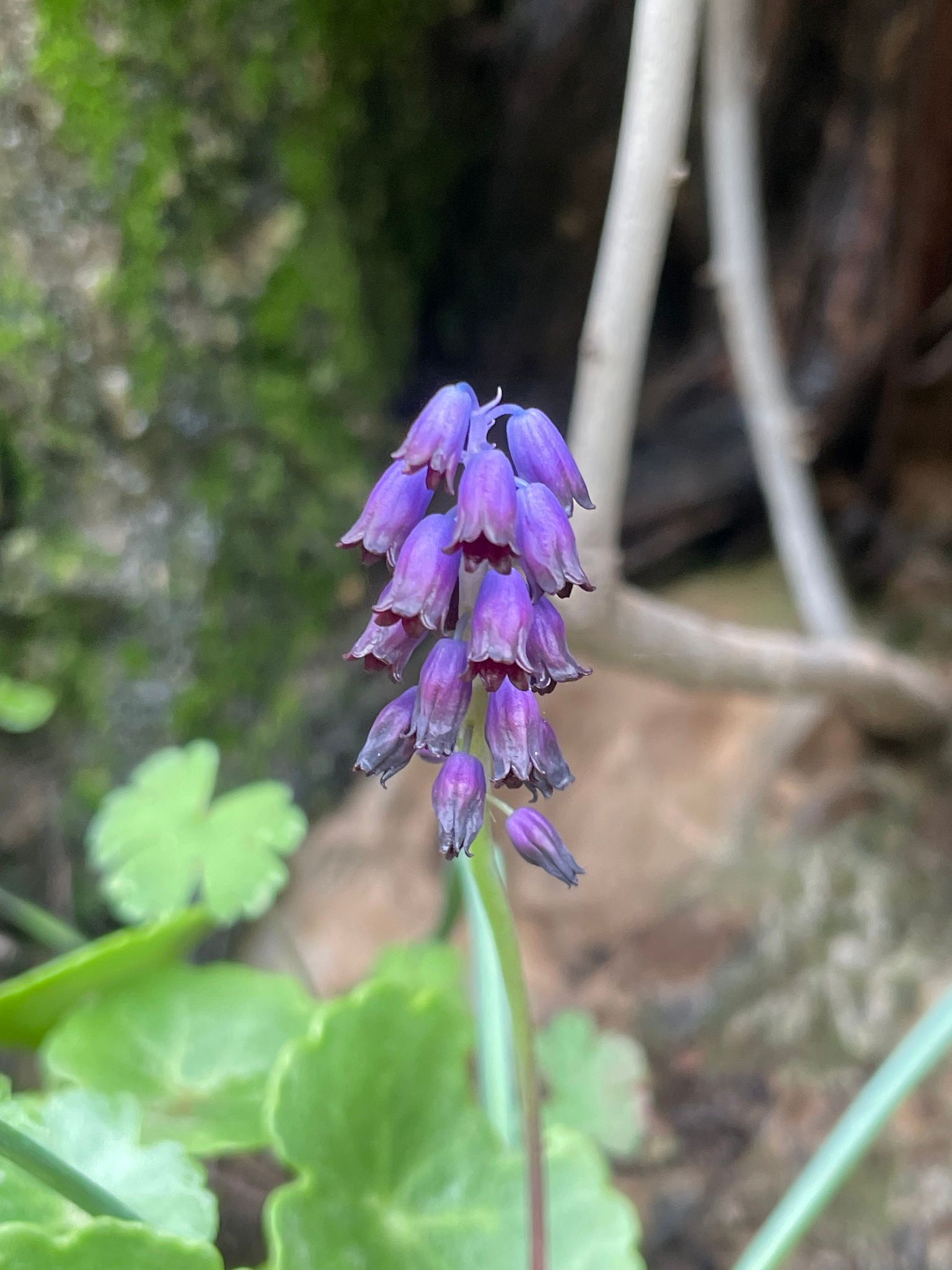
This is not M. kurdicum but M. inconstrictum, another member of the Pseudomuscari group[5], photographed in spring near Biyare (Byara) in Başûr. Its open, unpinched bells show what sets the group apart.
Where it grows
Kew's checklist gives its native range as northwestern Iran, and it lists it as a bulbous geophyte of the temperate zone: a plant that spends most of the year underground as a bulb[2]. In Kurdish terms, every record of it lies in Rojhilat, in the mountains of Kurdistan province between Dîwandere and Seqiz[1][3].
Beyond that, very little is known. The paper gives no habitat beyond the type locality, its height and its March date[1]. A 2011 survey of the grape hyacinths of Iran does not mention it at all[5]. The Global Biodiversity Information Facility holds no specimen or observation under its name, and on iNaturalist, where people share photographs of wild plants, it has not yet been recorded[6]. There is no openly licensed photograph of it anywhere we could find.
New grape hyacinths are still being found in the region: in 2024 botanists described yet another new Muscari from Iran, M. zagricum[7]. Anyone walking the hills between Dîwandere and Seqiz in early March could add the first public photograph of Muscari kurdicum to the record, as long as an expert confirms the species.
Its name in Kurdish
No Kurdish name has been recorded for Muscari kurdicum itself. For the genus Muscari as a whole, two Kurdish plant-name sources give names:
- Gêleqir, for "Muscari spp", in the plant list Flora Kurdistanê (II) by Ehmedê Dirihî in the journal Kurmancî (2007)[8];
- emroke, with giyalîliq, simbila koyan, simbila miskê, sîrikê seyan and sosin listed alongside it, in Dirihî's dictionary of Kurdish plant names (2013)[9].
The dictionary also gives sosin for Muscari azureum, the closest relative Maroofi named[9]. On the same page sosin stands for lilies, narcissi, primroses and Sternbergia as well[9]: a name for many spring flowers, not for one.
These are genus names, to be checked: they belong to Muscari in general, not to this species, and are quoted here exactly as each source prints them.
Sources
- 1.Maroofi, H. (2007). A new species of the genus Muscari (Liliaceae) from Iran. Iranian Journal of Botany 13(2): 75-77.
- 2.Plants of the World Online. Royal Botanic Gardens, Kew.
- abcMuscari kurdicum.
- plant_name_id 373401. powo.science.kew.orghttps://powo.science.kew.org/taxon/urn:lsid:ipni.org:names:77090049-1accessed 14 November 2026
- 3.International Plant Names Index. Royal Botanic Gardens, Kew, Harvard University Herbaria and Australian National Herbarium.
- afMuscari Mill. (1754); Pseudomuscari Garbari & Greuter (1970); Muscari sect. Pseudomuscari Losinsk. (1935); Muscari subgen. Pseudomuscari D.C.Stuart (1965).
- bcdhMuscari kurdicum Maroofi, with type data.
- eauthor record and published names of Hossein Maroofi.
- gPseudomuscari kurdicum (Maroofi) Jafari, Flora of Iran 171–175: 123 (2023).
- urn:lsid:ipni.org:names:77090049-1. ipni.orghttps://www.ipni.org/n/77090049-1accessed 14 November 2026
- 4.abBrooklyn Botanic Garden, New York Metropolitan Flora: Muscari botryoides.
- 5.Jafari, A. & Maassoumi, A. A. (2011). Synopsis of Leopoldia, Muscari and Pseudomuscari (Hyacinthaceae) in Iran, with Leopoldia ghouschtchiensis sp. nova. Annales Botanici Fennici 48: 396–400. doi:10.5735/085.048.0502https://doi.org/10.5735/085.048.0502
- 6.↩Global Biodiversity Information Facility (GBIF) and iNaturalist, records for Muscari kurdicum (checked 15 November 2026).
- 7.↩Alipour, S., Majidi, R. & Eker, İ. (2024). Muscari zagricum (Asparagaceae, Scilloideae), a unique new species from Iran. Phytotaxa 652(2): 133–141. doi:10.11646/phytotaxa.652.2.5https://doi.org/10.11646/phytotaxa.652.2.5
- 8.↩Ehmedê Dirihî (2007). Flora Kurdistanê (II). institutkurde.orghttps://www.institutkurde.org/publications/kurmanci/
- 9.Ahmet Kasımoğlu (Ehmedê Dirihî) (2013). Ferhenga Navên Nebatan a Kurdî (Dictionary of Kurdish Plant Names). Mardin Artuklu University, Institute of Living Languages in Turkey (ISBN 978-605-4202-12-6).
- iNaturalist. observation 346131645, Muscari inconstrictum, Byara (Arya Aras, 2026). inaturalist.orghttps://www.inaturalist.org/
Last updated 20 November 2026