Myosotis kurdica is a forget-me-not from the Qendîl (Qandil) mountains, the high range on the border between South Kurdistan (Başûr) and East Kurdistan (Rojhilat)[1]. Botanists know it from a single gathering: a handful of small plants collected in the summer of 1957, on the eastern slopes above the village of Piştaşan (Pushtashan), at about 2,000–2,200 m[1][2]. Its name, kurdica, means "Kurdish". As far as we could find, those plants are still the only ones on record[3].
How it got its name
- Named by
- Riedl, 1963Published in Oesterr. Bot. Z. 110: 522
A week above Piştaşan, summer 1957
At the end of July 1957 the botanist Karl Heinz Rechinger (1906–1998)[4] was collecting in the Qendîl range, in the Hewlêr (Erbil) district, during the journey his labels call Itinera orientalia 1956/57[1]. He worked around Piştaşan, about 15 km north-east of Ranye (Rania)[5], and his labels from those days cover the whole mountain: walnut groves and oak woods around 1,000–1,100 m, the gorges above the village, the eastern slopes, and higher still, up to 3,000 m on the way to a mountain lake[5].
It was a remarkable few days. Several plants he pressed there later turned out to be new to science and were named after the place: an Onosma from the gorges above Piştaşan (Onosma qandilica), a Cousinia from the oak woods below the village (Cousinia qandilica), and a milk-vetch from the same eastern slopes as our forget-me-not, Astragalus pushtashanicus[4][5]. The original sheets of all three are in Vienna[5].
Our plant is number 11750 in his collection. The printed label says where it grew: "on the eastern slopes above Pushtashan, about 2000–2200 m", gathered between 28 July and 1 August 1957[1]. On the duplicate sheet that went to Munich, someone added in ink that the plants grew secus rivulos, "along the little streams"[2]: a fitting place for a forget-me-not.
Named in Vienna, 1963
The specimens went to Vienna, where a young botanist, Harald Riedl (born 1936)[4], was working on the borage family (Boraginaceae) as preparatory work for Rechinger's great Flora Iranica[6]. He judged number 11750 to be a forget-me-not new to science, and in 1963 he described it as a new species, Myosotis kurdica, in a long paper "on new or critical Boraginaceae of the Asian flora", with an illustration[1][7][4]. His slip on the Munich sheet still reads "Myosotis kurdica H. Riedl, sp. n.", a new species[2].
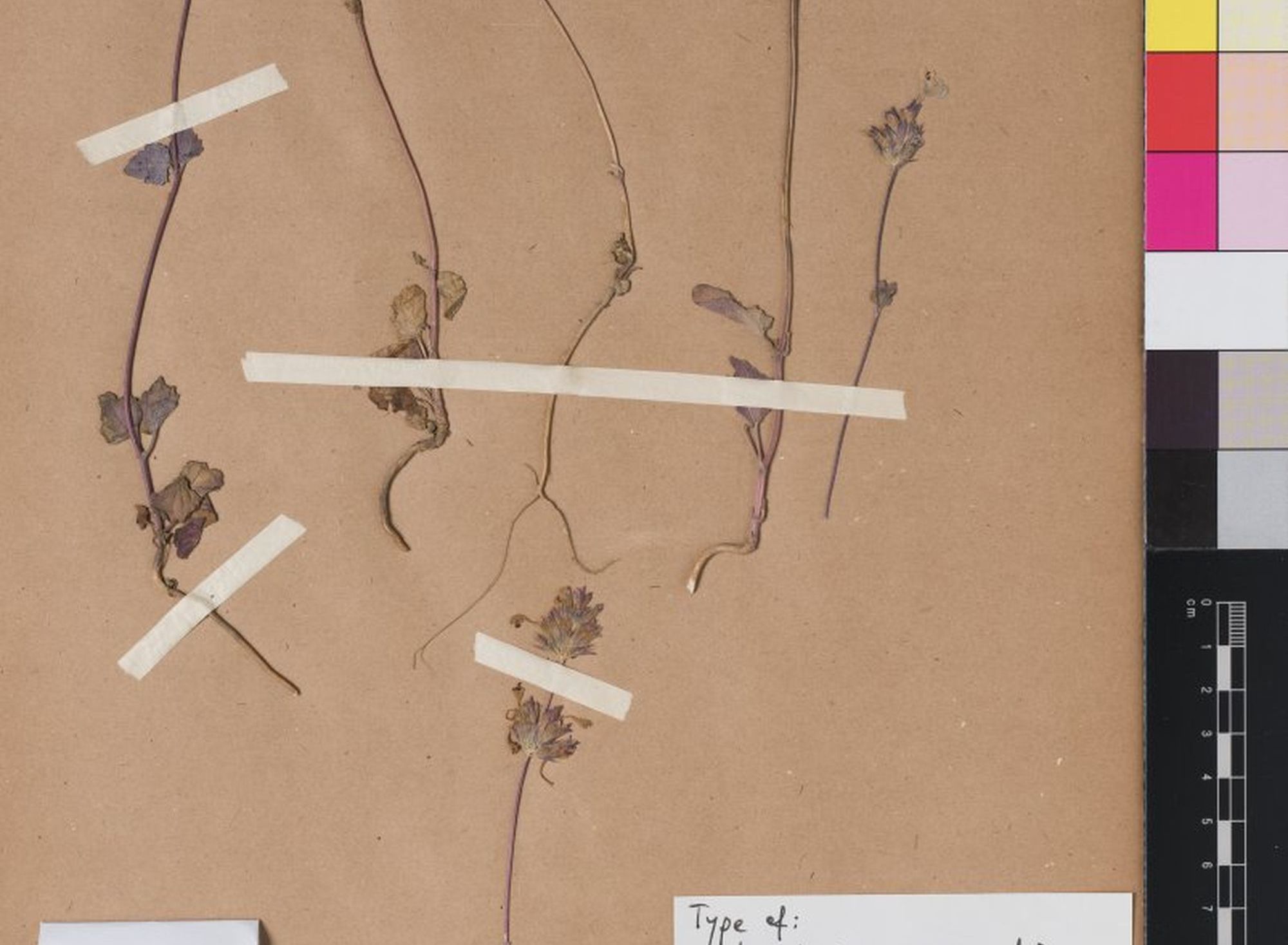
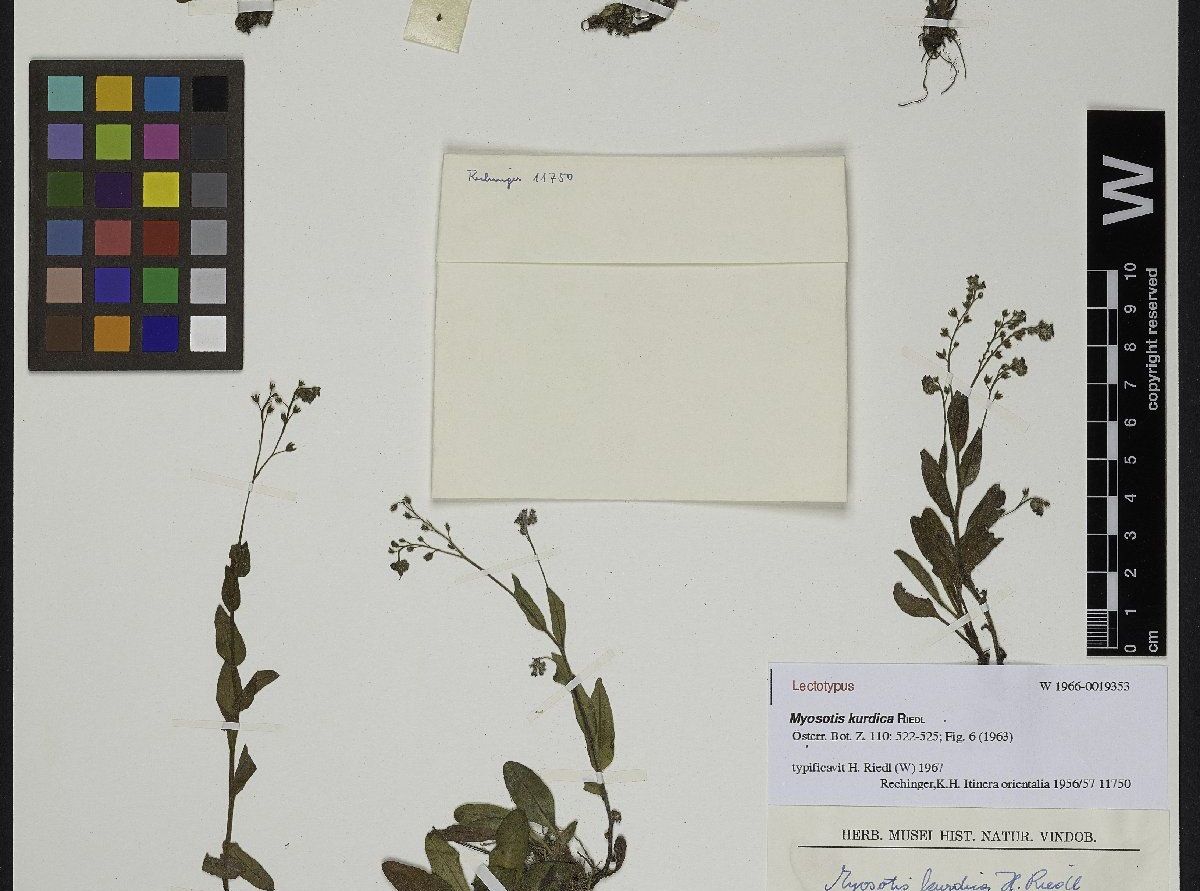
The gathering had been split between herbaria, so in 1967, in his Flora Iranica account of the family, Riedl chose the sheet in the Natural History Museum, Vienna as the lectotype: the one specimen to which the name is tied for good[1]. The Munich sheet, in the Botanische Staatssammlung München, is a duplicate of the same gathering[2].
A neighbour on Helgurd
In the same 1963 paper, one page earlier, Riedl dealt with another small forget-me-not, Myosotis diminuta[7][4]. Its only record from Başûr is older still: Joseph Bornmüller collected it in June 1893 at about 3,000 m in the alpine zone of Helgurd, near Rewandiz[8]. For more than a hundred years nobody documented it again, until botanists found it in 2013 in a wetland in Zanjan, far from its known sites[8].
What it looks like
This is what the two type sheets show[1][2]:
- a perennial[9], with tufts of leaves at the base on long stalks, the blades oblong to spoon-shaped;
- slender flowering stems with a few narrower leaves along them, the longest on the Vienna sheet about 15–16 cm against the scale bar[1];
- small flowers in loose, few-flowered sprays at the tips of the stems.
The flower colour is not given on either label.
Where it grows
Kew's checklist gives its range as "N. Iraq"[9]. In Kurdish terms, that is the Qendîl range in Başûr, on the border with Rojhilat[1]. The Global Biodiversity Information Facility (GBIF) holds just two records of it, and both are sheets of Rechinger's single 1957 gathering[3].
Two recent papers that added new forget-me-nots to Iraq's flora, in 2025 and 2026, list the species they know from the country's mountains, and M. kurdica is not among them[10][11]. One of them notes that the precise number of forget-me-nots in Iraq "remains undetermined"[10].
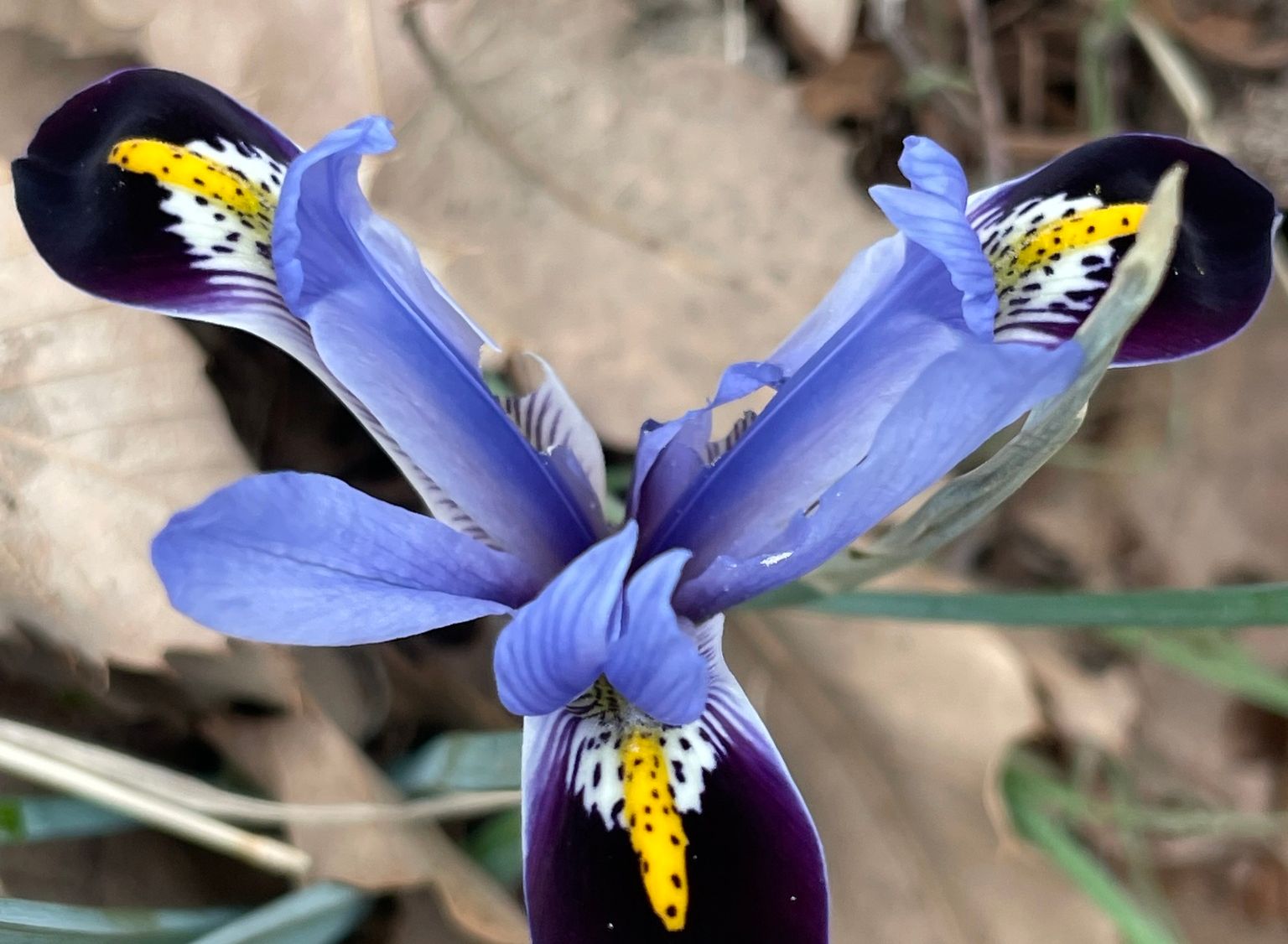
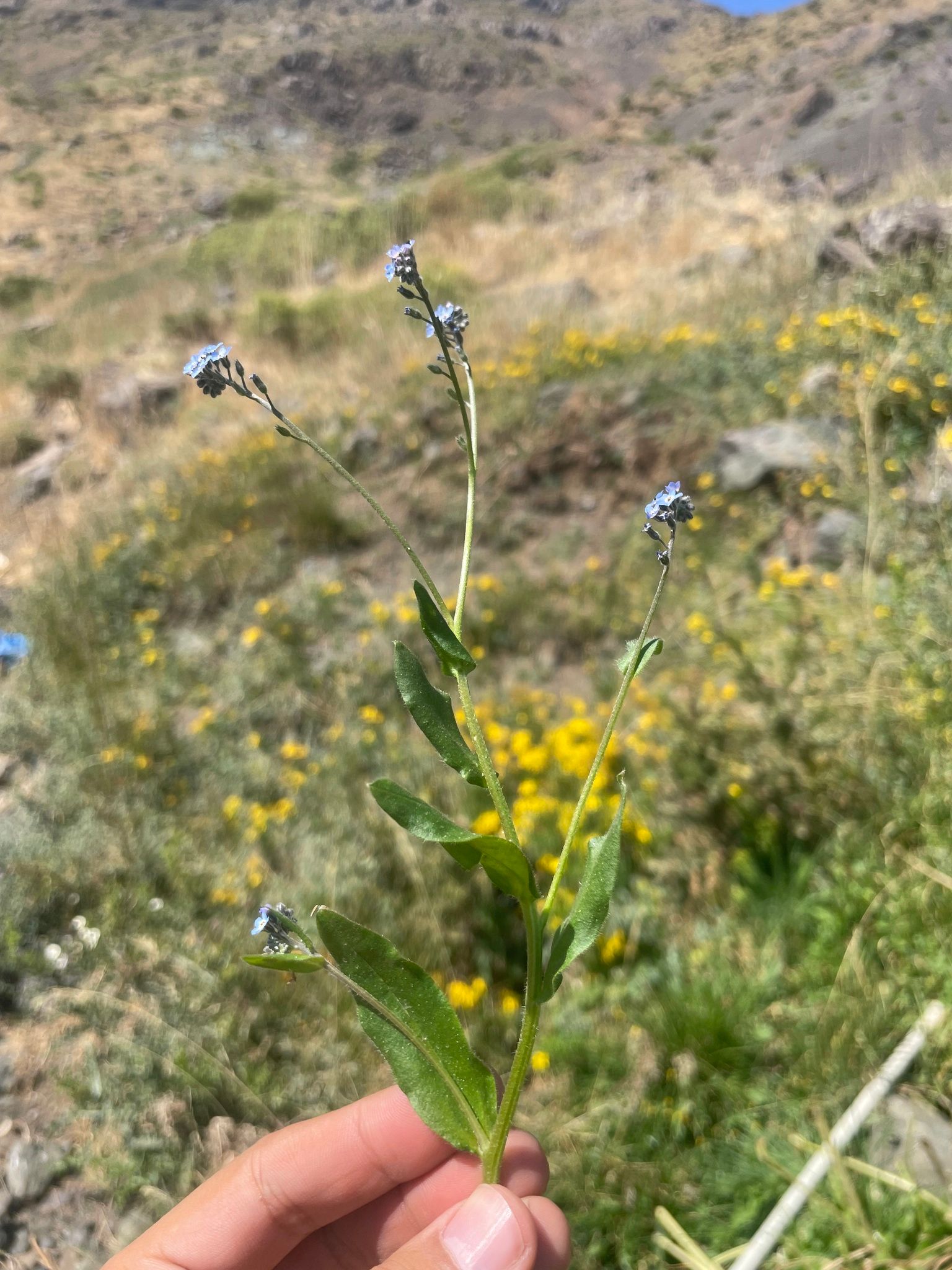
There may be a new lead. In July 2025 a naturalist photographed a blue-flowered forget-me-not near Çoman (Choman), not far from the Qendîl range, and posted it as Myosotis kurdica[12]. Nobody else has confirmed the identification yet, so for now it is a lead, not a record. If it holds, it would be the first sighting of the plant since 1957.
The species has not been assessed for the IUCN Red List[3].
Its name in Kurdish
No Kurdish name was written on the 1957 labels[1][2], and Ehmedê Dirihî's dictionary of Kurdish plant names has no entry for this species[13]. For forget-me-nots in general (the genus Myosotis), the dictionary gives çavê balindeyî and giya dûpişk (also written giyadûpişk)[13]. In English these read roughly as "bird's eye" and "scorpion herb" (our translation, still to be checked by a Kurdish speaker). The second name is not unique to forget-me-nots: on the same page the dictionary prints giyadûpişk for a heliotrope, a plantain, a nettle and Scorpiurus as well[13].
Dirihî also lists names for three other forget-me-nots: gulewîn, gurizê derewîn and xelate giya for the field forget-me-not (M. arvensis), catir for M. palustris, and cehterê bêyaban, guhmişk and zircatir for M. stricta[13]. Which name, if any, people in Qendîl use for their own forget-me-not is still to be recorded.
Sources
- 1.Natural History Museum Vienna (W) – Herbarium. via GBIF.
- abcdefghijherbarium specimen W 1966-0019353, lectotype of Myosotis kurdica (Rechinger 11750; via GBIF, occurrence 1230969032).
- W 1966-0019353 (GBIF occurrence 1230969032), Lectotype. api.gbif.orghttps://api.gbif.org/v1/occurrence/1230969032accessed 14 November 2026
- W 1966-0019353. api.gbif.orghttps://api.gbif.org/v1/occurrence/1230969032accessed 14 November 2026
- 2.abcdefBotanische Staatssammlung München, herbarium specimen M-0174252, duplicate of Rechinger 11750 (via GBIF, occurrence 2981280634).
- 3.abcGBIF.org GBIF Backbone Taxonomy and occurrence records. occurrence records and IUCN category for Myosotis kurdica (accessed 15 November 2026). gbif.orghttps://www.gbif.org/
- 4.International Plant Names Index. Royal Botanic Gardens, Kew, Harvard University Herbaria and Australian National Herbarium.
- 5.abcdHerbarium specimens collected by K. H. Rechinger at Pushtashan, July–August 1957 (Naturhistorisches Museum Wien and Royal Botanic Gardens, Kew; via GBIF).
- 6.↩Riedl, H. (1961). Die neue Borraginaceengattung Choriantha und ihre Stellung im Verwandtschaftskreis von Onosma (Vorarbeiten zu K. H. Rechinger, Flora iranica I). Österreichische Botanische Zeitschrift 108: 399–407.
- 7.abRiedl, H. (1963). Bemerkungen über neue oder kritische Borraginaceen der asiatischen Flora. Österreichische Botanische Zeitschrift 110(5): 511–542.
- 8.abMahmoodi, M., Ghahremaninejad, F. & Maassoumi, A. A. (2015). A new record of the genus Myosotis (Boraginaceae) for the flora of Iran: rediscovery of a rare plant. Iranian Journal of Botany 21(1): 43–46.
- 9.Plants of the World Online. Royal Botanic Gardens, Kew.
- abMyosotis kurdica.
- plant_name_id 2357519. powo.science.kew.orghttps://powo.science.kew.org/taxon/urn:lsid:ipni.org:names:119072-1accessed 14 November 2026
- 10.abHasan, H. H. & Sardar, A. S. (2025). New record for the flora of Iraq: Myosotis incrassata Guss. (Boraginaceae). Zanco Journal of Pure and Applied Sciences 37(4): 1–10. doi:10.21271/ZJPAS.37.4.1https://doi.org/10.21271/ZJPAS.37.4.1
- 11.↩Hasan, H. H. & Sardar, A. S. (2026). Myosotis arvensis subsp. arvensis (L.) Hill, 1764: a new record for the flora of Iraq. Bulletin of the Iraq Natural History Museum 19(1): 79–97. doi:10.26842/binhm.7.2026.19.1.0079https://doi.org/10.26842/binhm.7.2026.19.1.0079
- 12.↩iNaturalist. observation 298960907 (Çoman, 17 July 2025; identification unconfirmed). inaturalist.orghttps://www.inaturalist.org/
- 13.Ahmet Kasımoğlu (Ehmedê Dirihî) (2013). Ferhenga Navên Nebatan a Kurdî (Dictionary of Kurdish Plant Names). Mardin Artuklu University, Institute of Living Languages in Turkey (ISBN 978-605-4202-12-6).
Last updated 20 November 2026