How it got its name
- Named by
- Hausskn. & Bornm., 1899Published in Bull. Herb. Boissier 7: 251
A small blue mint of the Rewandiz mountains
Nepeta kurdica is a small annual of the mint family, a relative of catnip in the genus Nepeta. It grows 20 to 40 cm tall, its stems are often red below, and in early summer it carries dense, rounded heads of blue to violet flowers[1][2]. It was described from a plant collected in 1893 on a mountain above Rewandiz (Rawandiz), and the records we found since then come from the mountains and foothills of South Kurdistan (Başûr): Helgurd, Qendîl, Hewraman and the hills around Slêmanî[2][3][4].
It is also a plant whose name is in doubt. Kew's world checklist still accepts Nepeta kurdica as a species of its own[5], but the specialists who revised the genus for the Flora of Iraq in 2023 treat it as the same species as the older Nepeta humilis[2]. This page tells the story of both: the plant, and the name.
Named in Thuringia, collected above Rewandiz
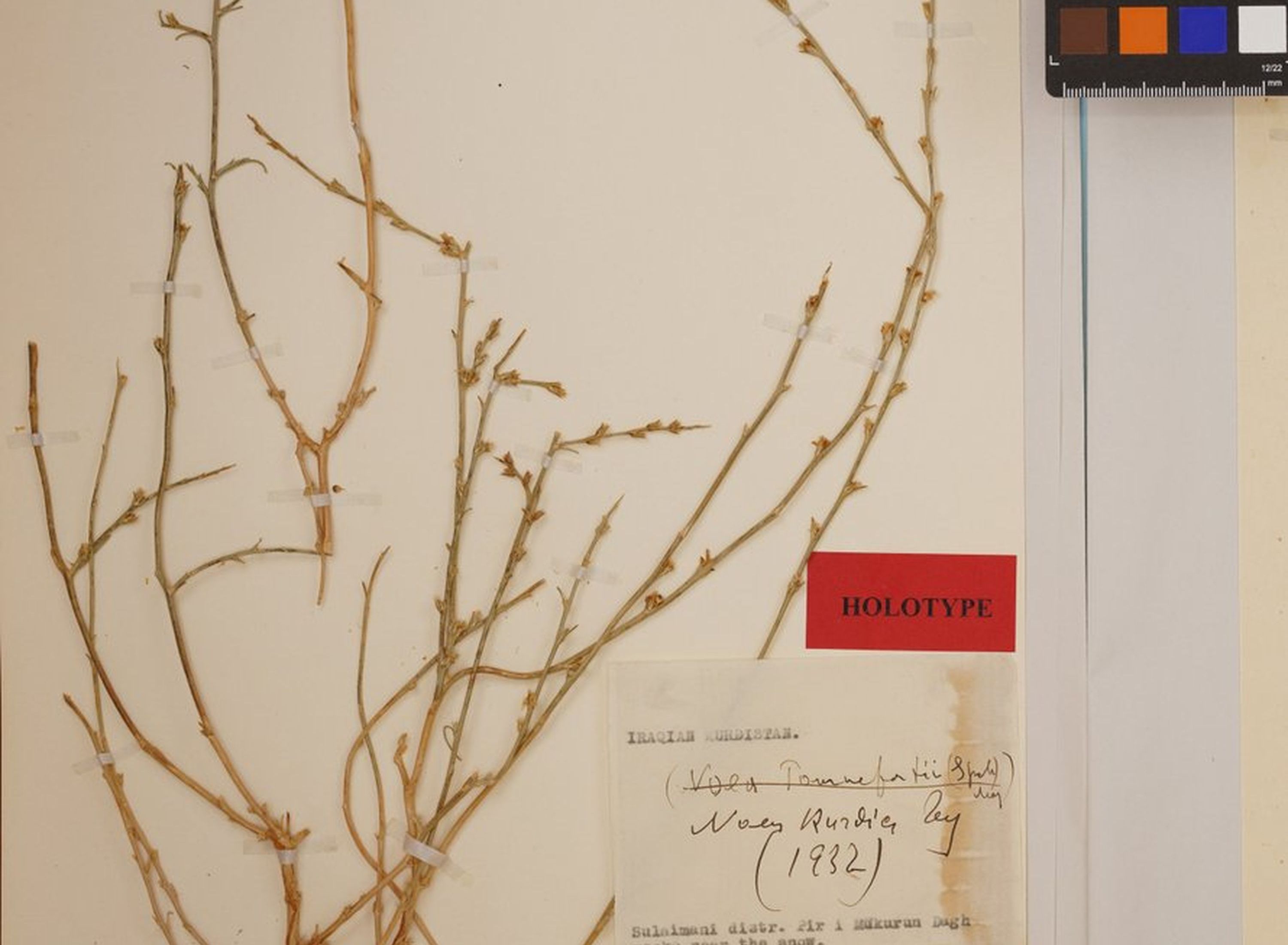
In 1892 and 1893 the German botanist Joseph Bornmüller (1862–1948)[6] made a long collecting journey through Persia and the Ottoman lands, his Iter Persico-turcicum[1][7]. On 21 June 1893 he was in the mountains around Rewandiz, and on a mountain he spelled Händarin, at 1,200 m, he pressed a sticky little annual with blue flowers. It went into his collection as number 1689[1].
He described it in a paper he signed in Berka an der Ilm, in Thuringia, on 4 January 1899[1]. Its title already names the country of the plant: "Twelve new Nepeta species from Persia, Kurdistan and Asia Minor"[1]. The name is credited jointly to him and Carl Haussknecht (1838–1903), so the plant is Nepeta kurdica Hausskn. & Bornm.[1][6].
The way he placed the plant says a lot about how Europeans saw the region then. In the paper he wrote it in Latin, layer upon layer:
Assyria orientalis: (Kurdistania) Riwandous (inter Ourmi et Erbil) in monte Händarin, alt. 1200 m. s. m., 21. VI. 1893 legi.
Eastern Assyria: (Kurdistan) Rewandiz (between Urmia and Erbil), on Mount Händarin, 1,200 m above sea level, collected by me on 21 June 1893.[1] (our translation)
The printed labels of his expedition were headed "Persia", but on his sheet of number 1689 now in Zurich, "Kurdistania" is written right after it[7]. Ancient Assyria, Persia, Kurdistan: three names for one mountainside. The one that stuck is the one in the plant's own name, kurdica, "Kurdish".
What it looks like
Bornmüller's Latin description still works as a field guide[1]:
- an annual, 20–40 cm tall, the whole plant covered in very short, dense, sticky glandular hairs that make it look slightly greyish;
- stems branched from the base, bluntly four-angled, red in the lower part, the branches held upright and far apart;
- lower leaves stalked, broadly ovate with a slightly heart-shaped base and blunt, rounded teeth, the blade only 15–25 mm long; the upper leaves almost stalkless; the leaves often tinged red;
- the flowers packed into dense heads about 12 mm wide, each branch ending in a single head, the upper ones drawing together into a short spike;
- narrow bracts fringed with long white hairs;
- a purplish calyx with spiny-tipped teeth, and a blue corolla about 15 mm long, two to two and a half times as long as the calyx, with black anthers barely sticking out;
- shiny, dark brown nutlets.
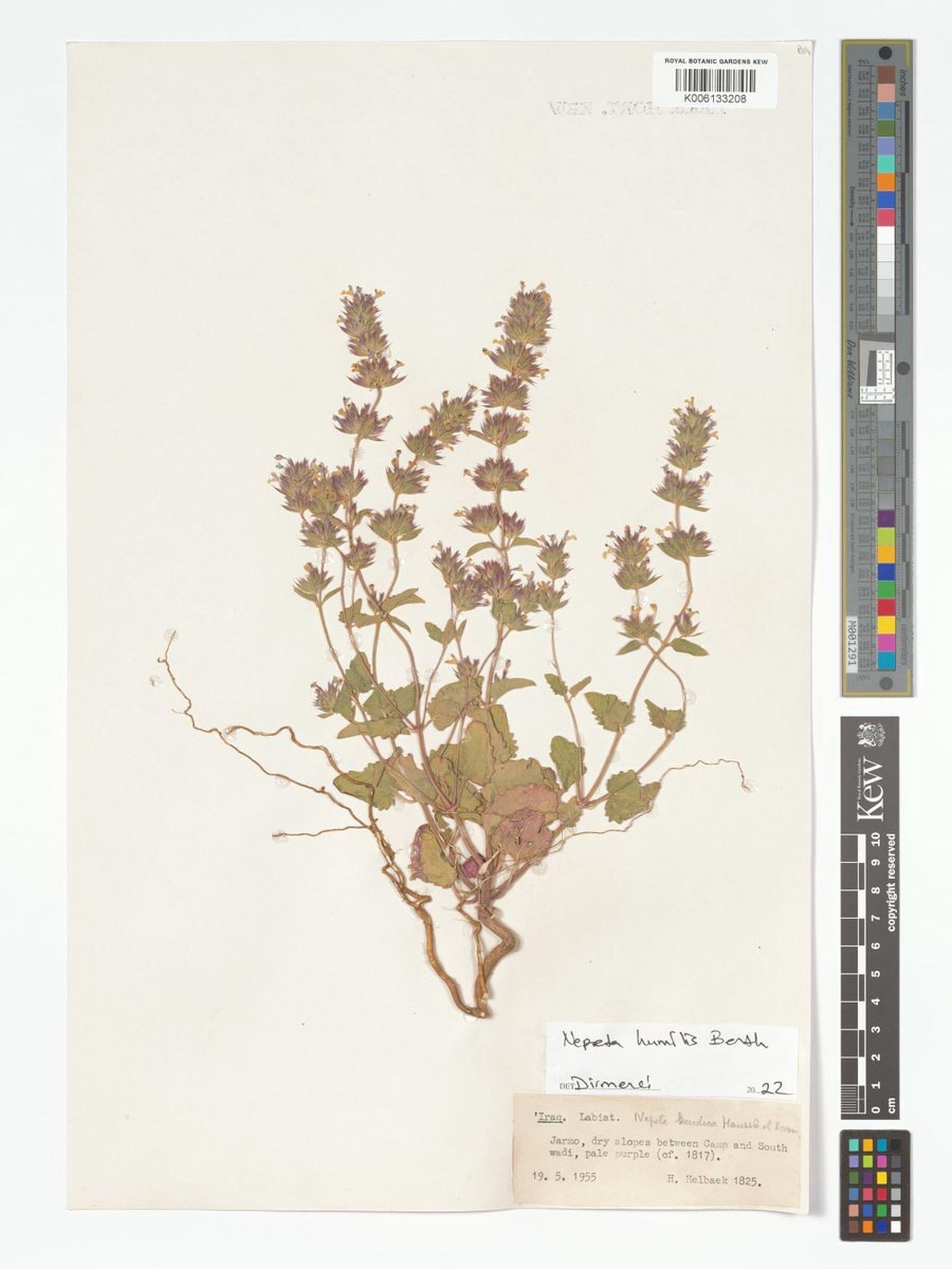
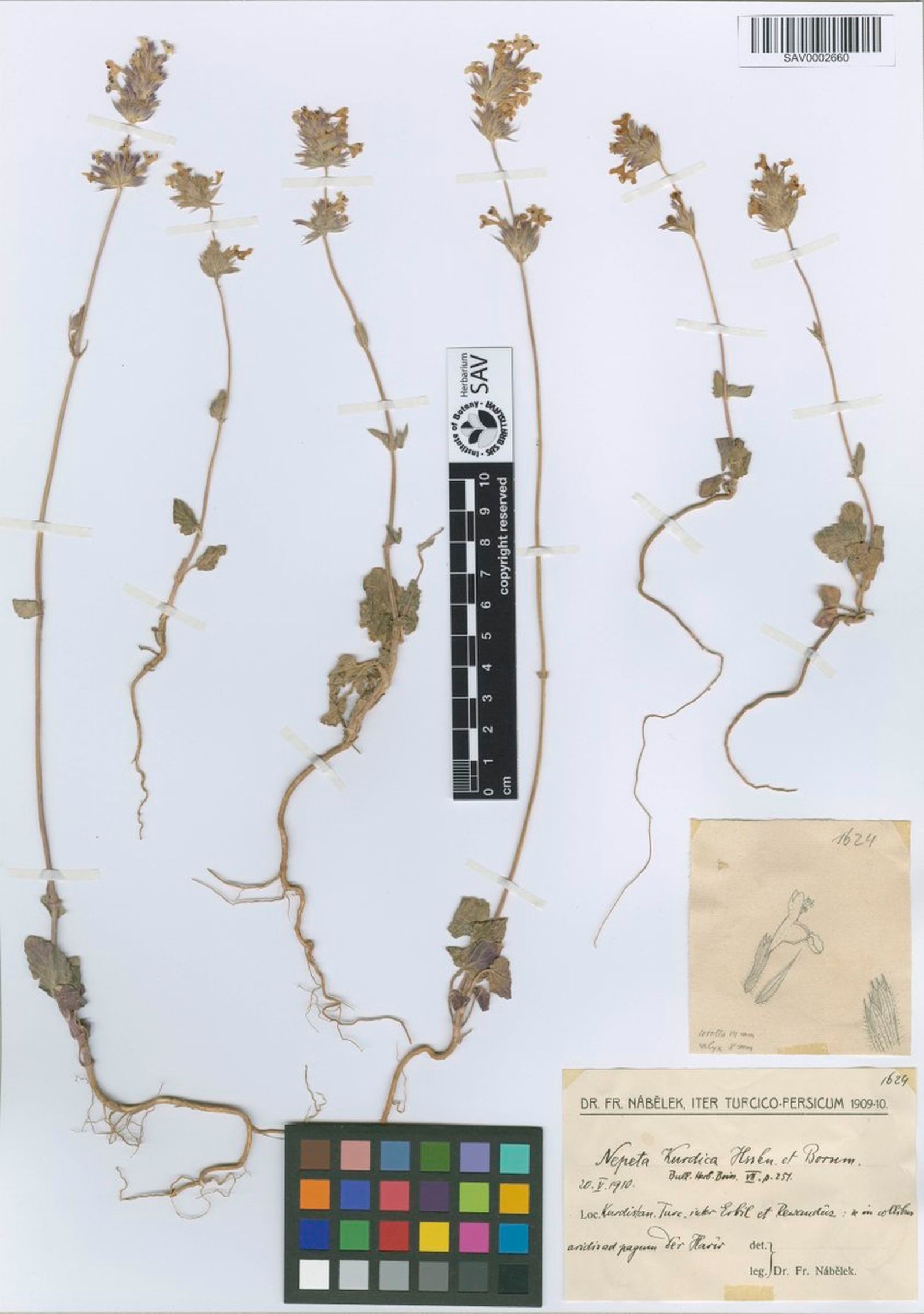
The collectors who came after him saw the same colours in the field: "purple-blue fls." on Helgurd in 1932[3][8], "pale purple" at Çermo (Jarmo) in 1955[8]. The 2023 revision, describing the species as a whole, gives its own figures: plants (5–)10 to 45 cm tall, a violet corolla 11–14 mm long (a little shorter than Bornmüller's 15 mm), and black, smooth nutlets; it flowers and fruits from June to August[2], although a few plants were already in flower in May in the lower hills[8][9].
One plant or two?
The first plant Bornmüller compared his new species with was Nepeta humilis, described by George Bentham in 1848[2]. He had found N. humilis himself in the same region, in the mountains he spelled "Sakri-Sakran", and his specimens matched the ones Haussknecht had brought from nearby Pîremegrûn (Pir Omar Gudrun)[1]. Still, he was sure his Rewandiz plant was different. N. humilis, he wrote, "has a far more slender habit", its delicate branches standing out almost horizontally rather than stiff and upright, with longer bracts and narrower calyx teeth[1] (our translation). He thought it even closer to a third species, N. wettsteinii[1], which grows in Gilan and Azerbaijan in north-western Iran[2].
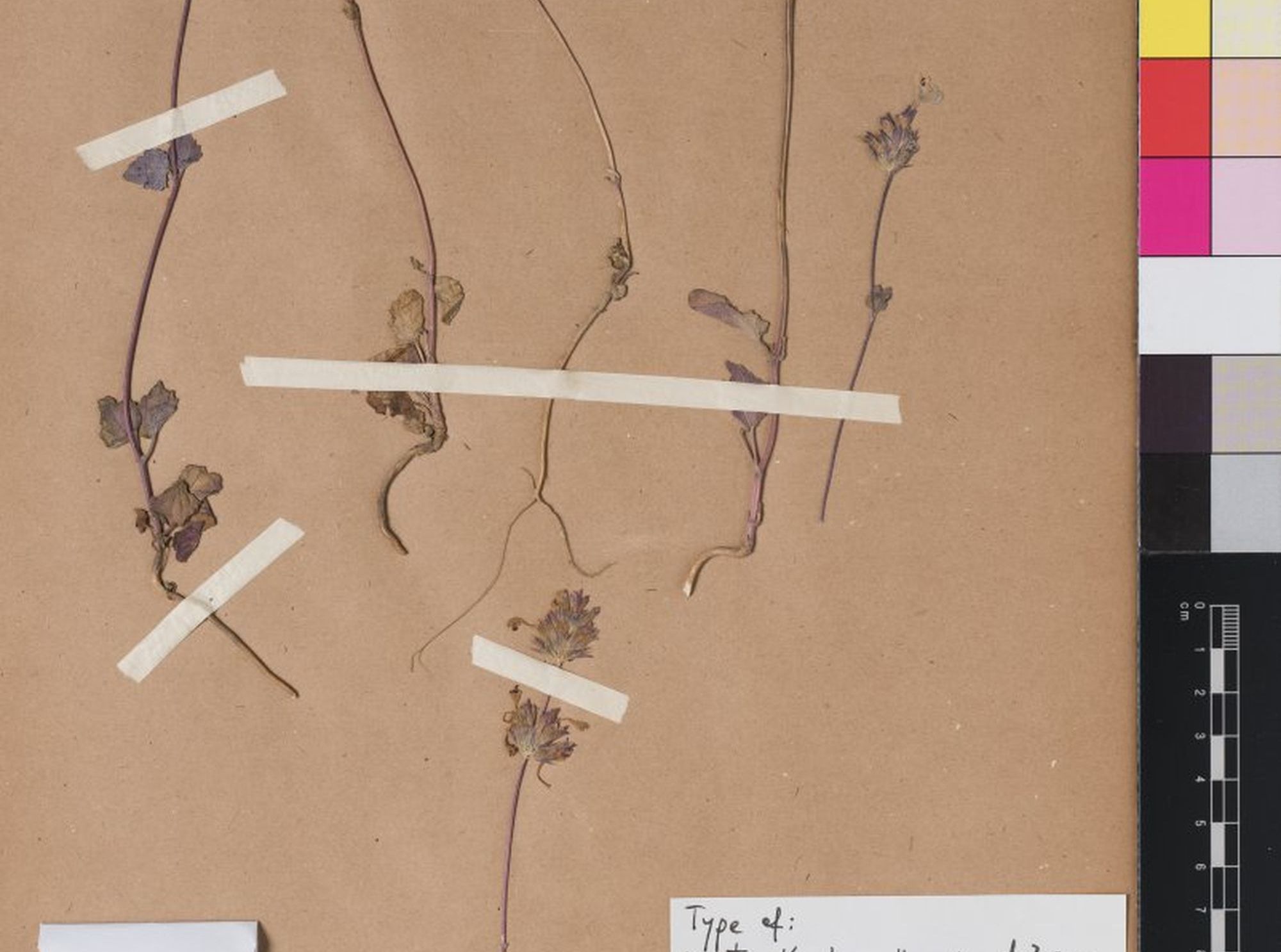
A century later, the specimens themselves tell the rest. In 1982 K. H. Rechinger's Flora Iranica listed N. kurdica as a synonym of N. wettsteinii, so that work recorded plants of N. kurdica under that name[2]. In 2013 a typification label by M. Lachmayer on the Vienna isotype added "= Nepeta wettsteinii"[7]. Then in 2022 the botanist Tuncay Dirmenci re-named the Kew sheets from Başûr filed as N. kurdica: the new slips read "Nepeta humilis Benth."[8][8].
The revision of Nepeta for the Flora of Iraq that he published in 2023 with Ali Haloob, Ferhat Celep and Shahina A. Ghazanfar explains why. The authors compared the type specimens of all three names, N. wettsteinii, N. humilis and N. kurdica, and concluded that N. kurdica "should be a synonym of Nepeta humilis". They also examined every specimen that Flora Iranica had named N. wettsteinii, and found that all of them belonged to N. humilis[2]. So the revision lists N. kurdica, with Bornmüller's number 1689 as its type, among the synonyms of N. humilis[2], and counts N. wettsteinii itself among the species "doubtfully recorded" for Iraq[2].
So the plant Bornmüller set apart for its stiff, upright branches is, for the authors of the revision, simply part of a species he already knew. Kew's checklist has not followed yet and still keeps N. kurdica separate[5]. Until the two agree, this page keeps the name the plant was given, and the name that ties it to Kurdistan.
The names in this group had one more twist. In 1891 the botanist Otto Kuntze held that the genus Glechoma was two years older than Nepeta and moved some 150 Nepeta species into it. Under his rules, Bornmüller noted in a footnote, Bentham's N. humilis would have had to become Glechoma benthamii, and he gave the whole move an exclamation mark of his own: "two years (!) older"[1] (our translation).
Pressed on Helgurd, at Çermo and on Qendîl
After Bornmüller, the plant turns up again and again in the herbarium cupboards, and the labels read like a map of Başûr:
- 1910: the botanist František Nábělek pressed it on 20 May on dry hills near the village of Dêr Harîr, between Hewlêr (Erbil) and Rewandiz, at 650 m. His label reads "Kurdistan. Turc.", Ottoman Kurdistan[9].
- 1932: on 24 July, E. R. Guest of the Rustam Herbarium found it at 1,800–2,100 m "on stony mountainside" on the mountain their labels spell "Arl Gird Dagh", Helgurd, and on the ridge east of Seri Hassan Beg, with "purple-blue fls."[3][8]. They first wrote it down as a different Nepeta, then corrected the label to N. kurdica[8].
- 1934: Henry Field and Yusuf Lazar collected it in the Rewandiz gorge on 24 June[4].
- 1955: at Çermo (Jarmo), near Çemçemal, the archaeobotanist Hans Helbæk pressed it twice in May[8]. Çermo was being dug by Robert Braidwood's team from Chicago, who worked in Kurdistan in 1948, 1950–51 and 1954–55 and called it "the first early village site with aceramic levels excavated in the Near East"[10][11]. Helbæk wrote the chapter on ancient plant remains for their report[10]. His label for this little annual of the living hillside places it right by the excavation camp: "Jarmo, dry slopes between Camp and South wadi, pale purple"[8].
- Later: further gatherings came from near Pewaz, from the Hewraman range north of Helebce (Halabja), from the road between Slêmanî and Pêncwên (Penjwin), and from Piştaşan (Pushtashan) at the foot of Qendîl[2][4].
Where it grows
Kew's checklist gives its native range as south-eastern Turkey to Iran, recorded from Iran, Iraq and Turkey[5]. In Kurdish terms that is a plant of Başûr, with its range running into North Kurdistan (Bakur) and East Kurdistan (Rojhilat)[5][2]. The 2023 revision gives it "a wide distribution" in the north and north-east of Başûr, between 800 and 3,200 m; its specimens run from the summits north of Zaxo and the Gara range in the west to Hewraman on the border of Rojhilat in the east, and south to a narrow gorge in the hills 10 km south of Derbendîxan (Darbandikhan)[2].
It is a plant of open, stony ground: stony mountainsides on Helgurd[3], dry slopes at Çermo[8], dry hills near Dêr Harîr[9], and, in the words of the 2023 revision, "wet places, slopes and eroded slopes"[2].
Names
No Kurdish name for this species has turned up in any source we checked. Ehmedê Dirihî's dictionary of Kurdish plant names gives şewbo for the genus Nepeta as a whole, and lists beybûna kitikan among the names of catnip, N. cataria[12].
It has never been assessed for the IUCN Red List[13].
Sources
- 1.Bornmüller, J. (1899). Zwölf neue Nepeta-Arten aus Persien, Kurdistan und Kleinasien. Bulletin de l'Herbier Boissier 7(4): 229–253.
- 2.Dirmenci, T., Haloob, A., Celep, F. & Ghazanfar, S. A. (2023). Revision of the genus Nepeta L. (Lamiaceae) in Iraq. Turkish Journal of Botany 47(2): 169–189. doi:10.55730/1300-008X.2754https://doi.org/10.55730/1300-008X.2754
- 3.abcdBlakelock, R. A. (1949). The Rustam Herbarium, 'Iraq. Systematic List. Part III. Kew Bulletin 4(4): 528.
- 4.abcGBIF.org GBIF Backbone Taxonomy and occurrence records. occurrence records for Nepeta kurdica (taxon 5610348), herbarium specimens at Kew. gbif.orghttps://www.gbif.org/
- 5.Plants of the World Online. Royal Botanic Gardens, Kew.
- abcdNepeta kurdica.
- plant_name_id 134718. powo.science.kew.orghttps://powo.science.kew.org/taxon/urn:lsid:ipni.org:names:452511-1accessed 14 November 2026
- 6.International Plant Names Index. Royal Botanic Gardens, Kew, Harvard University Herbaria and Australian National Herbarium.
- abNepeta kurdica Hausskn. & Bornm.; Glechoma humilis Kuntze; author records for Bornmüller and Haussknecht.
- urn:lsid:ipni.org:names:452511-1. ipni.orghttps://www.ipni.org/n/452511-1accessed 14 November 2026
- 7.abcType specimens of Bornmüller 1689: Z-000018938 (Zurich), WU 0070058 (Vienna), HBG 0518436 (Hamburg), via GBIF.
- 8.Royal Botanic Gardens, Kew – Herbarium Specimens. via GBIF. gbif.orghttps://www.gbif.org/dataset/cd6e21c8-9e8a-493a-8a76-fbf7862069e5
- 9.abcSlovak Academy of Sciences herbarium (SAV), specimen SAV0002660 (Nábělek, 1910), via GBIF.
- 10.abBraidwood, R. J. & Howe, B. (1960). Prehistoric Investigations in Iraqi Kurdistan. Studies in Ancient Oriental Civilization 31. Chicago: University of Chicago Press.
- 11.↩Braidwood, L. S., Braidwood, R. J., Howe, B., Reed, C. A. & Watson, P. J. (eds) (1983). Prehistoric Archeology Along the Zagros Flanks. Oriental Institute Publications 105. Chicago: The Oriental Institute.
- 12.↩Ahmet Kasımoğlu (Ehmedê Dirihî) (2013). Ferhenga Navên Nebatan a Kurdî (Dictionary of Kurdish Plant Names). Mardin Artuklu University, Institute of Living Languages in Turkey (ISBN 978-605-4202-12-6).
- 13.↩IUCN Red List category via GBIF: not evaluated.
- Bornmüller, J. (1899). Zwölf neue Nepeta-Arten aus dem Orient. Bulletin de l'Herbier Boissier 7: 229–ff.
- Bull. Herb. Boissier 7: p. 251. archive.orghttps://archive.org/details/bulletindelherbi07herb/page/n274/mode/1upaccessed 14 November 2026
- p. 251. archive.orghttps://archive.org/details/bulletindelherbi07herb/page/n274/mode/1upaccessed 14 November 2026
Last updated 20 November 2026