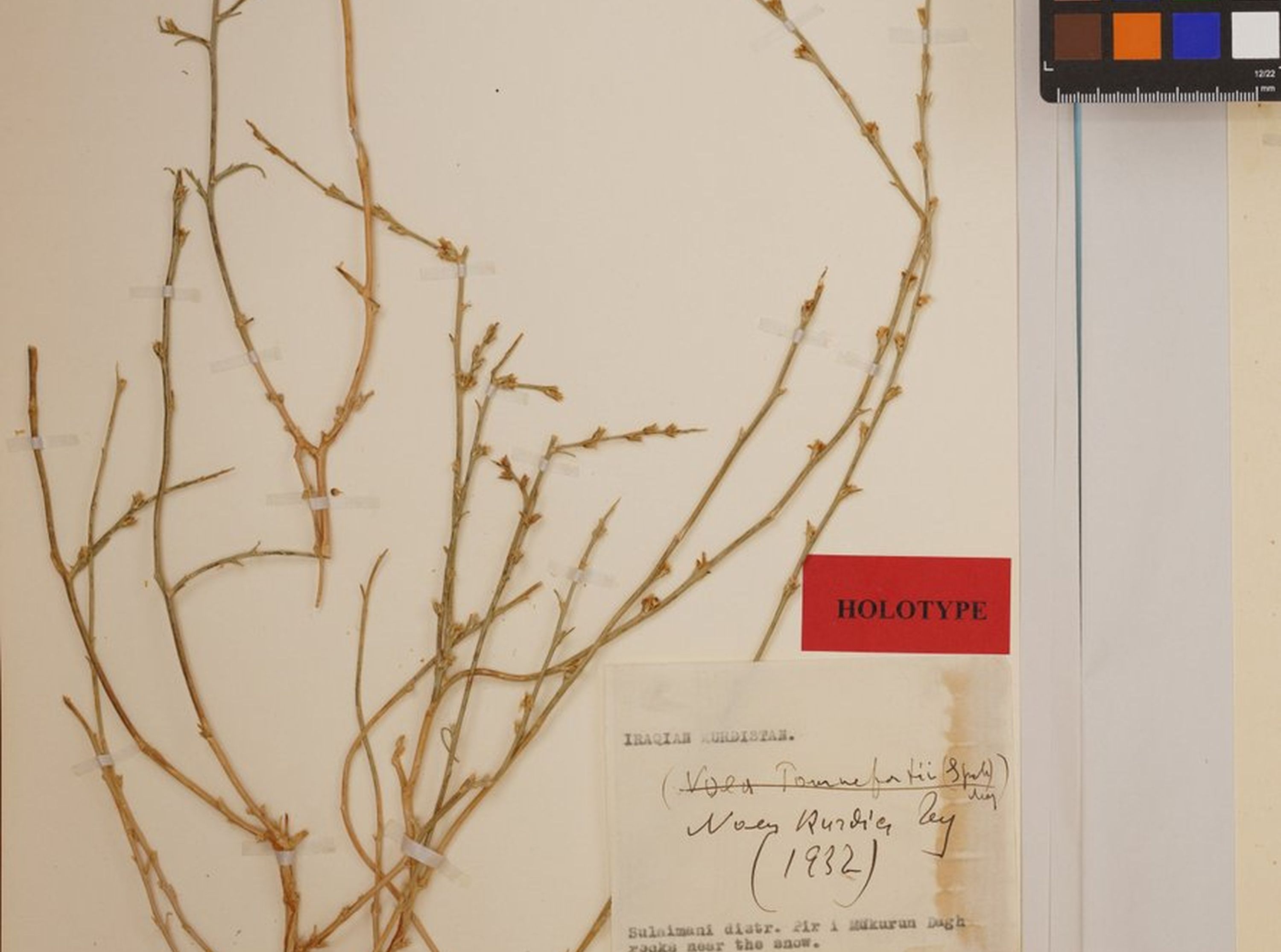
Noaea kurdica is a small, wiry subshrub, 30 to 40 cm tall, whose upright branches end in spines[1]. It belongs to the amaranth family (Amaranthaceae; older floras call it the goosefoot family, Chenopodiaceae)[2][3], and as far as the published record goes it is known only from South Kurdistan (Başûr), from the mountains and foothills around Silêmanî (Sulaimani)[1][2][4]. It is also something of a mystery: the Flora of Iraq calls it "a poorly known species that requires further investigation"[2].
How it got its name
- Named by
- Eig, 1945Published in Palestine J. Bot., Jerusalem Ser. 3: 134
Where it grows in Kurdistan
At 1000–2500 m above sea level.
"Rocks near the snow"
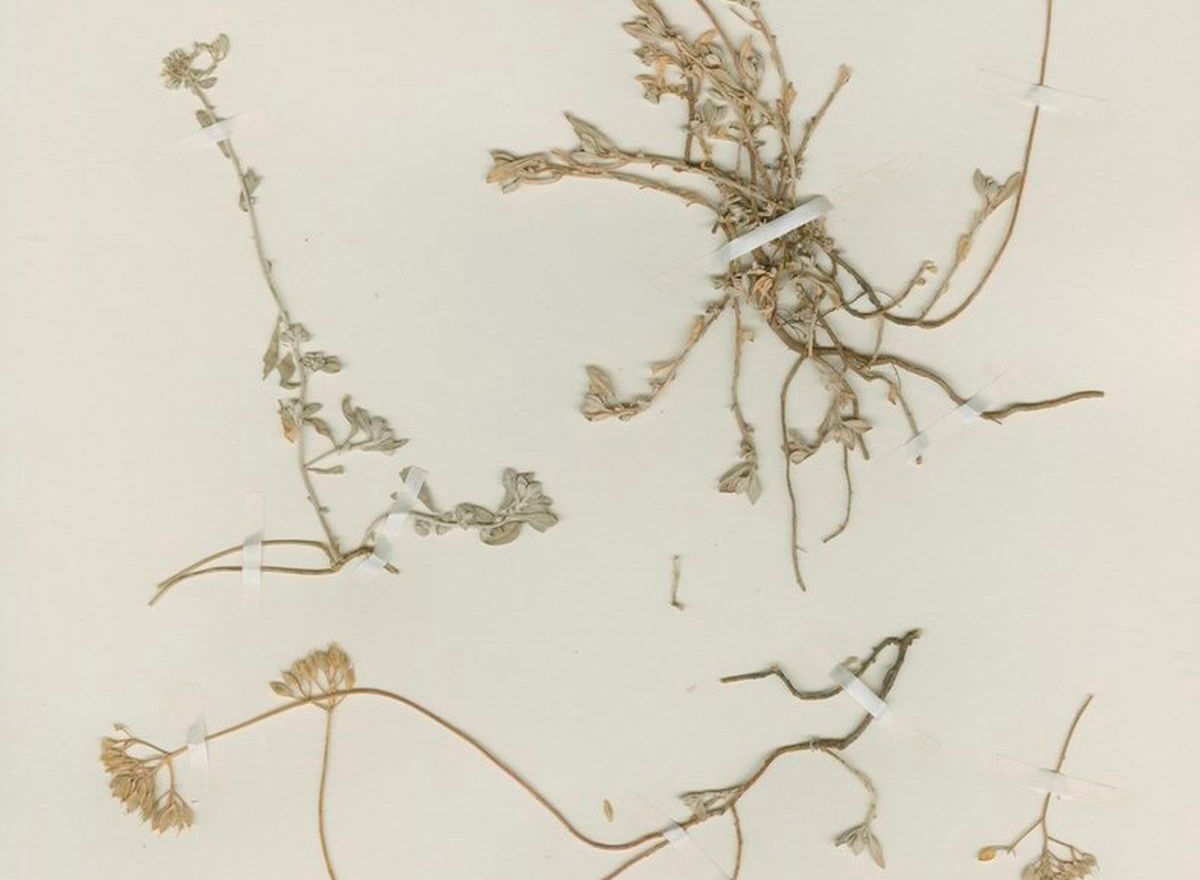
On 19 September 1933 the botanist Alexander Eig (1894–1938) of the Hebrew University of Jerusalem[5][6] and Sh. Duvdevani were collecting on Pîremegrûn, the mountain Eig's paper spells "Pir i Mukurun Dagh" (the labels have "Mukuran" and "Mukurum"), in the district of Silêmanî[1][7]. There they gathered a small, thorny shrub. The typed label describes the spot in four words: "rocks near the snow"[7]. The specimen, collection number 970, is still in the herbarium of the Hebrew University in Jerusalem, now with a red "Holotype" label: it is the one sheet to which the name Noaea kurdica is tied for good[2][7].
It was not Eig's first collecting trip of the year. In April 1933 he and Michael Zohary had collected with Guest of the Rustam Herbarium in the desert near Zubair and at Jabal Hamrin: their specimens are labelled "Guest, Eig and Zohary"[5]. In Eig's 1945 paper, "E" and "Z" stand for the two of them[1], and "1933 EZ" runs through its records from Kurdistan and the rest of Iraq[1].
A name that waited twelve years
The plant was first filed under a known species. On an older label someone wrote "Noea Tournefortii (Spach) Moq.", the name of a spineless relative[2]. That name is struck through, and beneath it is written "Noea kurdica Eig": Eig had decided that the shrub from Pîremegrûn was new to science[7].
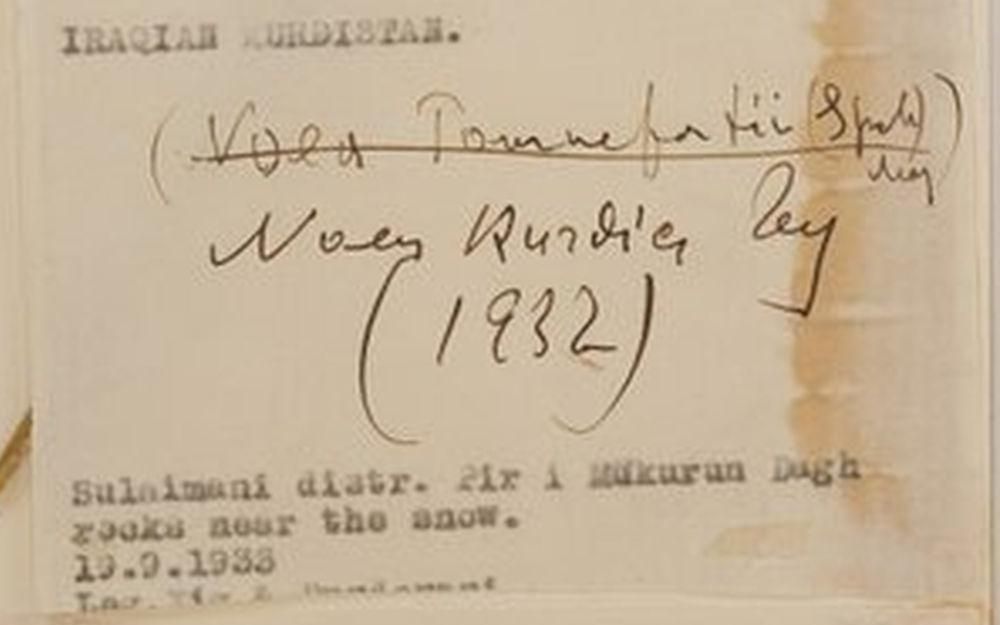
A second note on the sheet reads "det. A. Eig 1937", "identified by A. Eig in 1937"[7]. Eig died the following year[6], and he left work unfinished. In 1948 R. A. Blakelock of Kew wrote that many milkvetch (Astragalus) specimens from the Rustam Herbarium had been sent "to the late Dr. A. Eig, Professor of Botany at the Hebrew University of Jerusalem", and some had come back "bearing the names of unpublished new species"[5].
His shrub from Pîremegrûn was luckier. Eig had written it up in his revision of the goosefoot family of Palestine and the neighbouring countries. The revision appeared in November 1945, seven years after his death, with a one-word footnote to the author's name: "Posthumous"[1]. On page 134 the new species appears for the first time, with a small drawing of a flowering branch, a flower and a pistil, as Noea kurdica Eig, "sp. nov."[1]. The epithet kurdica means "Kurdish": both places Eig listed for it are in what his paper calls "Iraqian Kurdistan"[1].
Noea or Noaea?
Eig spelled the genus Noea, and so did his labels[1][7]. Today's botanical indexes use Noaea, the spelling of the botanist Alfred Moquin-Tandon (1804–1863), who named the genus in 1849; Noea is a later spelling of the same name by Boissier and Balansa (1859)[2][6].
Behind both spellings is a person. According to the Flora of Iraq, the genus commemorates Friedrich Wilhelm Noë (1798–1858), a pharmacist and botanist at Fiume (Rijeka) who became director of a botanic garden in Istanbul, and who was "a major contributor of specimens from Turkey and Iraq" to Boissier's herbarium in Geneva[2]. So a genus that honours a supplier of plants from these lands came to include a species named after Kurdistan.
What to look for
Eig's Latin description is the fullest there is[1]:
- a subshrub 30–40 cm tall, rough all over with a fine, short down;
- upright, long branches, unbranched or only a little branched, which end in a sharp point everywhere except near the base, and carry flowers along their whole length;
- few leaves: the lowest in pairs, the rest one by one, bluish green, narrow as threads, and soon falling;
- single, loosely spaced flowers, each with five white, papery perianth segments 6–7 mm long, humped in the middle; on Eig's plants the papery wings that grow from them in fruit were only just beginning to form;
- a long, thread-like style with two stigmas of unequal length.
The Flora of Iraq gives the features that set it apart from its commoner relative Noaea mucronata: the plant is covered in tiny papillae, not smooth; the flowering branches are very loose, with 5–20 mm between flowers in their lower and middle parts and never more than 15 flowers; and the perianth is brownish[2]. Of its fruit the Flora says only that it is shortly papillate[2]. It also points out that Eig himself never said how his new species differed from N. mucronata[2].
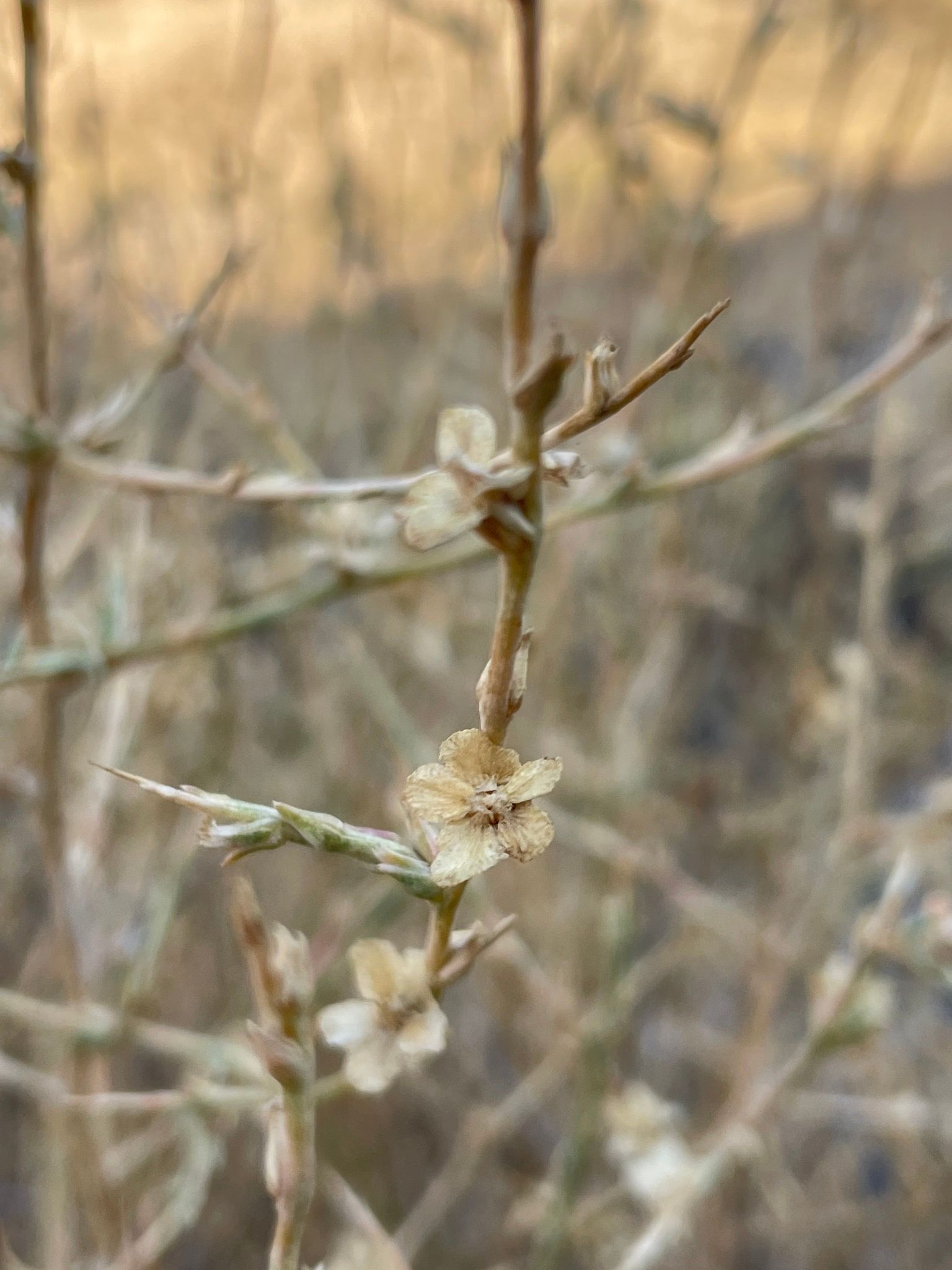
In N. mucronata those wings grow to about 10 mm across, pinkish or white and often turning brown[2].
Where it grows
Kew's checklist gives its native range simply as Iraq[3]. In Kurdish terms that is a plant of Başûr, and every record so far comes from the south-east of it, around Silêmanî:
- Pîremegrûn, the type locality: "rocks near the snow", September 1933[1][7].
- Qeredax, at a place Eig spells "NE of Kanitacht"[1]. The Flora of Iraq lists a second sheet in Jerusalem, collected by Zohary and Duvdevani at "Kan-i Sakht" in the foothills[2].
- Germiyan (Garmian), the region south of Silêmanî, which runs from 141 m near Kelar (Kalar) up to 1,802 m on Bamo Mountain: two collections made in 2023 during a plant survey of the region, the first records of the species there, which list it as rare and found in flower and fruit[4]. The survey does not say where exactly the plants grew. They are the first known collections of the species since Eig's day.
The Flora of Iraq gives its habitat as gravelly slopes between 1,000 and 2,500 m[2]. It expects the species to turn up in Turkey, western Iran and Syria too[2], but we found no published record from outside Başûr: a 1999 revision of the genus for Iran does not include it[8], and the Global Biodiversity Information Facility (GBIF) holds no specimen of it except the holotype[9]. It has not been assessed for the IUCN Red List[9].
A puzzle in a puzzling genus
Noaea is a small genus of about five species, spread across south-west and central Asia[2]. The Flora of Iraq warns that "the limits of species are poorly defined and the subshrubby species might be seen as elements of a polymorphic complex that needs further investigations"[2]. N. kurdica sits right in that complex. Is it a species of its own, or a local form of the widespread N. mucronata, "a typical steppe plant" in Eig's words, which grows across the hills and northern deserts of Iraq, Silêmanî included[1][2]? With a holotype, one more old sheet and two recent collections, nobody can yet say. New collections from the Silêmanî mountains and Germiyan, especially in flower and in fruit, are what the question needs.
Its name in Kurdish
No Kurdish name has been recorded for Noaea kurdica. Its labels carry none[7], Flora Kurdica's names database holds none for the genus[10], and Ehmedê Dirihî's dictionary of Kurdish plant names has no entry for Noaea at all[11].
For its spineless relative N. tournefortii, which also grows on Pîremegrûn[2], the Flora of Iraq records one local name, from Kholan: "GA SURIK", which its authors think may be short for "GIAH SURIK"[2]. Whether people use that name for N. kurdica as well, nobody has written down.
Sources
- 1.Eig, A. (1945). Revision of Chenopodiaceae [of Palestine and neighbouring countries]. Palestine Journal of Botany, Jerusalem Series 3(3).
- 2.Sukhorukov, A. P., Aellen, P., Edmondson, J. R. & Townsend, C. C. (2016). Chenopodiaceae. In: Ghazanfar, S. A. & Edmondson, J. R. (eds), Flora of Iraq 5(1): 238–240. Royal Botanic Gardens, Kew.
- 3.Plants of the World Online. Royal Botanic Gardens, Kew.
- abNoaea kurdica.
- plant_name_id 2378225. powo.science.kew.orghttps://powo.science.kew.org/taxon/urn:lsid:ipni.org:names:166195-1accessed 14 November 2026
- 4.abHameed, A. H. & Ahmad, S. A. (2025). A checklist of vascular plants of the Garmian region in Kurdistan, Iraq. Science Journal of University of Zakho 13(2): 206–227. doi:10.25271/sjuoz.2025.13.2.1475https://doi.org/10.25271/sjuoz.2025.13.2.1475
- 5.Blakelock, R. A. (1948). The Rustam Herbarium, 'Iraq. Systematic List. Part I. Kew Bulletin 3(3): 404–405.
- 6.International Plant Names Index. Royal Botanic Gardens, Kew, Harvard University Herbaria and Australian National Herbarium.
- abcNoaea kurdica Eig; Noaea Moq.; author records for Eig and Moquin-Tandon.
- urn:lsid:ipni.org:names:166195-1. ipni.orghttps://www.ipni.org/n/166195-1accessed 14 November 2026
- 7.abcdefghThe Hebrew University of Jerusalem, National Natural History Collections, herbarium specimen HUJ 0000028267, holotype of Noaea kurdica (via GBIF, occurrence 5156836960).
- 8.↩Assadi, M. (1999). A revision of the genus Noaea Moq. (Chenopodiaceae) in Iran. Iranian Journal of Botany 8(1): 23–33.
- 9.GBIF.org GBIF Backbone Taxonomy and occurrence records.
- aboccurrence records and IUCN category for Noaea kurdica (accessed 15 November 2026).
- occurrence 5156836960 (HUJ 0000028267, Holotype). api.gbif.orghttps://api.gbif.org/v1/occurrence/5156836960accessed 14 November 2026
- 10.↩Flora Kurdica names database (names.florakurdica.com).
- 11.↩Ahmet Kasımoğlu (Ehmedê Dirihî) (2013). Ferhenga Navên Nebatan a Kurdî (Dictionary of Kurdish Plant Names). Mardin Artuklu University, Institute of Living Languages in Turkey (ISBN 978-605-4202-12-6).
- Ghazanfar, S.A. & Edmondson, J.R. (eds) (2016). Flora of Iraq, Volume 5, part 1: Elatinaceae to Sphenocleaceae. Royal Botanic Gardens, Kew, p. 240. kew.iro.bl.ukhttps://kew.iro.bl.uk/server/api/core/bitstreams/7456e852-fcdb-44ce-acd9-147ae89d24eb/content#page=251accessed 14 November 2026
Last updated 20 November 2026